Get help with Essential Mathematics, Grade 11 (30S)
Most tutoring makes you sit through material you already know. MapleMind flips that: pick the exact skill that's causing trouble — any of the 25 below — and the tutor teaches just that one, step by step, as many times as it takes. Ask questions in plain words, any time of day, in English, French, or 12 other languages.
The official Manitoba Essential Mathematics, Grade 11 (30S) curriculum
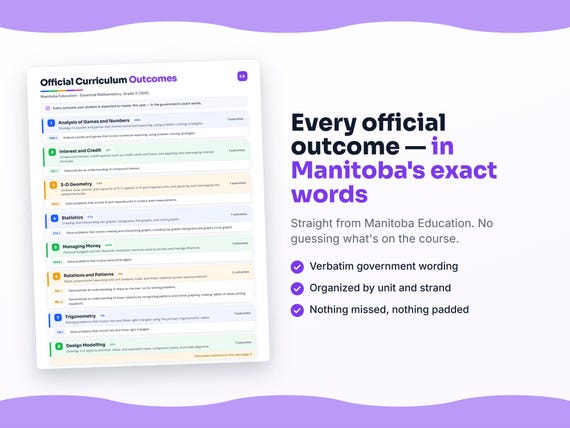
Manitoba defines Essential Mathematics, Grade 11 (30S) by strands and outcomes. MapleMind teaches the same curriculum reorganized for one-skill-at-a-time tutoring — the table shows exactly where every official strand lands, and the ministry's own wording is quoted under each unit below.
Official source Manitoba's official curriculumRead it on the government site — edu.gov.mb.ca ↗| Official strand | Outcomes | Where MapleMind teaches it |
|---|---|---|
| Strand A | 2 | Analysis of Games and Numbers |
| Strand I | 3 | Interest and Credit |
| Strand G | 3 | 3-D Geometry |
| Strand S | 1 | Statistics |
| Strand M | 2 | Managing Money |
| Strand R | 5 | Relations and Patterns |
| Strand TG | 1 | Trigonometry |
| Strand D | 2 | Design Modelling |
Every skill below, taught one on one.
 Try the first session free
How MapleMind teaches Essential Mathematics, Grade 11 (30S) — every unit, lesson, and skill
Every skill below runs as a short session: a plain-words lesson, a worked example, solving it together, then a five-question skill check that earns up to three stars. Guided Mode keeps it teaching instead of answer-handing — turning it off needs a parent's password.
Unit 1Analysis of Games and NumbersOfficial strand · Strand A
Strategy in puzzles and games that involve numerical reasoning, using problem-solving strategies.
Puzzles and Games with Numerical Reasoning
- Winning strategies for number puzzles11E3.A.1 — Analyze puzzles and games that involve numerical reasoning, determining, explaining, and verifying a strategy to solve a puzzle or win a game.
- Inventing and adapting a number game11E4.A.1 — Create a variation on a numerical puzzle or game and describe a strategy for solving or winning it, applying numerical reasoning to a new context.
The official wording — 2 outcomes in this unit
- 11E3.A.1
Analyze puzzles and games that involve numerical reasoning, using problem-solving strategies.
- 11E4.A.1
Analyze puzzles and games that involve numerical reasoning, using problem-solving strategies.
Unit 2Interest and CreditOfficial strand · Strand I
Compound interest, credit options such as credit cards and loans, and applying and rearranging interest formulas.
Interest and Borrowing
- Simple versus compound interest11E3.I.1 — Solve problems involving simple interest using I = Prt, and compare simple and compound interest to explain their relationship.
- Calculating compound interest11E3.I.1 — Solve contextual problems involving compound interest using a formula, explaining the effect of different compounding periods and using the Rule of 72 to estimate doubling time.
- Comparing credit options11E3.I.2 — Compare the advantages and disadvantages of different credit options, including bank and store credit cards, personal loans, lines of credit, and overdraft.
- Using credit wisely11E3.I.2 — Make informed decisions about using credit, including service charges, payday loans, and sales promotions, and solve contextual problems involving credit cards or loans.
- Rearranging interest and finance formulas11E3.I.3 — Solve problems that require applying and rearranging formulas related to simple interest and finance charges.
The official wording — 3 outcomes in this unit
- 11E3.I.1
Demonstrate an understanding of compound interest.
- 11E3.I.2
Demonstrate an understanding of credit options, including credit cards loans
- 11E3.I.3
Solve problems that require the manipulation and application of formulas related to simple interest finance charges
Unit 33-D GeometryOfficial strand · Strand G
Surface area, volume, and capacity of 3-D objects in SI and imperial units, and applying and rearranging the related formulas.
Surface Area, Volume, and Capacity
- Surface area of 3-D objects11E3.G.1 — Solve problems that involve SI and imperial units in surface area measurements of 3-D objects, including spheres, using referents and rearranging formulas.
- Volume and capacity of solids11E3.G.2 — Solve problems involving SI and imperial volume and capacity measurements, explaining the difference between volume and capacity and converting a volume between cubed units.
- Volume and capacity of composite solids11E3.G.2 — Determine the volume and capacity of cones, cylinders, prisms, pyramids, spheres, and composite 3-D objects using measuring tools, and relate cone/cylinder and pyramid/prism volumes.
- Rearranging volume, capacity, and surface-area formulas11E3.G.3 — Solve problems that require applying and rearranging formulas related to volume, capacity, and surface area.
The official wording — 3 outcomes in this unit
- 11E3.G.1
Solve problems that involve SI and imperial units in surface area measurements.
- 11E3.G.2
Solve problems that involve SI and imperial units in volume and capacity measurements.
- 11E3.G.3
Solve problems that require the manipulation and application of formulas related to volume and capacity surface area
Unit 4StatisticsOfficial strand · Strand S
Creating and interpreting bar graphs, histograms, line graphs, and circle graphs.
Creating and Interpreting Graphs
- Choosing and interpreting graphs11E3.S.1 — Solve problems that involve creating and interpreting bar graphs, histograms, line graphs, and circle graphs, describing trends and interpolating or extrapolating.
The official wording — 1 outcome in this unit
- 11E3.S.1
Solve problems that involve creating and interpreting graphs, including bar graphs histograms line graphs circle graphs
Unit 5Managing MoneyOfficial strand · Strand M
Personal budgets and the financial-institution services used to access and manage finances.
Budgets and Banking
- Personal budgets11E4.M.1 — Solve problems that involve personal budgets, identifying income and expenses, prioritizing, and modifying a budget to meet goals.
- Choosing accounts and services11E4.M.2 — Demonstrate an understanding of financial-institution services by comparing account types, service charges, and record-keeping options and selecting an account that meets given needs.
- Securing financial information11E4.M.2 — Describe ways to ensure the security of personal and financial information, and the advantages and disadvantages of online banking and debit-card purchases.
The official wording — 2 outcomes in this unit
- 11E4.M.1
Solve problems that involve personal budgets.
- 11E4.M.2
Demonstrate an understanding of financial institution services used to access and manage finances.
Unit 6Relations and PatternsOfficial strand · Strand R
Slope, proportional reasoning and unit analysis, scale, and linear relations across representations.
Slope, Proportion, and Scale
- Slope as rise over run11E4.R.1 — Demonstrate an understanding of slope as rise over run by solving contextual problems such as ramps, roofs, and road grade, including when slope is zero or undefined.
- Slope as rate of change11E4.R.1 — Demonstrate an understanding of slope as a rate of change by solving problems, relating slope to angle of elevation and to the safety and functionality of a design.
- Proportional reasoning and unit analysis11E4.R.2 — Solve problems by applying proportional reasoning and unit analysis, such as km/h or revolutions per minute, within and between systems.
- Rearranging slope and rate-of-change formulas11E4.R.3 — Solve problems that require applying and rearranging formulas related to slope and rate of change.
- Scale drawings and models11E4.R.4 — Solve problems that involve scale, determining dimensions from a scale drawing or model and constructing a scale model of a 3-D object.
Linear Relations
- Recognizing and representing linear relations11E4.R.5 — Demonstrate an understanding of linear relations by recognizing patterns and trends and representing them with tables of values, graphs, and equations.
- Interpolating and solving with linear relations11E4.R.5 — Interpolate and extrapolate values from a linear relation, and solve contextual problems by applying a linear relation and its formula.
The official wording — 5 outcomes in this unit
- 11E4.R.1
Demonstrate an understanding of slope as rise over run by solving problems.
- 11E4.R.2
Solve problems by applying proportional reasoning and unit analysis.
- 11E4.R.3
Solve problems that require the manipulation and application of formulas related to slope and rate of change.
- 11E4.R.4
Solve problems that involve scale.
- 11E4.R.5
Demonstrate an understanding of linear relations by recognizing patterns and trends graphing creating tables of values writing equations
Unit 7TrigonometryOfficial strand · Strand TG
Solving problems that involve two and three right triangles using the primary trigonometric ratios.
Two and Three Right Triangles
- Problems with two and three right triangles11E4.TG.1 — Solve problems that involve two and three right triangles using the primary trigonometric ratios, including angles of elevation and depression.
The official wording — 1 outcome in this unit
- 11E4.TG.1
Solve problems that involve two and three right triangles.
Unit 8Design ModellingOfficial strand · Strand D
Drawing 3-D objects and their views, and exploded views, component parts, and scale diagrams.
Drawing 3-D Objects and Views
- Drawing 3-D objects and their views11E4.D.1 — Model and draw 3-D objects and their views, including 2-D representations, isometric drawings, and top, front, and side views.
- Exploded views and component parts11E4.D.2 — Draw and describe exploded views, component parts, and scale diagrams of simple 3-D objects.
The official wording — 2 outcomes in this unit
- 11E4.D.1
Model and draw 3-D objects and their views.
- 11E4.D.2
Draw and describe exploded views, component parts, and scale diagrams of simple 3-D objects.
Printable workbook · A keepsake of the year
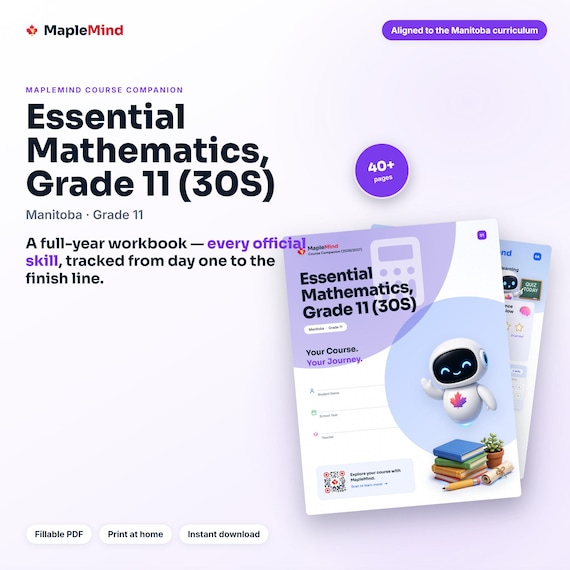
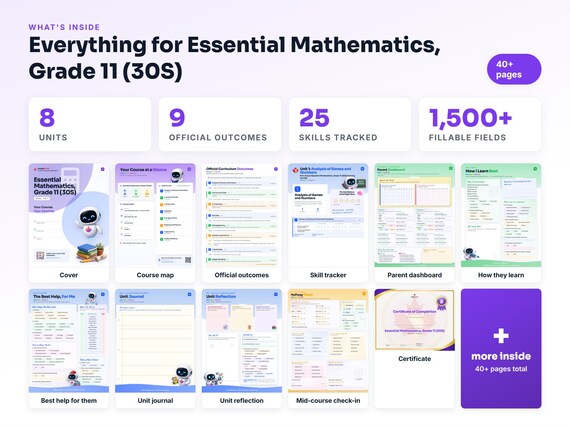
A Essential Mathematics, Grade 11 (30S) workbook worth keeping
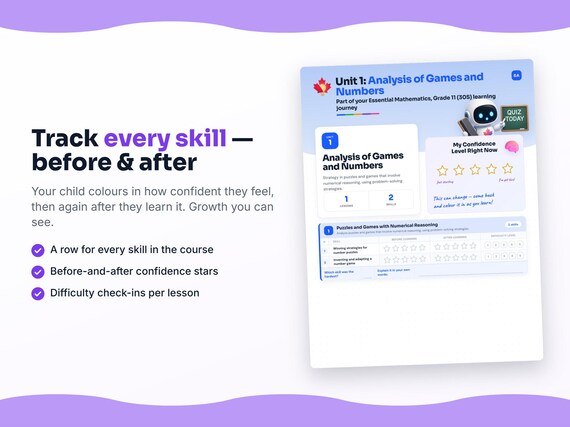
Built from the same official curriculum as this page. Before and after each skill above, your student colours in how sure they feel — so the two of you can see, on one page, what's clicking and what needs another look. It's a quiet way to follow how the year is really going.
By June it's full of their own handwriting: units worked through, confidence grown, a mid-year check-in, notes from parent-teacher night, and a certificate at the end. Less a worksheet, more a record of the year worth keeping on the shelf.
Instant download · see every page, reviews and the full description · five or more workbooks are $2.99 each
What it looks like in the app
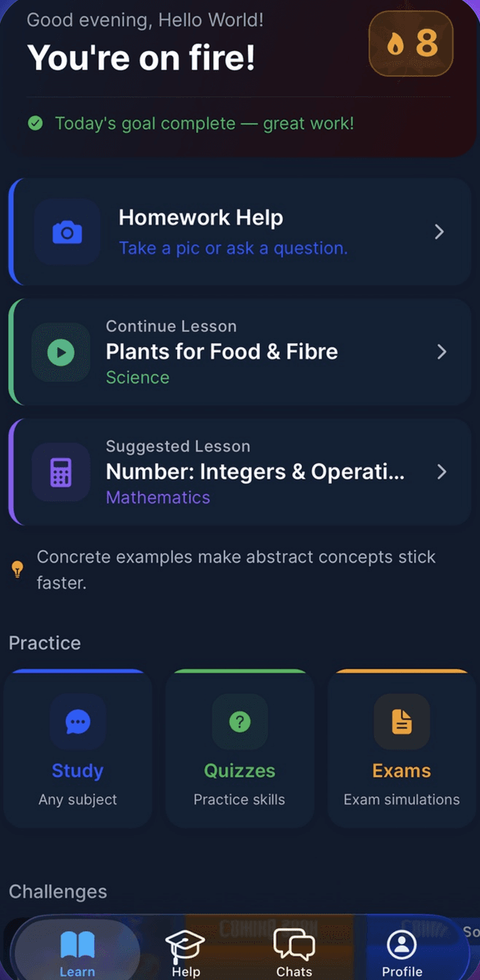
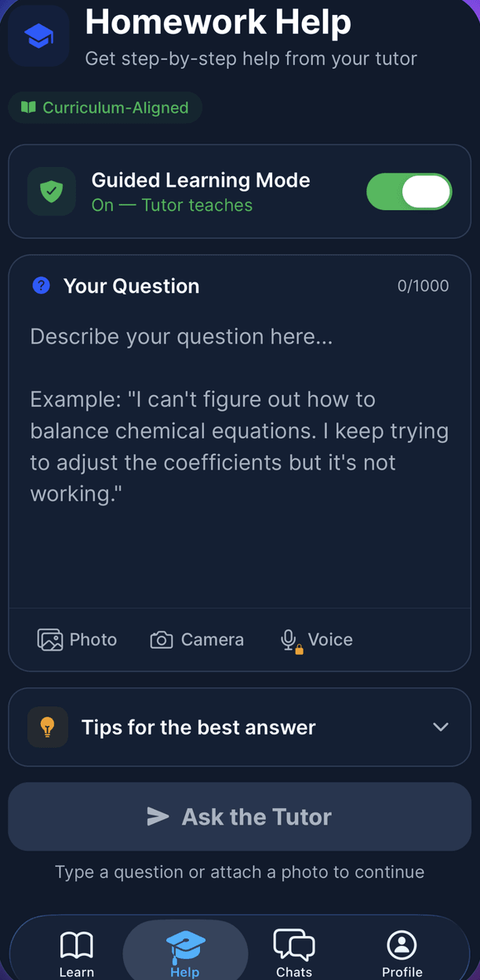
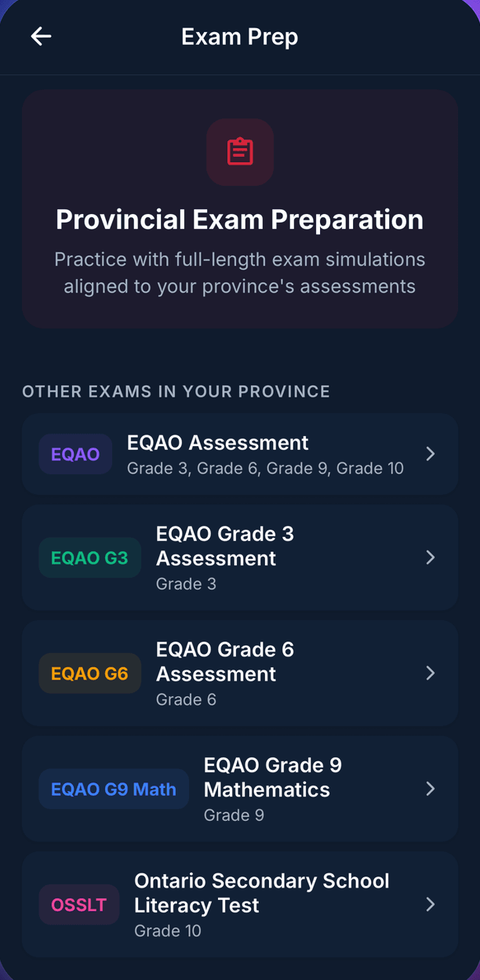
Common questions
Can MapleMind help me with Essential Mathematics, Grade 11 (30S)?
Yes. MapleMind's AI tutor covers all 25 skills in Manitoba's Essential Mathematics, Grade 11 (30S) — you pick the exact skill, and the tutor teaches it step by step: a short lesson, a worked example, solving together, then a skill check to show it stuck.
Is MapleMind aligned to Manitoba's official curriculum?
Yes. Every skill in this course maps to an official outcome code from Manitoba's Grade 11 Mathematics curriculum, and the ministry's own wording is quoted under each unit on this page — with the official government source linked so you can check it yourself.
What does MapleMind cost?
It's free to start — 5 tutoring chats and a practice quiz every day, no credit card. A Pro subscription ($9.99/month or $49.99/year CAD, 7-day free trial) unlocks unlimited tutoring, practice, and exam simulations.
What if I'm stuck on just one topic?
That's the point of skill-level tutoring: open Essential Mathematics, Grade 11 (30S) in the app, tap the exact skill from the list on this page, and the tutor teaches just that — no wading through lessons you don't need.
Does MapleMind work in French or other languages?
Yes — 14 languages, including French. Both the app and the tutor's explanations switch to the language you choose.
Where can I see the official Manitoba curriculum for Essential Mathematics, Grade 11 (30S)?
The official source is linked on this page — Manitoba's official curriculum. The outline here follows it: every MapleMind skill carries its official outcome code, and the ministry's own wording is quoted under each unit.
Keep exploring
Ready when you are
Pick a skill from this page and see it taught properly — free, in the browser, in under a minute.