Get help with Applied Mathematics, Grade 11 (30S)
Most tutoring makes you sit through material you already know. MapleMind flips that: pick the exact skill that's causing trouble — any of the 19 below — and the tutor teaches just that one, step by step, as many times as it takes. Ask questions in plain words, any time of day, in English, French, or 12 other languages.
The official Manitoba Applied Mathematics, Grade 11 (30S) curriculum
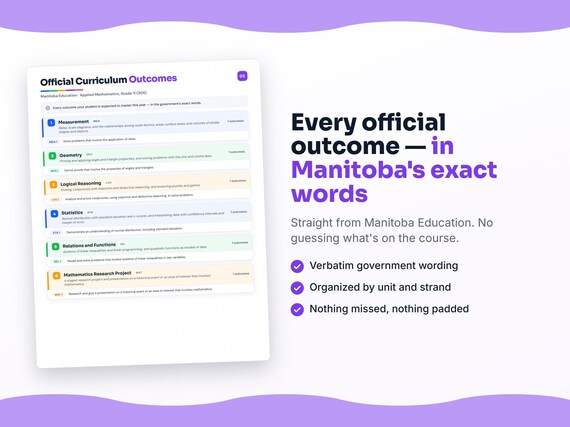
Manitoba defines Applied Mathematics, Grade 11 (30S) by strands and outcomes. MapleMind teaches the same curriculum reorganized for one-skill-at-a-time tutoring — the table shows exactly where every official strand lands, and the ministry's own wording is quoted under each unit below.
Official source Manitoba's official curriculumRead it on the government site — edu.gov.mb.ca ↗| Official strand | Outcomes | Where MapleMind teaches it |
|---|---|---|
| Strand M | 3 | Measurement |
| Strand G | 3 | Geometry |
| Strand L | 2 | Logical Reasoning |
| Strand S | 2 | Statistics |
| Strand R | 2 | Relations and Functions |
| Strand RP | 1 | Mathematics Research Project |
Every skill below, taught one on one.
 Try the first session free
How MapleMind teaches Applied Mathematics, Grade 11 (30S) — every unit, lesson, and skill
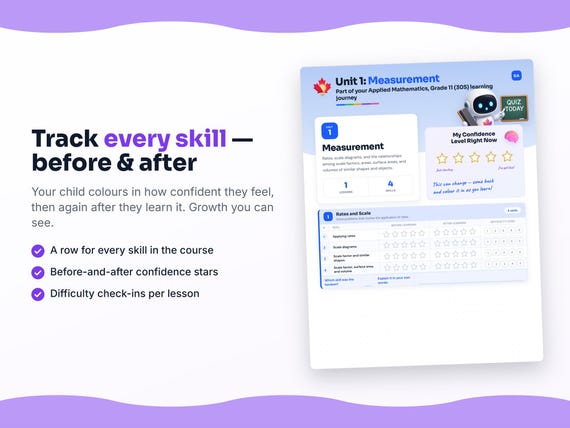
Every skill below runs as a short session: a plain-words lesson, a worked example, solving it together, then a five-question skill check that earns up to three stars. Guided Mode keeps it teaching instead of answer-handing — turning it off needs a parent's password.
Unit 1MeasurementOfficial strand · Strand M
Rates, scale diagrams, and the relationships among scale factors, areas, surface areas, and volumes of similar shapes and objects.
Rates and Scale
- Applying rates11A.M.1 — Solve problems that involve the application of rates, including comparing unit rates, interpreting rate graphs, and relating slope to a rate.
- Scale diagrams11A.M.2 — Solve problems that involve scale diagrams using proportional reasoning, determining scale factors and unknown dimensions.
- Scale factor and similar shapes11A.M.3 — Demonstrate an understanding of the relationship between scale factor and the area of similar 2-D shapes, and find the area of a shape given a scale diagram.
- Scale factor, surface area, and volume11A.M.3 — Demonstrate an understanding of the relationship between scale factor and the surface area and volume of similar 3-D objects, and solve related contextual problems.
The official wording — 3 outcomes in this unit
- 11A.M.1
Solve problems that involve the application of rates.
- 11A.M.2
Solve problems that involve scale diagrams, using proportional reasoning.
- 11A.M.3
Demonstrate an understanding of the relationships among scale factors, areas, surface areas, and volumes of similar 2-D shapes and 3-D objects.
Unit 2GeometryOfficial strand · Strand G
Proving and applying angle and triangle properties, and solving problems with the sine and cosine laws.
Angles, Triangles, and the Sine and Cosine Laws
- Proving angle and triangle properties11A.G.1 — Derive proofs that involve the properties of angles and triangles, using inductive and deductive reasoning for transversal, parallel-line, and polygon-angle relationships.
- Solving angle and triangle problems11A.G.2 — Solve problems that involve the properties of angles and triangles, including diagrams with parallel lines and transversals.
- The sine and cosine laws11A.G.3 — Solve problems that involve the cosine law and the sine law, sketching a diagram and manipulating the formula to find an unknown side or angle.
- The ambiguous case11A.G.3 — Explain whether zero, one, or two triangles exist given two sides and a non-included angle, and solve the resulting ambiguous-case problems.
The official wording — 3 outcomes in this unit
- 11A.G.1
Derive proofs that involve the properties of angles and triangles.
- 11A.G.2
Solve problems that involve the properties of angles and triangles.
- 11A.G.3
Solve problems that involve the cosine law and the sine law, including the ambiguous case.
Unit 3Logical ReasoningOfficial strand · Strand L
Proving conjectures with inductive and deductive reasoning, and analyzing puzzles and games.
Reasoning, Proof, and Puzzles
- Conjectures and proof11A.L.1 — Analyze and prove conjectures using inductive and deductive reasoning, providing counter-examples and identifying invalid arguments.
- Analyzing puzzles and games11A.L.2 — Analyze puzzles and games that involve spatial reasoning, determining, explaining, and verifying strategies to solve or win, framed as formal reasoning.
The official wording — 2 outcomes in this unit
- 11A.L.1
Analyze and prove conjectures, using inductive and deductive reasoning, to solve problems.
- 11A.L.2
Analyze puzzles and games that involve spatial reasoning, using problem-solving strategies.
Unit 4StatisticsOfficial strand · Strand S
Normal distribution with standard deviation and z-scores, and interpreting data with confidence intervals and margin of error.
Normal Distribution and Statistical Inference
- Standard deviation and the normal curve11A.S.1 — Demonstrate an understanding of standard deviation within a normal distribution, calculating it with technology and interpreting the properties of a normal curve.
- Z-scores11A.S.1 — Determine and explain the z-score for a value in a normally distributed data set, and solve contextual problems involving z-scores.
- Confidence intervals and margin of error11A.S.2 — Interpret statistical data using confidence intervals, confidence levels, and margin of error, and make inferences about a population from sample data.
The official wording — 2 outcomes in this unit
- 11A.S.1
Demonstrate an understanding of normal distribution, including standard deviation
- 11A.S.2
Interpret statistical data, using confidence intervals confidence levels margin of error
Unit 5Relations and FunctionsOfficial strand · Strand R
Systems of linear inequalities and linear programming, and quadratic functions as models of data.
Inequalities and Quadratic Models
- Systems of linear inequalities and linear programming11A.R.1 — Model and solve problems that involve systems of linear inequalities in two variables, including optimization problems using linear programming.
- Vertex and intercepts of a quadratic model11A.R.2 — Determine, with technology, the vertex and intercepts of the graph of a quadratic function, and relate the roots, zeros, and x-intercepts.
- Domain, range, and symmetry of a quadratic model11A.R.2 — Determine the domain, range, and axis of symmetry of a quadratic function, and solve a contextual problem best modelled by a quadratic function.
The official wording — 2 outcomes in this unit
- 11A.R.1
Model and solve problems that involve systems of linear inequalities in two variables.
- 11A.R.2
Demonstrate an understanding of the characteristics of quadratic functions, including vertex intercepts
Unit 6Mathematics Research ProjectOfficial strand · Strand RP
A staged research project and presentation on a historical event or an area of interest that involves mathematics.
Mathematics Research Project
- Designing the research inquiry11A.RP.1 — Design a research inquiry into a historical event or an area of interest that involves mathematics, choosing a topic and planning how to collect primary or secondary data.
- Researching and analyzing the data11A.RP.1 — Collect and analyze primary or secondary data for the research project, assessing accuracy, reliability, bias, and relevance, and interpreting it with statistical methods.
- Presenting the research project11A.RP.1 — Organize and present the research project, presenting multiple sides of any controversial issues with supporting data, with or without technology.
The official wording — 1 outcome in this unit
- 11A.RP.1
Research and give a presentation on a historical event or an area of interest that involves mathematics.
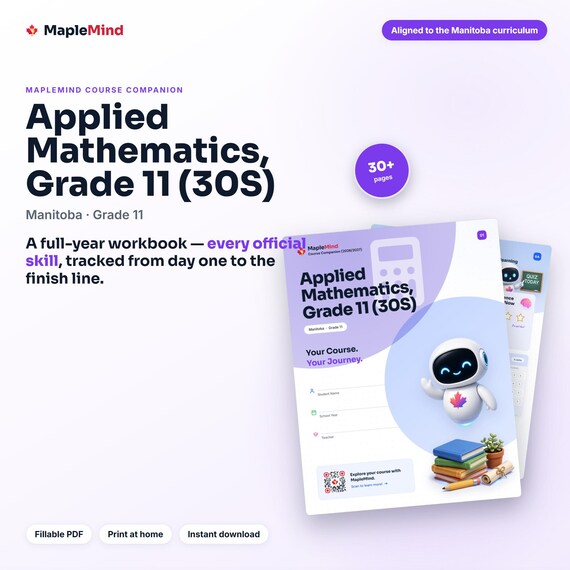
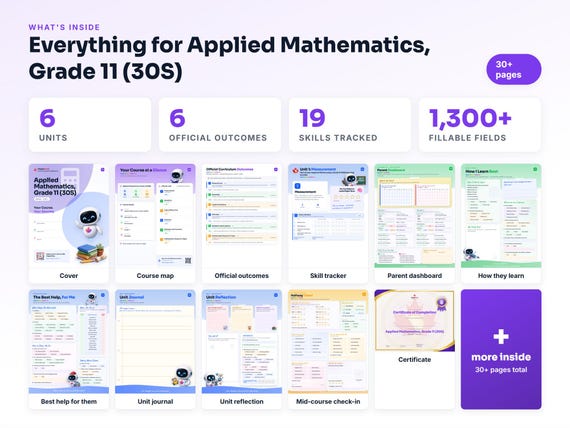
Printable workbook · A keepsake of the year
A Applied Mathematics, Grade 11 (30S) workbook worth keeping
Built from the same official curriculum as this page. Before and after each skill above, your student colours in how sure they feel — so the two of you can see, on one page, what's clicking and what needs another look. It's a quiet way to follow how the year is really going.
By June it's full of their own handwriting: units worked through, confidence grown, a mid-year check-in, notes from parent-teacher night, and a certificate at the end. Less a worksheet, more a record of the year worth keeping on the shelf.
Instant download · see every page, reviews and the full description · five or more workbooks are $2.99 each
What it looks like in the app



Common questions
Can MapleMind help me with Applied Mathematics, Grade 11 (30S)?
Yes. MapleMind's AI tutor covers all 19 skills in Manitoba's Applied Mathematics, Grade 11 (30S) — you pick the exact skill, and the tutor teaches it step by step: a short lesson, a worked example, solving together, then a skill check to show it stuck.
Is MapleMind aligned to Manitoba's official curriculum?
Yes. Every skill in this course maps to an official outcome code from Manitoba's Grade 11 Mathematics curriculum, and the ministry's own wording is quoted under each unit on this page — with the official government source linked so you can check it yourself.
What does MapleMind cost?
It's free to start — 5 tutoring chats and a practice quiz every day, no credit card. A Pro subscription ($9.99/month or $49.99/year CAD, 7-day free trial) unlocks unlimited tutoring, practice, and exam simulations.
What if I'm stuck on just one topic?
That's the point of skill-level tutoring: open Applied Mathematics, Grade 11 (30S) in the app, tap the exact skill from the list on this page, and the tutor teaches just that — no wading through lessons you don't need.
Does MapleMind work in French or other languages?
Yes — 14 languages, including French. Both the app and the tutor's explanations switch to the language you choose.
Where can I see the official Manitoba curriculum for Applied Mathematics, Grade 11 (30S)?
The official source is linked on this page — Manitoba's official curriculum. The outline here follows it: every MapleMind skill carries its official outcome code, and the ministry's own wording is quoted under each unit.
Keep exploring
Ready when you are
Pick a skill from this page and see it taught properly — free, in the browser, in under a minute.