Get help with Social Studies, Grade 5
Most tutoring makes your child sit through material your child already knows. MapleMind flips that: pick the exact skill that's causing trouble — any of the 53 below — and the tutor teaches just that one, step by step, as many times as it takes. Ask questions in plain words, any time of day, in English, French, or 12 other languages.
The official Manitoba Social Studies, Grade 5 curriculum
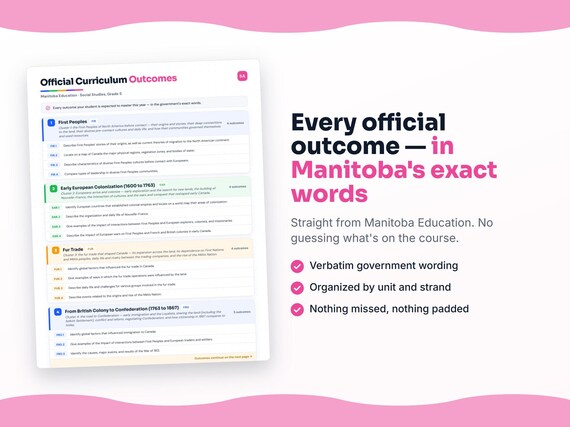
Manitoba defines Social Studies, Grade 5 by strands and outcomes. MapleMind teaches the same curriculum reorganized for one-skill-at-a-time tutoring — the table shows exactly where every official strand lands, and the ministry's own wording is quoted under each unit below.
Official source Manitoba's official curriculumRead it on the government site — edu.gov.mb.ca ↗| Official strand | Outcomes | Where MapleMind teaches it |
|---|---|---|
| Strand C1 | 11 | First Peoples |
| Strand C2 | 13 | Early European Colonization (1600 to 1763) |
| Strand C3 | 15 | Fur Trade |
| Strand C4 | 14 | From British Colony to Confederation (1763 to 1867) |
Every skill below, taught one on one.
 Try the first session free
How MapleMind teaches Social Studies, Grade 5 — every unit, lesson, and skill
Every skill below runs as a short session: a plain-words lesson, a worked example, solving it together, then a five-question skill check that earns up to three stars. Guided Mode keeps it teaching instead of answer-handing — turning it off needs a parent's password.
Unit 1First PeoplesOfficial strand · Strand C1
Cluster 1: the First Peoples of North America before contact — their origins and stories, their deep connections to the land, their diverse pre-contact cultures and daily life, and how their communities governed themselves and used resources.
Origins of First Peoples
- Origins and migrationKI-004 — Describe First Peoples' stories of their origins, as well as current theories of migration to the North American continent.
- The ice age and the landKL-014 — Describe the impact of the ice age on the land.
Connections to the Land
- Canada's physical regionsKL-015 — Locate on a map of Canada the major physical regions, vegetation zones, and bodies of water.
- Traditional territoriesKL-016 — Locate on a map of North America the traditional territories of First Peoples.
- Beliefs and connection to the landKL-017 — Describe practices and beliefs that reflected First Peoples' connections with the land and the natural environment.
Pre-Contact Cultures
- Diverse cultures before contactKI-005 — Describe characteristics of diverse First Peoples cultures before contact with Europeans.
- Comparing daily lifeKI-006 — Compare daily life in diverse First Peoples communities.
- Stories of pre-contact and early contactKH-024 — Relate First Peoples' stories of their pre-contact and early contact with Europeans.
First Peoples Governance
- Leadership in First Peoples communitiesKP-046 — Compare types of leadership in diverse First Peoples communities.
- How communities interactedKE-050 — Describe various ways in which First Peoples communities interacted with each other.
- Views of natural resourcesKE-051 — Compare First Peoples' and European approaches to natural resource use in early Canada.
The official wording — 11 outcomes in this unit
- KI-004
Describe First Peoples’ stories of their origins, as well as current theories of migration to the North American continent.
- KL-014
Describe the impact of the ice age on the land.
- KL-015
Locate on a map of Canada the major physical regions, vegetation zones, and bodies of water.
- KL-016
Locate on a map of North America the traditional territories of First Peoples.
- KL-017
Describe practices and beliefs that reflected First Peoples’ connections with the land and the natural environment.
- KI-005
Describe characteristics of diverse First Peoples cultures before contact with Europeans.
- KI-006
Compare daily life in diverse First Peoples communities.
- KH-024
Relate First Peoples’ stories of their pre-contact and early contact with Europeans.
- KP-046
Compare types of leadership in diverse First Peoples communities.
- KE-050
Describe various ways in which First Peoples communities interacted with each other.
- KE-051
Compare First Peoples’ and European approaches to natural resource use in early Canada.
Unit 2Early European Colonization (1600 to 1763)Official strand · Strand C2
Cluster 2: Europeans arrive and colonize — early exploration and the search for new lands, the building of Nouvelle-France, the interaction of cultures, and the wars and conquest that reshaped early Canada.
Early European Exploration
- European colonial empiresKG-043 — Identify European countries that established colonial empires and locate on a world map their areas of colonization.
- Why Europeans came to North AmericaKP-047 — Identify reasons why Europeans expanded their territories to include North America.
- Explorers and the Northwest PassageKH-025 — Relate stories of European explorers and traders in their search for new lands or the Northwest Passage.
- Places of the colonization eraKL-018 — Locate on a map of Canada places of historical significance during early European colonization.
Nouvelle-France
- Life in Nouvelle-FranceKI-008 — Describe the organization and daily life of Nouvelle-France.
- The royal governmentKP-048 — Describe the organization of the royal government in Nouvelle-France.
- Builders of Nouvelle-FranceKH-033 — Describe contributions of individuals in the settlement of Nouvelle-France.
Cultural Interaction
- Impact of contactKH-026 — Give examples of the impact of interactions between First Peoples and European explorers, colonists, and missionaries.
- Life in Atlantic settlementsKI-007 — Describe daily life in early French and British settlements in Atlantic Canada.
French–British Conflict
- European wars in early CanadaKH-027 — Describe the impact of European wars on First Peoples and French and British colonies in early Canada.
- The Acadian deportationKH-028 — Describe the reasons for and the impact of the Acadian deportation.
- The conquest of Nouvelle-FranceKH-029 — Describe the major events and impact of the British conquest of Nouvelle-France.
- Where Europeans settled and whyKL-019 — Identify factors that influenced the movement and settlement of Europeans in early Canada.
The official wording — 13 outcomes in this unit
- KG-043
Identify European countries that established colonial empires and locate on a world map their areas of colonization.
- KP-047
Identify reasons why Europeans expanded their territories to include North America.
- KH-025
Relate stories of European explorers and traders in their search for new lands or the Northwest Passage.
- KL-018
Locate on a map of Canada places of historical significance during early European colonization.
- KI-008
Describe the organization and daily life of Nouvelle-France.
- KP-048
Describe the organization of the royal government in Nouvelle-France.
- KH-033
Describe contributions of individuals in the settlement of Nouvelle-France.
- KH-026
Give examples of the impact of interactions between First Peoples and European explorers, colonists, and missionaries.
- KI-007
Describe daily life in early French and British settlements in Atlantic Canada.
- KH-027
Describe the impact of European wars on First Peoples and French and British colonies in early Canada.
- KH-028
Describe the reasons for and the impact of the Acadian deportation.
- KH-029
Describe the major events and impact of the British conquest of Nouvelle-France.
- KL-019
Identify factors that influenced the movement and settlement of Europeans in early Canada.
Unit 3Fur TradeOfficial strand · Strand C3
Cluster 3: the fur trade that shaped Canada — its expansion across the land, its dependence on First Nations and Métis peoples, daily life and rivalry between the trading companies, and the rise of the Métis Nation.
European Expansion
- Global forces behind the fur tradeKG-044 — Identify global factors that influenced the fur trade in Canada.
- How the fur trade shaped CanadaKH-030 — Describe the influence of the fur trade on the historical development of Canada.
- Fur trade moves west and northKH-031 — Describe factors that led to the development and expansion of the fur trade into the west and north of Canada.
- Mapping the fur trade and Métis NationKL-020 — Locate on a map of Canada places and regions of historical significance to the fur trade and the Métis Nation.
Importance of the Land
- How the land shaped the tradeKL-021 — Give examples of ways in which the fur trade operations were influenced by the land.
- The stories in place namesKH-034 — Describe the historical significance of Canadian place names.
- Fur trade versus farmingKP-049 — Give examples of conflicting priorities between the demands of the fur trade and agricultural settlement.
Life during the Fur Trade
- Daily life in the fur tradeKI-009 — Describe daily life and challenges for various groups involved in the fur trade.
- Stories of the fur tradeKH-032 — Relate stories of the people and events of the fur trade.
- The trade depended on First Nations and MétisKE-052 — Describe how the fur trade was dependent on the men and women of the First Nations and Métis Nation.
- Rival trading companiesKE-053 — Compare and contrast the operations of the Hudson's Bay and the North West Companies and describe the competition between them.
Métis Nation and Culture
- The rise of the Métis NationKH-035 — Describe events related to the origins and rise of the Métis Nation.
- Traditional Métis landsKL-023 — Locate on a map of western Canada traditional Métis lands and communities.
- Diversity of pre-Confederation CanadaKI-010 — Describe the cultural diversity of pre-Confederation Canada.
- Changing European views of First PeoplesKI-012 — Describe how European views of First Peoples changed from 1763 to 1867.
The official wording — 15 outcomes in this unit
- KG-044
Identify global factors that influenced the fur trade in Canada.
- KH-030
Describe the influence of the fur trade on the historical development of Canada.
- KH-031
Describe factors that led to the development and expansion of the fur trade into the west and north of Canada.
- KL-020
Locate on a map of Canada places and regions of historical significance to the fur trade and the Métis Nation.
- KL-021
Give examples of ways in which the fur trade operations were influenced by the land.
- KH-034
Describe the historical significance of Canadian place names.
- KP-049
Give examples of conflicting priorities between the demands of the fur trade and agricultural settlement.
- KI-009
Describe daily life and challenges for various groups involved in the fur trade.
- KH-032
Relate stories of the people and events of the fur trade.
- KE-052
Describe how the fur trade was dependent on the men and women of the First Nations and Métis Nation.
- KE-053
Compare and contrast the operations of the Hudson’s Bay and the North West Companies and describe the competition between them.
- KH-035
Describe events related to the origins and rise of the Métis Nation.
- KL-023
Locate on a map of western Canada traditional Métis lands and communities.
- KI-010
Describe the cultural diversity of pre-Confederation Canada.
- KI-012
Describe how European views of First Peoples changed from 1763 to 1867.
Unit 4From British Colony to Confederation (1763 to 1867)Official strand · Strand C4
Cluster 4: the road to Confederation — early immigration and the Loyalists, sharing the land (including the Selkirk Settlement), conflict and reform, negotiating Confederation, and how citizenship in 1867 compares to today.
Early Immigration
- Why people immigratedKG-045 — Identify global factors that influenced immigration to Canada.
- The United Empire LoyalistsKH-037 — Give reasons for the migration of the United Empire Loyalists and describe their impact on Canada.
- How migration affects identityKI-011 — Describe ways in which migration to another country or contact with other cultures may affect identities.
Sharing the Land
- First Peoples, traders, and settlersKH-036 — Give examples of the impact of interactions between First Peoples and European traders and settlers.
- The Selkirk SettlementKH-039 — Describe the reasons for, main events of, and impact of the Selkirk Settlement of the Red River.
Conflict and Reform
- The War of 1812KH-038 — Identify the causes, major events, and results of the War of 1812.
- The Rebellions of 1837–1838KH-040 — Identify people, events, and results of the 1837 to 1838 Rebellions and explain their impact on the development of Canada.
- Canada East and Canada WestKI-013 — Compare daily life in Canada East and Canada West.
Negotiating Confederation
- Arguments for and against ConfederationKH-041 — Describe the origins of Confederation and give arguments for and against Canadian Confederation.
- Building ConfederationKH-042 — Describe the roles of individuals in building Canadian Confederation.
- The first four provincesKL-022 — Locate on a map of Canada the four provinces of Confederation in 1867.
Citizenship Then and Now
- Citizens' rights in 1867KC-001 — Give examples of the responsibilities and rights of citizens of Canada in 1867.
- Who was left out in 1867KC-002 — Identify differences in citizenship rights for various groups in 1867.
- Citizenship then and nowKC-003 — Compare what it meant to be a citizen of Canada in 1867 to what it means today.
The official wording — 14 outcomes in this unit
- KG-045
Identify global factors that influenced immigration to Canada.
- KH-037
Give reasons for the migration of the United Empire Loyalists and describe their impact on Canada.
- KI-011
Describe ways in which migration to another country or contact with other cultures may affect identities.
- KH-036
Give examples of the impact of interactions between First Peoples and European traders and settlers.
- KH-039
Describe the reasons for, main events of, and impact of the Selkirk Settlement of the Red River.
- KH-038
Identify the causes, major events, and results of the War of 1812.
- KH-040
Identify people, events, and results of the 1837 to 1838 Rebellions and explain their impact on the development of Canada.
- KI-013
Compare daily life in Canada East and Canada West.
- KH-041
Describe the origins of Confederation and give arguments for and against Canadian Confederation.
- KH-042
Describe the roles of individuals in building Canadian Confederation.
- KL-022
Locate on a map of Canada the four provinces of Confederation in 1867.
- KC-001
Give examples of the responsibilities and rights of citizens of Canada in 1867.
- KC-002
Identify differences in citizenship rights for various groups in 1867.
- KC-003
Compare what it meant to be a citizen of Canada in 1867 to what it means today.
Printable workbook · A keepsake of the year
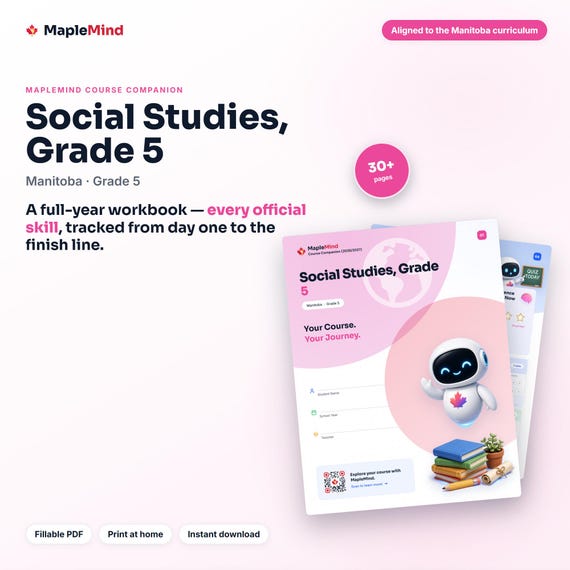
A Social Studies, Grade 5 workbook worth keeping
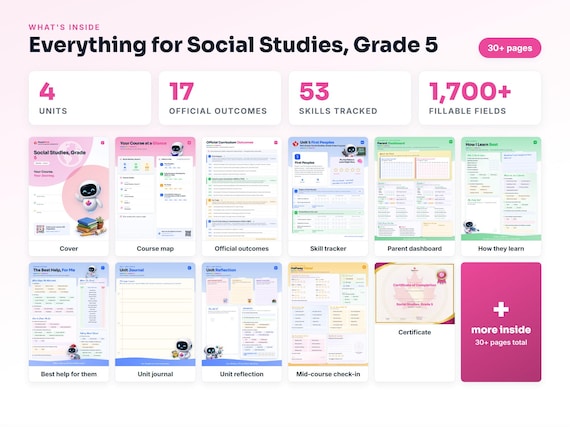
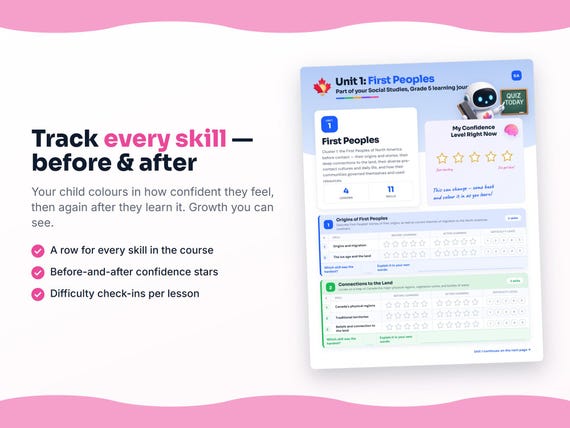
Built from the same official curriculum as this page. Before and after each skill above, your student colours in how sure they feel — so the two of you can see, on one page, what's clicking and what needs another look. It's a quiet way to follow how the year is really going.
By June it's full of their own handwriting: units worked through, confidence grown, a mid-year check-in, notes from parent-teacher night, and a certificate at the end. Less a worksheet, more a record of the year worth keeping on the shelf.
Instant download · see every page, reviews and the full description · five or more workbooks are $2.99 each
What it looks like in the app


Common questions
Can MapleMind help my child with Social Studies, Grade 5?
Yes. MapleMind's AI tutor covers all 53 skills in Manitoba's Social Studies, Grade 5 — your child picks the exact skill, and the tutor teaches it step by step: a short lesson, a worked example, solving together, then a skill check to show it stuck.
Is MapleMind aligned to Manitoba's official curriculum?
Yes. Every skill in this course maps to an official outcome code from Manitoba's Grade 5 Social Studies curriculum, and the ministry's own wording is quoted under each unit on this page — with the official government source linked so you can check it yourself.
What does MapleMind cost?
It's free to start — 5 tutoring chats and a practice quiz every day, no credit card. A Pro subscription ($9.99/month or $49.99/year CAD, 7-day free trial) unlocks unlimited tutoring, practice, and exam simulations.
What if my child is stuck on just one topic?
That's the point of skill-level tutoring: open Social Studies, Grade 5 in the app, tap the exact skill from the list on this page, and the tutor teaches just that — no wading through lessons your child doesn't need.
Does MapleMind work in French or other languages?
Yes — 14 languages, including French. Both the app and the tutor's explanations switch to the language your child chooses.
Where can I see the official Manitoba curriculum for Social Studies, Grade 5?
The official source is linked on this page — Manitoba's official curriculum. The outline here follows it: every MapleMind skill carries its official outcome code, and the ministry's own wording is quoted under each unit.
Keep exploring
Ready when you are
Pick a skill from this page and see it taught properly — free, in the browser, in under a minute.