Get help with Mathematics, Grade 5
Most tutoring makes your child sit through material your child already knows. MapleMind flips that: pick the exact skill that's causing trouble — any of the 37 below — and the tutor teaches just that one, step by step, as many times as it takes. Ask questions in plain words, any time of day, in English, French, or 12 other languages.
The official Manitoba Mathematics, Grade 5 curriculum
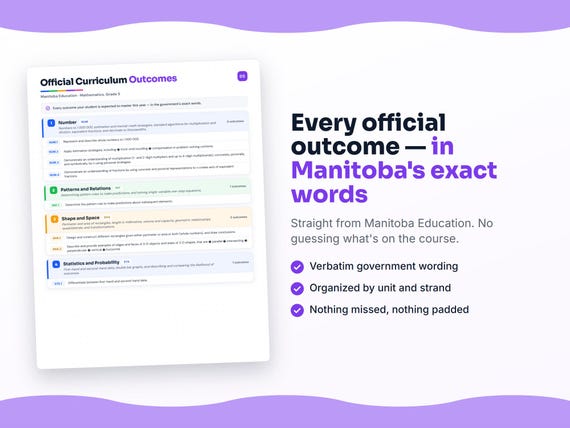
Manitoba defines Mathematics, Grade 5 by strands and outcomes. MapleMind teaches the same curriculum reorganized for one-skill-at-a-time tutoring — the table shows exactly where every official strand lands, and the ministry's own wording is quoted under each unit below.
Official source Manitoba's official curriculumRead it on the government site — edu.gov.mb.ca ↗| Official strand | Outcomes | Where MapleMind teaches it |
|---|---|---|
| Strand N | 11 | Number |
| Strand PR | 2 | Patterns and Relations |
| Strand SS | 8 | Shape and Space |
| Strand SP | 4 | Statistics and Probability |
Every skill below, taught one on one.
 Try the first session free
How MapleMind teaches Mathematics, Grade 5 — every unit, lesson, and skill
Every skill below runs as a short session: a plain-words lesson, a worked example, solving it together, then a five-question skill check that earns up to three stars. Guided Mode keeps it teaching instead of answer-handing — turning it off needs a parent's password.
Unit 1NumberOfficial strand · Strand N
Numbers to 1 000 000, estimation and mental-math strategies, standard algorithms for multiplication and division, equivalent fractions, and decimals to thousandths.
Numbers to 1 000 000
- Reading and writing numbers to a million5.N.1 — Represent and describe whole numbers to 1 000 000, writing with proper spacing and describing the meaning of each digit.
- Expanded notation to a million5.N.1 — Express a numeral to 1 000 000 in expanded notation, and write the numeral represented by an expanded notation.
Estimation and Mental Math
- Front-end rounding and compensation5.N.2 — Apply front-end rounding and compensation estimation strategies in problem-solving contexts for sums, differences, products, and quotients.
- Compatible numbers for estimating5.N.2 — Estimate sums and products using compatible numbers, and select an appropriate estimation strategy to solve a problem.
- Multiplication facts to 815.N.3 — Apply mental math strategies including skip-counting from a known fact and doubling to determine multiplication facts to 81.
- The 9s pattern and division facts5.N.3 — Apply mental math strategies using the 9s pattern and relating multiplication to division to determine related division facts to 81.
- Mental strategies for bigger multiplication5.N.4 — Apply mental mathematics strategies for multiplication including annexing then adding zeros and halving and doubling.
- Using the distributive property5.N.4 — Apply the distributive property as a mental mathematics strategy to determine products of factors close to multiples of ten.
Multiplication and Division Algorithms
- Multiplying with personal strategies and area models5.N.5 — Multiply 1- and 2-digit multipliers by up to 4-digit multiplicands using personal strategies, partial products, and area models.
- The standard multiplication algorithm5.N.5 — Use the standard algorithm of vertical multiplication and estimate products, connecting the algorithm to place value.
- Dividing and interpreting remainders5.N.6 — Divide with 1- and 2-digit divisors and up to 4-digit dividends using personal strategies, and interpret remainders depending on the context.
- The standard division algorithm5.N.6 — Use the standard algorithm of long division and estimate quotients, connecting the algorithm to place value.
Fractions and Decimals
- Equivalent fractions5.N.7 — Create sets of equivalent fractions using concrete and pictorial representations, and explain why there are many equivalent fractions for any fraction.
- Comparing fractions with unlike denominators5.N.7 — Compare fractions with like and unlike denominators by creating equivalent fractions, and position them on a number line.
- Decimals to thousandths5.N.8 — Describe and represent decimals to tenths, hundredths, and thousandths concretely, pictorially, and symbolically, and express equivalent decimals.
- Connecting decimals and fractions to thousandths5.N.9 — Relate decimals to fractions for tenths, hundredths, and thousandths, expressing a fraction with a denominator of 10, 100, or 1000 as a decimal.
- Ordering decimals with benchmarks5.N.10 — Compare and order decimals to thousandths using benchmarks on a number line and using place value.
- Ordering decimals with equivalent decimals5.N.10 — Compare and order decimals to thousandths using equivalent decimals, and explain that 0.2, 0.20, and 0.200 are equal.
- Adding and subtracting decimals5.N.11 — Add and subtract decimals to thousandths using personal strategies and the standard algorithms, aligning place values.
- Estimating and solving decimal problems5.N.11 — Estimate decimal sums and differences with front-end estimation, place the decimal correctly, and solve problems involving decimal addition and subtraction.
The official wording — 11 outcomes in this unit
- 5.N.1
Represent and describe whole numbers to 1 000 000.
- 5.N.2
Apply estimation strategies, including � front-end rounding � compensation in problem-solving contexts.
- 5.N.3
Apply mental math strategies to determine multiplication and related division facts to 81 (9 x 9).
- 5.N.4
Apply mental mathematics strategies for multiplication, such as n annexing then adding zeros n halving and doubling
- 5.N.5
Demonstrate an understanding of multiplication (1- and 2-digit multipliers and up to 4-digit multiplicands), concretely, pictorially, and symbolically, by n using personal strategies
- 5.N.6
Demonstrate an understanding of division (1- and 2-digit divisors and up to 4-digit dividends), concretely, pictorially, and symbolically, and interpret remainders by n using personal strategies
- 5.N.7
Demonstrate an understanding of fractions by using concrete and pictorial representations to n create sets of equivalent fractions
- 5.N.8
Describe and represent decimals (tenths, hundredths, thousandths) concretely, pictorially, and symbolically.
- 5.N.9
Relate decimals to fractions (tenths, hundredths, thousandths).
- 5.N.10
Compare and order decimals (tenths, hundredths, thousandths) by using � benchmarks � place value
- 5.N.11
Demonstrate an understanding of addition and subtraction of decimals (to thousandths), concretely, pictorially, and symbolically, by � using personal strategies � using the standard algorithms
Unit 2Patterns and RelationsOfficial strand · Strand PR
Determining pattern rules to make predictions, and solving single-variable one-step equations.
Patterns and Equations
- Pattern rules and predictions5.PR.1 — Determine the pattern rule to make predictions about subsequent elements, writing the rule as a mathematical expression.
- Writing single-variable equations5.PR.2 — Express a problem in context as a single-variable one-step equation using a letter variable, and create a problem for an equation.
- Solving single-variable equations5.PR.2 — Solve single-variable one-step equations with whole-number coefficients and whole-number solutions, with the unknown in any term.
The official wording — 2 outcomes in this unit
- 5.PR.1
Determine the pattern rule to make predictions about subsequent elements.
- 5.PR.2
Solve problems involving single-variable (expressed as symbols or letters), one-step equations with whole-number coefficients, and whole-number solutions.
Unit 3Shape and SpaceOfficial strand · Strand SS
Perimeter and area of rectangles, length in millimetres, volume and capacity, geometric relationships, quadrilaterals, and transformations.
Measurement
- Rectangles with given perimeter or area5.SS.1 — Design and construct different rectangles given either perimeter or area or both, and draw conclusions about the relationship.
- Measuring in millimetres5.SS.2 — Select and justify referents for the millimetre, and describe the relationship between mm and cm and between mm and m.
- Referents and estimating volume5.SS.3 — Select and justify referents for cubic centimetres and cubic metres, and estimate volume using those referents.
- Measuring and building volume5.SS.3 — Measure and record volume in cubic centimetres or cubic metres, and construct rectangular prisms for a given volume.
- Millilitres and litres5.SS.4 — Describe the relationship between millilitres and litres, and select and justify referents for mL and L.
- Estimating and measuring capacity5.SS.4 — Estimate capacity using referents, and measure and record capacity in millilitres or litres.
Geometry and Transformations
- Parallel, perpendicular, and more5.SS.5 — Describe and provide examples of edges, faces, and sides that are parallel, intersecting, perpendicular, vertical, and horizontal.
- Sorting quadrilaterals5.SS.6 — Identify and sort quadrilaterals including rectangles, squares, trapezoids, parallelograms, and rhombuses according to their attributes.
- Performing transformations5.SS.7 — Perform a single transformation (translation, rotation, or reflection) of a 2-D shape, and draw and describe the image.
- Identifying transformations5.SS.8 — Identify a single transformation (translation, rotation, or reflection) of 2-D shapes, and describe a rotation by direction.
The official wording — 8 outcomes in this unit
- 5.SS.1
Design and construct different rectangles given either perimeter or area or both (whole numbers), and draw conclusions.
- 5.SS.2
Demonstrate an understanding of measuring length (mm) by � selecting and justifying referents for the unit mm � modelling and describing the relationship between mm and cm units, and between mm and m units
- 5.SS.3
Demonstrate an understanding of volume by � selecting and justifying referents for cm3 or m3 units � estimating volume by using referents for cm3 or m3
- 5.SS.4
Demonstrate an understanding of capacity by � describing the relationship between mL and L � selecting and justifying referents for mL or L units
- 5.SS.5
Describe and provide examples of edges and faces of 3-D objects, and sides of 2-D shapes, that are � parallel � intersecting � perpendicular � vertical � horizontal
- 5.SS.6
Identify and sort quadrilaterals, including � rectangles � squares � trapezoids � parallelograms � rhombuses according to their attributes.
- 5.SS.7
Perform a single transformation (translation, rotation, or reflection) of a 2-D shape, and draw and describe the image.
- 5.SS.8
Identify a single transformation (translation, rotation, or reflection) of 2-D shapes.
Unit 4Statistics and ProbabilityOfficial strand · Strand SP
First-hand and second-hand data, double bar graphs, and describing and comparing the likelihood of outcomes.
Data and Probability
- First-hand and second-hand data5.SP.1 — Differentiate between first-hand and second-hand data, and formulate questions best answered by each.
- Double bar graphs5.SP.2 — Construct and interpret double bar graphs to draw conclusions, labelling the title, axes, and legend.
- Impossible, possible, and certain5.SP.3 — Describe the likelihood of a single outcome using words such as impossible, possible, and certain, and conduct a probability experiment.
- Comparing likelihoods5.SP.4 — Compare the likelihood of two possible outcomes using words such as less likely, equally likely, and more likely.
The official wording — 4 outcomes in this unit
- 5.SP.1
Differentiate between first-hand and second-hand data.
- 5.SP.2
Construct and interpret double bar graphs to draw conclusions.
- 5.SP.3
Describe the likelihood of a single outcome occurring, using words such as � impossible � possible � certain
- 5.SP.4
Compare the likelihood of two possible outcomes occurring, using words such as � less likely � equally likely � more likely
Printable workbook · A keepsake of the year
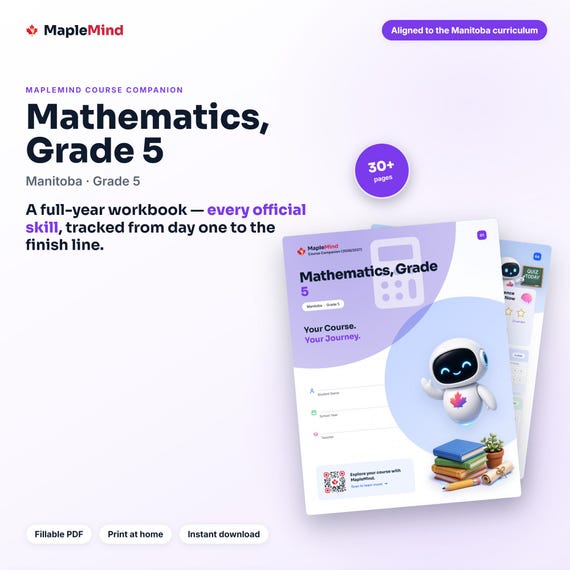
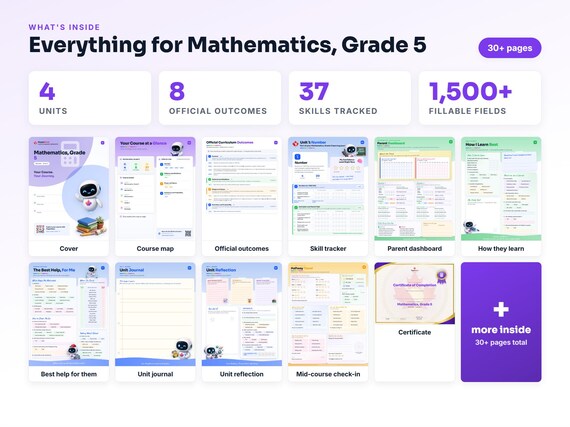
A Mathematics, Grade 5 workbook worth keeping
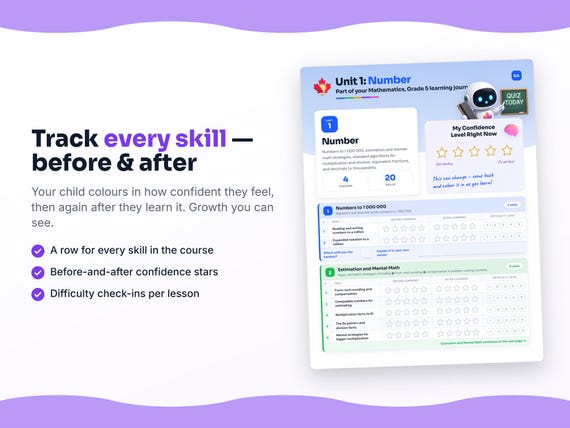
Built from the same official curriculum as this page. Before and after each skill above, your student colours in how sure they feel — so the two of you can see, on one page, what's clicking and what needs another look. It's a quiet way to follow how the year is really going.
By June it's full of their own handwriting: units worked through, confidence grown, a mid-year check-in, notes from parent-teacher night, and a certificate at the end. Less a worksheet, more a record of the year worth keeping on the shelf.
Instant download · see every page, reviews and the full description · five or more workbooks are $2.99 each
What it looks like in the app



Common questions
Can MapleMind help my child with Mathematics, Grade 5?
Yes. MapleMind's AI tutor covers all 37 skills in Manitoba's Mathematics, Grade 5 — your child picks the exact skill, and the tutor teaches it step by step: a short lesson, a worked example, solving together, then a skill check to show it stuck.
Is MapleMind aligned to Manitoba's official curriculum?
Yes. Every skill in this course maps to an official outcome code from Manitoba's Grade 5 Mathematics curriculum, and the ministry's own wording is quoted under each unit on this page — with the official government source linked so you can check it yourself.
What does MapleMind cost?
It's free to start — 5 tutoring chats and a practice quiz every day, no credit card. A Pro subscription ($9.99/month or $49.99/year CAD, 7-day free trial) unlocks unlimited tutoring, practice, and exam simulations.
What if my child is stuck on just one topic?
That's the point of skill-level tutoring: open Mathematics, Grade 5 in the app, tap the exact skill from the list on this page, and the tutor teaches just that — no wading through lessons your child doesn't need.
Does MapleMind work in French or other languages?
Yes — 14 languages, including French. Both the app and the tutor's explanations switch to the language your child chooses.
Where can I see the official Manitoba curriculum for Mathematics, Grade 5?
The official source is linked on this page — Manitoba's official curriculum. The outline here follows it: every MapleMind skill carries its official outcome code, and the ministry's own wording is quoted under each unit.
Keep exploring
Ready when you are
Pick a skill from this page and see it taught properly — free, in the browser, in under a minute.