Nova Scotia · For parents

What your child learns in Grade 12 in Nova Scotia

Every subject, unit by unit, from Nova Scotia’s curriculum: 422 skills in plain words.

Subjects
5
Skills
422
Provincial exams
None
Official curriculum
curriculum.novascotia.ca

Math in Grade 12

4 courses. Choose the one your child takes.

Calculus 12

4 units · 42 skills

  1. Unit 1

    Calculus 12 — Rates of Change and the Derivative

    Average rate of change of f over [a, b] is (f(b) − f(a)) / (b − a).

    • Average vs. instantaneous rate of change
    • From secant slopes to the tangent slope
    • The derivative as a limit
    2 more skills
    • Where a function is not differentiable
    • Implicit differentiation
  2. Unit 2

    Calculus 12 — Differentiation Rules and Applications

    lim notation: lim (x→a) f(x) is the value f(x) approaches as x approaches a.

    • Calculating limits and their properties
    • Removing removable discontinuities
    • Continuity of combinations and composites
    17 more skills
    • Power, sum, and difference rules
    • Product and quotient rules
    • The chain rule
    • Derivatives of trigonometric functions
    • Derivatives of exponential and logarithmic functions
    • Calculating and interpreting rate of change
    • Using derivatives to solve rate-of-change problems
    • Estimating change with differentials
    • Related rates
    • Critical points and absolute extrema
    • Increasing and decreasing intervals
    • Optimization: maximum and minimum values
    • Rules for definite integrals
    • The Fundamental Theorem of Calculus
    • Integration by substitution
    • Integration by parts
    • Net change from an integrated rate
  3. Unit 3

    Calculus 12 — Curve Analysis, Tangents and Antiderivatives

    A function is continuous at a point if the limit there exists and equals the function value.

    • Intervals of continuity
    • Developing the tangent from the secant
    • Equations of tangent and normal lines
    8 more skills
    • The connection between the graphs of f and f'
    • First and Second Derivative Tests for local extrema
    • Concavity and points of inflection
    • Initial value problems
    • The derivative–definite integral relationship
    • Constructing antiderivatives with the FTC
    • Antiderivatives of polynomials
    • Antiderivatives of exponential and trigonometric functions
  4. Unit 4

    Calculus 12 — Integration and Area

    A Riemann sum adds the areas of rectangles under a curve on an interval.

    • Riemann sums for area under a curve
    • The meaning of area under the curve
    • Expressing area as a definite integral
    3 more skills
    • Computing area by numerical integration
    • Areas of regions in a plane
    • Volumes by slices or shells

See the course: Calculus 12

Mathematics 12

4 units · 30 skills

  1. Unit 1

    Financial Mathematics

    Simple interest is earned only on the principal; compound interest is earned on principal plus accumulated interest.

    • Compound versus simple interest
    • Compound interest in loan and credit decisions
    • Graphing the effects of compound-interest variables
    4 more skills
    • Appreciating and depreciating assets
    • Justifying rent, lease, or buy
    • Analyzing an investment portfolio
    • Long-term and short-term investment strategy
  2. Unit 2

    Logical Reasoning

    Strategies include guess-and-check, looking for a pattern, working backward, and eliminating possibilities.

    • Strategies for puzzles and games
    • Sets, subsets, and Venn diagrams
    • Set operations and problem solving
  3. Unit 3

    Probability

    Probability is favourable outcomes over all outcomes (part-whole).

    • Converting between odds and probability
    • Assessing probability statements
    • Independent events
    7 more skills
    • Dependent events
    • Counting with graphic organizers
    • The fundamental counting principle
    • Factorial notation and nPr
    • Permutations with identical elements
    • When order matters: combinations vs permutations
    • Counting and applying combinations
  4. Unit 4

    Relations and Functions

    Degree and leading coefficient set a polynomial's end behaviour and number of turns.

    • Polynomial functions from graphs
    • Polynomial functions from equations
    • Fitting a polynomial function to data
    7 more skills
    • Interpreting and solving with polynomial models
    • Exponential and logarithmic functions from graphs
    • Exponential and logarithmic functions from equations
    • Modelling data with exponential and logarithmic functions
    • Angles and sinusoidal functions from graphs
    • Sinusoidal functions from equations
    • Modelling cyclic data with sinusoidal functions

Mathematics at Work 12

5 units · 22 skills

  1. Unit 1

    Geometry

    The sine law relates each side to the sine of its opposite angle: a/sin A = b/sin B = c/sin C.

    • The sine law
    • The cosine law
    • Properties of triangles and quadrilaterals
    5 more skills
    • Properties of regular polygons
    • Applying polygon properties
    • Single transformations
    • Combinations of transformations
    • Dilations and similarity
  2. Unit 2

    Number

    Logical puzzles are solved by systematic reasoning, not guessing.

    • Strategies for logical puzzles and games
    • Options for acquiring a vehicle
    • Solving vehicle-acquisition problems
    1 more skill
    • Justifying a vehicle decision
  3. Unit 3

    Algebra

    A linear relation changes by a constant amount for each equal step.

    • Recognizing patterns and trends in linear relations
    • Tables of values and equations
    • Graphing linear relations
    2 more skills
    • Interpolating and extrapolating
    • Scatterplots and trends
  4. Unit 4

    Statistics

    The mean is the sum divided by the count; the median is the middle value; the mode is the most frequent.

    • Mean, median, and mode
    • Outliers and interpreting data
  5. Unit 5

    Probability

    Probability is favourable outcomes divided by total outcomes.

    • Calculating probability
    • Odds and probability
    • Applications and decisions

Pre-Calculus 12

2 units · 26 skills

  1. Unit 1

    Trigonometry

    The six ratios are sine, cosine, tangent and their reciprocals cosecant, secant, cotangent.

    • Exact and approximate values of the six ratios
    • Finding the other ratios from one
    • Graphing and characteristics of sine, cosine, and tangent
    4 more skills
    • Transformations of trigonometric functions
    • Solving trigonometric equations
    • Verifying and proving identities
    • Sum, difference, and double-angle identities
  2. Unit 2

    Relations and Functions

    Functions combine value-by-value: (f + g)(x) = f(x) + g(x).

    • Combining functions by operations
    • Composition of functions
    • Translations of functions
    16 more skills
    • Stretches of functions
    • Reflections of functions
    • Combining translations and stretches
    • Finding the inverse of a relation
    • When an inverse is a function
    • Understanding logarithms
    • The laws of logarithms
    • Graphing exponential functions
    • Graphing logarithmic functions
    • Solving exponential equations
    • Solving logarithmic equations
    • Long and synthetic division of polynomials
    • Factoring with the factor theorem
    • Graphing polynomial functions
    • Graphing radical functions
    • Graphing rational functions

Science in Grade 12

3 courses. Choose the one your child takes.

Biology 12

BIO12 · 4 units · 35 skills

  1. Unit 1

    Maintaining Dynamic Equilibrium II

    Homeostasis is maintained by negative-feedback loops: receptor detects a change, control centre integrates, effector responds to return the variable to its set point.

    • Plant and animal systems maintaining homeostasis
    • Water, glucose, and ATP in living systems
    • Investigating the nervous system
    9 more skills
    • Structure and dynamics of the nervous system
    • Disease and homeostasis
    • Drugs, technology, and homeostasis over time
    • Treatments for vision and hearing
    • Protein and steroid hormones
    • Enzymes in cellular metabolism
    • Investigating the endocrine system
    • Feedback mechanisms in homeostasis
    • Contributions to homeostasis science
  2. Unit 2

    Reproduction and Development

    Plant investigations (germination rates, growth under conditions, root-tip mitosis prep) allow controlled experimentation with living material.

    • Experimenting on plant materials
    • Mitosis and meiosis in detail
    • Cell-based genetic technologies
    6 more skills
    • Radiation therapy and chemotherapy
    • Mammalian reproductive systems
    • Analyzing the human reproductive cycles
    • Current reproductive technologies
    • Evaluating reproductive technologies
    • Reproductive cycles and technology impact
  3. Unit 3

    Genetic Continuity

    Mendel established heritable 'factors' through pea-plant crosses (1860s).

    • The discovery of the gene
    • Chromosomes and inheritance
    • DNA, RNA, replication, and protein synthesis
    7 more skills
    • Mutations and their effects
    • Mendelian crosses
    • Causes of genetic disease
    • Arguing about genetic engineering
    • Genetics-based technology development
    • The Human Genome Project
    • Defending a position on genetic modification
  4. Unit 4

    Evolution, Change, and Diversity

    Peer review is scientists critically evaluating each other's work before publication — a self-correcting quality check.

    • Peer review and evolutionary concepts
    • Evidence, theories, and paradigms
    • Constructing arguments for diversity
    1 more skill
    • Origin, development, and diversity of life
See the course: Biology 12

Chemistry 12

CHE12 · 4 units · 87 skills

  1. Unit 1

    Thermochemistry

    Exothermic reactions release energy (delta-H negative); endothermic absorb it (delta-H positive).

    • Thermochemistry vocabulary
    • Molar enthalpies of combustion
    • Combustion equations with energy
    20 more skills
    • Energy in changes of state
    • Potential energy diagrams
    • Designing a thermochemistry experiment
    • Selecting instruments and processes
    • Measuring reaction energy changes
    • Hess's Law and reaction energy
    • Applying prediction methods to data
    • Displaying heats of formation
    • Settings of scientific activity
    • Risks and benefits of thermochemistry
    • Questions thermochemistry can and cannot answer
    • Courses of action on energy issues
    • Co-operative thermochemistry experiments
    • Identifying areas of further study
    • Alternative energy solutions
    • Technologies from thermochemistry
    • Peer review in thermochemistry
    • Research tools for information
    • Integrating information sources
    • Perspectives on a science decision
  2. Unit 2

    Solutions, Kinetics, and Equilibrium

    Solubility is the maximum mass of solute dissolving in a fixed solvent amount at a temperature.

    • Organizing solubility data
    • Molar solubility
    • Variation in solubility
    14 more skills
    • Predicting precipitates
    • Sources of error and uncertainty
    • Solutions and equilibrium careers
    • Factors affecting reaction rate
    • Sampling procedures
    • Collision theory
    • Reaction mechanisms and catalysts
    • Organizing kinetics data
    • Equilibrium in solutions
    • Factors affecting solubility via equilibrium
    • Sampling for equilibrium expressions
    • Solubility and equilibrium
    • Technology revising understanding
    • Technologies from scientific understanding
  3. Unit 3

    Acids and Bases

    Binary acids (HCl -> hydrochloric acid) and oxyacids (H2SO4 -> sulfuric acid) follow naming rules.

    • Acid-base classification and nomenclature
    • Acid-base definitions
    • How acid-base theory evolves
    22 more skills
    • Evidence, theories, and paradigms
    • Predicting acid-base products
    • New questions from learning
    • Strong vs weak acids and bases
    • Calculating pH
    • How indicators work
    • Understanding from titration curves
    • H+ and OH- via Le Chatelier
    • Prediction and hypothesis (acid-base)
    • Concentration by stoichiometry
    • Collecting titration data
    • Interpreting titration data
    • Co-operative titration experiment
    • Selecting titration instruments
    • Modes of representation
    • Line of best fit
    • Apparatus and materials safety
    • WHMIS handling and disposal
    • Communicating acid-base results
    • Society's influence on acid-base science
    • Constructing acid-base arguments
    • Acid-base careers
  4. Unit 4

    Electrochemistry

    Redox (oxidation-reduction) underlies corrosion, batteries, and metal extraction — sources of real questions.

    • Questions about redox
    • Scientific vs technological (redox)
    • Defining oxidation and reduction
    19 more skills
    • Comparing redox to other reactions
    • Balancing half-reactions
    • Designing chemical cells
    • Defining cell design problems
    • Parts of cells
    • Electrochemistry safety
    • Evaluating a self-designed cell
    • Designing a redox experiment
    • Operational definitions
    • Predicting spontaneity
    • Predicting cell voltage
    • Theoretical vs experimental potentials
    • Reliability of redox data
    • Electrochemical vs electrolytic cells
    • Electrolysis and electroplating
    • Hydrogen fuel cells
    • Evaluating a technology design
    • Analyzing natural and technological systems
    • Applications of findings

Physics 12

PHY12 · 4 units · 54 skills

  1. Unit 1

    Force, Motion, Work, and Energy

    Vectors in 2D are resolved into perpendicular components and recombined.

    • 2D vector analysis
    • Conservation of momentum (2D)
    • Choosing conservation laws (2D)
    11 more skills
    • Projectile motion
    • Construct and evaluate a device
    • Uniform circular motion
    • Circular motion and Newton's laws
    • Simple harmonic motion (qualitative)
    • Energy in simple harmonic motion
    • Organizing motion data
    • Investigating a technology over time
    • Kepler's laws
    • Universal gravitation and orbits
    • Scientific vs technological (orbits)
  2. Unit 2

    Fields

    A field is a region where a force acts on an object with the relevant property.

    • Fields as regions of influence
    • Field lines
    • Charges and poles
    13 more skills
    • Gravitation vs Coulomb's law
    • Ohm's law and circuits
    • Defining problems and relationships
    • Magnetic field of a current
    • Force on a moving charge
    • Electromagnetic induction
    • Motors and generators
    • Direct and alternating current
    • Designing a fields experiment
    • Controlled procedures (fields)
    • Prediction and hypothesis (fields)
    • Evidence, paradigms, and peer review
    • Communicating physics ideas
  3. Unit 3

    Waves and Modern Physics

    Einstein's E = mc^2 shows mass and energy are equivalent and interconvertible.

    • Mass-energy equivalence
    • Evolution of quantum physics
    • Quantum energy: black-body and photoelectric
    8 more skills
    • Photoelectric effect formula
    • Photon momentum
    • Compton effect and de Broglie
    • Wave and particle models of light
    • Alternative theoretical models
    • Bohr atomic model
    • Energy levels and photons
    • Quantum-mechanical luminous phenomena
  4. Unit 4

    Radioactivity

    Natural sources include cosmic rays, radon gas, and radioactive isotopes in rocks and food.

    • Sources of radioactivity
    • Mass-energy in nuclear reactions
    • Types of radiation
    10 more skills
    • Half-life
    • Fission and fusion
    • Sampling procedures (radioactivity)
    • Apparatus and materials safety
    • WHMIS handling and disposal (radioactivity)
    • Integrating radioactivity information
    • Radioactivity technologies and careers
    • Canadian contributions
    • Defending a position (radioactivity)
    • Risks and benefits of nuclear technology
See the course: Physics 12

English in Grade 12

2 courses. Choose the one your child takes.

Canadian Literature 12

3 units · 13 skills

  1. Unit 1

    Reading

    Canadian literature spans regions, communities, and traditions — choosing widely means reading beyond a single familiar voice.

    • Selecting and reading Canadian literature by interest
    • Experiencing poetry, prose, and drama in Canadian literature
    • Reading Canadian texts in their contexts
  2. Unit 2

    Responding

    A personal connection links your own experience, place, or identity to something in a Canadian text.

    • Exploring personal connections to Canadian literature
    • Articulating and justifying points of view about texts
    • Examining how responses reflect reader perspectives
    3 more skills
    • Reflecting on what responses reveal about values and attitudes
    • Examining how texts reveal and produce values and positions
    • Describing, discussing, and evaluating texts and genres
  3. Unit 3

    Identity, Diversity, and Voice

    Recurring themes are ideas that surface again and again across texts — survival, belonging, land, identity are common in Canadian writing.

    • Identifying recurring themes, values, and attitudes
    • Examining the reasons for and effects of point of view
    • Entering imaginatively into characters' lives
    1 more skill
    • Examining characters' development and self-understanding

English 12

ENG12 · 3 units · 34 skills

  1. Unit 1

    Speaking and Listening

    A discriminating question distinguishes what matters from what does not — it is finely judged.

    • Asking discriminating questions to evaluate ideas
    • Advocating and justifying positions convincingly
    • Interacting in leadership and support roles in complex situations
    4 more skills
    • Adapting language and delivery in complex contexts
    • Evaluating verbal and nonverbal elements of powerful communication
    • Making critical language choices of tone and style
    • Expressing voice or choosing to remain silent
  2. Unit 2

    Reading and Viewing

    Grade 12 broadens the text-set to world literature across periods, countries, and provinces.

    • Experiencing world literary genres and modes
    • Constructing meaning in complex and sophisticated texts
    • Articulating one's own processes with sophisticated texts
    14 more skills
    • Researching systematically to meet learning needs
    • Evaluating one's own research processes
    • Making informed personal responses that explore diverse perspectives
    • Justifying points of view and interpreting ambiguities
    • Critically evaluating accessed information
    • Showing relationships among language, purpose, and audience
    • Describing, discussing, and evaluating characteristics of texts
    • Examining how texts reveal and produce ideologies and identities
    • Examining how media texts construct roles, culture, and reality
    • Examining how textual features help create meaning
    • Analysing how texts influence perceptions of those impacted
    • Reflecting on cultural perspectives and systemic issues
    • Analysing authors' responsibility in portrayal
    • Evaluating the impact of bystander intervention
  3. Unit 3

    Writing and Other Ways of Representing

    Grade-12 reflective writing explores insights into challenging texts and issues, not just experiences.

    • Writing to explore insights into challenging texts
    • Reconstructing increasingly complex knowledge through notes
    • Making effective choices to enhance imaginative writing
    7 more skills
    • Understanding how construction creates and controls meaning
    • Making critical choices for complex purposes and audiences
    • Evaluating others' responses to one's work
    • Applying the strategies that work for you as a creator
    • Using conventions accurately and consistently
    • Committing to skillful crafting across a range of work
    • Integrating information from many sources to communicate meaning
See the course: English 12

French in Grade 12

Core French 12

2 units · 19 skills

  1. Unit 1

    Communication

    At this level negotiation is automatic and unobtrusive - you repair, confirm, and steer a conversation without it stalling.

    • Negotiating for understanding
    • Varying language for the audience
    • Participating in interviews
    10 more skills
    • Developing descriptions and comparisons
    • Presenting a point of view logically
    • Defending a point of view
    • Choosing pertinent information
    • Organizing information
    • Interpreting and analyzing information
    • Telling stories
    • Giving summaries
    • Using your own words
    • Discussing Acadian and other francophone cultures
  2. Unit 2

    Linguistic Elements

    Your repertoire is broad and idiomatic - you signal agreement, doubt, concession, and politeness naturally and appropriately.

    • Using expressions that support interaction
    • Using verb tenses suited to the context
    • Refuting, rejecting, and contradicting to express an opinion
    3 more skills
    • Narrating events in the past
    • Summarizing the main ideas of a text
    • Reacting critically and creatively

Social studies in Grade 12

2 courses. Choose the one your child takes.

Global Geography 12

GGS12 · 6 units · 28 skills

  1. Unit 1

    Unit 1: The Global Geographer

    Geographic Information Systems (GIS) layer spatial data on maps to reveal patterns and relationships.

    • Using data and technology for geographic issues
    • Key concepts and methods of geography
    • How the world reached its current state
    3 more skills
    • Issues from multiple perspectives
    • Conducting a geographic research project
    • A global issue across disciplines
  2. Unit 2

    Unit 2: The Planet Earth

    Earth's habitability depends on interacting systems: atmosphere, hydrosphere (water), biosphere (life), and lithosphere (land).

    • Earth as a unique planet for human life
    • The planetary state of health
    • The global distribution of ecosystems
    1 more skill
    • Natural disasters and humans
  3. Unit 3

    Unit 3: Population

    Quality of life is more than income - it includes health, education, safety, environment, and freedoms.

    • Understanding quality of life
    • Evaluating measures of quality of life
    • Population distribution and density
    2 more skills
    • Interpreting population with vital statistics
    • Implications of population change
  4. Unit 4

    Unit 4: Resources and Commodities

    Physical factors (climate, soil, water) determine where food can be grown.

    • The global production and distribution of food
    • The global distribution and consumption of water
    • Patterns of industrialization and resource extraction
    2 more skills
    • Effects of industrialization on quality of life
    • The costs of industrialization
  5. Unit 5

    Unit 5: Urbanization

    Urbanization is the growing share of people living in cities rather than rural areas.

    • Patterns of urbanization
    • Models of urban structure
    • Growth and decline of cities
    1 more skill
    • Improving urban environments
  6. Unit 6

    Unit 6: Culture and Politics

    Cultural groups can be defined by language, religion, ethnicity, and shared traditions.

    • The distribution of cultural groups
    • Culture and the environment
    • The contemporary global political pattern
    1 more skill
    • Mismatches between political and cultural patterns

Law 12

LAW12 · 4 units · 32 skills

  1. Unit 1

    Unit I: Foundations of Justice and Law

    Primary legal sources are statutes (written laws) and case law (court decisions); secondary sources explain and comment on them.

    • Applying research methods to legal issues
    • What law is and why laws are needed
    • The historical roots of Canadian law
    2 more skills
    • Law-making processes in Canada
    • The Charter's impact on justice
  2. Unit 2

    Unit II: Criminal Law

    Most crimes require both a guilty act (actus reus) and a guilty mind (mens rea) - the wrongful conduct and the intent.

    • What constitutes a criminal offence
    • Bringing a criminal case to trial
    • Criminal trial principles and processes
    2 more skills
    • Objectives and effectiveness of sentencing
    • How criminal law affects young people
  3. Unit 3

    Unit III: Civil Law

    In criminal law the state (Crown) prosecutes to punish an offence against society; in civil law one party (the plaintiff) sues another (the defendant) over a private wrong.

    • Civil law vs criminal law
    • Tort law and young people
    • Contract law and young people
    1 more skill
    • Law and family matters
  4. Unit 4

    Unit IV: Other Areas of Law

    Aboriginal rights arise from Indigenous peoples' prior occupation and use of the land; treaty rights arise from agreements with the Crown.

    • Aboriginal Rights and Treaty Rights
    • Legal effects of the Indian Act and Constitution Act
    • Sentencing circles
    15 more skills
    • How international law is made and applied
    • The effectiveness of international law
    • The Canadian immigration process
    • Comparing immigration acts
    • Human rights legislation
    • How safeguarded are human rights today
    • Landmark human rights cases and events
    • Environmental protection laws
    • Effectiveness of environmental laws
    • Statutes that govern employment
    • Balancing employer and employee rights
    • Consumer protection laws
    • Effectiveness of consumer laws
    • Contracts and internet commerce
    • Canadian law and the internet
See the course: Law 12

MapleMind

See Grade 12 in MapleMind

Real screens from the app your child would use.

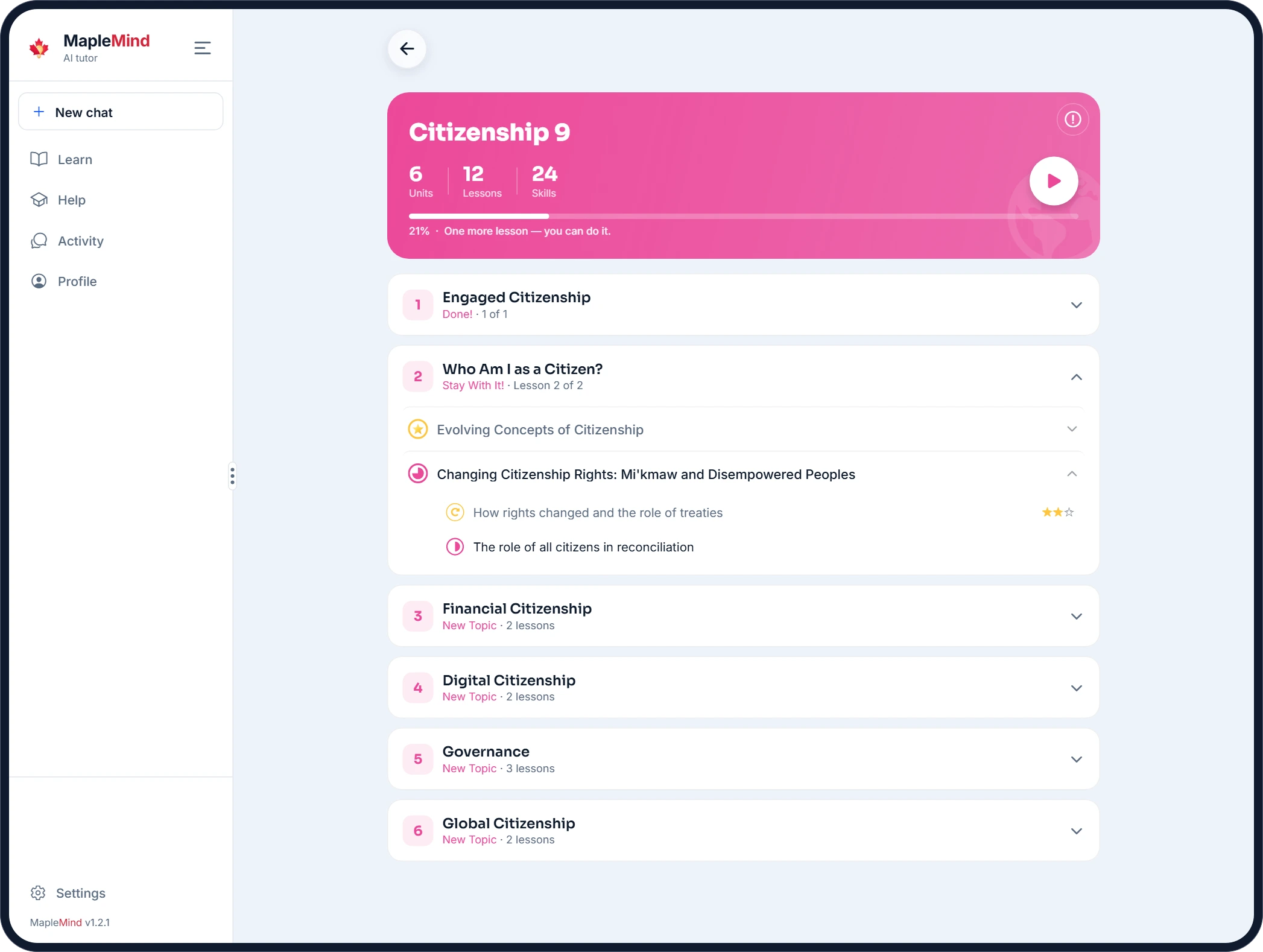
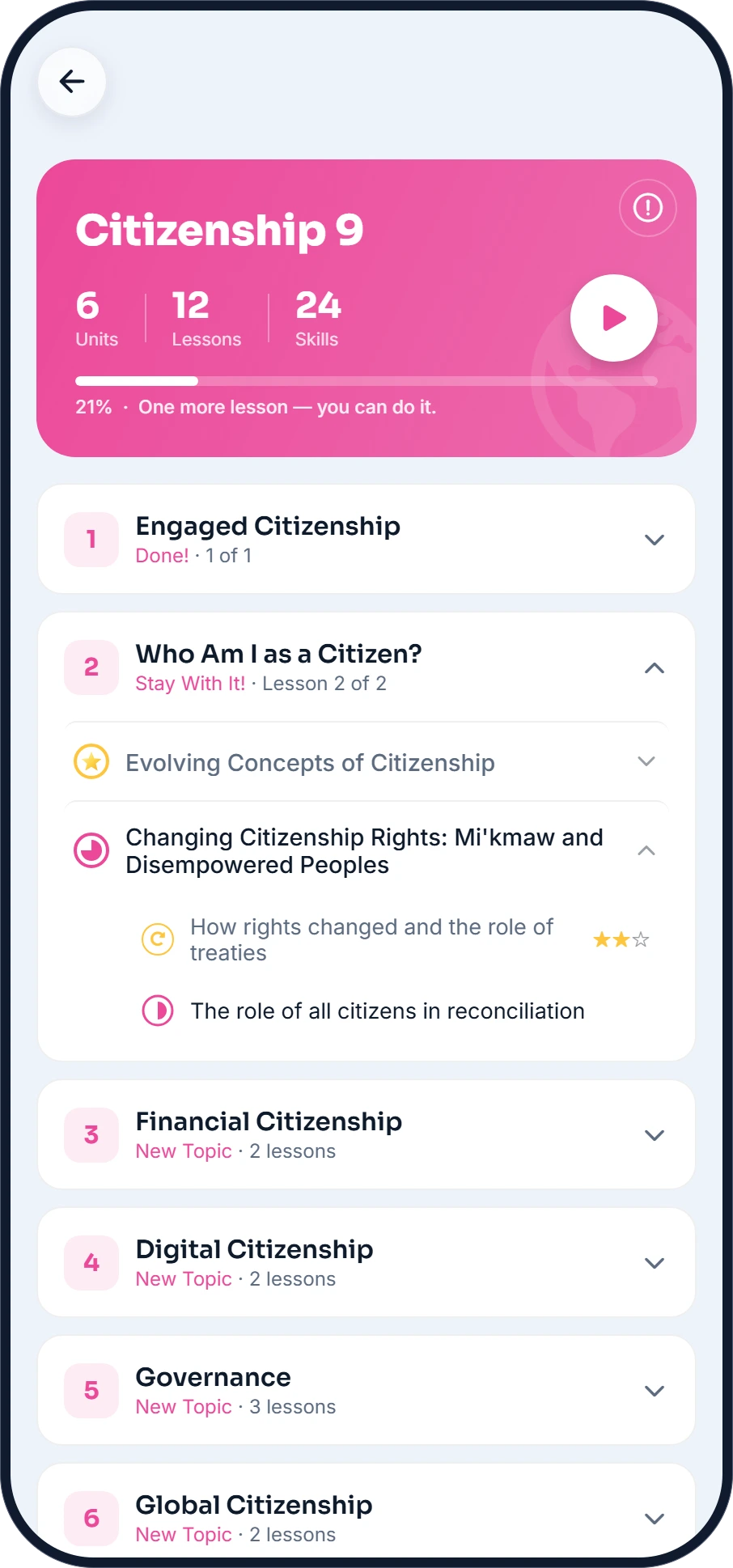
Citizenship 9 in MapleMind on a tablet: its units and lessons in order, a student partway through.Citizenship 9 in MapleMind on a phone: its units and lessons in order, a student partway through.
Their course, unit by unit, the way Nova Scotia teaches it.Shown: Citizenship 9
Homework Help on a tablet: a photo of a worksheet, the tutor’s worked example of a two-step equation, and a question back to the student.Homework Help on a phone: a photo of a worksheet, the tutor’s worked example of a two-step equation, and a question back to the student.
Homework Help: they take a photo of the question, and the tutor works through it with them.
The Parent Dashboard on a tablet: a student’s days studied, streak, lessons, quiz average and recent activity.The Parent Dashboard on a phone: a student’s days studied, streak, lessons, quiz average and recent activity.
The Parent Dashboard: how each child’s week went, in lessons, quizzes and days studied.
A Grade 9 provincial mathematics exam on a tablet: a readiness score, the exam’s time and its next sitting.A Grade 9 provincial mathematics exam on a phone: a readiness score, the exam’s time and its next sitting.
A provincial exam: a practice sitting under the real time, and how ready they are.
The Learn tab on a tablet: a four-day streak, the week’s days, Homework Help, the next lesson and a review.The Learn tab on a phone: a four-day streak, the week’s days, Homework Help, the next lesson and a review.
The Learn tab: their week so far, and the next thing to do.

Help at home

Questions parents ask

What will my child learn in Grade 12 in Nova Scotia?

Math: Calculus 12, Mathematics 12, Mathematics at Work 12 and Pre-Calculus 12. Science: Biology 12, Chemistry 12 and Physics 12. English: Canadian Literature 12 and English 12. French: Core French 12. Social studies: Global Geography 12 and Law 12. That’s 422 skills in all, from Nova Scotia’s curriculum.

Does my child write a provincial exam in Grade 12?

No. Nova Scotia has no provincial exam in Grade 12.

Where does this list come from?

From Nova Scotia’s official curriculum, the documents its education ministry publishes for each course. Each skill here is one of their expectations, written in plain words.

Can MapleMind help my child in Grade 12?

Yes. Every course on this page is in MapleMind, with lessons, practice and a tutor that works through each step with them. A free account gets 30 messages and 4 activities a day.

Help with Grade 12, one skill at a time.

Every course on this page is in MapleMind, free with daily limits.