Get help with Mathematics at Work 12
Most tutoring makes you sit through material you already know. MapleMind flips that: pick the exact skill that's causing trouble — any of the 22 below — and the tutor teaches just that one, step by step, as many times as it takes. Ask questions in plain words, any time of day, in English, French, or 12 other languages.
The official Nova Scotia Mathematics at Work 12 curriculum
Nova Scotia defines Mathematics at Work 12 by strands and outcomes. MapleMind teaches the same curriculum reorganized for one-skill-at-a-time tutoring — the table shows exactly where every official strand lands, and the ministry's own wording is quoted under each unit below.
Official source Nova Scotia's official curriculumRead it on the government site — curriculum.novascotia.ca ↗| Official strand | Outcomes | Where MapleMind teaches it |
|---|---|---|
| Strand G | 3 | Geometry |
| Strand N | 2 | Number |
| Strand A | 1 | Algebra |
| Strand S | 1 | Statistics |
| Strand P | 1 | Probability |
Every skill below, taught one on one.
 Try the first session free
How MapleMind teaches Mathematics at Work 12 — every unit, lesson, and skill
Every skill below runs as a short session: a plain-words lesson, a worked example, solving it together, then a five-question skill check that earns up to three stars. Guided Mode keeps it teaching instead of answer-handing — turning it off needs a parent's password.
Unit 1GeometryOfficial strand · Strand G
The sine and cosine laws, properties of triangles, quadrilaterals, and regular polygons, and transformations of 2-D shapes and 3-D objects — all in construction, industrial, and artistic contexts.
The sine law and cosine law
- The sine lawG01 — Solve problems using the sine law in construction, industrial, and artistic applications where a diagram is given, excluding the ambiguous case.
- The cosine lawG01 — Solve problems using the cosine law in construction, industrial, and artistic applications where a diagram is given.
Properties of polygons
- Properties of triangles and quadrilateralsG02 — Describe and illustrate the properties of triangles (including isosceles and equilateral) and quadrilaterals in terms of angle measures, side lengths, diagonals, and angles of intersection.
- Properties of regular polygonsG02 — Describe and illustrate the properties of regular polygons, including equal sides and equal interior angles, and explain why a property does or does not apply to a given polygon.
- Applying polygon propertiesG02 — Identify and solve contextual problems that apply the properties of polygons in construction, industrial, commercial, domestic, and artistic contexts.
Transformations
- Single transformationsG03 — Identify a single transformation (translation, rotation, or reflection) from an original shape and its image, and draw the image resulting from a given single transformation.
- Combinations of transformationsG03 — Draw the image of a shape from a combination of successive transformations and create designs using translations, rotations, and reflections across the coordinate grid.
- Dilations and similarityG03 — Determine and draw a dilation of a 2-D shape or 3-D object, explain how the original and its image are proportional using similarity, and solve a contextual transformation problem.
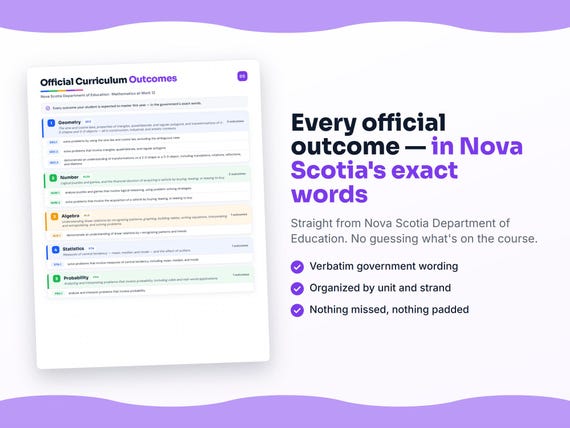
The official wording — 3 outcomes in this unit
- G01
solve problems by using the sine law and cosine law, excluding the ambiguous case
- G02
solve problems that involve triangles, quadrilaterals, and regular polygons
- G03
demonstrate an understanding of transformations on a 2-D shape or a 3-D object, including translations, rotations, reflections, and dilations
Unit 2NumberOfficial strand · Strand N
Logical puzzles and games, and the financial decision of acquiring a vehicle by buying, leasing, or leasing to buy.
Logical puzzles and games
- Strategies for logical puzzles and gamesN01 — Analyze puzzles and games that involve logical reasoning, choosing and verifying strategies such as looking for a pattern, making a systematic list, eliminating possibilities, or working backwards.
Acquiring a vehicle
- Options for acquiring a vehicleN02 — Describe and explain the options for buying, leasing, and leasing to buy a vehicle, including how each affects ownership and cost.
- Solving vehicle-acquisition problemsN02 — Solve, with or without technology, problems that involve the purchase, lease, or lease-to-purchase of a vehicle, comparing total costs.
- Justifying a vehicle decisionN02 — Justify a decision to buy, lease, or lease to buy a vehicle based on factors such as personal finances, intended use, maintenance, warranties, mileage, and insurance.
The official wording — 2 outcomes in this unit
- N01
analyze puzzles and games that involve logical reasoning, using problem-solving strategies
- N02
solve problems that involve the acquisition of a vehicle by buying, leasing, or leasing to buy
Unit 3AlgebraOfficial strand · Strand A
Understanding linear relations by recognizing patterns, graphing, building tables, writing equations, interpolating and extrapolating, and solving problems.
Linear relations
- Recognizing patterns and trends in linear relationsA01 — Identify the characteristics of a linear relation shown as a graph, table, number pattern, or equation, and sort relations into linear and non-linear.
- Tables of values and equationsA01 — Write an equation for a linear context, including direct and partial variation, and create a table of values from a given linear equation.
- Graphing linear relationsA01 — Sketch the graph of a linear relation from a table of values and decide whether the points should be connected based on the context.
- Interpolating and extrapolatingA01 — Solve contextual problems that require interpolating between or extrapolating beyond the data of a linear relation, including applying a linear formula.
- Scatterplots and trendsA01 — Create a scatterplot for a data set, describe its trend, sort scatterplots as linear, non-linear, or no trend, and match contexts to their graphs.
The official wording — 1 outcome in this unit
- A01
demonstrate an understanding of linear relations by ▪ recognizing patterns and trends
Unit 4StatisticsOfficial strand · Strand S
Measures of central tendency — mean, median, and mode — and the effect of outliers.
Measures of central tendency
- Mean, median, and modeS01 — Determine the mean, median, and mode for a data set, explain the advantages and disadvantages of each, and solve a contextual problem using them.
- Outliers and interpreting dataS01 — Identify outliers in a data set, explain their effect on the mean, median, and mode, and describe how measures of central tendency are used to interpret data in the media.
The official wording — 1 outcome in this unit
- S01
solve problems that involve measures of central tendency, including mean, median, and mode
Unit 5ProbabilityOfficial strand · Strand P
Analyzing and interpreting problems that involve probability, including odds and real-world applications.
Probability in the real world
- Calculating probabilityP01 — Calculate the probability of an event from data and express a probability as a fraction, decimal, and percent and in a statement.
- Odds and probabilityP01 — Explain the difference between odds and probability and determine the probability of an event given the odds for or against it.
- Applications and decisionsP01 — Describe applications of probability such as insurance, warranties, weather prediction, and product recalls, and explain how decisions combine theoretical probability, experimental results, and judgement.
The official wording — 1 outcome in this unit
- P01
analyze and interpret problems that involve probability
Printable workbook · A keepsake of the year
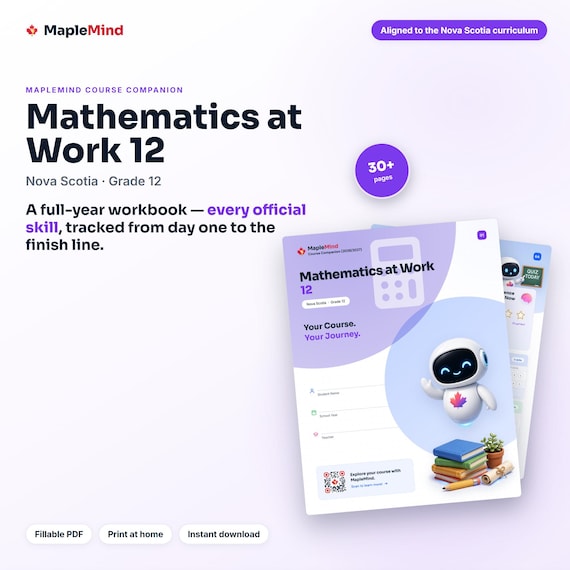
A Mathematics at Work 12 workbook worth keeping
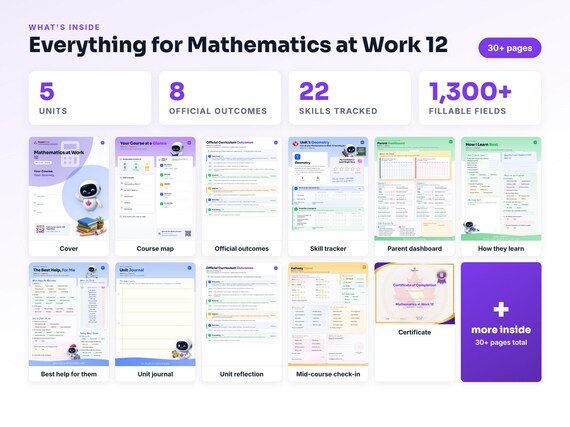
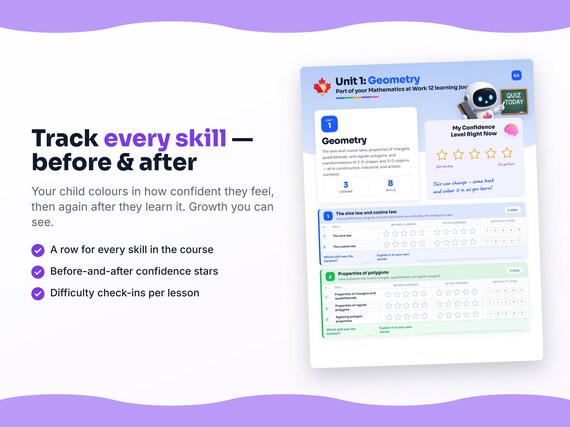
Built from the same official curriculum as this page. Before and after each skill above, your student colours in how sure they feel — so the two of you can see, on one page, what's clicking and what needs another look. It's a quiet way to follow how the year is really going.
By June it's full of their own handwriting: units worked through, confidence grown, a mid-year check-in, notes from parent-teacher night, and a certificate at the end. Less a worksheet, more a record of the year worth keeping on the shelf.
Instant download · see every page, reviews and the full description · five or more workbooks are $2.99 each
What it looks like in the app



Common questions
Can MapleMind help me with Mathematics at Work 12?
Yes. MapleMind's AI tutor covers all 22 skills in Nova Scotia's Mathematics at Work 12 — you pick the exact skill, and the tutor teaches it step by step: a short lesson, a worked example, solving together, then a skill check to show it stuck.
Is MapleMind aligned to Nova Scotia's official curriculum?
Yes. Every skill in this course maps to an official outcome code from Nova Scotia's Grade 12 Mathematics curriculum, and the ministry's own wording is quoted under each unit on this page — with the official government source linked so you can check it yourself.
What does MapleMind cost?
It's free to start — 5 tutoring chats and a practice quiz every day, no credit card. A Pro subscription ($9.99/month or $49.99/year CAD, 7-day free trial) unlocks unlimited tutoring, practice, and exam simulations.
What if I'm stuck on just one topic?
That's the point of skill-level tutoring: open Mathematics at Work 12 in the app, tap the exact skill from the list on this page, and the tutor teaches just that — no wading through lessons you don't need.
Does MapleMind work in French or other languages?
Yes — 14 languages, including French. Both the app and the tutor's explanations switch to the language you choose.
Where can I see the official Nova Scotia curriculum for Mathematics at Work 12?
The official source is linked on this page — Nova Scotia's official curriculum. The outline here follows it: every MapleMind skill carries its official outcome code, and the ministry's own wording is quoted under each unit.
Keep exploring
Ready when you are
Pick a skill from this page and see it taught properly — free, in the browser, in under a minute.