Get help with Mathematics at Work 11
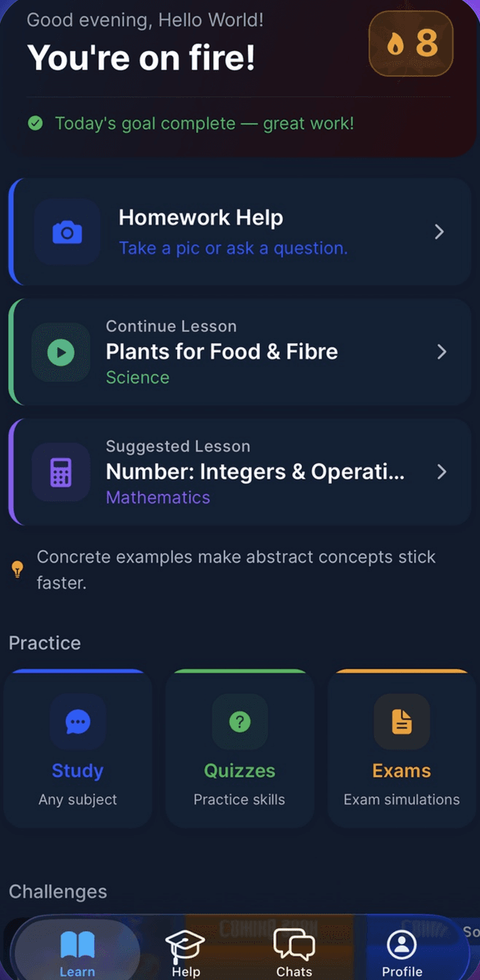
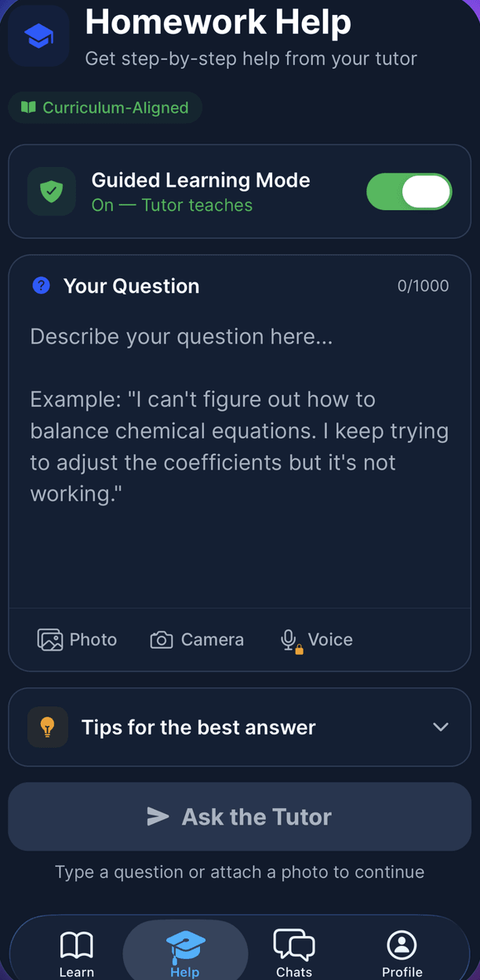
Most tutoring makes you sit through material you already know. MapleMind flips that: pick the exact skill that's causing trouble — any of the 25 below — and the tutor teaches just that one, step by step, as many times as it takes. Ask questions in plain words, any time of day, in English, French, or 12 other languages.
The official Nova Scotia Mathematics at Work 11 curriculum
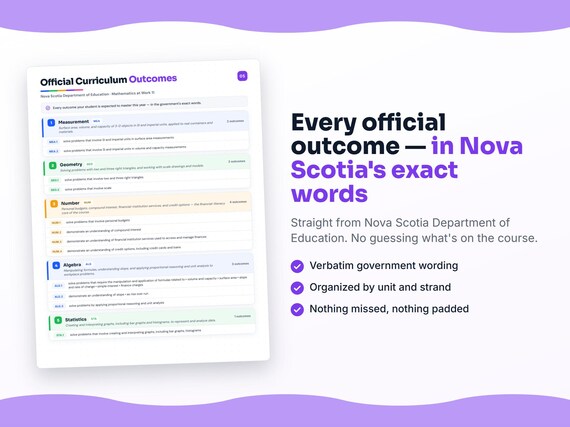
Nova Scotia defines Mathematics at Work 11 by strands and outcomes. MapleMind teaches the same curriculum reorganized for one-skill-at-a-time tutoring — the table shows exactly where every official strand lands, and the ministry's own wording is quoted under each unit below.
Official source Nova Scotia's official curriculumRead it on the government site — curriculum.novascotia.ca ↗| Official strand | Outcomes | Where MapleMind teaches it |
|---|---|---|
| Strand M | 2 | Measurement |
| Strand G | 2 | Geometry |
| Strand N | 4 | Number |
| Strand A | 3 | Algebra |
| Strand S | 1 | Statistics |
Every skill below, taught one on one.
 Try the first session free
How MapleMind teaches Mathematics at Work 11 — every unit, lesson, and skill
Every skill below runs as a short session: a plain-words lesson, a worked example, solving it together, then a five-question skill check that earns up to three stars. Guided Mode keeps it teaching instead of answer-handing — turning it off needs a parent's password.
Unit 1MeasurementOfficial strand · Strand M
Surface area, volume, and capacity of 3-D objects in SI and imperial units, applied to real containers and materials.
Surface area of 3-D objects
- Estimating surface areaM01 — Distinguish surface area from volume, use nets and referents to estimate the surface area of a 3-D object, and describe the effect of dimensional changes on surface area.
- Solving surface-area problemsM01 — Solve contextual problems that involve the surface area of 3-D objects, including spheres, that require the manipulation of formulas.
Volume and capacity
- Volume vs. capacity and referentsM02 — Explain the difference between volume and capacity, choose referents for each in SI and imperial units, and identify contexts where a given volume unit is used.
- Volume of 3-D objectsM02 — Determine the volume of prisms, cones, cylinders, pyramids, spheres, and composite 3-D objects, including problems that require manipulating formulas.
- Capacity of containersM02 — Solve problems involving the capacity of containers and measure capacity using tools such as graduated cylinders, measuring cups, and displacement.
The official wording — 2 outcomes in this unit
- M01
solve problems that involve SI and imperial units in surface area measurements
- M02
solve problems that involve SI and imperial units in volume and capacity measurements
Unit 2GeometryOfficial strand · Strand G
Solving problems with two and three right triangles, and working with scale drawings and models.
Two and three right-triangle problems
- Sketching and identifying right trianglesG01 — Identify all the right triangles in an illustration and sketch a 2-D or 3-D representation of a described problem, then judge whether a solution is reasonable.
- Solving with elevation, depression, and trigG01 — Solve contextual problems involving angles of elevation and depression and two or three right triangles using the primary trigonometric ratios.
Scale drawings and models
- Reading dimensions from a scaleG02 — Describe contexts that use scale and determine, using proportional reasoning, the real dimensions of an object from a given scale drawing or model.
- Constructing scale drawings and modelsG02 — Construct a model or scale diagram of a given object to a stated scale, with or without technology, and solve a contextual scale problem.
The official wording — 2 outcomes in this unit
- G01
solve problems that involve two and three right triangles
- G02
solve problems that involve scale
Unit 3NumberOfficial strand · Strand N
Personal budgets, compound interest, financial-institution services, and credit options — the financial-literacy core of the course.
Personal budgets
- Building a personal budgetN02 — Identify the income and expenses that belong in a personal budget and create a budget from given or collected income and expense data.
- Modifying a budget toward goalsN02 — Modify a personal budget to achieve set goals and investigate 'what if' questions, such as saving for a purchase or absorbing a cost increase.
Compound interest
- Simple vs. compound interestN03 — Solve simple-interest problems with I = Prt and compare simple and compound interest, explaining their relationship.
- Solving compound-interest problemsN03 — Solve compound-interest problems with a formula, explain the effect of different compounding periods, and estimate doubling time with the Rule of 72.
Banking services
- Accounts and banking servicesN04 — Describe the banking services and account types available at financial institutions and identify the account that best meets a given set of needs.
- Banking fees, safety, and securityN04 — Explain ATM service charges, the advantages and disadvantages of online and debit banking, and ways to keep personal and financial information secure.
Credit options
- Comparing credit optionsN05 — Compare the advantages and disadvantages of credit cards, personal loans, lines of credit, and overdraft, and describe strategies to use credit effectively.
- Solving credit-card and loan problemsN05 — Solve contextual problems that involve credit cards or loans, including credit linked to sales promotions such as 'no payments for a year'.
The official wording — 4 outcomes in this unit
- N02
solve problems that involve personal budgets
- N03
demonstrate an understanding of compound interest
- N04
demonstrate an understanding of financial institution services used to access and manage finances
- N05
demonstrate an understanding of credit options, including credit cards and loans
Unit 4AlgebraOfficial strand · Strand A
Manipulating formulas, understanding slope, and applying proportional reasoning and unit analysis to workplace problems.
Working with formulas
- Manipulating and applying formulasA01 — Solve contextual problems that require applying and rearranging formulas related to volume and capacity, surface area, slope and rate of change, simple interest, and finance charges, and verify equivalent forms.
Slope and rate of change
- Slope as rise over runA02 — Explain slope as rise over run using examples such as ramps and roof pitches, describe when a slope is zero or undefined, and relate slope to angle of elevation.
- Slope as rate of changeA02 — Explain slope as a rate of change using examples such as flow rates and costs per unit, connecting the geometric slope to how one quantity changes with another.
- Solving slope problemsA02 — Solve contextual problems that involve slope or rate of change, verifying that a slope such as a ramp's is constant.
Proportional reasoning and unit analysis
- Unit analysisA03 — Explain and apply unit analysis to convert quantities, such as kilometres per hour to metres per second, by multiplying by conversion ratios so unwanted units cancel.
- Proportional reasoning within and between systemsA03 — Solve problems within and between measurement systems using proportions or tables, such as kilometres to metres or kilometres per hour to feet per second.
The official wording — 3 outcomes in this unit
- A01
solve problems that require the manipulation and application of formulas related to ▪ volume and capacity ▪ surface area ▪ slope and rate of change ▪ simple interest ▪ finance charges
- A02
demonstrate an understanding of slope ▪ as rise over run
- A03
solve problems by applying proportional reasoning and unit analysis
Unit 5StatisticsOfficial strand · Strand S
Creating and interpreting graphs, including bar graphs and histograms, to represent and analyze data.
Creating and interpreting graphs
- Creating graphs from dataS01 — Determine which graph type suits a data set, explaining the trade-offs, and create a bar graph or histogram to represent the data, with or without technology.
- Interpreting graphs and trendsS01 — Describe the trends in a graph, interpolate and extrapolate values, and explain how the same data can be graphed to emphasize different points of view.
The official wording — 1 outcome in this unit
- S01
solve problems that involve creating and interpreting graphs, including bar graphs, histograms
Printable workbook · A keepsake of the year
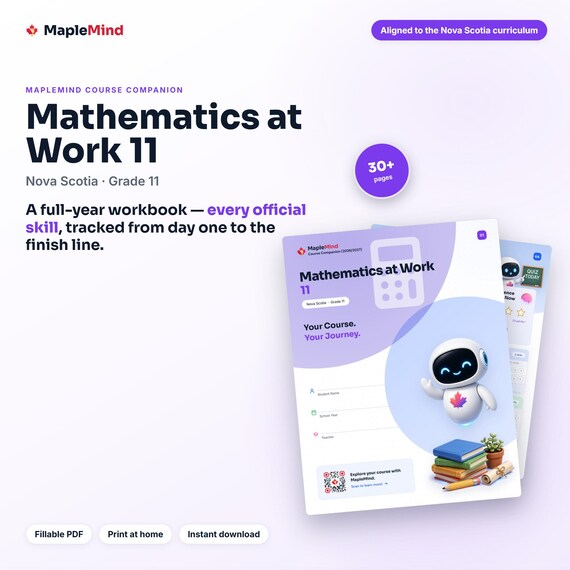
A Mathematics at Work 11 workbook worth keeping
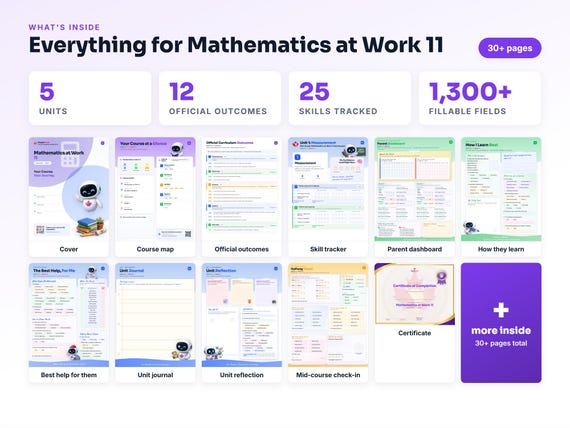
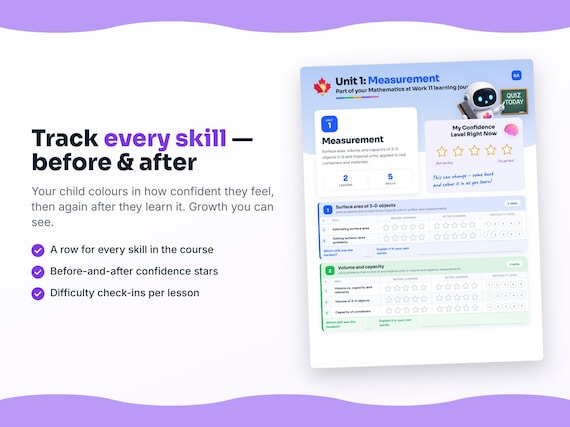
Built from the same official curriculum as this page. Before and after each skill above, your student colours in how sure they feel — so the two of you can see, on one page, what's clicking and what needs another look. It's a quiet way to follow how the year is really going.
By June it's full of their own handwriting: units worked through, confidence grown, a mid-year check-in, notes from parent-teacher night, and a certificate at the end. Less a worksheet, more a record of the year worth keeping on the shelf.
Instant download · see every page, reviews and the full description · five or more workbooks are $2.99 each
What it looks like in the app
Common questions
Can MapleMind help me with Mathematics at Work 11?
Yes. MapleMind's AI tutor covers all 25 skills in Nova Scotia's Mathematics at Work 11 — you pick the exact skill, and the tutor teaches it step by step: a short lesson, a worked example, solving together, then a skill check to show it stuck.
Is MapleMind aligned to Nova Scotia's official curriculum?
Yes. Every skill in this course maps to an official outcome code from Nova Scotia's Grade 11 Mathematics curriculum, and the ministry's own wording is quoted under each unit on this page — with the official government source linked so you can check it yourself.
What does MapleMind cost?
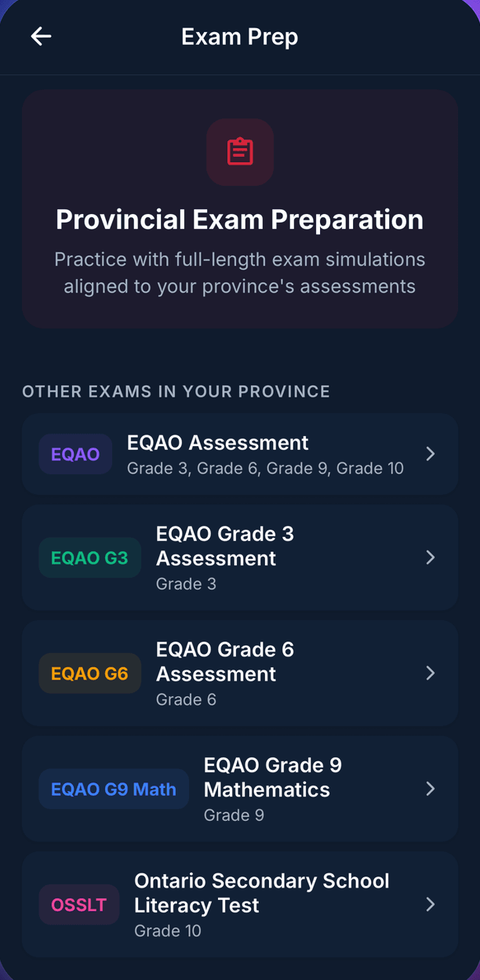
It's free to start — 5 tutoring chats and a practice quiz every day, no credit card. A Pro subscription ($9.99/month or $49.99/year CAD, 7-day free trial) unlocks unlimited tutoring, practice, and exam simulations.
What if I'm stuck on just one topic?
That's the point of skill-level tutoring: open Mathematics at Work 11 in the app, tap the exact skill from the list on this page, and the tutor teaches just that — no wading through lessons you don't need.
Does MapleMind work in French or other languages?
Yes — 14 languages, including French. Both the app and the tutor's explanations switch to the language you choose.
Where can I see the official Nova Scotia curriculum for Mathematics at Work 11?
The official source is linked on this page — Nova Scotia's official curriculum. The outline here follows it: every MapleMind skill carries its official outcome code, and the ministry's own wording is quoted under each unit.
Keep exploring
Ready when you are
Pick a skill from this page and see it taught properly — free, in the browser, in under a minute.