Get help with Physics 12
Most tutoring makes you sit through material you already know. MapleMind flips that: pick the exact skill that's causing trouble — any of the 54 below — and the tutor teaches just that one, step by step, as many times as it takes. Ask questions in plain words, any time of day, in English, French, or 12 other languages.
The official Nova Scotia Physics 12 curriculum
Nova Scotia defines Physics 12 by strands and outcomes. MapleMind teaches the same curriculum reorganized for one-skill-at-a-time tutoring — the table shows exactly where every official strand lands, and the ministry's own wording is quoted under each unit below.
Official source Nova Scotia's official curriculumRead it on the government site — curriculum.novascotia.ca ↗| Official strand | Outcomes | Where MapleMind teaches it |
|---|---|---|
| Strand 1 | 14 | Force, Motion, Work, and Energy |
| Strand 2 | 16 | Fields |
| Strand 3 | 11 | Waves and Modern Physics |
| Strand 4 | 13 | Radioactivity |
Every skill below, taught one on one.
 Try the first session free
How MapleMind teaches Physics 12 — every unit, lesson, and skill
Every skill below runs as a short session: a plain-words lesson, a worked example, solving it together, then a five-question skill check that earns up to three stars. Guided Mode keeps it teaching instead of answer-handing — turning it off needs a parent's password.
Unit 1Force, Motion, Work, and EnergyOfficial strand · Strand 1
Advanced mechanics: 2D vectors and momentum, projectile and circular motion, simple harmonic motion and its energy, and universal gravitation with Kepler's laws.
2D vectors, momentum, and projectiles
- 2D vector analysisphys12.1.1 — Use vector analysis in two dimensions for masses, relative motion, static equilibrium, and torque.
- Conservation of momentum (2D)phys12.1.2 — Apply the law of conservation of momentum to two-dimensional collisions and explosions.
- Choosing conservation laws (2D)phys12.1.3 — Determine when conservation of momentum and energy are best used for elastic and inelastic interactions.
- Projectile motionphys12.1.5 — Analyze quantitatively the horizontal and vertical motion of a projectile.
- Construct and evaluate a devicephys12.1.4 — Construct, test, and evaluate a device or system against developed criteria.
Circular and simple harmonic motion
- Uniform circular motionphys12.1.6 — Describe uniform circular motion using algebraic and vector analysis.
- Circular motion and Newton's lawsphys12.1.7 — Explain quantitatively circular motion using Newton's laws.
- Simple harmonic motion (qualitative)phys12.1.9 — Explain qualitatively the relationship among displacement, velocity, time, and acceleration for simple harmonic motion.
- Energy in simple harmonic motionphys12.1.10 — Explain quantitatively the relationship between potential and kinetic energy of a mass in simple harmonic motion.
- Organizing motion dataphys12.1.11 — Compile and organize data using tables and graphs to facilitate interpretation.
- Investigating a technology over timephys12.1.8 — Investigate and display evidence about the development of a practical problem or technology over time.
Gravitation and orbits
- Kepler's lawsphys12.1.12 — Explain Kepler's first and second laws qualitatively and apply the third law quantitatively.
- Universal gravitation and orbitsphys12.1.13 — Explain and apply the law of universal gravitation to orbital motion using numeric and graphic analysis.
- Scientific vs technological (orbits)phys12.1.14 — Distinguish scientific questions from technological problems in orbital situations.
The official wording — 14 outcomes in this unit
- phys12.1.1
use vector analysis in two dimensions for systems involving two or more masses, relative motions, static equilibrium, and static torques
- phys12.1.2
apply quantitatively the laws of conservation of momentum to two-dimensional collisions and explosions
- phys12.1.3
determine in which real-life situations involving elastic and inelastic interactions the laws of conservation of momentum and energy are best used
- phys12.1.5
analyze quantitatively the horizontal and vertical motion of a projectile
- phys12.1.4
construct, test, and evaluate a device or system on the basis of developed criteria
- phys12.1.6
describe uniform circular motion using algebraic and vector analysis
- phys12.1.7
explain quantitatively circular motion using Newton
- phys12.1.9
explain qualitatively the relationship between displacement, velocity, time, and acceleration for simple harmonic motion
- phys12.1.10
explain quantitatively the relationship between potential and kinetic energies of a mass in simple harmonic motion
- phys12.1.11
compile and organize data, using data tables and graphs, to facilitate interpretation of the data
- phys12.1.8
identify questions, analyze, compile, and display evidence and information to investigate the development over time of a practical problem, issue, or technology
- phys12.1.12
explain qualitatively Kepler
- phys12.1.13
explain and apply the law of universal gravitation to orbital notations by using appropriate numeric and graphic analysis
- phys12.1.14
distinguish between scientific questions and technological problems
Unit 2FieldsOfficial strand · Strand 2
Electric, magnetic, and gravitational fields: field concepts and lines, Coulomb's and Ohm's laws, the magnetic field of currents, forces on moving charges, electromagnetic induction, motors and generators, and AC/DC.
Field concepts and forces
- Fields as regions of influencephys12.2.3 — Describe magnetic, electric, and gravitational fields as regions that affect mass and charge.
- Field linesphys12.2.4 — Describe fields by illustrating the source and direction of the lines of force.
- Charges and polesphys12.2.5 — Describe electric fields via like and unlike charges and magnetic fields via poles.
- Gravitation vs Coulomb's lawphys12.2.7 — Compare Newton's law of universal gravitation with Coulomb's law and apply both quantitatively.
- Ohm's law and circuitsphys12.2.8 — Apply Ohm's law to series, parallel, and combination circuits.
- Defining problems and relationshipsphys12.2.6 — Define problems, estimate quantities, and infer or calculate relationships among variables.
Electromagnetism and induction
- Magnetic field of a currentphys12.2.12 — Describe the magnetic field produced by a current in a straight conductor and a solenoid.
- Force on a moving chargephys12.2.13 — Analyze qualitatively the forces on a moving charge in a uniform magnetic field.
- Electromagnetic inductionphys12.2.14 — Analyze qualitatively electromagnetic induction from changing flux and a moving conductor.
- Motors and generatorsphys12.2.15 — Compare how a motor and a generator function using electromagnetism.
- Direct and alternating currentphys12.2.16 — Describe and compare direct current and alternating current.
Investigating fields and milestones
- Designing a fields experimentphys12.2.11 — Design an experiment and identify specific variables.
- Controlled procedures (fields)phys12.2.9 — Carry out procedures controlling variables and using instruments effectively, accurately, and safely.
- Prediction and hypothesis (fields)phys12.2.10 — State a prediction and hypothesis based on evidence and background information.
- Evidence, paradigms, and peer reviewphys12.2.1 — Explain the roles of evidence, theories, paradigms, and peer review in a major scientific milestone.
- Communicating physics ideasphys12.2.2 — Communicate questions, ideas, and intentions and respond to the ideas of others.
The official wording — 16 outcomes in this unit
- phys12.2.3
describe magnetic, electric, and gravitational fields as regions of space that affect mass and charge
- phys12.2.4
describe magnetic, electric, and gravitational fields by illustrating the source and direction of the lines of force
- phys12.2.5
describe electric fields in terms of like and unlike charges, and magnetic fields in terms of poles
- phys12.2.7
compare Newton
- phys12.2.8
apply Ohm
- phys12.2.6
define and delimit problems, estimate quantities, interpret patterns and trends in data, and infer or calculate the relationships among variables
- phys12.2.12
describe the magnetic field produced by a current in a long, straight conductor, and in a solenoid
- phys12.2.13
analyze qualitatively the forces acting on a moving charge in a uniform magnetic field
- phys12.2.14
analyze qualitatively electromagnetic induction by both a changing magnetic flux and a moving conductor
- phys12.2.15
compare and contrast the ways a motor and generator function, using the principles of electromagnetism
- phys12.2.16
describe and compare direct current and alternating current
- phys12.2.11
design an experiment and identify specific variables
- phys12.2.9
carry out procedures controlling the major variables, selecting and using instruments effectively, accurately, and safely, and adapting or extending procedures where required
- phys12.2.10
state a prediction and a hypothesis based on available evidence and background information
- phys12.2.1
explain the roles of evidence, theories and paradigms, and peer review in the development of the scientific knowledge associated with a major scientific milestone
- phys12.2.2
communicate questions, ideas, and intentions, and receive, interpret, understand, support, and respond to the ideas of others
Unit 3Waves and Modern PhysicsOfficial strand · Strand 3
The quantum revolution: mass-energy equivalence, the birth of quantum physics, black-body radiation and the photoelectric effect, photon momentum and the Compton effect, wave-particle duality, and the Bohr atomic model.
Mass-energy and the quantum revolution
- Mass-energy equivalencephys12.3.1 — Apply the law of conservation of mass and energy using Einstein's mass-energy equivalence.
- Evolution of quantum physicsphys12.3.2 — Explain how quantum physics evolved as evidence and theories were tested and revised.
- Quantum energy: black-body and photoelectricphys12.3.3 — Describe how the quantum energy concept explains black-body radiation and the photoelectric effect.
- Photoelectric effect formulaphys12.3.4 — Explain and apply the formula for the photoelectric effect.
Photons, duality, and the atom
- Photon momentumphys12.3.5 — Explain how photon momentum revolutionized scientific thinking.
- Compton effect and de Brogliephys12.3.7 — Explain quantitatively the Compton effect and the de Broglie hypothesis.
- Wave and particle models of lightphys12.3.8 — Summarize the evidence for the wave and particle models of light.
- Alternative theoretical modelsphys12.3.6 — Apply and assess alternative theoretical models for interpreting knowledge in a field.
- Bohr atomic modelphys12.3.9 — Explain quantitatively the Bohr model as a synthesis of classical and quantum concepts.
- Energy levels and photonsphys12.3.10 — Explain the relationship among energy levels, level differences, and emitted photon energy.
- Quantum-mechanical luminous phenomenaphys12.3.11 — Use the quantum-mechanical model to explain naturally luminous phenomena.
The official wording — 11 outcomes in this unit
- phys12.3.1
apply quantitatively the law of conservation of mass and energy using Einstein
- phys12.3.2
explain how quantum physics evolved as new evidence came to light and as laws and theories were tested and subsequently restricted, revised, or replaced, and use library and electronic research tools to collect information on this topic
- phys12.3.3
describe how the quantum energy concept explains both black-body radiation and the photoelectric effect
- phys12.3.4
explain qualitatively and apply the formula for the photoelectric effect
- phys12.3.5
explain how a photon momentum revolutionized thinking in the scientific community
- phys12.3.7
explain quantitatively the Compton effect and the de Broglie hypothesis, using the laws of mechanics, the conservation of momentum, and the nature of light
- phys12.3.8
summarize the evidence for the wave and particle models of light
- phys12.3.6
apply and assess alternative theoretical models for interpreting knowledge in a given field
- phys12.3.9
explain quantitatively the Bohr atomic model as a synthesis of classical and quantum concepts
- phys12.3.10
explain the relationship among the energy levels in Bohr
- phys12.3.11
use the quantum-mechanical model to explain naturally luminous phenomena
Unit 4RadioactivityOfficial strand · Strand 4
Nuclear physics: sources of radioactivity, mass-energy in nuclear reactions, types of radiation, half-life, fission and fusion, safe handling, and the technologies, careers, and societal issues of nuclear science.
Radiation, decay, and nuclear energy
- Sources of radioactivityphys12.4.1 — Describe sources of radioactivity in natural and constructed environments.
- Mass-energy in nuclear reactionsphys12.4.3 — Use the law of conservation of mass and energy with Einstein's mass-energy equivalence in nuclear reactions.
- Types of radiationphys12.4.8 — Describe the products of radioactive decay and the characteristics of alpha, beta, and gamma radiation.
- Half-lifephys12.4.9 — Analyze radioactive decay data to predict half-life.
- Fission and fusionphys12.4.10 — Compare and contrast nuclear fission and fusion.
Nuclear science, safety, and society
- Sampling procedures (radioactivity)phys12.4.5 — Develop appropriate sampling procedures.
- Apparatus and materials safetyphys12.4.6 — Select and use apparatus and materials safely.
- WHMIS handling and disposal (radioactivity)phys12.4.7 — Demonstrate WHMIS knowledge by handling and disposing of lab materials properly.
- Integrating radioactivity informationphys12.4.4 — Select and integrate information from various sources on radioactivity.
- Radioactivity technologies and careersphys12.4.2 — Describe technologies developed from radioactivity understanding, their community role, and related careers.
- Canadian contributionsphys12.4.11 — Analyze examples of Canadian contributions to a development of science and technology.
- Defending a position (radioactivity)phys12.4.12 — Identify, present, and defend a position based on multiple perspectives and data.
- Risks and benefits of nuclear technologyphys12.4.13 — Analyze and evaluate the risks and benefits of a nuclear application from various perspectives and criteria.
The official wording — 13 outcomes in this unit
- phys12.4.1
describe sources of radioactivity in the natural and constructed environments
- phys12.4.3
use quantitatively the law of conservation of mass and energy using Einstein
- phys12.4.8
describe the products of radioactive decay and the characteristics of alpha, beta, and gamma radiation
- phys12.4.9
analyze data on radioactive decay to predict half-life
- phys12.4.10
compare and contrast fission and fusion
- phys12.4.5
develop appropriate sampling procedures
- phys12.4.6
select and use apparatus and materials safely
- phys12.4.7
demonstrate a knowledge of WHMIS standards by selecting and applying proper techniques for handling and disposing of lab materials
- phys12.4.4
select and integrate information from various print and electronic sources or from several parts of the same source
- phys12.4.2
identify, analyze, and describe examples where technologies were developed based on scientific understanding, the design and function of these technologies as part of a community
- phys12.4.11
analyze examples of Canadian contribution to a particular development of science and technology
- phys12.4.12
identify, develop, present, and defend a position or course of action based on identifying multiple perspectives that influence the issue, and on interpreting data and the relationship among variables
- phys12.4.13
analyze and evaluate, from a variety of perspectives, using a variety of criteria, the risks and benefits to society and the environment of a particular application of scientific knowledge and technology
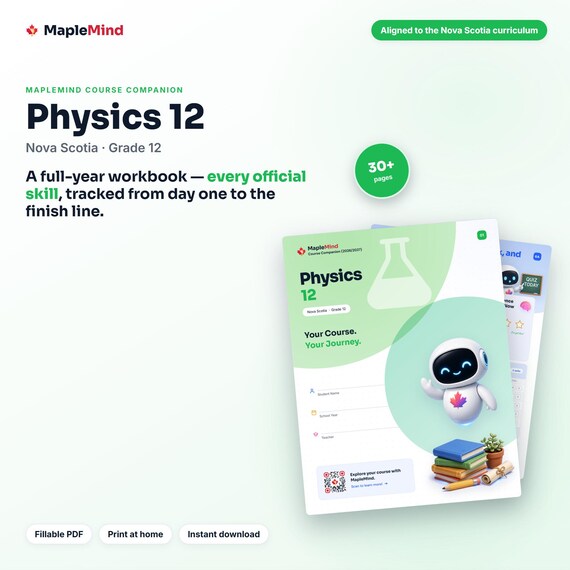


Printable workbook · A keepsake of the year
A Physics 12 workbook worth keeping
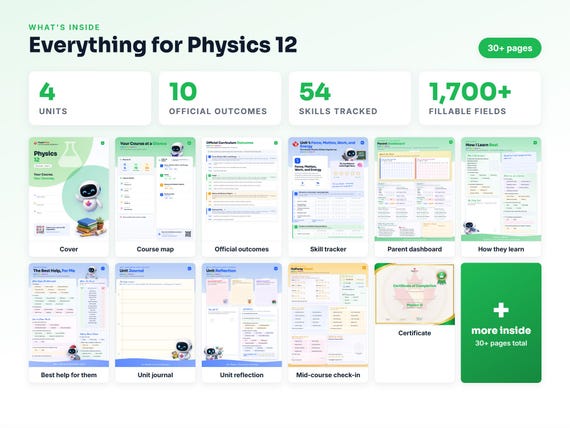
Built from the same official curriculum as this page. Before and after each skill above, your student colours in how sure they feel — so the two of you can see, on one page, what's clicking and what needs another look. It's a quiet way to follow how the year is really going.
By June it's full of their own handwriting: units worked through, confidence grown, a mid-year check-in, notes from parent-teacher night, and a certificate at the end. Less a worksheet, more a record of the year worth keeping on the shelf.
Instant download · see every page, reviews and the full description · five or more workbooks are $2.99 each
What it looks like in the app



Common questions
Can MapleMind help me with Physics 12?
Yes. MapleMind's AI tutor covers all 54 skills in Nova Scotia's Physics 12 — you pick the exact skill, and the tutor teaches it step by step: a short lesson, a worked example, solving together, then a skill check to show it stuck.
Is MapleMind aligned to Nova Scotia's official curriculum?
Yes. Every skill in this course maps to an official outcome code from Nova Scotia's Grade 12 Science curriculum, and the ministry's own wording is quoted under each unit on this page — with the official government source linked so you can check it yourself.
What does MapleMind cost?
It's free to start — 5 tutoring chats and a practice quiz every day, no credit card. A Pro subscription ($9.99/month or $49.99/year CAD, 7-day free trial) unlocks unlimited tutoring, practice, and exam simulations.
What if I'm stuck on just one topic?
That's the point of skill-level tutoring: open Physics 12 in the app, tap the exact skill from the list on this page, and the tutor teaches just that — no wading through lessons you don't need.
Does MapleMind work in French or other languages?
Yes — 14 languages, including French. Both the app and the tutor's explanations switch to the language you choose.
Where can I see the official Nova Scotia curriculum for Physics 12?
The official source is linked on this page — Nova Scotia's official curriculum. The outline here follows it: every MapleMind skill carries its official outcome code, and the ministry's own wording is quoted under each unit.
Keep exploring
Ready when you are
Pick a skill from this page and see it taught properly — free, in the browser, in under a minute.