Get help with Biology 12
Most tutoring makes you sit through material you already know. MapleMind flips that: pick the exact skill that's causing trouble — any of the 35 below — and the tutor teaches just that one, step by step, as many times as it takes. Ask questions in plain words, any time of day, in English, French, or 12 other languages.
The official Nova Scotia Biology 12 curriculum
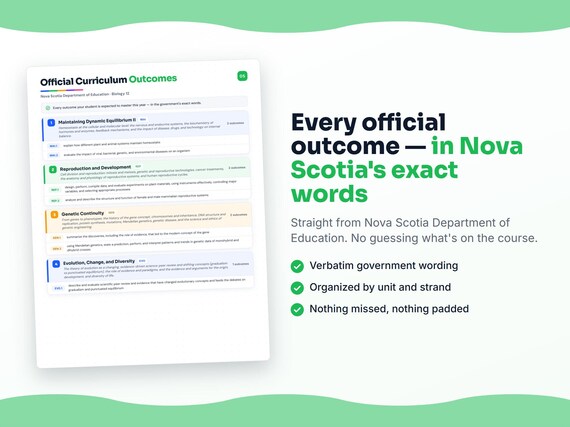
Nova Scotia defines Biology 12 by strands and outcomes. MapleMind teaches the same curriculum reorganized for one-skill-at-a-time tutoring — the table shows exactly where every official strand lands, and the ministry's own wording is quoted under each unit below.
Official source Nova Scotia's official curriculumRead it on the government site — curriculum.novascotia.ca ↗| Official strand | Outcomes | Where MapleMind teaches it |
|---|---|---|
| Strand 1 | 12 | Maintaining Dynamic Equilibrium II |
| Strand 2 | 9 | Reproduction and Development |
| Strand 3 | 10 | Genetic Continuity |
| Strand 4 | 4 | Evolution, Change, and Diversity |
Every skill below, taught one on one.
 Try the first session free
How MapleMind teaches Biology 12 — every unit, lesson, and skill
Every skill below runs as a short session: a plain-words lesson, a worked example, solving it together, then a five-question skill check that earns up to three stars. Guided Mode keeps it teaching instead of answer-handing — turning it off needs a parent's password.
Unit 1Maintaining Dynamic Equilibrium IIOfficial strand · Strand 1
Homeostasis at the cellular and molecular level: the nervous and endocrine systems, the biochemistry of hormones and enzymes, feedback mechanisms, and the impact of disease, drugs, and technology on internal balance.
Homeostasis, biochemistry, and the nervous system
- Plant and animal systems maintaining homeostasisbio12.1.1 — Explain how different plant and animal systems act together to maintain homeostasis at a detailed level.
- Water, glucose, and ATP in living systemsbio12.1.2 — Identify the roles of key compounds such as water, glucose, and ATP that are commonly found in living systems.
- Investigating the nervous systembio12.1.3 — Design an experiment to investigate an aspect of the nervous system, identifying the specific variables involved.
- Structure and dynamics of the nervous systembio12.1.4 — Analyze the nervous system, organizing data to interpret its structure and functional dynamics.
Disease, drugs, hormones, and enzymes
- Disease and homeostasisbio12.1.5 — Evaluate the impact of viral, bacterial, genetic, and environmental diseases on an organism's homeostasis.
- Drugs, technology, and homeostasis over timebio12.1.6 — Analyze how and why drugs and technologies that affect homeostasis have developed and improved over time.
- Treatments for vision and hearingbio12.1.7 — Evaluate and describe examples of treatments and technologies for visual and auditory functions.
- Protein and steroid hormonesbio12.1.8 — Identify and describe the structure and function of important biochemical compounds, including protein and steroid hormones.
- Enzymes in cellular metabolismbio12.1.9 — Explain the critical role of enzymes in cellular metabolism.
- Investigating the endocrine systembio12.1.10 — Design and carry out an experiment on an aspect of the endocrine system, identifying variables and organizing the data.
- Feedback mechanisms in homeostasisbio12.1.11 — Analyze homeostatic phenomena to identify the feedback mechanisms at work.
- Contributions to homeostasis sciencebio12.1.12 — Analyze contributions, including Canadian, to the science and technology of homeostasis and how these improved over time.
The official wording — 12 outcomes in this unit
- bio12.1.1
explain how different plant and animal systems maintain homeostatis
- bio12.1.2
identify the role of some compounds, such as water, glucose, and ATP, commonly found in living systems
- bio12.1.3
design an experiment to investigate and collect data on aspects of the nervous system and identify specific variables involved
- bio12.1.4
analyze the nervous system and compile and organize data to interpret its structure and dynamics
- bio12.1.5
evaluate the impact of viral, bacterial, genetic, and environmental diseases on an organism
- bio12.1.6
analyze how and why technologies and drugs developed and improved over time can affect homeostasis
- bio12.1.7
evaluate and describe examples of treatments and technologies for visual and auditory functions
- bio12.1.8
identify and describe the structure and function of important biochemical compounds, including protein and steroid hormones
- bio12.1.9
explain the critical role of enzymes in cellular metabolism
- bio12.1.10
design and do an experiment, identify variables, and compile and organize data on selected aspects of the endocrine system
- bio12.1.11
analyze homeostatic phenomena to identify the feedback mechanisms involved
- bio12.1.12
analyze contributions, including Canadian, to science and technology and how these have improved over time
Unit 2Reproduction and DevelopmentOfficial strand · Strand 2
Cell division and reproduction: mitosis and meiosis, genetic and reproductive technologies, cancer treatments, the anatomy and physiology of reproductive systems, and human reproductive cycles.
Mitosis, meiosis, and genetic technology
- Experimenting on plant materialsbio12.2.1 — Design, carry out, and evaluate experiments on plant materials, using instruments effectively, controlling major variables, and selecting appropriate processes.
- Mitosis and meiosis in detailbio12.2.2 — Describe in detail the processes of mitosis and meiosis.
- Cell-based genetic technologiesbio12.2.3 — Investigate, analyze, and communicate genetic techniques built on our understanding of cells, using organized data and examples.
- Radiation therapy and chemotherapybio12.2.4 — Evaluate the physiological and ethical consequences of medical treatments such as radiation therapy and chemotherapy.
Reproductive systems and cycles
- Mammalian reproductive systemsbio12.2.5 — Analyze and describe the structure and function of the female and male mammalian reproductive systems.
- Analyzing the human reproductive cyclesbio12.2.6 — Apply criteria — including applications, chemicals, and diseases — to explain the human reproductive cycles.
- Current reproductive technologiesbio12.2.7 — Integrate information from various sources to explain current reproductive technologies for plants and animals.
- Evaluating reproductive technologiesbio12.2.8 — Distinguish scientific questions from technological problems to evaluate the use of human reproductive technologies.
- Reproductive cycles and technology impactbio12.2.9 — Explain the human reproductive cycles, analyzing examples of how technology and science affect reproduction.
The official wording — 9 outcomes in this unit
- bio12.2.1
design, perform, compile data, and evaluate experiments on plant materials, using instruments effectively, controlling major variables, and selecting appropriate processes
- bio12.2.2
describe in detail mitosis and meiosis
- bio12.2.3
investigate, analyze, and communicate genetic techniques, giving examples from organized data, that use technologies that have been developed based on cells
- bio12.2.4
evaluate the physiological and ethical consequences of medical treatments such as radiation therapy and chemotherapy
- bio12.2.5
analyze and describe the structure and function of female and male mammalian reproductive systems
- bio12.2.6
identify and apply criteria, including potential applications, chemicals, and diseases, to explain the human reproductive cycles
- bio12.2.7
select and integrate information from various sources and explain current reproductive technologies for plants and animals
- bio12.2.8
distinguish between scientific questions and technological problems to evaluate the use of reproductive technologies for humans
- bio12.2.9
explain the human reproductive cycles, including analyzing examples of the effects of technology and science on reproduction
Unit 3Genetic ContinuityOfficial strand · Strand 3
From genes to phenotypes: the history of the gene concept, chromosomes and inheritance, DNA structure and replication, protein synthesis, mutations, Mendelian genetics, genetic disease, and the science and ethics of genetic engineering.
The gene, DNA, and protein synthesis
- The discovery of the genebio12.3.1 — Summarize the discoveries and evidence that led to the modern concept of the gene.
- Chromosomes and inheritancebio12.3.2 — Identify and describe the roles of chromosomes in transmitting hereditary information from cell to cell.
- DNA, RNA, replication, and protein synthesisbio12.3.3 — Explain how the model of DNA replication, the structure of DNA and RNA, and protein synthesis transformed scientific thinking.
- Mutations and their effectsbio12.3.4 — Describe and predict the effects of genetic mutations on a cell's information, including protein synthesis, phenotype, and heredity.
Mendelian genetics and genetic engineering
- Mendelian crossesbio12.3.5 — Use Mendelian genetics to predict, interpret, and analyze patterns in monohybrid and dihybrid crosses.
- Causes of genetic diseasebio12.3.6 — Explain the circumstances that lead to genetic diseases.
- Arguing about genetic engineeringbio12.3.7 — Analyze the risks and benefits of genetic engineering and construct evidence-based arguments recognizing multiple perspectives.
- Genetics-based technology developmentbio12.3.8 — Analyze, describe, and evaluate the development, design, and solutions of genetics-based technology.
- The Human Genome Projectbio12.3.9 — Explain and analyze, from various perspectives, the risks and benefits of the influence of the Human Genome Project.
- Defending a position on genetic modificationbio12.3.10 — Investigate and defend a position or course of action on genetic modification, integrating sources and connecting to related careers.
The official wording — 10 outcomes in this unit
- bio12.3.1
summarize the discoveries, including the role of evidence, that led to the modern concept of the gene
- bio12.3.2
identify and describe the roles of chromosomes in the transmission of hereditary information from one cell to another
- bio12.3.3
explain how the current model of DNA replication, the structure of DNA and RNA, and protein synthesis revolutionized thinking in scientific communities
- bio12.3.4
describe and predict the effects of genetic mutations on a cell
- bio12.3.5
using Mendelian genetics, state a prediction, perform, and interpret patterns and trends in genetic data of monohybrid and dihybrid crosses
- bio12.3.6
explain the circumstances that lead to genetic diseases
- bio12.3.7
analyze the risks and benefits to society and the environment and construct arguments concerning the use of genetic engineering, using examples and evidence from various perspectives
- bio12.3.8
analyze, describe, and evaluate genetics-based technology development, design, and solutions
- bio12.3.9
explain and analyze, from a variety of perspectives, the risks and benefits of the influence of the Human Genome Project
- bio12.3.10
investigate, perform, and defend a position or course of action on genetic modification, integrating various sources and science- and technology-based careers
Unit 4Evolution, Change, and DiversityOfficial strand · Strand 4
The theory of evolution as a changing, evidence-driven science: peer review and shifting concepts (gradualism vs punctuated equilibrium), the role of evidence and paradigms, and the evidence and arguments for the origin, development, and diversity of life.
Evolution: evidence, theory, and diversity
- Peer review and evolutionary conceptsbio12.4.1 — Describe and evaluate scientific peer review and the evidence that has changed evolutionary concepts, including the gradualism vs punctuated-equilibrium debate.
- Evidence, theories, and paradigmsbio12.4.2 — Explain and analyze how evidence, theories, and paradigms are tested and subsequently restricted, revised, or replaced.
- Constructing arguments for diversitybio12.4.3 — Identify questions, collect information, and construct evidence-based arguments for the development and diversity of living organisms.
- Origin, development, and diversity of lifebio12.4.4 — Outline the evidence and arguments about the origin, development, and diversity of life on Earth and identify new questions arising from them.
The official wording — 4 outcomes in this unit
- bio12.4.1
describe and evaluate scientific peer review and evidence that have changed evolutionary concepts and feeds the debates on gradualism and punctuated equilibrium
- bio12.4.2
explain and analyze the roles of evidence, theories, and paradigms as these are tested, and subsequently restricted, revised, or replaced
- bio12.4.3
identify questions to investigate, collect information, and construct arguments to support the development and diversity of living organisms, using examples and evidence
- bio12.4.4
outline evidence and arguments pertaining to the origin, development, and diversity of living organisms on Earth and identify new questions that arise from what was learned
Printable workbook · A keepsake of the year
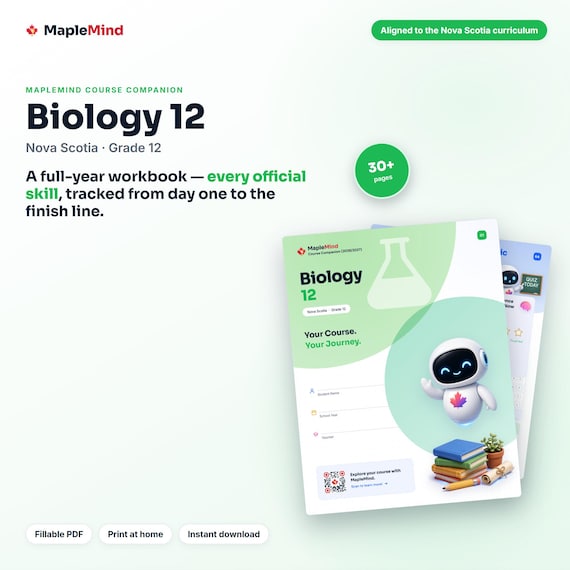
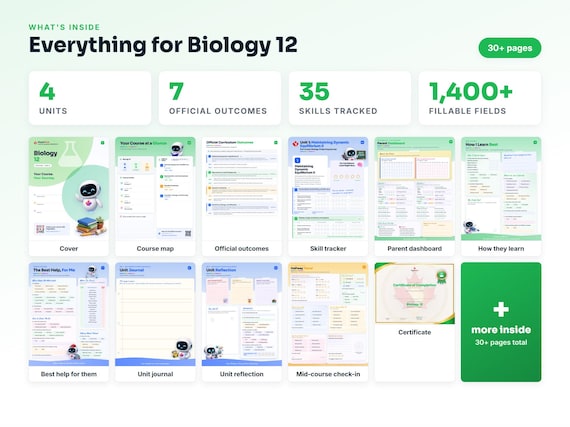
A Biology 12 workbook worth keeping
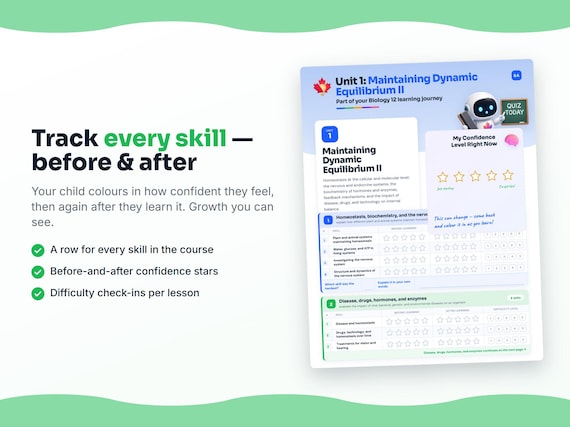
Built from the same official curriculum as this page. Before and after each skill above, your student colours in how sure they feel — so the two of you can see, on one page, what's clicking and what needs another look. It's a quiet way to follow how the year is really going.
By June it's full of their own handwriting: units worked through, confidence grown, a mid-year check-in, notes from parent-teacher night, and a certificate at the end. Less a worksheet, more a record of the year worth keeping on the shelf.
Instant download · see every page, reviews and the full description · five or more workbooks are $2.99 each
What it looks like in the app
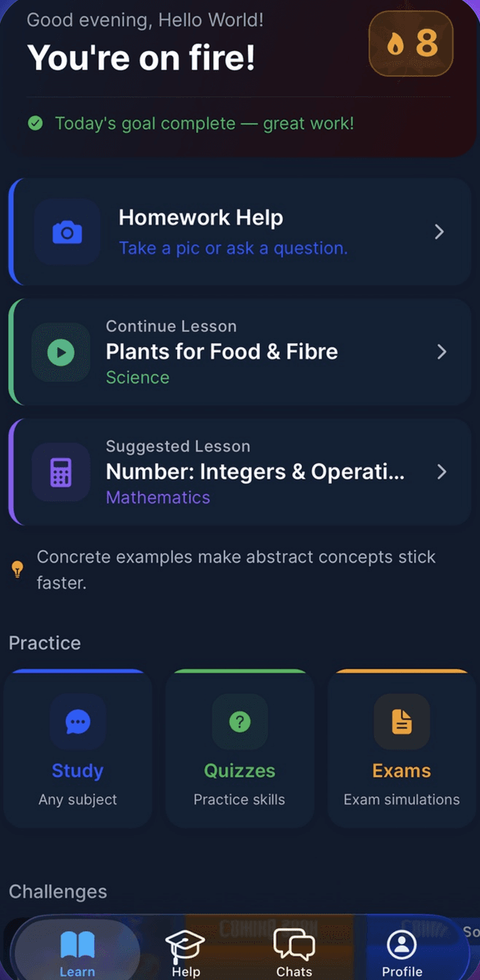

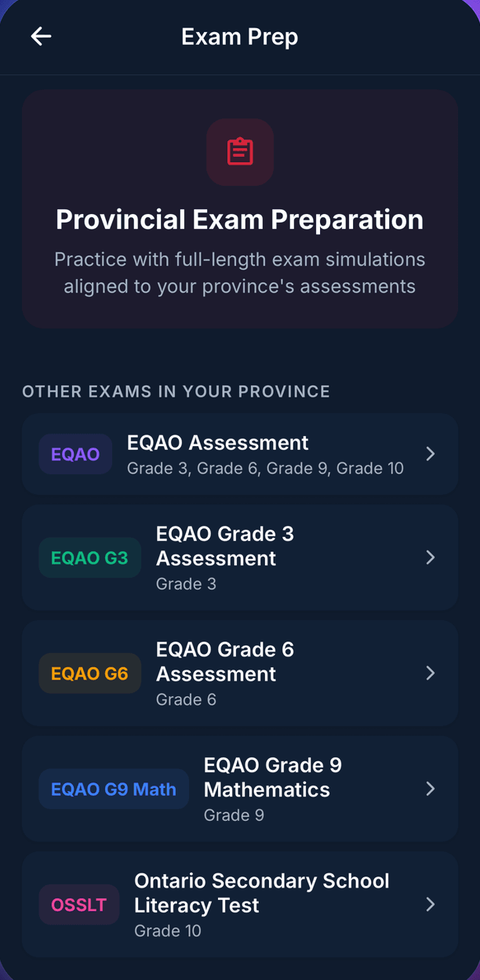
Common questions
Can MapleMind help me with Biology 12?
Yes. MapleMind's AI tutor covers all 35 skills in Nova Scotia's Biology 12 — you pick the exact skill, and the tutor teaches it step by step: a short lesson, a worked example, solving together, then a skill check to show it stuck.
Is MapleMind aligned to Nova Scotia's official curriculum?
Yes. Every skill in this course maps to an official outcome code from Nova Scotia's Grade 12 Science curriculum, and the ministry's own wording is quoted under each unit on this page — with the official government source linked so you can check it yourself.
What does MapleMind cost?
It's free to start — 5 tutoring chats and a practice quiz every day, no credit card. A Pro subscription ($9.99/month or $49.99/year CAD, 7-day free trial) unlocks unlimited tutoring, practice, and exam simulations.
What if I'm stuck on just one topic?
That's the point of skill-level tutoring: open Biology 12 in the app, tap the exact skill from the list on this page, and the tutor teaches just that — no wading through lessons you don't need.
Does MapleMind work in French or other languages?
Yes — 14 languages, including French. Both the app and the tutor's explanations switch to the language you choose.
Where can I see the official Nova Scotia curriculum for Biology 12?
The official source is linked on this page — Nova Scotia's official curriculum. The outline here follows it: every MapleMind skill carries its official outcome code, and the ministry's own wording is quoted under each unit.
Keep exploring
Ready when you are
Pick a skill from this page and see it taught properly — free, in the browser, in under a minute.