Get help with Oceans 11
Most tutoring makes you sit through material you already know. MapleMind flips that: pick the exact skill that's causing trouble — any of the 28 below — and the tutor teaches just that one, step by step, as many times as it takes. Ask questions in plain words, any time of day, in English, French, or 12 other languages.
The official Nova Scotia Oceans 11 curriculum
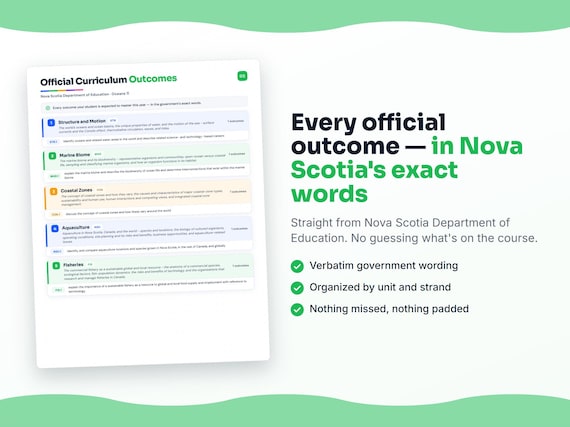
Nova Scotia defines Oceans 11 by strands and outcomes. MapleMind teaches the same curriculum reorganized for one-skill-at-a-time tutoring — the table shows exactly where every official strand lands, and the ministry's own wording is quoted under each unit below.
Official source Nova Scotia's official curriculumRead it on the government site — curriculum.novascotia.ca ↗| Official strand | Outcomes | Where MapleMind teaches it |
|---|---|---|
| OSM | 6 | Structure and Motion |
| MBIO | 5 | Marine Biome |
| CZON | 5 | Coastal Zones |
| AQUA | 6 | Aquaculture |
| FISH | 6 | Fisheries |
Every skill below, taught one on one.
 Try the first session free
How MapleMind teaches Oceans 11 — every unit, lesson, and skill
Every skill below runs as a short session: a plain-words lesson, a worked example, solving it together, then a five-question skill check that earns up to three stars. Guided Mode keeps it teaching instead of answer-handing — turning it off needs a parent's password.
Unit 1Structure and MotionOfficial strand · OSM
The world's oceans and ocean basins, the unique properties of water, and the motion of the sea - surface currents and the Coriolis effect, thermohaline circulation, waves, and tides.
The World's Oceans and Ocean Careers
- The world's oceans and ocean careersOSM-1 — Identify the world's oceans and related water areas and describe real science- and technology-based careers connected to the ocean.
- The structure of Earth's watersOSM-2 — Analyze the basic structure of Earth's waters - basins, layers, and the distribution of salt and fresh water - using evidence.
- The unique properties of waterOSM-3 — Identify, collect data on, and describe the unique properties of water - polarity, high specific heat, density, and how salinity and temperature affect it.
- Currents, the Coriolis effect, and thermohaline circulationOSM-4 — Identify, explain, and show how ocean currents, the Coriolis effect, and thermohaline circulation are related.
- Wave motion in the seaOSM-5 — Identify and describe wave motion found in the marine environment and in everyday situations.
- Tides and tide theoryOSM-6 — Identify and describe tide theory and the different types of tides.
The official wording — 6 outcomes in this unit
- OSM-1
identify oceans and related water areas in the world and describe related science- and technology- based careers
- OSM-2
analyze the basic structure of Earth’s waters using evidence and information to support your findings
- OSM-3
identify, collect data, and describe the unique properties of water
- OSM-4
identify, explain, and show how ocean currents’ Coriolis effect, and thermohaline currents are related
- OSM-5
identify and describe wave motion found in the marine environment and in everyday situations
- OSM-6
identify and describe tide theory and types of tides
Unit 2Marine BiomeOfficial strand · MBIO
The marine biome and its biodiversity - representative organisms and communities, open-ocean versus coastal life, sampling and classifying marine organisms, and how an organism functions in its habitat.
The Marine Biome and Its Biodiversity
- The marine biome and its interconnectionsMBIO-1 — Explain the marine biome, describe the biodiversity of ocean life, and determine the interconnections within it.
- Comparing marine organisms and communitiesMBIO-2 — Compare representative marine organisms and the communities they form.
- Open ocean versus coastal zonesMBIO-3 — Compare the characteristics of the open ocean and coastal zones and their impact on local ecosystems.
- Sampling and classifying marine organismsMBIO-4 — Develop sampling procedures to obtain quantitative abundance data at a local coastal area and apply classification systems and nomenclature.
- How an organism functions in its habitatMBIO-5 — Explain how a particular marine organism functions in its habitat - its adaptations, feeding, and niche.
The official wording — 5 outcomes in this unit
- MBIO-1
explain the marine biome and describe the biodiversity of ocean life and determine interconnections that exist within the marine biome
- MBIO-2
compare representative marine organisms and communities
- MBIO-3
compare characteristics of the open ocean and coastal zones referencing terms and impact on local ecosystems
- MBIO-4
develop and report appropriate sampling procedures to obtain quantitative data on the abundance of marine organisms at a local coastal area and describe and apply classification systems and nomenclatures to organisms found in the marine biome
- MBIO-5
explain how a particular organism functions in its habitat
Unit 3Coastal ZonesOfficial strand · CZON
The concept of coastal zones and how they vary, the causes and characteristics of major coastal-zone types, sustainability and human use, human interactions and competing views, and integrated coastal zone management.
Coastal Zones and Their Management
- The concept of coastal zones and how they varyCZON-1 — Discuss the concept of a coastal zone and how coastal zones vary around the world.
- Causes and characteristics of coastal-zone typesCZON-2 — Describe and explain the causes and characteristics of the major types of coastal zones.
- Sustainability and human use of the coastCZON-3 — Identify and explain sustainability and human use of a coastal environment, including populations and resources, locally and globally.
- Human interactions and competing views on the coastCZON-4 — List and discuss human interactions with coastal-zone processes and describe competing views about them.
- Integrated coastal zone managementCZON-5 — Discuss the purpose and process of integrated coastal zone management and analyze a local management structure and its interrelationships.
The official wording — 5 outcomes in this unit
- CZON-1
discuss the concept of coastal zones and how these vary around the world
- CZON-2
describe and explain the causes and characteristics of major types of coastal zones
- CZON-3
identify and explain sustainability and human use of an environment, including populations and resources, locally and globally
- CZON-4
list and discuss human interactions with the processes involved in the coastal zone environment, and describe competing views
- CZON-5
discuss the purpose and process of integrated coastal zone management and analyze a coastal zone management structure and the interrelationships found in a local area
Unit 4AquacultureOfficial strand · AQUA
Aquaculture in Nova Scotia, Canada, and the world - species and locations, the biology of cultured organisms, operating conditions, site planning and its risks and benefits, business opportunities, and aquaculture-related issues.
Farming the Sea
- Aquaculture locations and speciesAQUA-1 — Identify and compare aquaculture locations and species grown in Nova Scotia, the rest of Canada, and globally.
- The biology of cultured organismsAQUA-2 — Describe groups of organisms raised through aquaculture and their locations, referring to the anatomy, physiology, and ecology of a major cultured species.
- Conditions for aquaculture operationsAQUA-3 — Describe, measure, and analyze the conditions required for aquaculture operations.
- Site planning: risks and benefitsAQUA-4 — Analyze aquaculture site planning from various perspectives and report on the risks and benefits to society and the environment.
- Aquaculture business opportunitiesAQUA-5 — Identify, analyze, and evaluate various aquaculture business opportunities.
The official wording — 6 outcomes in this unit
- AQUA-1
identify, and compare aquaculture locations and species grown in Nova Scotia, in the rest of Canada, and globally
- AQUA-2
describe and identify groups of organisms raised through aquaculture and their geographic locations, referring to anatomy and physiology of a major species and ecology of cultured species
- AQUA-3
describe, measure, and analyze conditions for aquaculture operations
- AQUA-4
analyze site planning from various perspectives and report on both the risks and benefits to society and the environment
- AQUA-5
identify, analyze, and evaluate various aquaculture business opportunities
- AQUA-6
explain aquaculture-related issues
Unit 5FisheriesOfficial strand · FISH
The commercial fishery as a sustainable global and local resource - the anatomy of a commercial species, ecological factors, fish-population dynamics, the risks and benefits of technology, and the organizations that research and manage fisheries in Canada.
The Sustainable Fishery
- The fishery as a sustainable resourceFISH-1 — Explain the importance of a sustainable fishery as a resource for global and local food supply and employment, using proper terminology.
- Anatomy of a commercial fishery speciesFISH-2 — Describe, identify, and analyze the external and internal anatomy of a major finfish or shellfish species in the commercial fishery.
- Ecological factors in the fisheryFISH-3 — Construct, interpret, and evaluate the various ecological factors that affect a fishery.
- Fish-population dynamicsFISH-4 — Compile and organize fish-population data and explain the dynamic interrelationships among the physical environment, biological environment, and the health and distribution of a fish stock.
- Risks and benefits of fishery technologyFISH-5 — Compare the risks and benefits to society and the environment of applying scientific knowledge or introducing technology to the fisheries.
- Fisheries research and management organizationsFISH-6 — Identify, describe, and analyze the multiple perspectives of the main organizations in fisheries research and decision-making in Canada.
The official wording — 6 outcomes in this unit
- FISH-1
explain the importance of a sustainable fishery as a resource to global and local food supply and employment with reference to terminology
- FISH-2
describe, identify, and analyze the external and internal anatomy of a major finfish or shellfish species that is part of the commercial fishery
- FISH-3
construct, interpret, and evaluate various ecological factors
- FISH-4
compile and organize fish population data and explain the dynamic interrelationships among the physical environment, the biological environment, and the health and distribution of a fish stock
- FISH-5
compare the risks and benefits to society and the environment of applying scientific knowledge or introducing a technology to the fisheries
- FISH-6
identify, describe, and analyze multiple perspectives of the main organizations in research and decision making in fisheries management in Canada
Printable workbook · A keepsake of the year
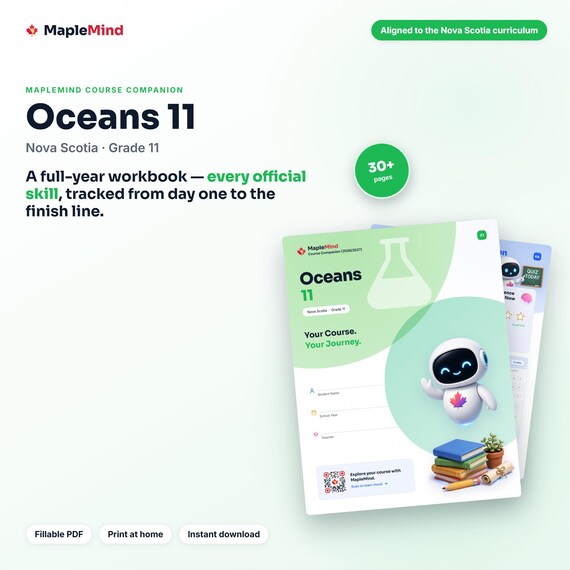
A Oceans 11 workbook worth keeping
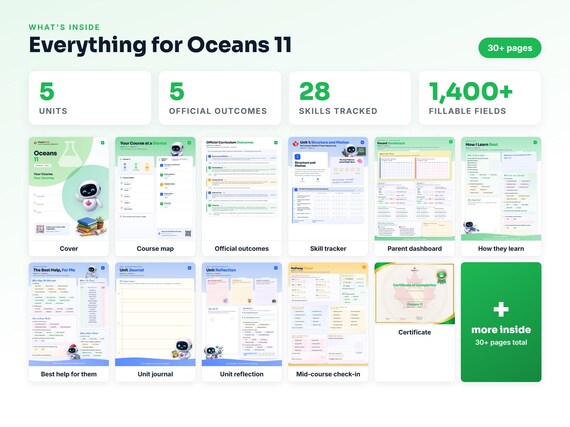
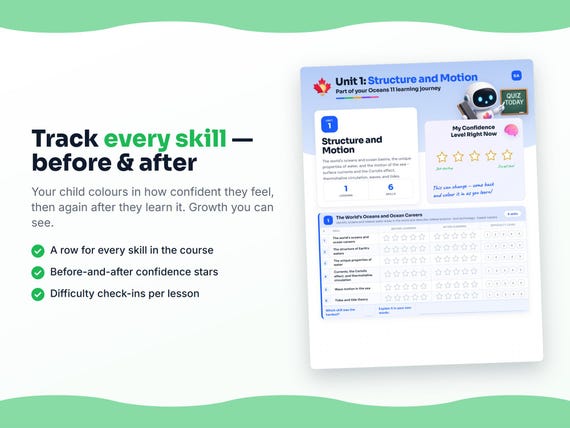
Built from the same official curriculum as this page. Before and after each skill above, your student colours in how sure they feel — so the two of you can see, on one page, what's clicking and what needs another look. It's a quiet way to follow how the year is really going.
By June it's full of their own handwriting: units worked through, confidence grown, a mid-year check-in, notes from parent-teacher night, and a certificate at the end. Less a worksheet, more a record of the year worth keeping on the shelf.
Instant download · see every page, reviews and the full description · five or more workbooks are $2.99 each
What it looks like in the app



Common questions
Can MapleMind help me with Oceans 11?
Yes. MapleMind's AI tutor covers all 28 skills in Nova Scotia's Oceans 11 — you pick the exact skill, and the tutor teaches it step by step: a short lesson, a worked example, solving together, then a skill check to show it stuck.
Is MapleMind aligned to Nova Scotia's official curriculum?
Yes. Every skill in this course maps to an official outcome code from Nova Scotia's Grade 11 Science curriculum, and the ministry's own wording is quoted under each unit on this page — with the official government source linked so you can check it yourself.
What does MapleMind cost?
It's free to start — 5 tutoring chats and a practice quiz every day, no credit card. A Pro subscription ($9.99/month or $49.99/year CAD, 7-day free trial) unlocks unlimited tutoring, practice, and exam simulations.
What if I'm stuck on just one topic?
That's the point of skill-level tutoring: open Oceans 11 in the app, tap the exact skill from the list on this page, and the tutor teaches just that — no wading through lessons you don't need.
Does MapleMind work in French or other languages?
Yes — 14 languages, including French. Both the app and the tutor's explanations switch to the language you choose.
Where can I see the official Nova Scotia curriculum for Oceans 11?
The official source is linked on this page — Nova Scotia's official curriculum. The outline here follows it: every MapleMind skill carries its official outcome code, and the ministry's own wording is quoted under each unit.
Keep exploring
Ready when you are
Pick a skill from this page and see it taught properly — free, in the browser, in under a minute.