Get help with Biology 11
Most tutoring makes you sit through material you already know. MapleMind flips that: pick the exact skill that's causing trouble — any of the 24 below — and the tutor teaches just that one, step by step, as many times as it takes. Ask questions in plain words, any time of day, in English, French, or 12 other languages.
The official Nova Scotia Biology 11 curriculum
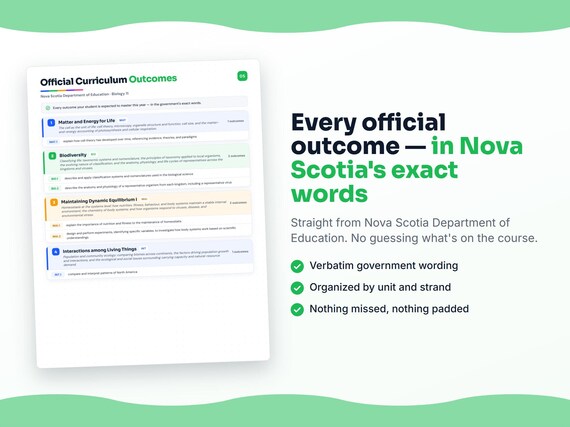
Nova Scotia defines Biology 11 by strands and outcomes. MapleMind teaches the same curriculum reorganized for one-skill-at-a-time tutoring — the table shows exactly where every official strand lands, and the ministry's own wording is quoted under each unit below.
Official source Nova Scotia's official curriculumRead it on the government site — curriculum.novascotia.ca ↗| Official strand | Outcomes | Where MapleMind teaches it |
|---|---|---|
| Strand 1 | 8 | Matter and Energy for Life |
| Strand 2 | 6 | Biodiversity |
| Strand 3 | 7 | Maintaining Dynamic Equilibrium I |
| Strand 4 | 3 | Interactions among Living Things |
Every skill below, taught one on one.
 Try the first session free
How MapleMind teaches Biology 11 — every unit, lesson, and skill
Every skill below runs as a short session: a plain-words lesson, a worked example, solving it together, then a five-question skill check that earns up to three stars. Guided Mode keeps it teaching instead of answer-handing — turning it off needs a parent's password.
Unit 1Matter and Energy for LifeOfficial strand · Strand 1
The cell as the unit of life: cell theory, microscopy, organelle structure and function, cell size, and the matter-and-energy accounting of photosynthesis and cellular respiration.
Cell theory, microscopy, and organelles
- How cell theory developedbio11.1.1 — Explain how the cell theory was built and revised over time, tracing the evidence, competing theories, and shifting paradigms behind its three tenets.
- Microscope technique and recording databio11.1.2 — Prepare and examine specimens under a light microscope and accurately record the observed data.
- Observing and describing organellesbio11.1.3 — Use appropriate equipment to observe cell organelles and describe their appearance and location.
- Prokaryotic vs eukaryotic cellsbio11.1.4 — Compare and contrast the structural differences between prokaryotic and eukaryotic cells.
- Organelles and cell processesbio11.1.5 — Describe how specific organelles carry out and coordinate the processes that keep a cell alive.
- Investigating cell sizebio11.1.6 — Carry out an investigation of cell size, controlling variables and displaying the collected data with valid conclusions.
- Investigating photosynthesis and respirationbio11.1.7 — Design, carry out, and report on experiments that investigate the basic processes of photosynthesis and cellular respiration.
- Matter and energy in photosynthesis and respirationbio11.1.8 — Compare and contrast the matter and energy transformations of photosynthesis and aerobic respiration.
The official wording — 8 outcomes in this unit
- bio11.1.1
explain how cell theory has developed over time, referencing evidence, theories, and paradigms
- bio11.1.2
perform experiments using specimens and microscopes and record the data collected
- bio11.1.3
using appropriate equipment, observe and describe cell organelles
- bio11.1.4
compare and contrast different types of procaryotic and eucaryotic cells
- bio11.1.5
describe how organelles manage various cell processes
- bio11.1.6
do investigations of cell size and display collected data, including variables and conclusions
- bio11.1.7
design, perform, and report on experiments that investigate the basic and critical processes of photosynthesis and respiration
- bio11.1.8
compare and contrast matter and energy transformations associated with the processes of photosynthesis and aerobic respiration
Unit 2BiodiversityOfficial strand · Strand 2
Classifying life: taxonomic systems and nomenclature, the principles of taxonomy applied to local organisms, the evolving nature of classification, and the anatomy, physiology, and life cycles of representatives across the kingdoms and viruses.
Classification systems and taxonomy
- Classification systems and nomenclaturebio11.2.1 — Describe and apply the classification systems and naming conventions used across the biological sciences.
- Applying taxonomy to local organismsbio11.2.2 — Use organisms from local or regional ecosystems to demonstrate the fundamental principles of taxonomy.
- How classification knowledge changesbio11.2.3 — Analyze and describe cases where classification and biological knowledge were enhanced or revised by new laws, theories, or technologies.
- Arguing biodiversity decisions from evidencebio11.2.4 — Construct evidence-based arguments to support a decision or judgment about biodiversity, recognizing multiple perspectives.
Representatives of the kingdoms
- Anatomy and physiology across kingdomsbio11.2.5 — Describe the anatomy and physiology of a representative organism from each kingdom, including a representative virus.
- Life cycles across kingdomsbio11.2.6 — Analyze and explain the life cycle of a representative organism from each kingdom, including a representative virus.
The official wording — 6 outcomes in this unit
- bio11.2.1
describe and apply classification systems and nomenclatures used in the biological science
- bio11.2.2
use organisms found in local or regional ecosystems to demonstrate an understanding of the fundamental principles of taxonomy
- bio11.2.3
analyze and describe examples where scientific knowledge evolved, was enhanced, or revised as a result of new laws, theories, and/or technologies
- bio11.2.4
construct arguments to support a decision or judgment, using examples and evidence, recognizing various perspectives
- bio11.2.5
describe the anatomy and physiology of a representative organism from each kingdom, including a representative virus
- bio11.2.6
analyze and explain the life cycle of a representative organism from each kingdom, including a representative virus
Unit 3Maintaining Dynamic Equilibrium IOfficial strand · Strand 3
Homeostasis at the systems level: how nutrition, fitness, behaviour, and body systems maintain a stable internal environment; the chemistry of body systems; and how organisms respond to viruses, disease, and environmental stress.
Homeostasis, nutrition, fitness, and behaviour
- Nutrition, fitness, and homeostasisbio11.3.1 — Explain how nutrition and fitness support the maintenance of homeostasis, while weighing how scientific and technological funding decisions are made.
- Behaviour and homeostasisbio11.3.2 — Explain with examples how behaviours such as tropisms, instinct, and learned behaviour help maintain homeostasis, considering the perspectives that shape related decisions.
Body systems, chemistry, and health
- Investigating body systemsbio11.3.3 — Design and carry out experiments with controlled variables to investigate how body systems work.
- How body-support systems improved over timebio11.3.4 — Analyze and report how natural and technological systems that support the body have developed and improved over time, including organ transplants.
- How plant and animal systems maintain homeostasisbio11.3.5 — Explain how different plant and animal systems act to maintain homeostasis.
- Chemicals in body systemsbio11.3.6 — Identify and describe the roles of elements, compounds, biochemicals, and water in the structure and function of body systems.
- Viruses, disease, and disrupted homeostasisbio11.3.7 — Identify and predict how viruses, diseases, and environmental factors affect an organism's homeostasis, and propose alternate solutions.
The official wording — 7 outcomes in this unit
- bio11.3.1
explain the importance of nutrition and fitness to the maintenance of homeostatis
- bio11.3.2
explain, with specific examples, how behaviours such as tropisms, instinct, and learned, help to maintain homeostasis
- bio11.3.3
design and perform experiments, identifying specific variables, to investigate how body systems work based on scientific understandings
- bio11.3.4
analyze and report how natural and technological systems have developed and improved over time, including organ transplants
- bio11.3.5
explain how different plant and animal systems maintain homeostasis
- bio11.3.6
identify and describe the role of chemicals, including elements, compounds, biochemicals, and water on the structure and function of various body systems
- bio11.3.7
identify and predict the impact of viruses, diseases, and environmental factors on the homeostasis of an organism and propose alternate solutions
Unit 4Interactions among Living ThingsOfficial strand · Strand 4
Population and community ecology: comparing biomes across continents, the factors driving population growth and interactions, and the ecological and social issues surrounding carrying capacity and natural-resource demand.
Biomes, populations, and carrying capacity
- Comparing biomes across continentsbio11.4.1 — Compare and interpret the pattern of North America's biomes against another continent in terms of climate, vegetation, geography, and location.
- Population growth and interactionsbio11.4.2 — Synthesize information to describe and explain the factors influencing population growth and the interactions within and between populations.
- Carrying capacity and resource demandbio11.4.3 — Propose courses of action on social, economic, and cultural issues tied to Earth's carrying capacity and the demand on natural resources, using the energy pyramid.
The official wording — 3 outcomes in this unit
- bio11.4.1
compare and interpret patterns of North America
- bio11.4.2
synthesize information from multiple sources to describe and explain factors that influence population growth and interactions within and between populations
- bio11.4.3
propose courses of action on social, economic, and cultural issues related to Earth
Printable workbook · A keepsake of the year
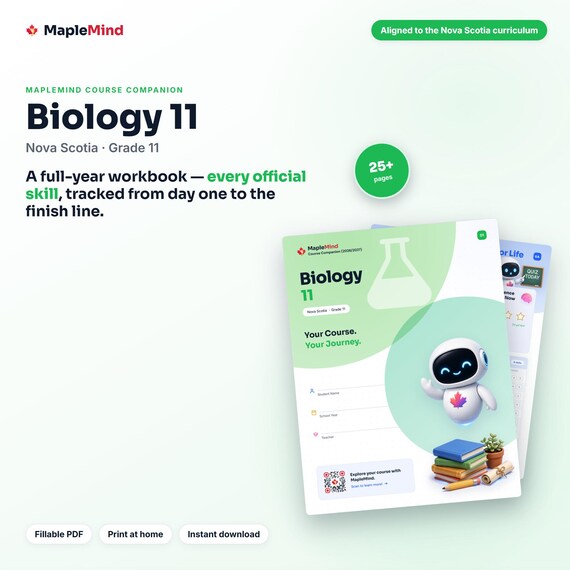
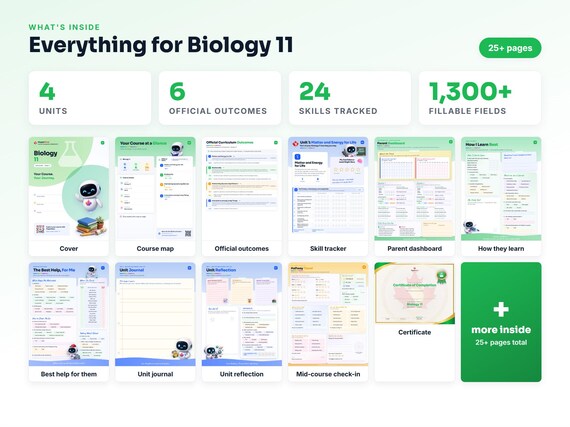
A Biology 11 workbook worth keeping
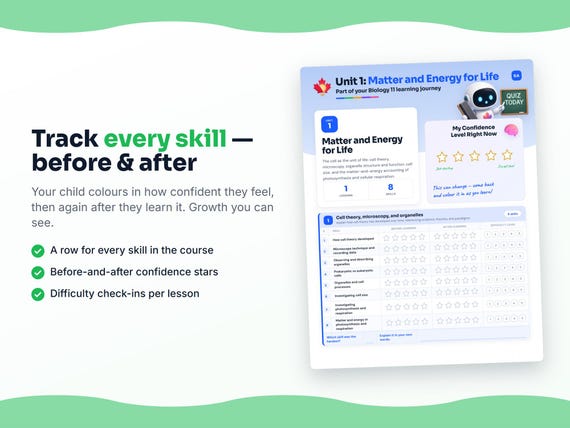
Built from the same official curriculum as this page. Before and after each skill above, your student colours in how sure they feel — so the two of you can see, on one page, what's clicking and what needs another look. It's a quiet way to follow how the year is really going.
By June it's full of their own handwriting: units worked through, confidence grown, a mid-year check-in, notes from parent-teacher night, and a certificate at the end. Less a worksheet, more a record of the year worth keeping on the shelf.
Instant download · see every page, reviews and the full description · five or more workbooks are $2.99 each
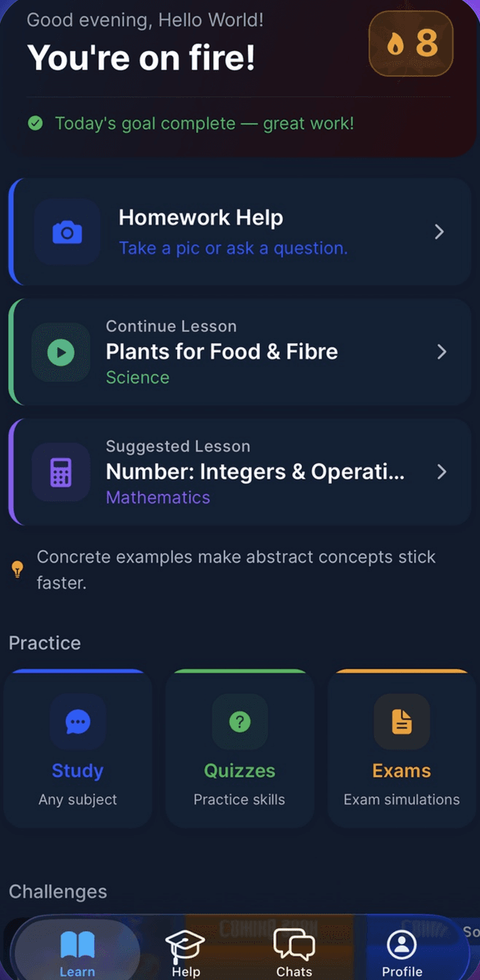
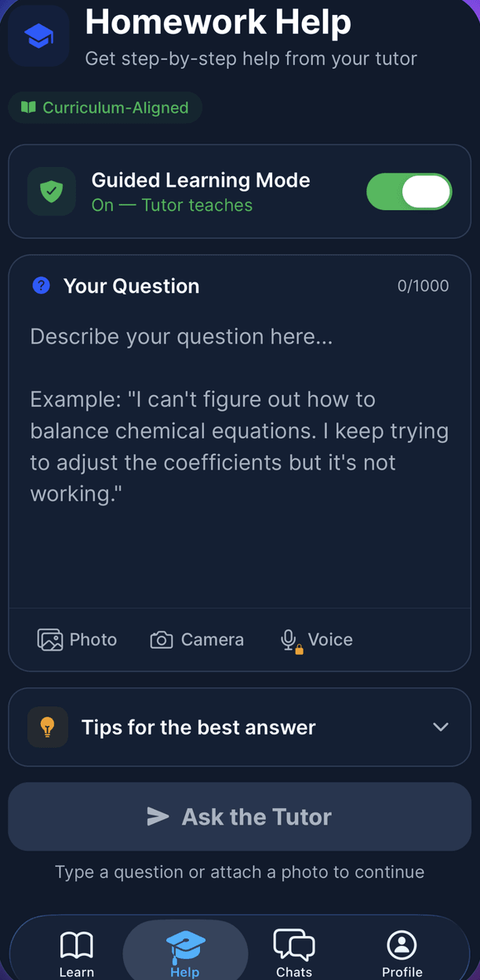
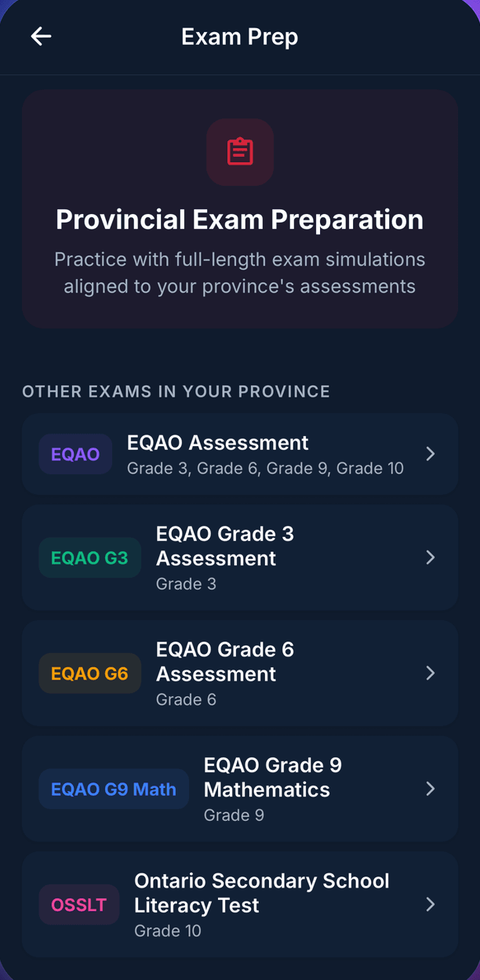
What it looks like in the app
Common questions
Can MapleMind help me with Biology 11?
Yes. MapleMind's AI tutor covers all 24 skills in Nova Scotia's Biology 11 — you pick the exact skill, and the tutor teaches it step by step: a short lesson, a worked example, solving together, then a skill check to show it stuck.
Is MapleMind aligned to Nova Scotia's official curriculum?
Yes. Every skill in this course maps to an official outcome code from Nova Scotia's Grade 11 Science curriculum, and the ministry's own wording is quoted under each unit on this page — with the official government source linked so you can check it yourself.
What does MapleMind cost?
It's free to start — 5 tutoring chats and a practice quiz every day, no credit card. A Pro subscription ($9.99/month or $49.99/year CAD, 7-day free trial) unlocks unlimited tutoring, practice, and exam simulations.
What if I'm stuck on just one topic?
That's the point of skill-level tutoring: open Biology 11 in the app, tap the exact skill from the list on this page, and the tutor teaches just that — no wading through lessons you don't need.
Does MapleMind work in French or other languages?
Yes — 14 languages, including French. Both the app and the tutor's explanations switch to the language you choose.
Where can I see the official Nova Scotia curriculum for Biology 11?
The official source is linked on this page — Nova Scotia's official curriculum. The outline here follows it: every MapleMind skill carries its official outcome code, and the ministry's own wording is quoted under each unit.
Keep exploring
Ready when you are
Pick a skill from this page and see it taught properly — free, in the browser, in under a minute.