Get help with Chemistry 12
Most tutoring makes you sit through material you already know. MapleMind flips that: pick the exact skill that's causing trouble — any of the 87 below — and the tutor teaches just that one, step by step, as many times as it takes. Ask questions in plain words, any time of day, in English, French, or 12 other languages.
The official Nova Scotia Chemistry 12 curriculum
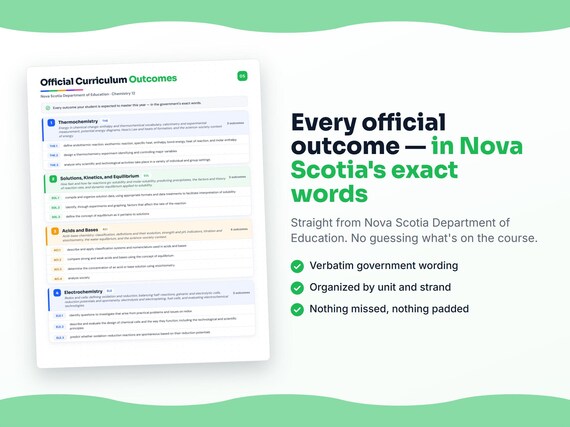
Nova Scotia defines Chemistry 12 by strands and outcomes. MapleMind teaches the same curriculum reorganized for one-skill-at-a-time tutoring — the table shows exactly where every official strand lands, and the ministry's own wording is quoted under each unit below.
Official source Nova Scotia's official curriculumRead it on the government site — curriculum.novascotia.ca ↗| Official strand | Outcomes | Where MapleMind teaches it |
|---|---|---|
| Strand 1 | 23 | Thermochemistry |
| Strand 2 | 17 | Solutions, Kinetics, and Equilibrium |
| Strand 3 | 25 | Acids and Bases |
| Strand 4 | 22 | Electrochemistry |
Every skill below, taught one on one.
 Try the first session free
How MapleMind teaches Chemistry 12 — every unit, lesson, and skill
Every skill below runs as a short session: a plain-words lesson, a worked example, solving it together, then a five-question skill check that earns up to three stars. Guided Mode keeps it teaching instead of answer-handing — turning it off needs a parent's password.
Unit 1ThermochemistryOfficial strand · Strand 1
Energy in chemical change: enthalpy and thermochemical vocabulary, calorimetry and experimental measurement, potential energy diagrams, Hess's Law and heats of formation, and the science-society context of energy.
Enthalpy, combustion, and energy concepts
- Thermochemistry vocabularychem12.1.7 — Define the core thermochemistry terms precisely.
- Molar enthalpies of combustionchem12.1.4 — Compare the molar enthalpies of several combustion reactions of organic compounds.
- Combustion equations with energychem12.1.5 — Write and balance combustion equations for alkanes, including the energy amounts.
- Energy in changes of statechem12.1.8 — Calculate and compare the energy involved in changes of state during reactions.
- Potential energy diagramschem12.1.15 — Illustrate energy changes of reactions using potential energy diagrams.
Calorimetry, Hess's Law, and prediction
- Designing a thermochemistry experimentchem12.1.9 — Design a thermochemistry experiment, identifying and controlling major variables.
- Selecting instruments and processeschem12.1.11 — Evaluate and select appropriate instruments and processes for inquiry and decision making.
- Measuring reaction energy changeschem12.1.12 — Determine experimentally the changes in energy of chemical reactions.
- Hess's Law and reaction energychem12.1.17 — Calculate reaction energy using bond energy, heats of formation, and Hess's Law.
- Applying prediction methods to datachem12.1.18 — Apply a prediction method for heats of reaction to your experimental values.
- Displaying heats of formationchem12.1.16 — Compile and display heats-of-formation evidence in varied formats.
Thermochemistry, technology, and society
- Settings of scientific activitychem12.1.1 — Analyze why scientific and technological work happens in varied individual and group settings.
- Risks and benefits of thermochemistrychem12.1.2 — Analyze, from various perspectives, the risks and benefits to society and the environment of applying thermochemistry.
- Questions thermochemistry can and cannot answerchem12.1.3 — Distinguish questions answerable by thermochemistry from those that are not, and technological from non-technological problems.
- Courses of action on energy issueschem12.1.6 — Propose courses of action on science-and-technology social issues, including sustainability.
- Co-operative thermochemistry experimentschem12.1.10 — Work co-operatively with team members to develop and carry out thermochemistry experiments.
- Identifying areas of further studychem12.1.13 — Analyze acquired thermochemistry knowledge to identify areas for further science-and-technology study.
- Alternative energy solutionschem12.1.14 — Propose alternative solutions to energy problems and identify their strengths and weaknesses.
- Technologies from thermochemistrychem12.1.19 — Analyze and describe technologies developed from understanding thermochemistry.
- Peer review in thermochemistrychem12.1.20 — Describe the importance of peer review in developing thermochemistry knowledge.
- Research tools for informationchem12.1.21 — Use library and electronic research tools to collect information on a topic.
- Integrating information sourceschem12.1.22 — Select and integrate information from various sources or parts of one source.
- Perspectives on a science decisionchem12.1.23 — Identify the multiple perspectives influencing a science-related decision in a thermochemistry project.
The official wording — 23 outcomes in this unit
- chem12.1.7
define endothermic reaction, exothermic reaction, specific heat, enthalpy, bond energy, heat of reaction, and molar enthalpy
- chem12.1.4
compare the molar enthalpies of several combustion reactions involving organic compounds
- chem12.1.5
write and balance chemical equations for combustion reactions of alkanes, including energy amounts
- chem12.1.8
calculate and compare the energy involved in changes of state in chemical reactions
- chem12.1.15
illustrate changes in energy of various chemical reactions, using potential energy diagrams
- chem12.1.9
design a thermochemistry experiment identifying and controlling major variables
- chem12.1.11
evaluate and select appropriate instruments for collecting evidence and appropriate processes for problem solving, inquiring, and decision making
- chem12.1.12
determine experimentally the changes in energy of various chemical reactions
- chem12.1.17
calculate the changes in energy of various chemical reactions using bond energy, heats of formation, and Hess
- chem12.1.18
apply one of the methods of predicting heats of reactions to your experimentally determined values
- chem12.1.16
compile and display evidence and information on heats of formation in a variety of formats, including diagrams, flow charts, tables, and graphs
- chem12.1.1
analyze why scientific and technological activities take place in a variety of individual and group settings
- chem12.1.2
analyze from a variety of perspectives the risks and benefits to society and the environment by applying thermochemistry
- chem12.1.3
distinguish between questions that can be answered using thermochemistry and those that cannot, and between problems that can be solved by technology and those that cannot
- chem12.1.6
propose courses of action on social issues related to science and technology, taking into account an array of perspectives, including that of sustainability
- chem12.1.10
work co-operatively with team members to develop and carry out thermochemistry experiments
- chem12.1.13
analyze the knowledge and skills acquired in their study of thermochemistry to identify areas of further study related to science and technology
- chem12.1.14
propose alternative solutions to solving energy problems and identify the potential strengths and weaknesses of each
- chem12.1.19
analyze and describe examples where technologies were developed based on understanding thermochemistry
- chem12.1.20
describe the importance of peer review in the development of their knowledge about thermochemistry
- chem12.1.21
use library and electronic research tools to collect information on a given topic
- chem12.1.22
select and integrate information from various print and electronic sources or from several parts of the same source
- chem12.1.23
identify multiple perspectives that influence a science-related decision or issue involving their thermochemistry project
Unit 2Solutions, Kinetics, and EquilibriumOfficial strand · Strand 2
How fast and how far reactions go: solubility and molar solubility, predicting precipitates, the factors and theory of reaction rate, and dynamic equilibrium applied to solubility.
Solubility and precipitates
- Organizing solubility datachem12.2.1 — Compile and organize solution data to interpret solubility.
- Molar solubilitychem12.2.2 — Determine the molar solubility of a pure substance in water.
- Variation in solubilitychem12.2.3 — Explain the variation in solubility of different substances in the same solvent.
- Predicting precipitateschem12.2.4 — Use solubility generalizations to predict precipitate formation.
- Sources of error and uncertaintychem12.2.5 — Identify and explain sources of error and uncertainty.
- Solutions and equilibrium careerschem12.2.6 — Identify science- and technology-based careers related to solutions and equilibrium.
Reaction rates and collision theory
- Factors affecting reaction ratechem12.2.7 — Identify, through experiment and graphing, the factors that affect reaction rate.
- Sampling procedureschem12.2.8 — Implement appropriate sampling procedures.
- Collision theorychem12.2.9 — Describe collision theory and its link to factors altering reaction rate.
- Reaction mechanisms and catalystschem12.2.10 — Describe a reaction mechanism and the role of a catalyst.
- Organizing kinetics datachem12.2.11 — Compile and organize data to facilitate interpretation.
Equilibrium in solutions
- Equilibrium in solutionschem12.2.12 — Define equilibrium as it applies to solutions.
- Factors affecting solubility via equilibriumchem12.2.13 — Explain how different factors affect solubility using equilibrium.
- Sampling for equilibrium expressionschem12.2.14 — Develop appropriate sampling procedures for equilibrium expressions.
- Solubility and equilibriumchem12.2.15 — Explain solubility using the concept of equilibrium.
- Technology revising understandingchem12.2.16 — Analyze cases where a technology enhanced or revised scientific understanding.
- Technologies from scientific understandingchem12.2.17 — Analyze cases where technologies were developed from scientific understanding.
The official wording — 17 outcomes in this unit
- chem12.2.1
compile and organize solution data, using appropriate formats and data treatments to facilitate interpretation of solubility
- chem12.2.2
determine the molar solubility of a pure substance in water
- chem12.2.3
explain the variations in the solubility of various pure substances, given the same solvent
- chem12.2.4
use the solubility generalizations to predict the formation of precipitates
- chem12.2.5
identify and explain sources of error and uncertainty
- chem12.2.6
identify and describe science- and technology-based careers related to solutions and equilibrium
- chem12.2.7
identify, through experiments and graphing, factors that affect the rate of the reaction
- chem12.2.8
implement appropriate sampling procedures
- chem12.2.9
describe collision theory and its connection to factors involved in altering reaction rates
- chem12.2.10
describe a reaction mechanism and catalyst
- chem12.2.11
compile and organize data, using appropriate formats and data treatments to facilitate interpretation of the data
- chem12.2.12
define the concept of equilibrium as it pertains to solutions
- chem12.2.13
explain how different factors affect solubility, using the concept of equilibrium
- chem12.2.14
develop appropriate sampling procedures for equilibrium expressions
- chem12.2.15
explain solubility, using the concept of equilibrium
- chem12.2.16
analyze and describe examples where scientific understanding was enhanced or revised as a result of the invention of a technology
- chem12.2.17
analyze and describe examples where technologies were developed based on scientific understanding
Unit 3Acids and BasesOfficial strand · Strand 3
Acid-base chemistry: classification, definitions and their evolution, strength and pH, indicators, titration and stoichiometry, the water equilibrium, and the science-society context.
Definitions, theory, and classification
- Acid-base classification and nomenclaturechem12.3.1 — Describe and apply the classification systems and nomenclature of acids and bases.
- Acid-base definitionschem12.3.2 — Describe acid-base definitions up to the Bronsted-Lowry definition.
- How acid-base theory evolveschem12.3.3 — Explain how acid-base theory evolves as new evidence and theories are tested and revised.
- Evidence, theories, and paradigmschem12.3.4 — Explain the roles of evidence, theories, and paradigms in acid-base theories.
- Predicting acid-base productschem12.3.5 — Predict the products of acid-base reactions.
- New questions from learningchem12.3.6 — Identify new questions or problems that arise from what was learned.
Strength, pH, indicators, and equilibrium
- Strong vs weak acids and baseschem12.3.12 — Compare strong and weak acids and bases using equilibrium.
- Calculating pHchem12.3.13 — Calculate the pH of an acid or base from concentration and vice versa.
- How indicators workchem12.3.14 — Explain how acid-base indicators function.
- Understanding from titration curveschem12.3.15 — Analyze cases where acid-base understanding was enhanced using titration curves.
- H+ and OH- via Le Chatelierchem12.3.22 — Describe the interactions between H+ and OH- ions using Le Chatelier's principle.
- Prediction and hypothesis (acid-base)chem12.3.11 — State a prediction and hypothesis based on evidence and background information.
Titration technique and calculation
- Concentration by stoichiometrychem12.3.16 — Determine the concentration of an acid or base using stoichiometry.
- Collecting titration datachem12.3.17 — Use instruments effectively and accurately to collect titration data.
- Interpreting titration datachem12.3.18 — Interpret titration data and infer relationships among variables.
- Co-operative titration experimentchem12.3.19 — Work co-operatively to plan and carry out a titration and troubleshoot problems.
- Selecting titration instrumentschem12.3.20 — Evaluate and select appropriate instruments and processes for titrations.
- Modes of representationchem12.3.21 — Select and use numeric, symbolic, graphical, and linguistic representations to communicate titration ideas and results.
- Line of best fitchem12.3.8 — Identify a line of best fit and interpolate or extrapolate from it.
- Apparatus and materials safetychem12.3.9 — Select and use apparatus and materials safely.
- WHMIS handling and disposalchem12.3.10 — Demonstrate WHMIS knowledge by selecting proper handling and disposal techniques.
- Communicating acid-base resultschem12.3.7 — Explain the importance of communicating results using appropriate language and conventions.
Acids, bases, and society
- Society's influence on acid-base sciencechem12.3.23 — Analyze society's influence on acid-base scientific and technological work.
- Constructing acid-base argumentschem12.3.24 — Construct evidence-based arguments to support a decision, recognizing various perspectives.
- Acid-base careerschem12.3.25 — Identify and describe science- and technology-based careers related to acids and bases.
The official wording — 25 outcomes in this unit
- chem12.3.1
describe and apply classification systems and nomenclature used in acids and bases
- chem12.3.2
describe various acid-base definitions up to the Br
- chem12.3.3
explain how acid-base theory evolves as new evidence and laws and theories are tested and revised, or replaced
- chem12.3.4
explain the roles of evidence, theories, and paradigms in acid-base theories
- chem12.3.5
predict products of acid-base reactions
- chem12.3.6
identify new questions or problems that arise from what was learned
- chem12.3.12
compare strong and weak acids and bases using the concept of equilibrium
- chem12.3.13
calculate the pH of an acid or a base given its concentration, and vice versa
- chem12.3.14
explain how acid-base indicators function
- chem12.3.15
analyze and describe examples where acid-base understanding was enhanced as a result of using titration curves
- chem12.3.22
describe the interactions between H+ ions and OH
- chem12.3.11
state a prediction and a hypothesis based on available evidence and background information
- chem12.3.16
determine the concentration of an acid or base solution using stoichiometry
- chem12.3.17
use instruments effectively and accurately for collecting titration data
- chem12.3.18
interpret patterns and trends in data, and infer or calculate relationships among variables from titration data
- chem12.3.19
work co-operatively with team members to develop and carry out a plan for a titration experiment, and troubleshoot problems as they arise
- chem12.3.20
evaluate and select appropriate instruments for collecting evidence and appropriate processes for titrations
- chem12.3.21
select and use appropriate numeric, symbolic, graphical, and linguistic modes of representation to communicate ideas, titrations, and results
- chem12.3.8
identify a line of best fit on a scatter plot and interpolate or extrapolate based on the line of best fit
- chem12.3.9
select and use apparatus and materials safely
- chem12.3.10
demonstrate a knowledge of WHMIS standards by selecting proper techniques for handling and disposing of materials
- chem12.3.7
explain the importance of communicating the results of acid-base reactions using appropriate language and conventions
- chem12.3.23
analyze society
- chem12.3.24
construct arguments to support a decision using examples and evidence and recognizing various perspectives
- chem12.3.25
identify and describe science- and technology-based careers related to acids and bases
Unit 4ElectrochemistryOfficial strand · Strand 4
Redox and cells: defining oxidation and reduction, balancing half-reactions, galvanic and electrolytic cells, reduction potentials and spontaneity, electrolysis and electroplating, fuel cells, and evaluating electrochemical technologies.
Oxidation, reduction, and half-reactions
- Questions about redoxchem12.4.1 — Identify investigable questions arising from practical redox problems and issues.
- Scientific vs technological (redox)chem12.4.2 — Distinguish scientific questions from technological problems in electrochemistry.
- Defining oxidation and reductionchem12.4.3 — Define oxidation and reduction experimentally and theoretically.
- Comparing redox to other reactionschem12.4.4 — Compare oxidation-reduction reactions with other kinds of reactions.
- Balancing half-reactionschem12.4.5 — Write and balance half-reactions and net redox reactions.
Electrochemical and electrolytic cells
- Designing chemical cellschem12.4.6 — Describe and evaluate the design and function of chemical cells.
- Defining cell design problemschem12.4.7 — Define problems in cell experimental designs and evaluate the processes used.
- Parts of cellschem12.4.8 — Illustrate and label the parts of electrochemical and electrolytic cells and explain how they work.
- Electrochemistry safetychem12.4.9 — Select and use apparatus and materials safely for electrochemistry experiments.
- Evaluating a self-designed cellchem12.4.10 — Evaluate a personally designed and constructed cell against self-developed criteria.
- Designing a redox experimentchem12.4.11 — Design an experiment identifying and controlling major variables.
- Operational definitionschem12.4.12 — Formulate operational definitions of major variables.
Reduction potentials and applications
- Predicting spontaneitychem12.4.13 — Predict whether redox reactions are spontaneous from reduction potentials.
- Predicting cell voltagechem12.4.14 — Predict the voltage of various electrochemical cells.
- Theoretical vs experimental potentialschem12.4.15 — Compare theoretical and experimental reduction potentials and account for discrepancies.
- Reliability of redox datachem12.4.16 — Evaluate the reliability of data and data-collection methods for reduction potentials.
- Electrochemical vs electrolytic cellschem12.4.17 — Compare electrochemical and electrolytic cells by energy, electron flow, and chemical change.
- Electrolysis and electroplatingchem12.4.18 — Explain the processes of electrolysis and electroplating.
- Hydrogen fuel cellschem12.4.20 — Explain how electrical energy is produced in a hydrogen fuel cell.
- Evaluating a technology designchem12.4.19 — Evaluate the design and function of a technology using self-identified criteria.
- Analyzing natural and technological systemschem12.4.21 — Analyze natural and technological systems to interpret and explain their structure and dynamics.
- Applications of findingschem12.4.22 — Identify and evaluate potential applications of experimental findings.
The official wording — 22 outcomes in this unit
- chem12.4.1
identify questions to investigate that arise from practical problems and issues on redox
- chem12.4.2
distinguish between scientific questions and technological problems
- chem12.4.3
define oxidation and reduction experimentally and theoretically
- chem12.4.4
compare oxidation-reduction reactions with other kinds of reactions
- chem12.4.5
write and balance half-reactions and net reactions
- chem12.4.6
describe and evaluate the design of chemical cells and the way they function, including the technological and scientific principles
- chem12.4.7
define problems regarding experimental designs for cells and evaluate the processes used in problem solving and decision making
- chem12.4.8
illustrate and label the parts of electrochemical and electrolytic cells and explain how they work
- chem12.4.9
select and use apparatus and materials safely for electrochemistry experiments
- chem12.4.10
evaluate a personally designed and constructed cell on the basis of criteria they have developed themselves
- chem12.4.11
design an experiment identifying and controlling major variables
- chem12.4.12
formulate operational definitions of major variables
- chem12.4.13
predict whether oxidation-reduction reactions are spontaneous based on their reduction potentials
- chem12.4.14
predict the voltage of various electrochemical cells
- chem12.4.15
compare theoretical and experimental reduction potential values and account for discrepancies
- chem12.4.16
evaluate the reliability of data and data collection methods involving reduction potentials
- chem12.4.17
compare electrochemical and electrolytic cells in terms of energy efficiency, electron flow/transfer, and chemical change
- chem12.4.18
explain the processes of electrolysis and electroplating
- chem12.4.20
explain how electrical energy is produced in a hydrogen fuel cell
- chem12.4.19
evaluate the design of a technology and the way it functions on the basis of a variety of criteria that they have identified themselves
- chem12.4.21
analyze natural and technological systems to interpret and explain their structure and dynamics
- chem12.4.22
identify and evaluate potential applications of findings


Printable workbook · A keepsake of the year
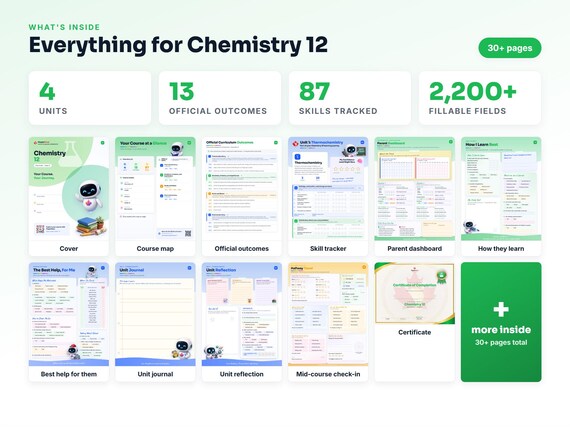
A Chemistry 12 workbook worth keeping
Built from the same official curriculum as this page. Before and after each skill above, your student colours in how sure they feel — so the two of you can see, on one page, what's clicking and what needs another look. It's a quiet way to follow how the year is really going.
By June it's full of their own handwriting: units worked through, confidence grown, a mid-year check-in, notes from parent-teacher night, and a certificate at the end. Less a worksheet, more a record of the year worth keeping on the shelf.
Instant download · see every page, reviews and the full description · five or more workbooks are $2.99 each
What it looks like in the app



Common questions
Can MapleMind help me with Chemistry 12?
Yes. MapleMind's AI tutor covers all 87 skills in Nova Scotia's Chemistry 12 — you pick the exact skill, and the tutor teaches it step by step: a short lesson, a worked example, solving together, then a skill check to show it stuck.
Is MapleMind aligned to Nova Scotia's official curriculum?
Yes. Every skill in this course maps to an official outcome code from Nova Scotia's Grade 12 Science curriculum, and the ministry's own wording is quoted under each unit on this page — with the official government source linked so you can check it yourself.
What does MapleMind cost?
It's free to start — 5 tutoring chats and a practice quiz every day, no credit card. A Pro subscription ($9.99/month or $49.99/year CAD, 7-day free trial) unlocks unlimited tutoring, practice, and exam simulations.
What if I'm stuck on just one topic?
That's the point of skill-level tutoring: open Chemistry 12 in the app, tap the exact skill from the list on this page, and the tutor teaches just that — no wading through lessons you don't need.
Does MapleMind work in French or other languages?
Yes — 14 languages, including French. Both the app and the tutor's explanations switch to the language you choose.
Where can I see the official Nova Scotia curriculum for Chemistry 12?
The official source is linked on this page — Nova Scotia's official curriculum. The outline here follows it: every MapleMind skill carries its official outcome code, and the ministry's own wording is quoted under each unit.
Keep exploring
Ready when you are
Pick a skill from this page and see it taught properly — free, in the browser, in under a minute.