Get help with Law 12
Most tutoring makes you sit through material you already know. MapleMind flips that: pick the exact skill that's causing trouble — any of the 32 below — and the tutor teaches just that one, step by step, as many times as it takes. Ask questions in plain words, any time of day, in English, French, or 12 other languages.
The official Nova Scotia Law 12 curriculum
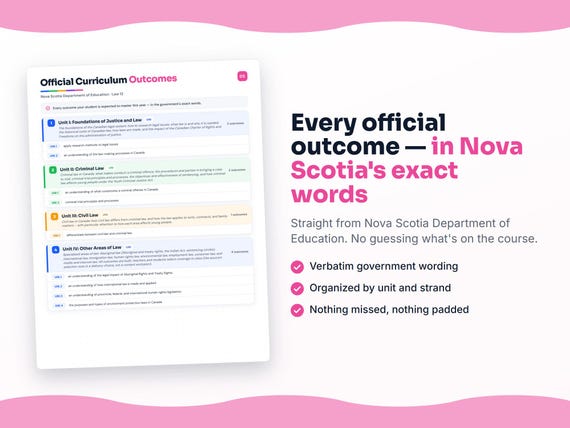
Nova Scotia defines Law 12 by strands and outcomes. MapleMind teaches the same curriculum reorganized for one-skill-at-a-time tutoring — the table shows exactly where every official strand lands, and the ministry's own wording is quoted under each unit below.
Official source Nova Scotia's official curriculumRead it on the government site — curriculum.novascotia.ca ↗| Official strand | Outcomes | Where MapleMind teaches it |
|---|---|---|
| Strand I | 5 | Unit I: Foundations of Justice and Law |
| Strand II | 5 | Unit II: Criminal Law |
| III | 4 | Unit III: Civil Law |
| Strand IV | 18 | Unit IV: Other Areas of Law |
Every skill below, taught one on one.
 Try the first session free
How MapleMind teaches Law 12 — every unit, lesson, and skill
Every skill below runs as a short session: a plain-words lesson, a worked example, solving it together, then a five-question skill check that earns up to three stars. Guided Mode keeps it teaching instead of answer-handing — turning it off needs a parent's password.
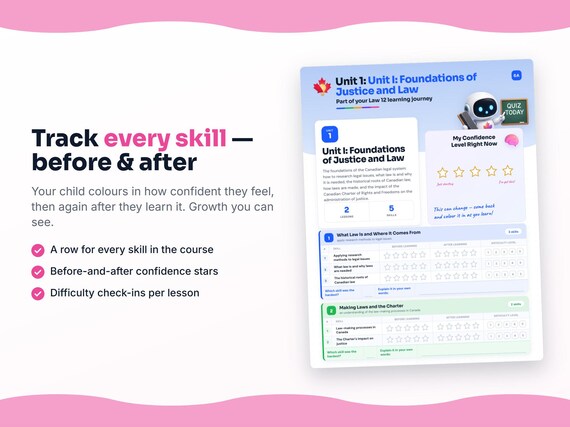
Unit 1Unit I: Foundations of Justice and LawOfficial strand · Strand I
The foundations of the Canadian legal system: how to research legal issues, what law is and why it is needed, the historical roots of Canadian law, how laws are made, and the impact of the Canadian Charter of Rights and Freedoms on the administration of justice.
What Law Is and Where It Comes From
- Applying research methods to legal issuesF1 — Apply research methods to legal issues, including finding, evaluating, and citing legal sources such as statutes and cases.
- What law is and why laws are neededF2 — Explain what law is and why laws are needed in a society, distinguishing law from other rules and values.
- The historical roots of Canadian lawF3 — Investigate the historical roots of Canadian law, including English common law, French civil law, and Indigenous legal traditions.
Making Laws and the Charter
- Law-making processes in CanadaF4 — Demonstrate an understanding of the law-making processes in Canada, including the passage of a bill and the division of federal and provincial powers.
- The Charter's impact on justiceF5 — Analyze the impact of the Canadian Charter of Rights and Freedoms on the administration of justice and law in Canada.
The official wording — 5 outcomes in this unit
- F1
apply research methods to legal issues
- F2
explain what law is and why laws are needed
- F3
investigate the historical roots of Canadian law
- F4
an understanding of the law-making processes in Canada
- F5
analyze the impact of the Canadian Charter of Rights and Freedoms on the administration of justice and law in Canada
Unit 2Unit II: Criminal LawOfficial strand · Strand II
Criminal law in Canada: what makes conduct a criminal offence, the procedures and parties in bringing a case to trial, criminal trial principles and processes, the objectives and effectiveness of sentencing, and how criminal law affects young people under the Youth Criminal Justice Act.
Offences and Bringing a Case to Trial
- What constitutes a criminal offenceCR1 — Demonstrate an understanding of what constitutes a criminal offence in Canada, including the guilty act and guilty mind.
- Bringing a criminal case to trialCR2 — Describe the procedures and parties involved in bringing a criminal case to trial, from investigation and arrest to bail.
Trial, Sentencing, and Youth Justice
- Criminal trial principles and processesCR3 — Describe criminal trial principles and processes, including the burden of proof, the roles of judge and jury, and rules of evidence.
- Objectives and effectiveness of sentencingCR4 — Evaluate the objectives and effectiveness of various sentencing options in the Canadian justice system.
- How criminal law affects young peopleCR5 — Investigate and assess how criminal law affects young people, including the principles of the Youth Criminal Justice Act.
The official wording — 5 outcomes in this unit
- CR1
an understanding of what constitutes a criminal offense in Canada
- CR2
the procedures and parties involved in bringing a criminal case to trial
- CR3
criminal trial principles and processes
- CR4
the objectives and effectiveness of various sentencing options
- CR5
investigate and assess how criminal law affects young people
Unit 3Unit III: Civil LawOfficial strand · III
Civil law in Canada: how civil law differs from criminal law, and how the law applies to torts, contracts, and family matters - with particular attention to how each area affects young people.
Civil Law: Torts, Contracts, and Family
- Civil law vs criminal lawCI1 — Differentiate between civil law and criminal law, including who brings the action, the burden of proof, and the remedies available.
- Tort law and young peopleCI2 — Analyze the role of law as it applies to torts and the relationship between tort law and young people.
- Contract law and young peopleCI3 — Analyze the role of law as it applies to contractual obligations and the implications of contractual obligations for young people.
- Law and family mattersCI4 — Analyze the relationship between law and family matters, including marriage, separation, divorce, and the interests of children.
The official wording — 4 outcomes in this unit
- CI1
differentiate between civil law and criminal law
- CI2
the role of law as it applies to torts and the relationship between tort law and young people
- CI3
the role of law as it applies to contractual obligations as well as the implications of contractual obligations to young people
- CI4
the relationship between law and family matters
Unit 4Unit IV: Other Areas of LawOfficial strand · Strand IV
Specialized areas of law: Aboriginal law (Aboriginal and treaty rights, the Indian Act, sentencing circles), international law, immigration law, human rights law, environmental law, employment law, consumer law, and media and internet law. All outcomes are built; teachers and students select coverage in class (the source's selection note is a delivery choice, not a content exclusion).
Aboriginal Law
- Aboriginal Rights and Treaty RightsAB1 — Demonstrate an understanding of the legal impact of Aboriginal Rights and Treaty Rights, including section 35 and the Nova Scotia Marshall decision.
- Legal effects of the Indian Act and Constitution ActAB2 — Analyze the legal effects of the Indian Act (1876) and the Constitution Act (1982) on Aboriginal peoples.
- Sentencing circlesAB3 — Examine the importance and role of sentencing circles within Aboriginal communities as a restorative-justice practice.
International and Immigration Law
- How international law is made and appliedIN1 — Demonstrate an understanding of how international law is made and applied, including treaties and international bodies.
- The effectiveness of international lawIN2 — Analyze the effectiveness of international law, including its strengths and its enforcement limits.
- The Canadian immigration processIM1 — Chart the immigration process as defined by current Canadian immigration law, including the main categories of entry.
- Comparing immigration actsIM2 — Compare the current Immigration and Refugee Protection Act (2001) with previous immigration acts, including how policy and fairness have changed.
Human Rights Law
- Human rights legislationHR1 — Demonstrate an understanding of provincial, federal, and international human rights legislation.
- How safeguarded are human rights todayHR2 — Evaluate the extent to which human rights in Canada are safeguarded today, including gaps and ongoing challenges.
- Landmark human rights cases and eventsHR3 — Examine the development of human rights law in Canada by analyzing landmark cases and events, including Nova Scotia's Viola Desmond.
Environmental, Employment, Consumer, and Media Law
- Environmental protection lawsEV.1 — Demonstrate an understanding of the purposes and types of environmental protection laws in Canada.
- Effectiveness of environmental lawsEV.2 — Evaluate the effectiveness of environmental laws in sustaining natural resources.
- Statutes that govern employmentEM.1 — Demonstrate an understanding of the statutes that govern terms of employment, including minimum standards.
- Balancing employer and employee rightsEM.2 — Evaluate the extent to which Canadian law balances the rights of employers and employees.
- Consumer protection lawsCO.1 — Demonstrate an understanding of the purposes and types of consumer protection laws in Canada.
- Effectiveness of consumer lawsCO.2 — Evaluate the effectiveness of consumer protection laws in Canada.
- Contracts and internet commerceMI.1 — Examine the role of contracts as they pertain to internet commerce, including click-through agreements.
- Canadian law and the internetMI.2 — Analyze the evolving relationship between Canadian law and the internet, including privacy, defamation, and jurisdiction.
The official wording — 18 outcomes in this unit
- AB1
an understanding of the legal impact of Aboriginal Rights and Treaty Rights
- AB2
the legal effects of the Indian Act (1876) and the Constitution Act (1982) on Aboriginal peoples
- AB3
the importance and role of sentencing circles within Aboriginal communities
- IN1
an understanding of how international law is made and applied
- IN2
the effectiveness of international law
- IM1
the immigration process as defined by current Canadian immigration law
- IM2
the current Immigration and Refugee Protection Act (2001) with previous immigration acts
- HR1
an understanding of provincial, federal, and international human rights legislation
- HR2
the extent to which human rights in Canada are safeguarded today
- HR3
the development of human rights law in Canada by analyzing landmark cases and events
- EV.1
the purposes and types of environment protection laws in Canada
- EV.2
the effectiveness of environmental laws in sustaining natural resources
- EM.1
the statutes that govern terms of employments
- EM.2
the extent to which Canadian law balances the rights of employers and employees
- CO.1
the purposes and types of consumer protection laws in Canada
- CO.2
the effectiveness of consumer protection laws in Canada
- MI.1
the role of contracts as they pertain to Internet commerce
- MI.2
the evolving relationship between Canadian law and the Internet
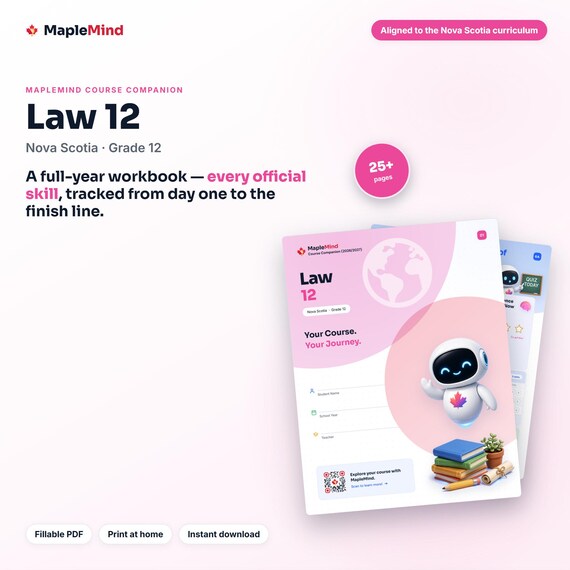
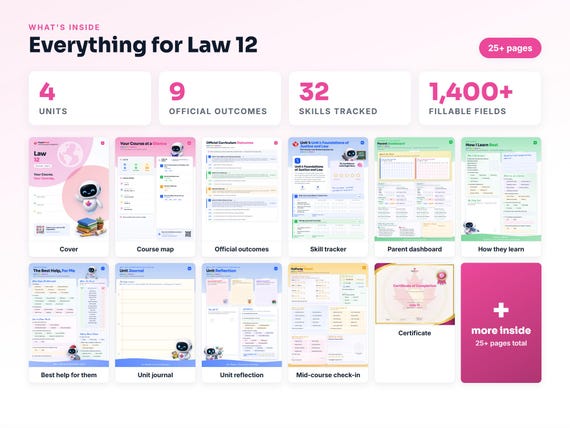
Printable workbook · A keepsake of the year
A Law 12 workbook worth keeping
Built from the same official curriculum as this page. Before and after each skill above, your student colours in how sure they feel — so the two of you can see, on one page, what's clicking and what needs another look. It's a quiet way to follow how the year is really going.
By June it's full of their own handwriting: units worked through, confidence grown, a mid-year check-in, notes from parent-teacher night, and a certificate at the end. Less a worksheet, more a record of the year worth keeping on the shelf.
Instant download · see every page, reviews and the full description · five or more workbooks are $2.99 each
What it looks like in the app



Common questions
Can MapleMind help me with Law 12?
Yes. MapleMind's AI tutor covers all 32 skills in Nova Scotia's Law 12 — you pick the exact skill, and the tutor teaches it step by step: a short lesson, a worked example, solving together, then a skill check to show it stuck.
Is MapleMind aligned to Nova Scotia's official curriculum?
Yes. Every skill in this course maps to an official outcome code from Nova Scotia's Grade 12 Social Studies curriculum, and the ministry's own wording is quoted under each unit on this page — with the official government source linked so you can check it yourself.
What does MapleMind cost?
It's free to start — 5 tutoring chats and a practice quiz every day, no credit card. A Pro subscription ($9.99/month or $49.99/year CAD, 7-day free trial) unlocks unlimited tutoring, practice, and exam simulations.
What if I'm stuck on just one topic?
That's the point of skill-level tutoring: open Law 12 in the app, tap the exact skill from the list on this page, and the tutor teaches just that — no wading through lessons you don't need.
Does MapleMind work in French or other languages?
Yes — 14 languages, including French. Both the app and the tutor's explanations switch to the language you choose.
Where can I see the official Nova Scotia curriculum for Law 12?
The official source is linked on this page — Nova Scotia's official curriculum. The outline here follows it: every MapleMind skill carries its official outcome code, and the ministry's own wording is quoted under each unit.
Keep exploring
Ready when you are
Pick a skill from this page and see it taught properly — free, in the browser, in under a minute.