Get help with African Canadian Studies 11
Most tutoring makes you sit through material you already know. MapleMind flips that: pick the exact skill that's causing trouble — any of the 46 below — and the tutor teaches just that one, step by step, as many times as it takes. Ask questions in plain words, any time of day, in English, French, or 12 other languages.
The official Nova Scotia African Canadian Studies 11 curriculum
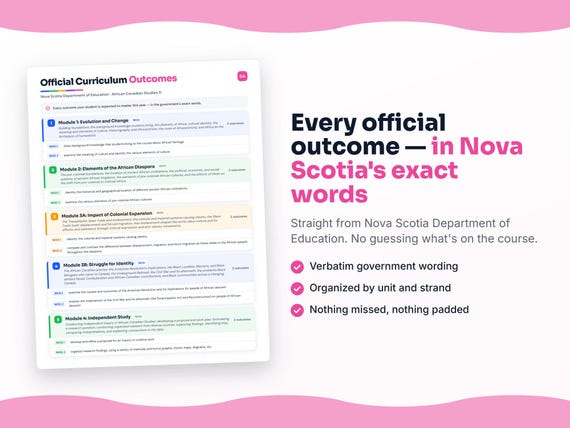
Nova Scotia defines African Canadian Studies 11 by strands and outcomes. MapleMind teaches the same curriculum reorganized for one-skill-at-a-time tutoring — the table shows exactly where every official strand lands, and the ministry's own wording is quoted under each unit below.
Official source Nova Scotia's official curriculumRead it on the government site — curriculum.novascotia.ca ↗| Official strand | Outcomes | Where MapleMind teaches it |
|---|---|---|
| Strand M1 | 7 | Module 1: Evolution and Change |
| Strand M2 | 4 | Module 2: Elements of the African Diaspora |
| M3A | 6 | Module 3A: Impact of Colonial Expansion |
| M3B | 7 | Module 3B: Struggle for Identity |
| Strand M4 | 8 | Module 4: Independent Study |
| Strand M5 | 5 | Module 5: In Pursuit of Justice |
| Strand M6 | 7 | Module 6: The Journey toward Empowerment |
Every skill below, taught one on one.
 Try the first session free
How MapleMind teaches African Canadian Studies 11 — every unit, lesson, and skill
Every skill below runs as a short session: a plain-words lesson, a worked example, solving it together, then a five-question skill check that earns up to three stars. Guided Mode keeps it teaching instead of answer-handing — turning it off needs a parent's password.
Unit 1Module 1: Evolution and ChangeOfficial strand · Strand M1
Building foundations: the background knowledge students bring, the diversity of Africa, cultural identity, the meaning and elements of culture, historiography and Afrocentrism, the roots of Afrocentricity, and Africa as the birthplace of humankind.
Background Knowledge, Diversity, and Identity
- Background knowledge about African heritage1.1 — Share and build on the background knowledge students bring to the course about African heritage.
- The diversity of Africa1.2 — Examine the diversity of Africa in light of its physical environments, cultures, languages, and nationalities.
- Describing your own cultural identity1.3 — Describe your own cultural identity and explain why this identity is important.
Culture, Afrocentrism, and the Birthplace of Humankind
- The meaning and elements of culture1.4 — Examine the meaning of culture and identify the various elements of culture.
- Historiography, ethnocentrism, and Afrocentrism1.5 — Examine the meaning of historiography, ethnocentrism, Eurocentrism, and Afrocentrism, and analyse the significance of these terms for the construction of identity.
- The roots of Afrocentricity1.6 — Investigate the roots of Afrocentricity in the history, geography, and culture of Africa.
- Africa as the birthplace of humankind1.7 — Explore the notion of Africa as the birthplace of humankind.
The official wording — 7 outcomes in this unit
- 1.1
share background knowledge that students bring to the course about African heritage
- 1.2
examine the diversity of Africa in light of its physical environments, cultures, languages, and nationalities
- 1.3
describe their own cultural identity and why this identity is important
- 1.4
examine the meaning of culture and identify the various elements of culture
- 1.5
examine the meaning of “historiography, ethnocentrism, Eurocentrism, and Afrocentrism” and analyze the significance of these terms for the construction of identity
- 1.6
investigate the roots of Afrocentricity from the history, geography, and culture of Africa
- 1.7
explore the notion of Africa as the birth place of humankind
Unit 2Module 2: Elements of the African DiasporaOfficial strand · Strand M2
The pre-colonial foundations: the location of ancient African civilizations, the political, economic, and social systems of ancient African kingdoms, the elements of pre-colonial African cultures, and the effects of these on the shift from pre-colonial to colonial Africa.
Ancient African Civilizations and Kingdoms
- Locating ancient African civilizations2.1 — Identify the historical and geographical location of different ancient African civilizations.
- Systems of ancient African kingdoms2.2 — Examine the political, economic, and social systems of ancient African kingdoms such as Kush, Aksum, Ghana, and Mali.
Pre-Colonial Cultures and the Shift to Colonial Africa
- Elements of pre-colonial African cultures2.3 — Examine the various elements of pre-colonial African cultures.
- From pre-colonial to colonial Africa2.4 — Analyse the effects of cultural components on pre-colonial African history and the changes from pre-colonial to colonial Africa.
The official wording — 4 outcomes in this unit
- 2.1
identify the historical and geographical location of different ancient African civilizations
- 2.2
examine the political, economic, and social systems of ancient African kingdoms (e.g., Kush, Aksum, Ghana, Mali)
- 2.3
examine the various elements of pre-colonial African cultures
- 2.4
analyze the effects of these cultural components on the history of pre-colonial Africa and on the changes that took place from pre-colonial Africa to colonial Africa
Unit 3Module 3A: Impact of Colonial ExpansionOfficial strand · M3A
The Transatlantic Slave Trade and enslavement: the colonial and imperial systems causing slavery, the Slave Trade itself, displacement and forced migration, how enslavement shaped the world, slave culture and its effects, and resistance through cultural expression and anti-slavery movements.
Colonial Systems and the Transatlantic Slave Trade
- Colonial systems causing slavery3A.1 — Identify the colonial and imperial systems that caused slavery.
- The Transatlantic Slave Trade3A.2 — Examine the Transatlantic Slave Trade, including its routes, conditions, and economics.
Forced Migration, the Global Impact of Enslavement, and Resistance
- Displacement, migration, and forced migration3A.3 — Compare and contrast the difference between displacement, migration, and forced migration as these relate to African peoples throughout the diaspora.
- How enslavement shaped the world3A.4 — Investigate how enslavement has been used to shape the world economically and politically throughout time.
- Slave culture and the effects of enslavement3A.5 — Explore the economic, political, social, and spiritual development of slave culture in North America and the Caribbean, and analyse the effects of enslavement on people of African descent.
- Resistance to enslavement3A.6 — Examine how people of African descent used cultural expression and anti-slavery movements to resist enslavement.
The official wording — 6 outcomes in this unit
- 3A.1
identify the colonial and imperial systems causing slavery
- 3A.2
examine the Transatlantic Slave Trade (routes, conditions, economics, etc.)
- 3A.3
compare and contrast the difference between displacement, migration, and force migration as these relate to the African people throughout the diaspora
- 3A.4
investigate how enslavement has been used to shape the world economically and politically throughout time
- 3A.5
explore the development (economical, political, social, spiritual) of slave culture in North America and the Caribbean and analyze the effects of enslavement on people of African descent
- 3A.6
examine how people of African descent used various means to resist enslavement through cultural expression (music, slave insurrections, religion, folktales, literature) and anti-slavery movements
Unit 4Module 3B: Struggle for IdentityOfficial strand · M3B
The African Canadian journey: the American Revolution's implications, the Black Loyalists, Maroons, and Black Refugees who came to Canada, the Underground Railroad, the Civil War and its aftermath, the problems Black settlers faced, Confederation and African Canadian contributions, and Black communities across a changing Canada.
Revolution, Black Loyalists, and the Underground Railroad
- The American Revolution and people of African descent3B.1 — Examine the causes and outcomes of the American Revolution and its implications for people of African descent.
- Black Loyalists, Maroons, and Black Refugees3B.2 — Investigate why the Black Loyalists, Maroons, and Black Refugees immigrated to Canada.
- The Underground Railroad3B.3 — Evaluate the impact of the Underground Railroad on the diaspora of African people within the United States and Canada.
Civil War, Settlement, and Confederation
- The Civil War and its aftermath3B.4 — Analyse the implications of the Civil War and its aftermath, including the Emancipation Act and Reconstruction, on people of African descent.
- Problems Black settlers experienced in Canada3B.5 — Identify the problems Black settlers experienced coming to Canada, such as Slave Code Laws, discriminatory legislation, environment, and settlement patterns.
- Confederation and African Canadian contributions3B.6 — Examine the implications of Confederation on Canada, and demonstrate an understanding of the contributions and roles African Canadians played before and after Confederation, including leadership and military service.
- Black communities across a changing Canada3B.7 — Compare and contrast Black communities across Canada within changing demographics, such as migration patterns, immigration policy, and the expansion of Black communities after 1867.
The official wording — 7 outcomes in this unit
- 3B.1
examine the causes and outcomes of the American Revolution and its implications for people of African descent
- 3B.2
investigate why the Black Loyalists, Maroons, and Black Refugees immigrated to Canada
- 3B.3
evaluate the impact of the Underground Railroad on the diaspora of African people within the United States and Canada
- 3B.4
analyze the implications of the Civil War and its aftermath (the Emancipation Act and Reconstruction) on people of African descent
- 3B.5
identify the problems Black settlers experienced coming to Canada, (e.g., Slave Code Laws, legislation, environment, and settlement patterns)
- 3B.6
examine the implications of Confederation on Canada as a nation, and demonstrate an understanding of the contributions and roles that African Canadians have played in pre- and post- confederation (e.g., leadership in communities and society, military)
- 3B.7
compare and contrast Black communities across Canada within changing demographics (e.g., Migration patterns, Immigration policy, expansion of Black communities after 1867)
Unit 5Module 4: Independent StudyOfficial strand · Strand M4
Conducting independent inquiry in African Canadian Studies: developing a proposal and work plan, formulating a research question, conducting organized research from diverse sources, organizing findings, identifying bias, comparing interpretations, and explaining connections in the data.
Planning and Conducting the Inquiry
- Developing an inquiry proposal4.1 — Develop and refine a proposal for an inquiry or creative work in African Canadian Studies.
- Building a work plan4.2 — Develop a work plan that enables time management, monitors progress, and contributes to the criteria for evaluation.
- Formulating a research question4.3 — Formulate a clear, focused question for research.
- Conducting organized research4.4 — Conduct organized research using a variety of information sources that present a diverse range of perspectives on African Canadian Studies.
Organizing, Evaluating, and Interpreting Findings
- Organizing research findings4.5 — Organize research findings using a variety of methods and forms, such as graphs, charts, maps, and diagrams.
- Identifying bias and stereotyping4.6 — Demonstrate an ability to identify bias, prejudice, stereotyping, or a lack of substantiation in statements, arguments, and opinions.
- Comparing interpretations4.7 — Compare key interpretations of African Canadian studies.
- Explaining connections in the data4.8 — Explain relationships and connections in the data studied, such as chronological ties, cause and effect, and similarities and differences.
The official wording — 8 outcomes in this unit
- 4.1
develop and refine a proposal for an inquiry or creative work
- 4.2
develop a work plan that enables time management, monitors progress, and contributes to the criteria for evaluation
- 4.3
formulate a question for research
- 4.4
conduct an organized research, using a variety of information sources (e.g., audio-visual materials, internet sites) that present a diverse range of perspectives on African Canadian Studies
- 4.5
organize research findings, using a variety of methods and forms: graphs, charts, maps, diagrams, etc.
- 4.6
demonstrate an ability to identify bias, prejudice, stereotyping, or a lack of substantiation in statements, arguments, and opinions
- 4.7
compare key interpretations of African Canadian studies
- 4.8
explain relationships and connections in the data studied (e.g., chronological ties, cause and effect, similarities and differences)
Unit 6Module 5: In Pursuit of JusticeOfficial strand · Strand M5
The struggle for justice: power, disenfranchisement, segregation, and racism; the Civil-Rights Movement in Africa, the United States, and Canada; its impact in Canada and especially Nova Scotia; legal documents and the Canadian context; and the Black church as an instrument of leadership.
Power, Racism, and the Civil-Rights Movement
- Power, disenfranchisement, segregation, and racism5.1 — Examine the concept of power and the correlation between power, disenfranchisement, segregation, and racism as these relate to the social conditions of people of African descent, including employment, housing, education, and politics.
- The Civil-Rights Movement compared5.2 — Compare and contrast the history of the Civil-Rights Movement in Africa, the United States, and Canada.
- The Civil-Rights Movement in Nova Scotia5.3 — Analyse the impact of the Civil-Rights Movement on people of African descent in Canada, and in particular in Nova Scotia.
Legal Documents and the Black Church
- Legal documents and the Canadian context5.4 — Investigate how legal documents relate to the Canadian context regarding Confederation and the Constitution, including UN documents and the Charter of Rights and Freedoms.
- The Black church as an instrument of leadership5.5 — Examine the traditions of the Black church as an instrument for political, social, and educational leadership.
The official wording — 5 outcomes in this unit
- 5.1
examine the concept of power and the correlation between power, disenfranchisement, segregation, and racism as these relate to the social conditions of people of African descent (e.g., employment, housing, education, and politics)
- 5.2
compare and contrast the history of the Civil-Rights Movement in Africa, United States, and Canada
- 5.3
analyze the impact of the Civil-Rights Movement on people of African descent in Canada, and in particular, in Nova Scotia
- 5.4
investigate how legal documents relate to the Canadian context regarding Confederation, Constitution. (e.g., UN documents, Charter of Rights and Freedom, Constitutional documents)
- 5.5
examine the traditions of the Black church as an instrument for political, social, and educational leadership
Unit 7Module 6: The Journey toward EmpowermentOfficial strand · Strand M6
Empowerment and its future: the empowerment model and institutional change, global political empowerment, grassroots organizations, the contributions and achievements of African Canadians, the evolution of Black families, the challenges facing African Canadians and African Nova Scotians today, and collective consciousness across the diaspora.
Empowerment, Independence, and Grassroots Organizations
- The empowerment model and institutional change6.1 — Examine the empowerment model (Catalyst, Awareness, Analysis and Action) and investigate its impact on people of African descent through institutional change.
- Global empowerment and independence6.2 — Investigate the global impact of political empowerment and the independence of colonized countries from the 1950s to the present.
- Grassroots organizations over time6.3 — Demonstrate how community-based and grassroots organizations have developed and changed over time.
Contributions and Achievements of African Canadians
- Contributions in political and religious institutions6.4 — Demonstrate an understanding of the contributions and achievements of African Canadians in political and religious institutions.
- Contributions in judicial institutions6.4 — Demonstrate an understanding of the contributions and achievements of African Canadians in judicial institutions.
Families, Contemporary Challenges, and Collective Consciousness
- The evolution of Black families in Canada6.5 — Examine the evolution of Black families in Canada, including traditional, extended, and nuclear family structures.
- Challenges facing African Canadians and African Nova Scotians today6.6 — Examine the challenges facing African Canadians and African Nova Scotians today.
- Collective consciousness across the diaspora6.7 — Demonstrate an understanding of the collective consciousness of people of African descent throughout the diaspora as it relates to the African continent.
The official wording — 7 outcomes in this unit
- 6.1
examine the concept of empowerment (i.e., empowerment model: Catalyst, Awareness, Analysis and Action-CAAA) and investigate its impact on people of African descent through institutional change (e.g., education, economics, political institutions, individual empowerment, community empowerment)
- 6.2
investigate the global impact of political empowerment and independence of colonized countries from the 1950s to the present
- 6.3
demonstrate how community-based groups / grassroots organizations have developed and changed over time (e.g., Nova Scotia Association for the Advancement of Coloured People, African United Baptist Association, Black United Front, Nova Scotia Coloured Home, Association for Black Social Workers, Black Cultural Centre, Congress of Black Women)
- 6.4
demonstrate an understanding of the contributions and achievements of African Canadians in the following contexts: social, educational, political, religious, and judicial institutions
- 6.5
examine the evolution of Black families in Canada such as traditional family structure, extended family, and nuclear family
- 6.6
examine the challenges facing African Canadians and African Nova Scotians today
- 6.7
demonstrate an understanding of the consciousness of people of African descent throughout the diaspora as these relate to the African continent
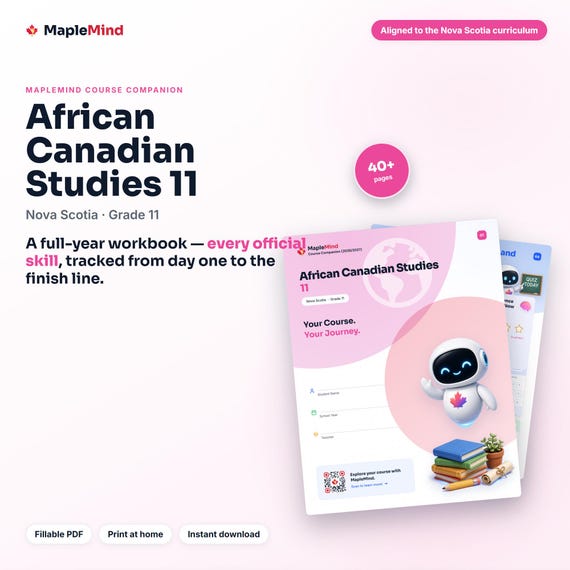
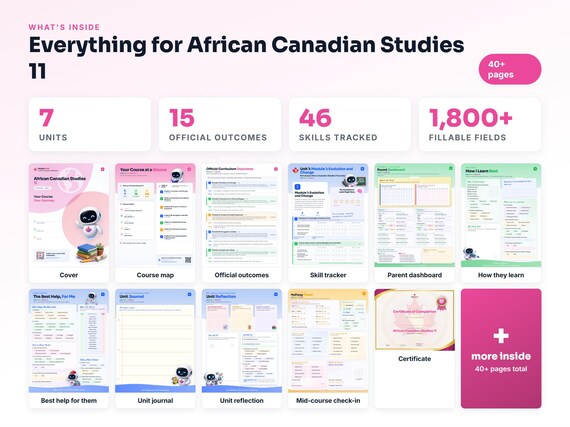
Printable workbook · A keepsake of the year
A African Canadian Studies 11 workbook worth keeping
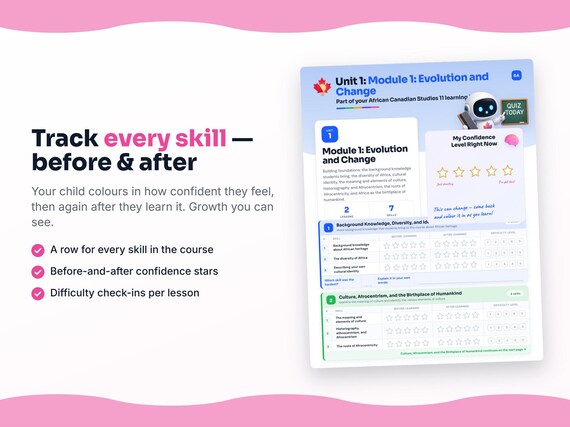
Built from the same official curriculum as this page. Before and after each skill above, your student colours in how sure they feel — so the two of you can see, on one page, what's clicking and what needs another look. It's a quiet way to follow how the year is really going.
By June it's full of their own handwriting: units worked through, confidence grown, a mid-year check-in, notes from parent-teacher night, and a certificate at the end. Less a worksheet, more a record of the year worth keeping on the shelf.
Instant download · see every page, reviews and the full description · five or more workbooks are $2.99 each
What it looks like in the app
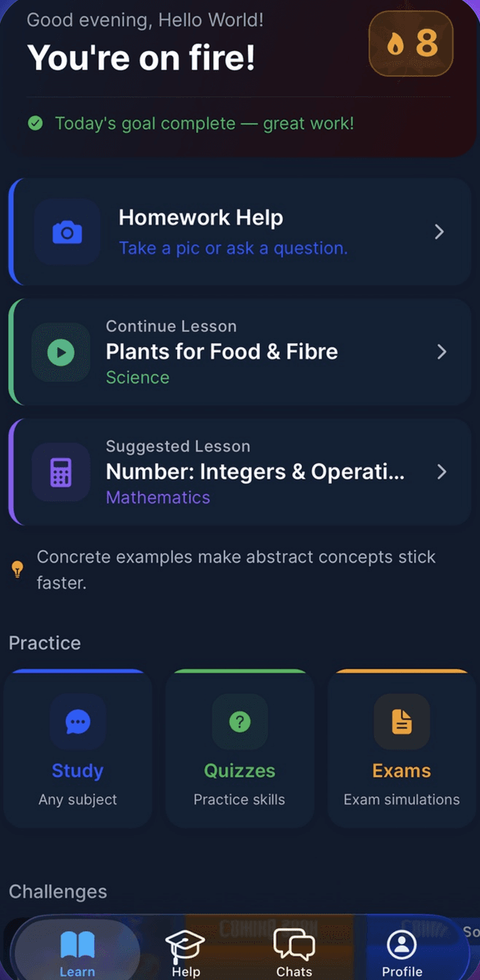
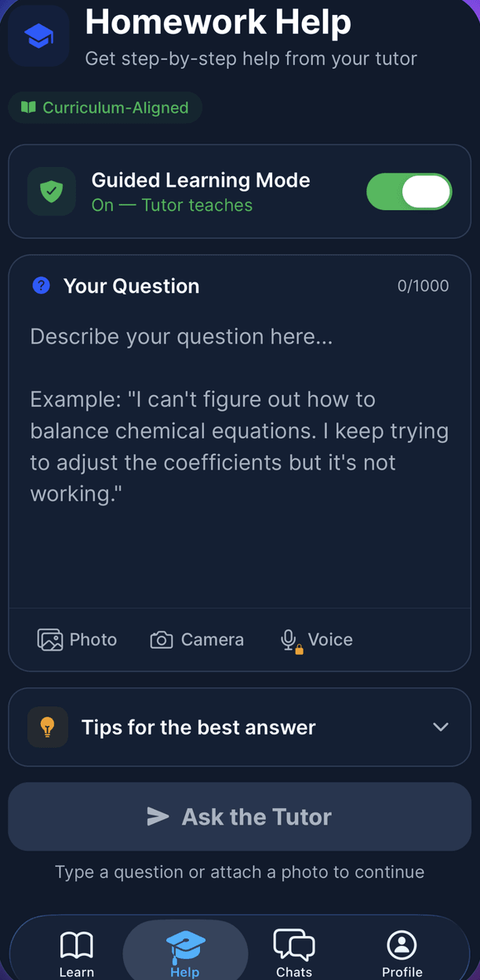
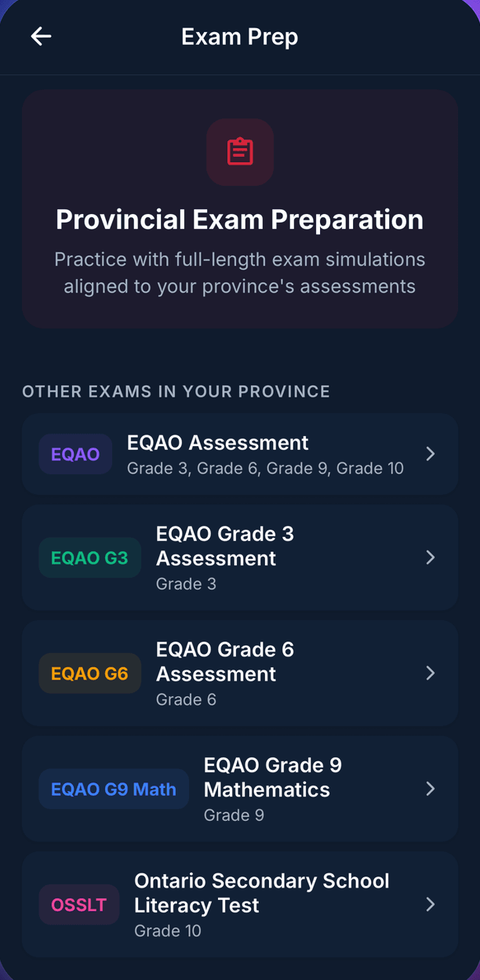
Common questions
Can MapleMind help me with African Canadian Studies 11?
Yes. MapleMind's AI tutor covers all 46 skills in Nova Scotia's African Canadian Studies 11 — you pick the exact skill, and the tutor teaches it step by step: a short lesson, a worked example, solving together, then a skill check to show it stuck.
Is MapleMind aligned to Nova Scotia's official curriculum?
Yes. Every skill in this course maps to an official outcome code from Nova Scotia's Grade 11 Social Studies curriculum, and the ministry's own wording is quoted under each unit on this page — with the official government source linked so you can check it yourself.
What does MapleMind cost?
It's free to start — 5 tutoring chats and a practice quiz every day, no credit card. A Pro subscription ($9.99/month or $49.99/year CAD, 7-day free trial) unlocks unlimited tutoring, practice, and exam simulations.
What if I'm stuck on just one topic?
That's the point of skill-level tutoring: open African Canadian Studies 11 in the app, tap the exact skill from the list on this page, and the tutor teaches just that — no wading through lessons you don't need.
Does MapleMind work in French or other languages?
Yes — 14 languages, including French. Both the app and the tutor's explanations switch to the language you choose.
Where can I see the official Nova Scotia curriculum for African Canadian Studies 11?
The official source is linked on this page — Nova Scotia's official curriculum. The outline here follows it: every MapleMind skill carries its official outcome code, and the ministry's own wording is quoted under each unit.
Keep exploring
Ready when you are
Pick a skill from this page and see it taught properly — free, in the browser, in under a minute.