Get help with Global Geography 12
Most tutoring makes you sit through material you already know. MapleMind flips that: pick the exact skill that's causing trouble — any of the 28 below — and the tutor teaches just that one, step by step, as many times as it takes. Ask questions in plain words, any time of day, in English, French, or 12 other languages.
The official Nova Scotia Global Geography 12 curriculum
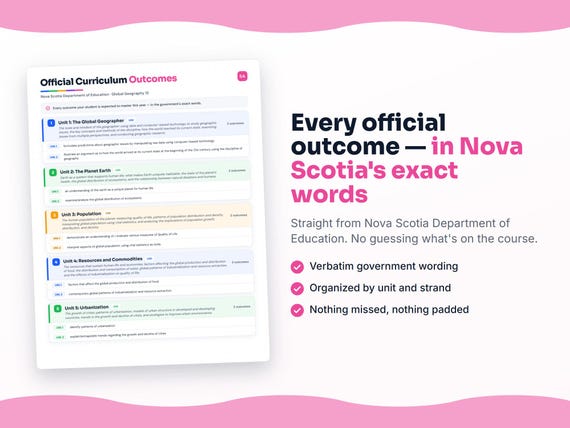
Nova Scotia defines Global Geography 12 by strands and outcomes. MapleMind teaches the same curriculum reorganized for one-skill-at-a-time tutoring — the table shows exactly where every official strand lands, and the ministry's own wording is quoted under each unit below.
Official source Nova Scotia's official curriculumRead it on the government site — curriculum.novascotia.ca ↗| Official strand | Outcomes | Where MapleMind teaches it |
|---|---|---|
| Strand 1 | 6 | Unit 1: The Global Geographer |
| Strand 2 | 4 | Unit 2: The Planet Earth |
| Strand 3 | 4 | Unit 3: Population |
| Strand 4 | 4 | Unit 4: Resources and Commodities |
| Strand 5 | 4 | Unit 5: Urbanization |
| Strand 6 | 4 | Unit 6: Culture and Politics |
Every skill below, taught one on one.
 Try the first session free
How MapleMind teaches Global Geography 12 — every unit, lesson, and skill
Every skill below runs as a short session: a plain-words lesson, a worked example, solving it together, then a five-question skill check that earns up to three stars. Guided Mode keeps it teaching instead of answer-handing — turning it off needs a parent's password.
Unit 1Unit 1: The Global GeographerOfficial strand · Strand 1
The tools and mindset of the geographer: using data and computer-based technology to study geographic issues, the key concepts and methods of the discipline, how the world reached its current state, examining issues from multiple perspectives, and conducting geographic research.
The Geographer's Tools and Methods
- Using data and technology for geographic issues1.1 — Formulate predictions about geographic issues by manipulating raw data using computer-based technology such as GIS and spreadsheets.
- Key concepts and methods of geography1.2 — Identify key concepts, skills, and problem-solving and analytical methods used by geographers.
Perspectives and Geographic Research
- How the world reached its current state1.3 — Illustrate an argument about how the world arrived at its current state at the beginning of the 21st century, using the discipline of geography.
- Issues from multiple perspectives1.4 — Examine geographic issues from multiple perspectives and with regard to the experiences of youth.
- Conducting a geographic research project1.5 — Plan, conduct, and present a geographic research project, independently or collaboratively, using the skills and methods of geography.
- A global issue across disciplines1.6 — Research a global issue from the perspective of geography and at least two other disciplines.
The official wording — 6 outcomes in this unit
- 1.1
formulate predictions about geographic issues by manipulating raw data using computer-based technology
- 1.2
identify key concepts, skills, and problem solving and analytical methods used by geographers
- 1.3
illustrate an argument as to how the world arrived at its current state at the beginning of the 21st century, using the discipline of geography
- 1.4
examine all issues from multiple perspectives and with regard to the experiences of youth
- 1.5
plan, conduct, and present a research project, independently or collaboratively, using the skills and methods of geography
- 1.6
research a global issue from the perspective of geography and at least two other disciplines
Unit 2Unit 2: The Planet EarthOfficial strand · Strand 2
Earth as a system that supports human life: what makes Earth uniquely habitable, the state of the planet's health, the global distribution of ecosystems, and the relationship between natural disasters and humans.
Earth as a Living System
- Earth as a unique planet for human life2.1 — Demonstrate an understanding of the earth as a unique planet for human life, including the systems that make it habitable.
- The planetary state of health2.2 — Evaluate the planetary state of health, including indicators of environmental stress.
Ecosystems and Natural Disasters
- The global distribution of ecosystems2.3 — Examine and analyze the global distribution of ecosystems (biomes) and the factors that shape it.
- Natural disasters and humans2.4 — Investigate the relationship between natural disasters and humans, including hazard, vulnerability, and response.
The official wording — 4 outcomes in this unit
- 2.1
an understanding of the earth as a unique planet for human life
- 2.2
evaluate the planetary state of health
- 2.3
examine/analyze the global distribution of ecosystems
- 2.4
the relationship between natural disasters and humans
Unit 3Unit 3: PopulationOfficial strand · Strand 3
The human population of the planet: measuring quality of life, patterns of population distribution and density, interpreting global population using vital statistics, and analyzing the implications of population growth, distribution, and density.
Quality of Life and Where People Live
- Understanding quality of life3.1 — Demonstrate an understanding of quality of life and the different dimensions that make it up.
- Evaluating measures of quality of life3.1 — Evaluate various measures of quality of life, such as GDP per capita and the Human Development Index.
- Population distribution and density3.2 — Explain patterns of population distribution and density and the factors that shape where people live.
Reading and Projecting Population
- Interpreting population with vital statistics3.3 — Interpret aspects of global population using vital statistics such as birth rates, death rates, and population pyramids.
- Implications of population change3.4 — Analyze the implications of population growth, distribution, and density for societies and the environment.
The official wording — 4 outcomes in this unit
- 3.1
demonstrate an understanding of / evaluate various measures of Quality of Life
- 3.2
explain patterns of population distributions and densities
- 3.3
interpret aspects of global population, using vital statistics as tools
- 3.4
the implications of growth, distributions, and densities
Unit 4Unit 4: Resources and CommoditiesOfficial strand · Strand 4
The resources that sustain human life and economies: factors affecting the global production and distribution of food, the distribution and consumption of water, global patterns of industrialization and resource extraction, and the effects of industrialization on quality of life.
Food and Water
- The global production and distribution of food4.1 — Analyze factors that affect the global production and distribution of food, including physical, economic, and political factors.
- The global distribution and consumption of water4.2 — Analyze factors that affect the global distribution and consumption of water, including scarcity and competing uses.
Industrialization and Its Effects
- Patterns of industrialization and resource extraction4.3 — Examine contemporary global patterns of industrialization and resource extraction.
- Effects of industrialization on quality of life4.4 — Examine and evaluate the effects of industrialization on quality of life throughout the world, weighing benefits.
- The costs of industrialization4.4 — Evaluate the environmental and social costs of industrialization on quality of life throughout the world.
The official wording — 4 outcomes in this unit
- 4.1
factors that affect the global production and distribution of food
- 4.2
factors that affect the global distribution and consumption of water
- 4.3
contemporary global patterns of industrialization and resource extraction
- 4.4
the effects of industrialization on quality of life throughout the world
Unit 5Unit 5: UrbanizationOfficial strand · Strand 5
The growth of cities: patterns of urbanization, models of urban structure in developed and developing countries, trends in the growth and decline of cities, and strategies to improve urban environments.
Urban Patterns and Structure
- Patterns of urbanization5.1 — Identify patterns of urbanization, including the global shift toward urban living.
- Models of urban structure5.2 — Evaluate models of urban structure in developed and developing countries.
Urban Change and Improvement
- Growth and decline of cities5.3 — Explain and extrapolate trends regarding the growth and decline of cities.
- Improving urban environments5.4 — Illustrate strategies to improve urban environments and make cities more livable and sustainable.
The official wording — 4 outcomes in this unit
- 5.1
identify patterns of urbanization
- 5.2
models of urban structure in developed and developing countries
- 5.3
explain/extrapolate trends regarding the growth and decline of cities
- 5.4
strategies to improve urban environments
Unit 6Unit 6: Culture and PoliticsOfficial strand · Strand 6
The cultural and political geography of the world: the distribution of cultural groups, how the environment is affected by cultural attitudes and practices, the evolution of the contemporary global political pattern, and the spatial disjunctions between political, cultural, and other patterns.
Cultural Geography
- The distribution of cultural groups6.1 — Analyze the distribution of different cultural groups in the world, including language and religion.
- Culture and the environment6.2 — Investigate the extent to which the environment is affected by cultural attitudes and practices.
Political Geography
- The contemporary global political pattern6.3 — Examine the evolution of the contemporary global political pattern, including the modern state system.
- Mismatches between political and cultural patterns6.4 — Analyze the spatial disjunctions between political, cultural, and other patterns, and the conflicts they can cause.
The official wording — 4 outcomes in this unit
- 6.1
the distribution of different cultural groups in the world
- 6.2
the extent to which the environment has been/is affected by cultural attitudes and practices
- 6.3
the evolution of the contemporary global political pattern
- 6.4
the spatial disjunctions between political, cultural, and other patterns
Printable workbook · A keepsake of the year
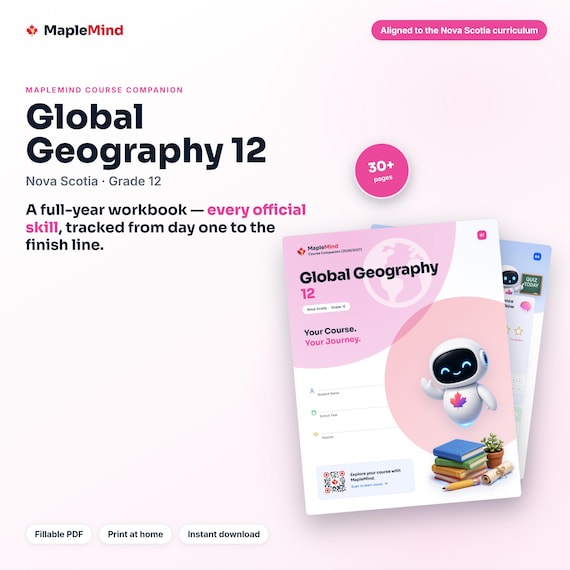
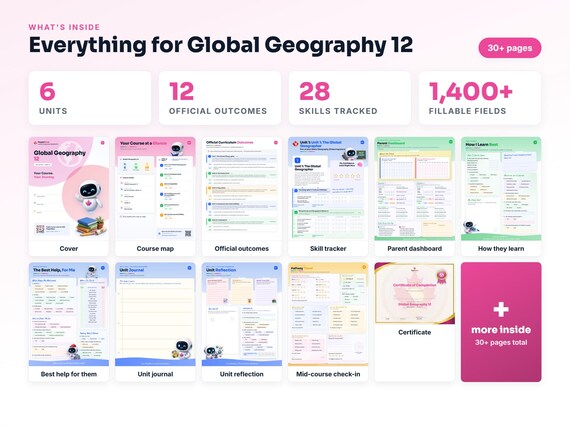
A Global Geography 12 workbook worth keeping
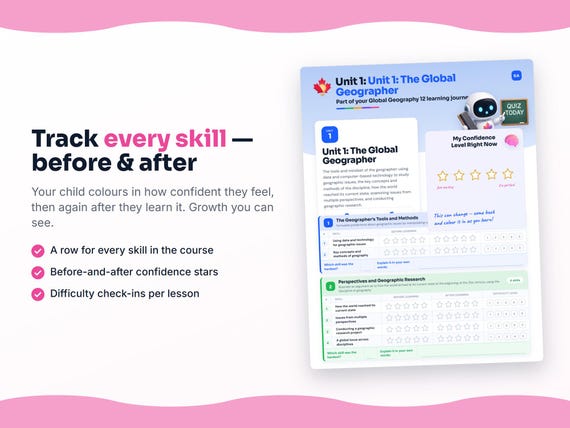
Built from the same official curriculum as this page. Before and after each skill above, your student colours in how sure they feel — so the two of you can see, on one page, what's clicking and what needs another look. It's a quiet way to follow how the year is really going.
By June it's full of their own handwriting: units worked through, confidence grown, a mid-year check-in, notes from parent-teacher night, and a certificate at the end. Less a worksheet, more a record of the year worth keeping on the shelf.
Instant download · see every page, reviews and the full description · five or more workbooks are $2.99 each
What it looks like in the app
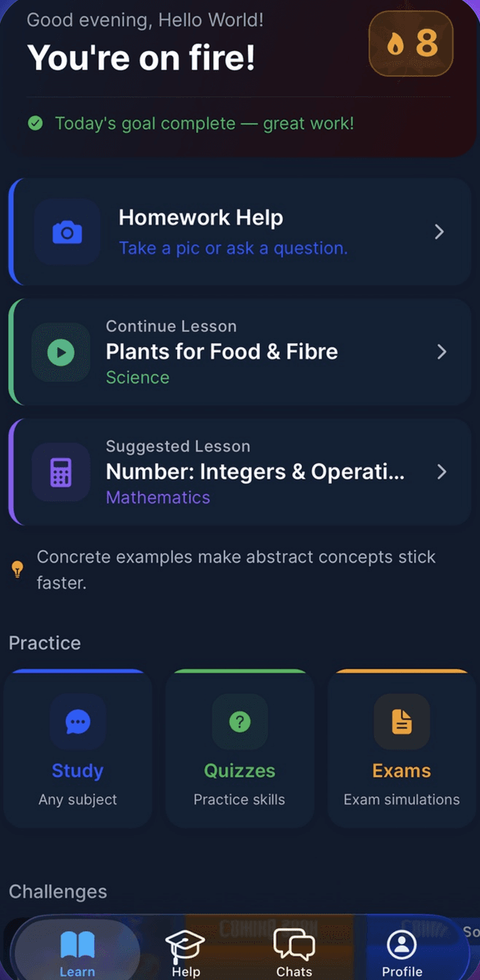
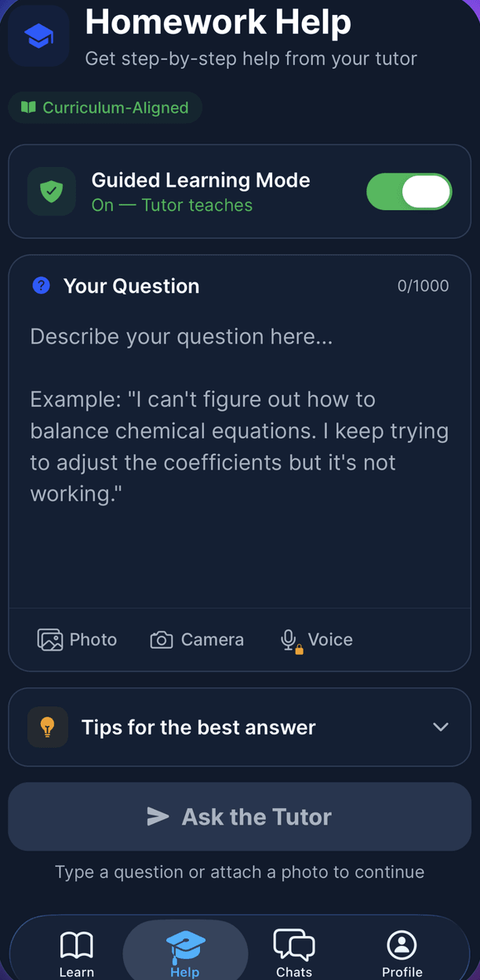
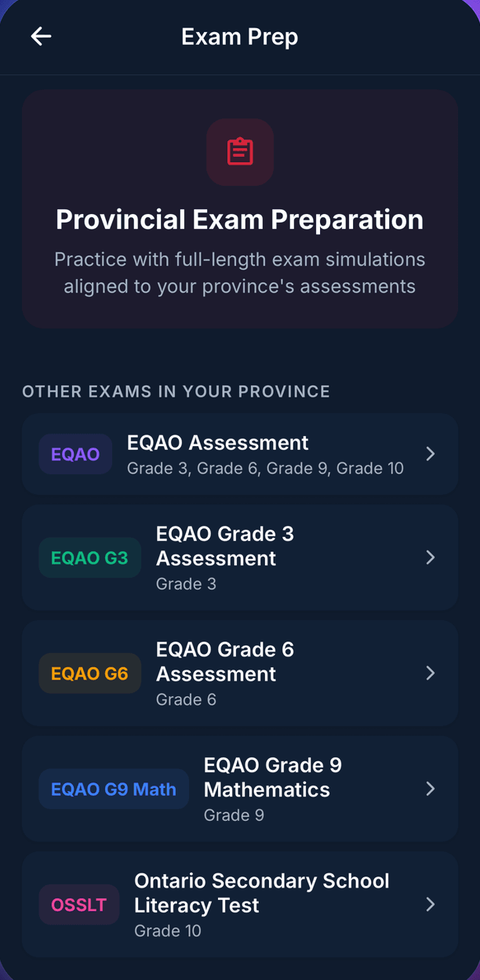
Common questions
Can MapleMind help me with Global Geography 12?
Yes. MapleMind's AI tutor covers all 28 skills in Nova Scotia's Global Geography 12 — you pick the exact skill, and the tutor teaches it step by step: a short lesson, a worked example, solving together, then a skill check to show it stuck.
Is MapleMind aligned to Nova Scotia's official curriculum?
Yes. Every skill in this course maps to an official outcome code from Nova Scotia's Grade 12 Social Studies curriculum, and the ministry's own wording is quoted under each unit on this page — with the official government source linked so you can check it yourself.
What does MapleMind cost?
It's free to start — 5 tutoring chats and a practice quiz every day, no credit card. A Pro subscription ($9.99/month or $49.99/year CAD, 7-day free trial) unlocks unlimited tutoring, practice, and exam simulations.
What if I'm stuck on just one topic?
That's the point of skill-level tutoring: open Global Geography 12 in the app, tap the exact skill from the list on this page, and the tutor teaches just that — no wading through lessons you don't need.
Does MapleMind work in French or other languages?
Yes — 14 languages, including French. Both the app and the tutor's explanations switch to the language you choose.
Where can I see the official Nova Scotia curriculum for Global Geography 12?
The official source is linked on this page — Nova Scotia's official curriculum. The outline here follows it: every MapleMind skill carries its official outcome code, and the ministry's own wording is quoted under each unit.
Keep exploring
Ready when you are
Pick a skill from this page and see it taught properly — free, in the browser, in under a minute.