Get help with Canadian History 11
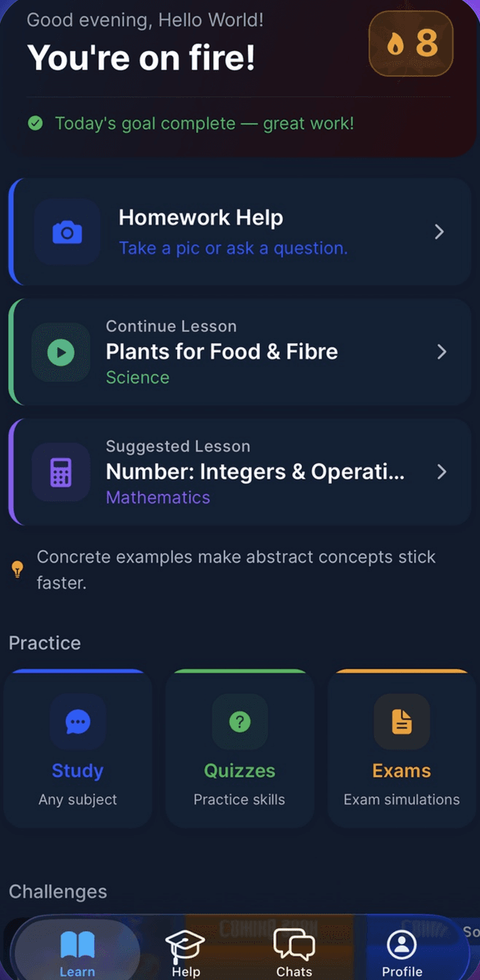
Most tutoring makes you sit through material you already know. MapleMind flips that: pick the exact skill that's causing trouble — any of the 31 below — and the tutor teaches just that one, step by step, as many times as it takes. Ask questions in plain words, any time of day, in English, French, or 12 other languages.
The official Nova Scotia Canadian History 11 curriculum
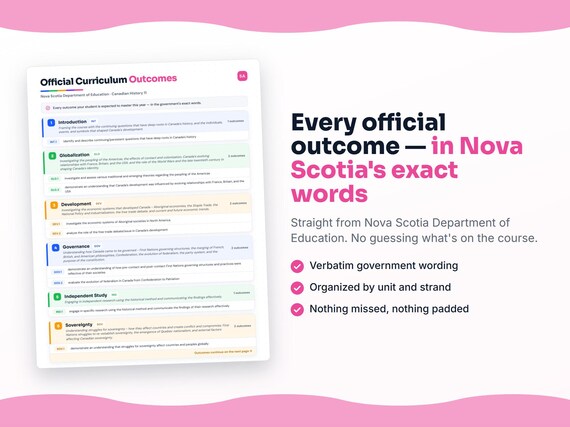
Nova Scotia defines Canadian History 11 by strands and outcomes. MapleMind teaches the same curriculum reorganized for one-skill-at-a-time tutoring — the table shows exactly where every official strand lands, and the ministry's own wording is quoted under each unit below.
Official source Nova Scotia's official curriculumRead it on the government site — curriculum.novascotia.ca ↗| Official strand | Outcomes | Where MapleMind teaches it |
|---|---|---|
| Strand IN | 2 | Introduction |
| Strand GL | 6 | Globalization |
| Strand D | 5 | Development |
| Strand G | 6 | Governance |
| Strand IS | 1 | Independent Study |
| Strand S | 5 | Sovereignty |
| Strand J | 5 | Justice |
Every skill below, taught one on one.
 Try the first session free
How MapleMind teaches Canadian History 11 — every unit, lesson, and skill
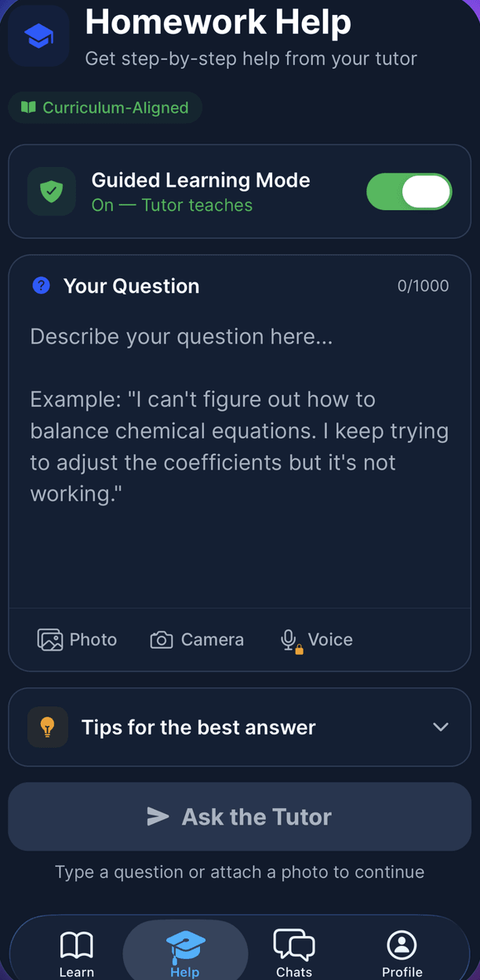
Every skill below runs as a short session: a plain-words lesson, a worked example, solving it together, then a five-question skill check that earns up to three stars. Guided Mode keeps it teaching instead of answer-handing — turning it off needs a parent's password.
Unit 1IntroductionOfficial strand · Strand IN
Framing the course with the continuing questions that have deep roots in Canada's history, and the individuals, events, and symbols that shaped Canada's development.
Persistent Questions and Historical Significance
- Continuing questions in Canada's historyIN1 — Identify and describe continuing, persistent questions that have deep roots in Canada's history.
- Individuals, events, and symbols of significanceIN2 — Identify individuals, events, and symbols believed to have shaped Canada's development, and explain their historical significance.
The official wording — 2 outcomes in this unit
- IN1
identify and describe continuing/persistent questions that have deep roots in Canada’s history
- IN2
identify those individuals, events, and/or symbols that they believe have contributed to the development of Canada and explain their historical significance
Unit 2GlobalizationOfficial strand · Strand GL
Investigating the peopling of the Americas, the effects of contact and colonization, Canada's evolving relationships with France, Britain, and the USA, and the role of the World Wars and the late twentieth century in shaping Canada's identity.
Peopling the Americas and the Impact of Contact
- Theories of the peopling of the AmericasGL1 — Investigate and assess various traditional and emerging theories regarding the peopling of the Americas.
- The effects of contact and colonizationGL2 — Analyse the effects of contact and the subsequent colonization on peoples of the Americas.
Evolving Relationships and the Wars
- Relationships with France, Britain, and the USAGL3 — Demonstrate an understanding that Canada's development was influenced by evolving relationships with France, Britain, and the USA.
- WWI and Canadian identityGL4 — Analyse the role played by the First World War in shaping Canada's identity.
- WWII and Canadian identityGL5 — Analyse the role played by the Second World War in shaping Canada's identity.
- Canada's roles in the late twentieth centuryGL6 — Analyse the evolution of Canada's roles in the late twentieth century.
The official wording — 6 outcomes in this unit
- GL1
investigate and assess various traditional and emerging theories regarding the peopling of the Americas
- GL2
analyze the effects of contact and subsequent colonization
- GL3
demonstrate an understanding that Canada’s development was influenced by evolving relationships with France, Britain, and the USA
- GL4
analyze the role played by WWI in shaping Canada’s identity
- GL5
analyze the role played by WWII in shaping Canada’s identity
- GL6
analyze the evolution of Canada’s roles in the late twentieth century
Unit 3DevelopmentOfficial strand · Strand D
Investigating the economic systems that developed Canada - Aboriginal economies, the Staple Trade, the National Policy and industrialization, the free trade debate, and current and future economic trends.
Early Economies, the Staple Trade, and the National Policy
- Economic systems of Aboriginal societiesD1 — Investigate the economic systems of Aboriginal societies in North America.
- The Staple Trade and colonial developmentD2 — Analyse the role played by the Staple Trade in the development of colonial Canada.
- The National Policy and industrializationD3 — Analyse the relationship between the National Policy and the industrialization of Canada.
Free Trade and Canada's Economic Future
- The free trade debateD4 — Analyse the role of the free trade debate and issue in Canada's development.
- Economic trends and Canada's futureD5 — Analyse the economic trends and policies that impact Canada's current and future development.
The official wording — 5 outcomes in this unit
- D1
investigate the economic systems of Aboriginal societies in North America
- D2
analyze the role played by the Staple Trade in the development of (Colonial) Canada
- D3
analyze the relationship between the National Policy and the industrialization of Canada
- D4
analyze the role of the free trade debate/issue in Canada’s development
- D5
analyze the economic trends and policies that impact on Canada’s current and future development
Unit 4GovernanceOfficial strand · Strand G
Understanding how Canada came to be governed - First Nations governing structures, the merging of French, British, and American philosophies, Confederation, the evolution of federalism, the party system, and the purpose of the constitution.
First Nations Governance to Confederation
- First Nations governing structuresG1 — Demonstrate an understanding of how pre-contact and post-contact First Nations governing structures and practices reflected their societies.
- Merging French, British, and American philosophiesG2 — Demonstrate an understanding of how and why competing French, British, and American governing philosophies merged in British North America.
- The road to ConfederationG3 — Analyse how emerging political and economic structures led to Confederation.
Federalism, Parties, and the Constitution
- The evolution of federalismG4 — Evaluate the evolution of federalism in Canada from Confederation to Patriation.
- From two parties to manyG5 — Analyse the shift from a traditional two-party process to a multi-party process in post-Confederation Canada.
- The purpose of the constitutionG6 — Demonstrate an understanding of the purpose of the Canadian constitution.
The official wording — 6 outcomes in this unit
- G1
demonstrate an understanding of how pre-contact and post-contact First Nations governing structures and practices were reflective of their societies
- G2
demonstrate an understanding of how and why competing French, British, and American governing philosophies merged in BNA
- G3
analyze how emerging political and economic structures led to Confederation
- G4
evaluate the evolution of federalism in Canada from Confederation to Patriation
- G5
analyze the shift from a traditional two-party process to a multi-party process in post- Confederation Canada
- G6
demonstrate an understanding of the purpose of the Canadian constitution
Unit 5Independent StudyOfficial strand · Strand IS
Engaging in independent research using the historical method and communicating the findings effectively.
Research Using the Historical Method
- Conducting and communicating historical researchIS1 — Engage in specific research using the historical method and communicate the findings of that research effectively.
The official wording — 1 outcome in this unit
- IS1
engage in specific research using the historical method and communicate the findings of their research effectively
Unit 6SovereigntyOfficial strand · Strand S
Understanding struggles for sovereignty - how they affect countries and create conflict and compromise, First Nations struggles to re-establish sovereignty, the emergence of Quebec nationalism, and external factors affecting Canadian sovereignty.
Sovereignty, Conflict, and First Nations
- Sovereignty struggles around the worldS1 — Demonstrate an understanding that struggles for sovereignty affect countries and peoples globally.
- Sovereignty, conflict, and compromiseS2 — Demonstrate an understanding of how desires for sovereignty create conflict and compromise.
- First Nations struggles to re-establish sovereigntyS3 — Analyse the struggles of First Nations to re-establish sovereignty in Canada.
Quebec Nationalism and External Factors
- The emergence of Quebec nationalismS4 — Identify and explain the historical and contemporary facts that promoted the emergence of Quebec nationalism.
- External factors and Canadian sovereigntyS5 — Analyse the external factors that have impacted the struggle for Canadian sovereignty.
The official wording — 5 outcomes in this unit
- S1
demonstrate an understanding that struggles for sovereignty affect countries and peoples globally
- S2
demonstrate an understanding of how desires for sovereignty create conflict and compromise
- S3
analyze the struggles of First Nations to re-establish sovereignty
- S4
identify and explain the historical and contemporary facts that promoted the emergence of Quebec nationalism
- S5
analyze the external factors that have impacted on the struggle for Canadian sovereignty
Unit 7JusticeOfficial strand · Strand J
Understanding the roots of Canada's legal system, the relationship between land, culture, and displacement, immigration policy, the effects of unequal power, and the evolution of the struggle for rights and freedoms.
Legal Roots, Land, and Culture
- Contributions to Canada's legal systemJ1 — Analyse the contributions of First Nations, France, and Britain to Canada's legal system.
- The relationship between land and cultureJ2 — Demonstrate an understanding of the relationship between land and culture for peoples in Canada.
- The effects of displacementJ2 — Analyse the effects of displacement on peoples in Canada.
Immigration, Power, and the Struggle for Rights
- Canada's immigration policiesJ3 — Demonstrate an understanding of Canada's immigration policies and analyse their origins and effects.
- Power, inequities, and responsesJ4 — Demonstrate an understanding of how the lack of political and economic power has led to inequities, and analyse the responses to those inequities.
- The evolution of rights and freedomsJ5 — Analyse the evolution of the struggle to achieve rights and freedoms in Canada.
The official wording — 5 outcomes in this unit
- J1
analyze the contributions of First Nations, France, and Britain to Canada’s legal system
- J2
demonstrate an understanding of the relationship between land and culture
- J3
demonstrate an understanding of Canada’s immigration policies and analyze their origins and effects
- J4
demonstrate an understanding of how the lack of political and economic power has led to inequities and analyze the responses to these inequities
- J5
analyze the evolution of the struggle to achieve rights and freedoms
Printable workbook · A keepsake of the year
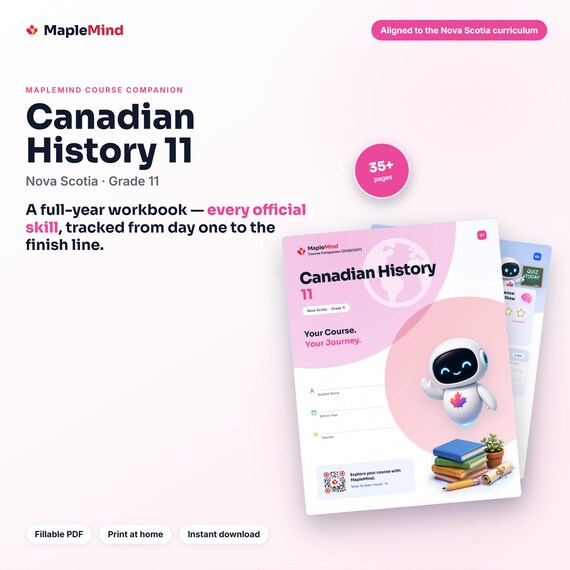
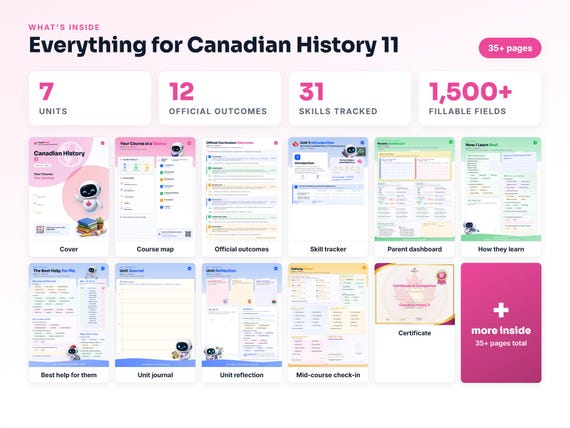
A Canadian History 11 workbook worth keeping
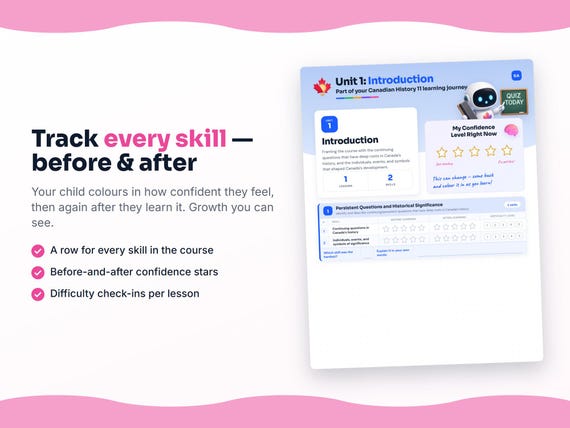
Built from the same official curriculum as this page. Before and after each skill above, your student colours in how sure they feel — so the two of you can see, on one page, what's clicking and what needs another look. It's a quiet way to follow how the year is really going.
By June it's full of their own handwriting: units worked through, confidence grown, a mid-year check-in, notes from parent-teacher night, and a certificate at the end. Less a worksheet, more a record of the year worth keeping on the shelf.
Instant download · see every page, reviews and the full description · five or more workbooks are $2.99 each
What it looks like in the app
Common questions
Can MapleMind help me with Canadian History 11?
Yes. MapleMind's AI tutor covers all 31 skills in Nova Scotia's Canadian History 11 — you pick the exact skill, and the tutor teaches it step by step: a short lesson, a worked example, solving together, then a skill check to show it stuck.
Is MapleMind aligned to Nova Scotia's official curriculum?
Yes. Every skill in this course maps to an official outcome code from Nova Scotia's Grade 11 Social Studies curriculum, and the ministry's own wording is quoted under each unit on this page — with the official government source linked so you can check it yourself.
What does MapleMind cost?
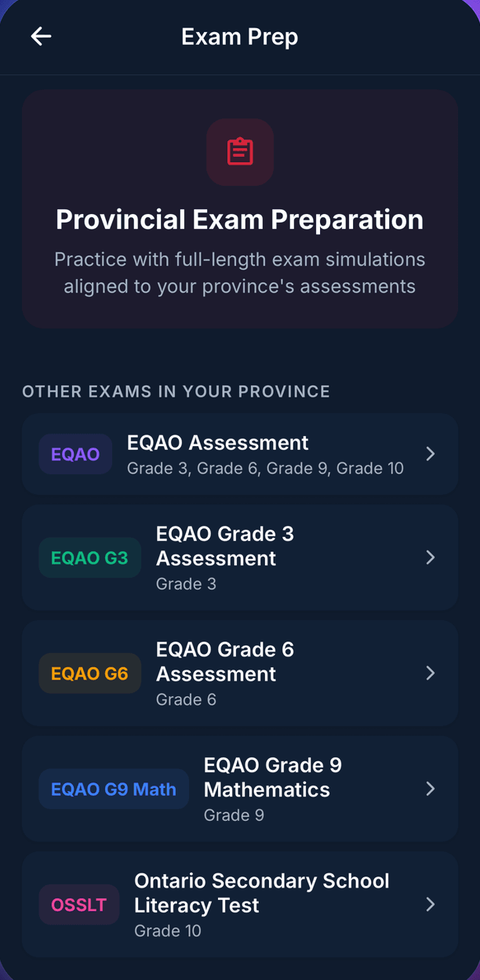
It's free to start — 5 tutoring chats and a practice quiz every day, no credit card. A Pro subscription ($9.99/month or $49.99/year CAD, 7-day free trial) unlocks unlimited tutoring, practice, and exam simulations.
What if I'm stuck on just one topic?
That's the point of skill-level tutoring: open Canadian History 11 in the app, tap the exact skill from the list on this page, and the tutor teaches just that — no wading through lessons you don't need.
Does MapleMind work in French or other languages?
Yes — 14 languages, including French. Both the app and the tutor's explanations switch to the language you choose.
Where can I see the official Nova Scotia curriculum for Canadian History 11?
The official source is linked on this page — Nova Scotia's official curriculum. The outline here follows it: every MapleMind skill carries its official outcome code, and the ministry's own wording is quoted under each unit.
Keep exploring
Ready when you are
Pick a skill from this page and see it taught properly — free, in the browser, in under a minute.