Get help with English 12
Most tutoring makes you sit through material you already know. MapleMind flips that: pick the exact skill that's causing trouble — any of the 34 below — and the tutor teaches just that one, step by step, as many times as it takes. Ask questions in plain words, any time of day, in English, French, or 12 other languages.
The official Nova Scotia English 12 curriculum
Nova Scotia defines English 12 by strands and outcomes. MapleMind teaches the same curriculum reorganized for one-skill-at-a-time tutoring — the table shows exactly where every official strand lands, and the ministry's own wording is quoted under each unit below.
Official source Nova Scotia's official curriculumRead it on the government site — curriculum.novascotia.ca ↗| Official strand | Outcomes | Where MapleMind teaches it |
|---|---|---|
| Strand SL | 6 | Speaking and Listening |
| Strand RV | 13 | Reading and Viewing |
| Strand W | 9 | Writing and Other Ways of Representing |
Every skill below, taught one on one.
 Try the first session free
How MapleMind teaches English 12 — every unit, lesson, and skill
Every skill below runs as a short session: a plain-words lesson, a worked example, solving it together, then a five-question skill check that earns up to three stars. Guided Mode keeps it teaching instead of answer-handing — turning it off needs a parent's password.
Unit 1Speaking and ListeningOfficial strand · Strand SL
Speaking and listening to explore and reflect at a sophisticated level, to communicate and respond in leadership and support roles across complex situations, and to make critical language and voice choices with sensitivity and respect.
Exploring and Advocating Through Talk
- Asking discriminating questions to evaluate ideasNS-ELA-12.1.2 — Ask discriminating questions to acquire, interpret, analyze, and evaluate ideas and information.
- Advocating and justifying positions convincinglyNS-ELA-12.1.3 — Articulate, advocate, and justify positions on an issue or text in a convincing manner, showing an understanding of a range of viewpoints.
Communicating in Complex Situations
- Interacting in leadership and support roles in complex situationsNS-ELA-12.2.1 — Interact in both leadership and support roles in a range of situations, some characterized by complexity of purpose, procedure, and subject matter.
- Adapting language and delivery in complex contextsNS-ELA-12.2.2 — Adapt language and delivery for a variety of audiences and purposes in informal and formal contexts, some characterized by complexity of purpose, procedure, and subject matter.
- Evaluating verbal and nonverbal elements of powerful communicationNS-ELA-12.2.4 — Reflect critically on and evaluate one's own and others' uses of language, recognizing elements of verbal and nonverbal messages that produce powerful communication.
Critical Language Choices and Voice
- Making critical language choices of tone and styleNS-ELA-12.3.3 — Address the demands of a variety of speaking situations, making critical language choices, especially of tone and style.
- Expressing voice or choosing to remain silentNS-ELA-12.3.3 — Express individual voice, remaining engaged, while being able to determine whether to express oneself or remain silent.
The official wording — 6 outcomes in this unit
- NS-ELA-12.1.2
ask discriminating questions to acquire, interpret, analyze, and evaluate ideas and information
- NS-ELA-12.1.3
articulate, advocate, and justify positions on an issue or text in a convincing manner, showing an understanding of a range of viewpoints
- NS-ELA-12.2.1
interact in both leadership and support roles in a range of situations, some of which are characterized by complexity of purpose, procedure, and subject matter
- NS-ELA-12.2.2
adapt language and delivery for a variety of audiences and purposes in informal and formal contexts, some of which are characterized by complexity of purpose, procedure, and subject matter
- NS-ELA-12.2.4
reflect critically on and evaluate their own and others’ uses of language in a range of contexts, recognizing elements of verbal and nonverbal messages that produce powerful communication
- NS-ELA-12.3.3
address the demands of a variety of speaking situations, making critical language choices, especially of tone and style
Unit 2Reading and ViewingOfficial strand · Strand RV
Reading and viewing complex, sophisticated, and world literary texts; researching and evaluating research processes; responding personally and critically to challenging texts; and analysing issues related to gender-based violence through a variety of texts.
Reading Sophisticated and World Literary Texts
- Experiencing world literary genres and modesNS-ELA-12.4.2 — Read widely and experience a variety of literary genres and modes from different provinces and countries, and world literature from different literary periods.
- Constructing meaning in complex and sophisticated textsNS-ELA-12.4.4 — Use cueing systems and a variety of strategies to construct meaning in reading and viewing complex and sophisticated print and media texts.
- Articulating one's own processes with sophisticated textsNS-ELA-12.4.5 — Articulate one's own processes and strategies in exploring, interpreting, and reflecting on sophisticated texts and tasks.
Researching and Evaluating Research
- Researching systematically to meet learning needsNS-ELA-12.5.1 — Access, select, and research, in systematic ways, specific information to meet personal and individual learning needs, using information in ways characterized by complexity of purpose, procedure, or subject matter.
- Evaluating one's own research processesNS-ELA-12.5.1 — Evaluate one's own research processes.
Responding Personally to Challenging Texts
- Making informed personal responses that explore diverse perspectivesNS-ELA-12.6.1 — Make informed personal responses to increasingly challenging print and media texts and reflect on them — connecting personal values and cultures to those in texts, analyzing thematic connections and universality, and demonstrating a willingness to explore diverse perspectives to develop or modify points of view.
- Justifying points of view and interpreting ambiguitiesNS-ELA-12.6.2 — Articulate and justify points of view about texts and text elements, interpreting ambiguities in complex and sophisticated texts.
Responding Critically to Complex Texts
- Critically evaluating accessed informationNS-ELA-12.7.1 — Critically evaluate the information one accesses.
- Showing relationships among language, purpose, and audienceNS-ELA-12.7.2 — Show the relationships among language, topic, purpose, context, and audience, noting the relationship of specific elements of a particular text to elements of other texts.
- Describing, discussing, and evaluating characteristics of textsNS-ELA-12.7.2 — Describe, discuss, and evaluate the language, ideas, and other significant characteristics of a variety of texts and genres.
- Examining how texts reveal and produce ideologies and identitiesNS-ELA-12.7.3 — Respond critically to complex and sophisticated texts by examining how they work to reveal and produce ideologies, identities, and positions.
- Examining how media texts construct roles, culture, and realityNS-ELA-12.7.3 — Respond critically to complex texts by examining how media texts construct notions of roles, behaviour, culture, and reality.
- Examining how textual features help create meaningNS-ELA-12.7.3 — Respond critically to complex texts by examining how textual features help a reader and viewer create meaning of the texts.
Analysing Gender-Based Violence Through Texts (GCO 11)
- Analysing how texts influence perceptions of those impactedNS-ELA-12.11.1 — Analyse how texts influence perceptions of those impacted by gender-based violence.
- Reflecting on cultural perspectives and systemic issuesNS-ELA-12.11.2 — Reflect on the relationship between cultural perspectives on gender and systemic issues that contribute to gender-based violence.
- Evaluating the impact of bystander interventionNS-ELA-12.11.4 — Evaluate the impact of bystander intervention in various contexts.
The official wording — 13 outcomes in this unit
- NS-ELA-12.4.2
read widely and experience a variety of literary genre and modes from different provinces and countries, and world literature from different literary periods
- NS-ELA-12.4.4
use the cueing systems and a variety of strategies to construct meaning in reading and viewing complex and sophisticated print and media texts
- NS-ELA-12.4.5
articulate their own processes and strategies in exploring, interpreting, and reflecting on sophisticated texts and tasks
- NS-ELA-12.5.1
access, select, and research, in systematic ways, specific information to meet personal and individual learning needs − use information, in ways characterized by complexity of purpose, procedure, or subject matter
- NS-ELA-12.6.1
make informed personal responses to increasingly challenging print and media texts and reflect on their responses − make connections between their own values, beliefs, and cultures and those reflected in literary and media texts − analyze thematic connections among texts and articulate an understanding of the universality of many themes − demonstrate a willingness to explore diverse perspectives to develop or modify their points of view
- NS-ELA-12.6.2
articulate and justify points of view about texts and text elements − interpret ambiguities in complex and sophisticated texts
- NS-ELA-12.7.1
critically evaluate the information they access
- NS-ELA-12.7.2
show the relationships among language, topic, purpose, context, and audience − note the relationship of specific elements of a particular text to elements of other texts
- NS-ELA-12.7.3
respond critically to complex and sophisticated texts − examine how texts work to reveal and produce ideologies, identities, and positions
- NS-ELA-12.11.1
analyse how texts influence perceptions of those impacted by gender-based violence
- NS-ELA-12.11.2
reflect on the relationship between cultural perspectives on gender and systemic issues that contribute to gender-based violence
- NS-ELA-12.11.3
analyse the responsibility of authors in their portrayal of gender-based violence
- NS-ELA-12.11.4
evaluate the impact of bystander intervention in various contexts
Unit 3Writing and Other Ways of RepresentingOfficial strand · Strand W
Using writing and other ways of representing to explore and reflect on challenging texts and insights; creating texts that control meaning for complex demands; and using a range of strategies with accurate conventions and skillful crafting.
Writing to Explore and Reflect
- Writing to explore insights into challenging textsNS-ELA-12.8.1 — Use writing and other ways of representing to explore, extend, and reflect on insights into challenging texts and issues, the writing processes and strategies used, achievements as a language user, and the basis for feelings, values, and attitudes.
- Reconstructing increasingly complex knowledge through notesNS-ELA-12.8.2 — Use note-making strategies to reconstruct increasingly complex knowledge, exploring the use of photographs, diagrams, storyboards, and similar tools in documenting experiences.
- Making effective choices to enhance imaginative writingNS-ELA-12.8.3 — Make effective choices of language and techniques to enhance the impact of imaginative writing and other ways of representing.
Creating Texts That Control Meaning
- Understanding how construction creates and controls meaningNS-ELA-12.9.2 — Demonstrate an understanding of the ways in which the construction of texts can create, enhance, or control meaning.
- Making critical choices for complex purposes and audiencesNS-ELA-12.9.2 — Make critical choices of form, style, and content to address increasingly complex demands of different purposes and audiences.
- Evaluating others' responses to one's workNS-ELA-12.9.3 — Evaluate the responses of others to one's writing and media production.
Developing Effective Writing and Representation
- Applying the strategies that work for you as a creatorNS-ELA-12.10.1 — Apply one's knowledge of what strategies are effective for oneself as a creator of various writing and other representations.
- Using conventions accurately and consistentlyNS-ELA-12.10.2 — Use the conventions of written language accurately and consistently in final products.
- Committing to skillful crafting across a range of workNS-ELA-12.10.4 — Demonstrate a commitment to the skillful crafting of a range of writing and other representations.
- Integrating information from many sources to communicate meaningNS-ELA-12.10.5 — Integrate information from many sources to construct and communicate meaning.
The official wording — 9 outcomes in this unit
- NS-ELA-12.8.1
use writing and other ways of representing to explore, extend, and reflect on − their experiences with and insights into challenging texts and issues − the writing processes and strategies they use − their achievements as language users and learners − the basis for their feelings, values, and attitudes
- NS-ELA-12.8.2
use note-making strategies to reconstruct increasingly complex knowledge − explore the use of photographs, diagrams, storyboards, etc., in documenting experiences
- NS-ELA-12.8.3
make effective choices of language and techniques to enhance the impact of imaginative writing and other ways of representing
- NS-ELA-12.9.2
demonstrate an understanding of the ways in which the construction of texts can create, enhance, or control meaning
- NS-ELA-12.9.3
evaluate the responses of others to their writing and media production
- NS-ELA-12.10.1
apply their knowledge of what strategies are effective for them as creators of various writing and other representations
- NS-ELA-12.10.2
use the conventions of written language accurately and consistently in final products
- NS-ELA-12.10.4
demonstrate a commitment to the skillful crafting of a range of writing and other representations
- NS-ELA-12.10.5
integrate information from many sources to construct and communicate meaning
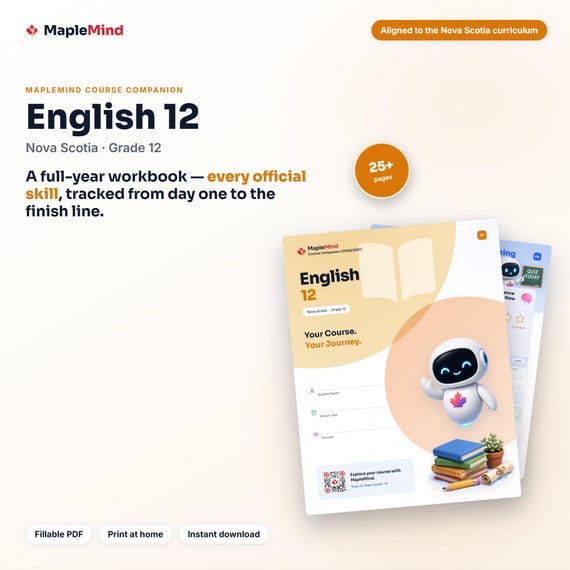
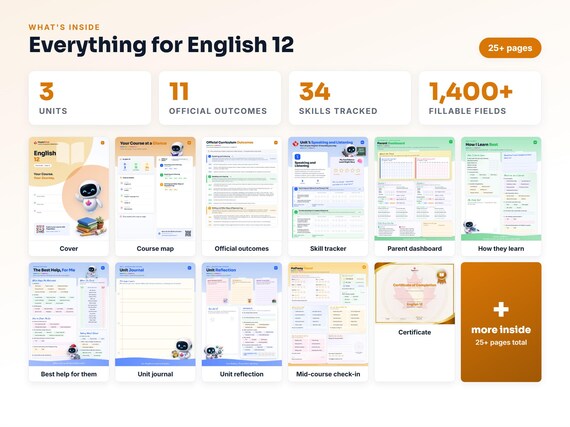
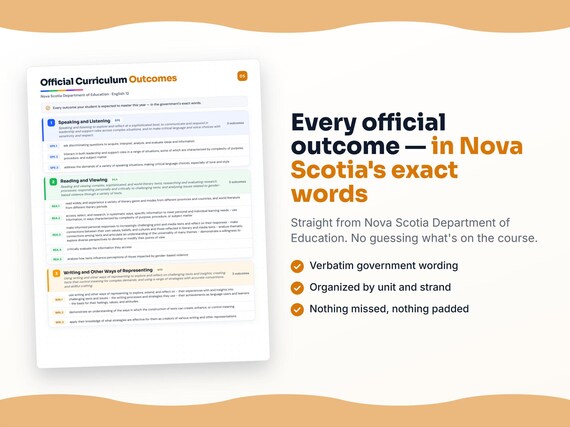
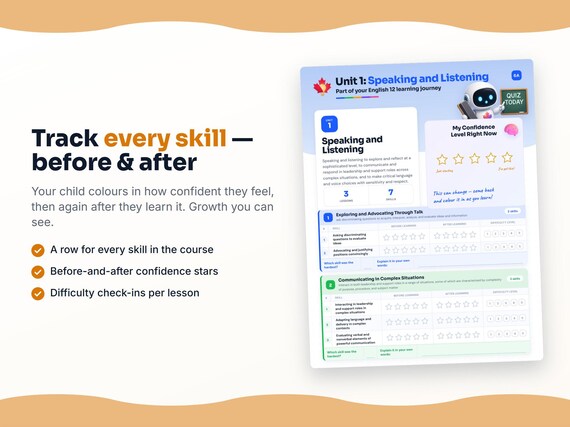
Printable workbook · A keepsake of the year
A English 12 workbook worth keeping
Built from the same official curriculum as this page. Before and after each skill above, your student colours in how sure they feel — so the two of you can see, on one page, what's clicking and what needs another look. It's a quiet way to follow how the year is really going.
By June it's full of their own handwriting: units worked through, confidence grown, a mid-year check-in, notes from parent-teacher night, and a certificate at the end. Less a worksheet, more a record of the year worth keeping on the shelf.
Instant download · see every page, reviews and the full description · five or more workbooks are $2.99 each
What it looks like in the app



Common questions
Can MapleMind help me with English 12?
Yes. MapleMind's AI tutor covers all 34 skills in Nova Scotia's English 12 — you pick the exact skill, and the tutor teaches it step by step: a short lesson, a worked example, solving together, then a skill check to show it stuck.
Is MapleMind aligned to Nova Scotia's official curriculum?
Yes. Every skill in this course maps to an official outcome code from Nova Scotia's Grade 12 English Language Arts curriculum, and the ministry's own wording is quoted under each unit on this page — with the official government source linked so you can check it yourself.
What does MapleMind cost?
It's free to start — 5 tutoring chats and a practice quiz every day, no credit card. A Pro subscription ($9.99/month or $49.99/year CAD, 7-day free trial) unlocks unlimited tutoring, practice, and exam simulations.
What if I'm stuck on just one topic?
That's the point of skill-level tutoring: open English 12 in the app, tap the exact skill from the list on this page, and the tutor teaches just that — no wading through lessons you don't need.
Does MapleMind work in French or other languages?
Yes — 14 languages, including French. Both the app and the tutor's explanations switch to the language you choose.
Where can I see the official Nova Scotia curriculum for English 12?
The official source is linked on this page — Nova Scotia's official curriculum. The outline here follows it: every MapleMind skill carries its official outcome code, and the ministry's own wording is quoted under each unit.
Keep exploring
Ready when you are
Pick a skill from this page and see it taught properly — free, in the browser, in under a minute.