Get help with Canadian Literature 12
Most tutoring makes you sit through material you already know. MapleMind flips that: pick the exact skill that's causing trouble — any of the 13 below — and the tutor teaches just that one, step by step, as many times as it takes. Ask questions in plain words, any time of day, in English, French, or 12 other languages.
The official Nova Scotia Canadian Literature 12 curriculum
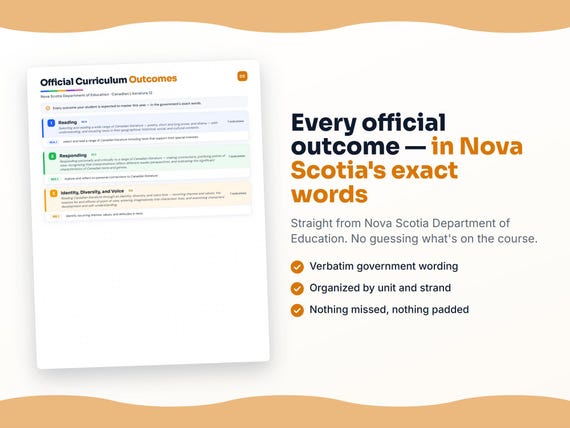
Nova Scotia defines Canadian Literature 12 by strands and outcomes. MapleMind teaches the same curriculum reorganized for one-skill-at-a-time tutoring — the table shows exactly where every official strand lands, and the ministry's own wording is quoted under each unit below.
Official source Nova Scotia's official curriculumRead it on the government site — curriculum.novascotia.ca ↗| Official strand | Outcomes | Where MapleMind teaches it |
|---|---|---|
| Strand 1 | 3 | Reading |
| Strand 2 | 6 | Responding |
| Strand 3 | 4 | Identity, Diversity, and Voice |
Every skill below, taught one on one.
 Try the first session free
How MapleMind teaches Canadian Literature 12 — every unit, lesson, and skill
Every skill below runs as a short session: a plain-words lesson, a worked example, solving it together, then a five-question skill check that earns up to three stars. Guided Mode keeps it teaching instead of answer-handing — turning it off needs a parent's password.
Unit 1ReadingOfficial strand · Strand 1
Selecting and reading a wide range of Canadian literature — poetry, short and long prose, and drama — with understanding, and situating texts in their geographical, historical, social, and cultural contexts.
Reading a Range of Canadian Literature
- Selecting and reading Canadian literature by interestNS-ELA-CDNLIT-12.1.1 — Select and read a range of Canadian literature, including texts that support the student's special interests.
- Experiencing poetry, prose, and drama in Canadian literatureNS-ELA-CDNLIT-12.1.2 — Experience poetry, short and long prose, and drama within Canadian literature.
- Reading Canadian texts in their contextsNS-ELA-CDNLIT-12.1.3 — Demonstrate knowledge of the geographical, historical, social, and cultural contexts of literary texts.
The official wording — 3 outcomes in this unit
- NS-ELA-CDNLIT-12.1.1
select and read a range of Canadian literature including texts that support their special interests
- NS-ELA-CDNLIT-12.1.2
experience poetry, short and long prose, and drama in Canadian literature
- NS-ELA-CDNLIT-12.1.3
demonstrate knowledge about the geographical, historical, social, and cultural contexts of literary texts
Unit 2RespondingOfficial strand · Strand 2
Responding personally and critically to a range of Canadian literature — making connections, justifying points of view, recognizing that interpretations reflect different reader perspectives, and evaluating the significant characteristics of Canadian texts and genres.
Responding Personally and Critically to Canadian Literature
- Exploring personal connections to Canadian literatureNS-ELA-CDNLIT-12.2.1 — Explore and reflect on personal connections to Canadian literature.
- Articulating and justifying points of view about textsNS-ELA-CDNLIT-12.2.2 — Articulate and justify points of view about Canadian texts.
- Examining how responses reflect reader perspectivesNS-ELA-CDNLIT-12.2.3 — Examine how responses and interpretations reflect different reader perspectives.
- Reflecting on what responses reveal about values and attitudesNS-ELA-CDNLIT-12.2.4 — Reflect on what the student's own responses reveal about their personal values and attitudes.
- Examining how texts reveal and produce values and positionsNS-ELA-CDNLIT-12.2.5 — Examine how texts work to reveal and produce values, identities, and positions.
- Describing, discussing, and evaluating texts and genresNS-ELA-CDNLIT-12.2.6 — Describe, discuss, and evaluate the language, ideas, and other significant characteristics of a variety of Canadian texts and genres.
The official wording — 6 outcomes in this unit
- NS-ELA-CDNLIT-12.2.1
explore and reflect on personal connections to Canadian literature
- NS-ELA-CDNLIT-12.2.2
articulate and justify points of view about texts
- NS-ELA-CDNLIT-12.2.3
examine how responses and interpretations reflect different reader perspectives
- NS-ELA-CDNLIT-12.2.4
reflect on what their own responses reveal about their personal values and attitudes
- NS-ELA-CDNLIT-12.2.5
examine how texts work to reveal and produce values, identities, and positions
- NS-ELA-CDNLIT-12.2.6
describe, discuss, and evaluate the language, ideas, and other significant characteristics of a variety of texts and genres
Unit 3Identity, Diversity, and VoiceOfficial strand · Strand 3
Reading Canadian literature through an identity, diversity, and voice lens — recurring themes and values, the reasons for and effects of point of view, entering imaginatively into characters' lives, and examining characters' development and self-understanding.
Identity, Diversity, and Voice in Canadian Literature
- Identifying recurring themes, values, and attitudesNS-ELA-CDNLIT-12.3.1 — Identify recurring themes, values, and attitudes across Canadian texts.
- Examining the reasons for and effects of point of viewNS-ELA-CDNLIT-12.3.2 — Examine the reasons for and effects of a particular point of view in Canadian texts.
- Entering imaginatively into characters' livesNS-ELA-CDNLIT-12.3.3 — Explore Canadian texts by entering imaginatively into the lives and situations of characters.
- Examining characters' development and self-understandingNS-ELA-CDNLIT-12.3.4 — Explore and examine characters' development and their understanding of themselves in Canadian texts.
The official wording — 4 outcomes in this unit
- NS-ELA-CDNLIT-12.3.1
identify recurring themes, values, and attitudes in texts
- NS-ELA-CDNLIT-12.3.2
examine the reasons for and effects of a particular point of view
- NS-ELA-CDNLIT-12.3.3
explore texts by entering imaginatively into the lives and situations of characters
- NS-ELA-CDNLIT-12.3.4
explore and examine characters’ development and characters’ understanding of themselves
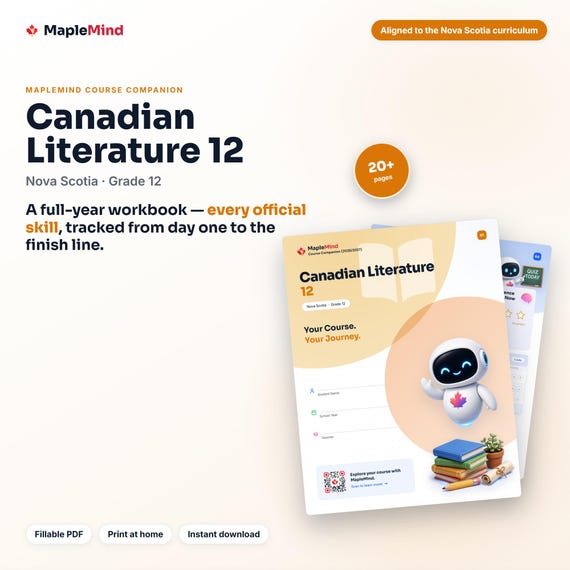
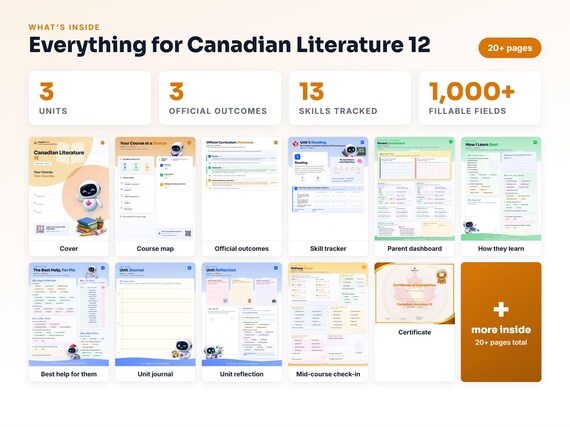
Printable workbook · A keepsake of the year
A Canadian Literature 12 workbook worth keeping
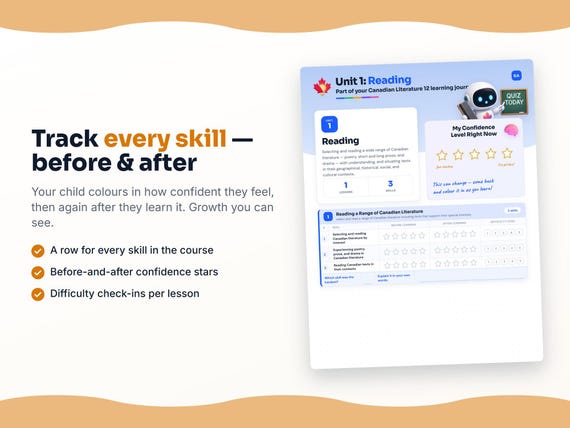
Built from the same official curriculum as this page. Before and after each skill above, your student colours in how sure they feel — so the two of you can see, on one page, what's clicking and what needs another look. It's a quiet way to follow how the year is really going.
By June it's full of their own handwriting: units worked through, confidence grown, a mid-year check-in, notes from parent-teacher night, and a certificate at the end. Less a worksheet, more a record of the year worth keeping on the shelf.
Instant download · see every page, reviews and the full description · five or more workbooks are $2.99 each
What it looks like in the app



Common questions
Can MapleMind help me with Canadian Literature 12?
Yes. MapleMind's AI tutor covers all 13 skills in Nova Scotia's Canadian Literature 12 — you pick the exact skill, and the tutor teaches it step by step: a short lesson, a worked example, solving together, then a skill check to show it stuck.
Is MapleMind aligned to Nova Scotia's official curriculum?
Yes. Every skill in this course maps to an official outcome code from Nova Scotia's Grade 12 English Language Arts curriculum, and the ministry's own wording is quoted under each unit on this page — with the official government source linked so you can check it yourself.
What does MapleMind cost?
It's free to start — 5 tutoring chats and a practice quiz every day, no credit card. A Pro subscription ($9.99/month or $49.99/year CAD, 7-day free trial) unlocks unlimited tutoring, practice, and exam simulations.
What if I'm stuck on just one topic?
That's the point of skill-level tutoring: open Canadian Literature 12 in the app, tap the exact skill from the list on this page, and the tutor teaches just that — no wading through lessons you don't need.
Does MapleMind work in French or other languages?
Yes — 14 languages, including French. Both the app and the tutor's explanations switch to the language you choose.
Where can I see the official Nova Scotia curriculum for Canadian Literature 12?
The official source is linked on this page — Nova Scotia's official curriculum. The outline here follows it: every MapleMind skill carries its official outcome code, and the ministry's own wording is quoted under each unit.
Keep exploring
Ready when you are
Pick a skill from this page and see it taught properly — free, in the browser, in under a minute.