Get help with Core French 12
Most tutoring makes you sit through material you already know. MapleMind flips that: pick the exact skill that's causing trouble — any of the 19 below — and the tutor teaches just that one, step by step, as many times as it takes. Ask questions in plain words, any time of day, in English, French, or 12 other languages.
The official Nova Scotia Core French 12 curriculum
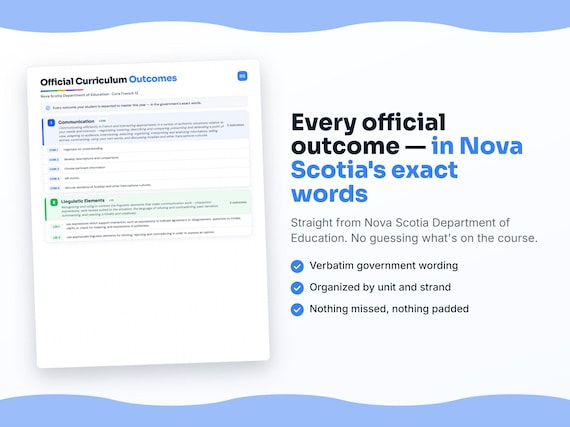
Nova Scotia defines Core French 12 by strands and outcomes. MapleMind teaches the same curriculum reorganized for one-skill-at-a-time tutoring — the table shows exactly where every official strand lands, and the ministry's own wording is quoted under each unit below.
Official source Nova Scotia's official curriculumRead it on the government site — curriculum.novascotia.ca ↗| Official strand | Outcomes | Where MapleMind teaches it |
|---|---|---|
| GCO1 | 13 | Communication |
| GCO4 | 6 | Linguistic Elements |
Every skill below, taught one on one.
 Try the first session free
How MapleMind teaches Core French 12 — every unit, lesson, and skill
Every skill below runs as a short session: a plain-words lesson, a worked example, solving it together, then a five-question skill check that earns up to three stars. Guided Mode keeps it teaching instead of answer-handing — turning it off needs a parent's password.
Unit 1CommunicationOfficial strand · GCO1
Communicating efficiently in French and interacting appropriately in a variety of authentic situations relative to your needs and interests - negotiating meaning, describing and comparing, presenting and defending a point of view, adapting to audience, interviewing, selecting, organizing, interpreting and analyzing information, telling stories, summarizing, using your own words, and discussing Acadian and other francophone cultures.
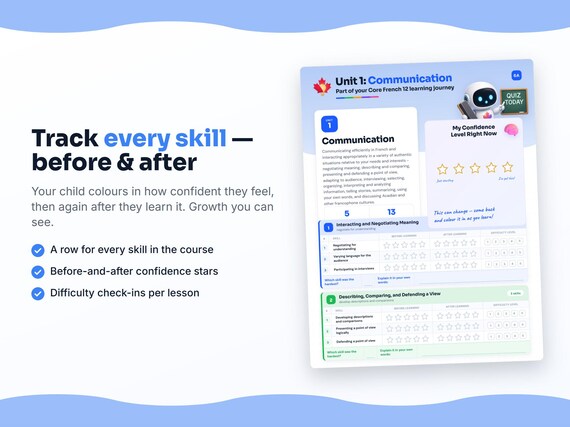
Interacting and Negotiating Meaning
- Negotiating for understanding1.1 — Negotiate for understanding autonomously in French - sustaining and repairing spontaneous conversation smoothly.
- Varying language for the audience1.13 — Vary your language use autonomously in French according to audience - shift register fluidly and appropriately across any listener or context.
- Participating in interviews1.15 — Participate in interviews autonomously in French - lead a natural, in-depth interview and give rich, spontaneous responses.
Describing, Comparing, and Defending a View
- Developing descriptions and comparisons1.8 — Develop descriptions and comparisons autonomously in French - nuanced, evaluative descriptions and sophisticated comparisons.
- Presenting a point of view logically1.9 — Present your own point of view autonomously in French in a logical manner - a persuasive, well-structured argument delivered spontaneously.
- Defending a point of view1.10 — Defend your own point of view autonomously in French - sustain and win a spontaneous debate with adaptive, persuasive rebuttals.
Working with Information
- Choosing pertinent information1.22 — Choose pertinent information autonomously in French - evaluate and select from complex or conflicting sources.
- Organizing information1.23 — Organize information autonomously in French - structure complex, synthesized material logically and persuasively.
- Interpreting and analyzing information1.24 — Interpret and analyze information autonomously in French - critical, in-depth analysis of complex texts.
Narrating, Summarizing, and Rephrasing
- Telling stories1.25 — Tell stories autonomously in French - engaging, well-crafted narratives delivered spontaneously with stylistic control.
- Giving summaries1.26 — Give summaries autonomously in French - synthesize and abstract from complex material fluently.
- Using your own words1.30 — Use your own words autonomously in French - reformulate and paraphrase fluently for precision and style.
Acadian and Francophone Cultures
- Discussing Acadian and other francophone cultures1.41 — Discuss elements of Acadian and other francophone cultures autonomously in French - informed, critical discussion in national and international perspective.
The official wording — 13 outcomes in this unit
- 1.1
negotiate for understanding
- 1.13
vary language use according to audience
- 1.15
participate in interviews
- 1.8
develop descriptions and comparisons
- 1.9
present own point of view in a logical manner
- 1.10
defend own point of view
- 1.22
choose pertinent information
- 1.23
organize information
- 1.24
interpret and analyze information
- 1.25
tell stories
- 1.26
give summaries
- 1.30
use own words
- 1.41
discuss elements of Acadian and other francophone cultures.
Unit 2Linguistic ElementsOfficial strand · GCO4
Recognizing and using in context the linguistic elements that make communication work - interaction expressions, verb tenses suited to the situation, the language of refuting and contradicting, past narration, summarizing, and reacting critically and creatively.
Interaction Expressions and Verb Tenses
- Using expressions that support interaction4.1 — Use French expressions that support interaction autonomously - a full, idiomatic repertoire deployed spontaneously and appropriately.
- Using verb tenses suited to the context4.2 — Use verb tenses corresponding to the context autonomously in French - the full tense system, including conditional and subjunctive, deployed spontaneously.
Opinion, Past Narration, and Response
- Refuting, rejecting, and contradicting to express an opinion4.3 — Use French linguistic elements for refuting, rejecting, and contradicting autonomously - sophisticated, persuasive refutation.
- Narrating events in the past4.4 — Use French linguistic elements to narrate events in the past autonomously - rich, layered past narration with the full past-tense system.
- Summarizing the main ideas of a text4.5 — Use French linguistic elements to summarize the main ideas of a text autonomously - precise, synthesized summaries with sophisticated cohesion.
- Reacting critically and creatively4.6 — Use French linguistic elements to react critically and creatively autonomously - insightful critique and original creative work.
The official wording — 6 outcomes in this unit
- 4.1
use expressions which support interaction, such as expressions to indicate agreement or disagreement, questions to initiate, clarify, or check for meaning, and expressions of politeness
- 4.2
use linguistic elements to describe diverse situations using verb tenses corresponding to the context
- 4.3
use appropriate linguistic elements for refuting, rejecting and contradicting in order to express an opinion
- 4.4
use appropriate linguistic elements to narrate events in the past
- 4.5
use appropriate linguistic elements to summarize the main ideas of a text
- 4.6
use appropriate linguistic elements to react critically and creatively
Printable workbook · A keepsake of the year
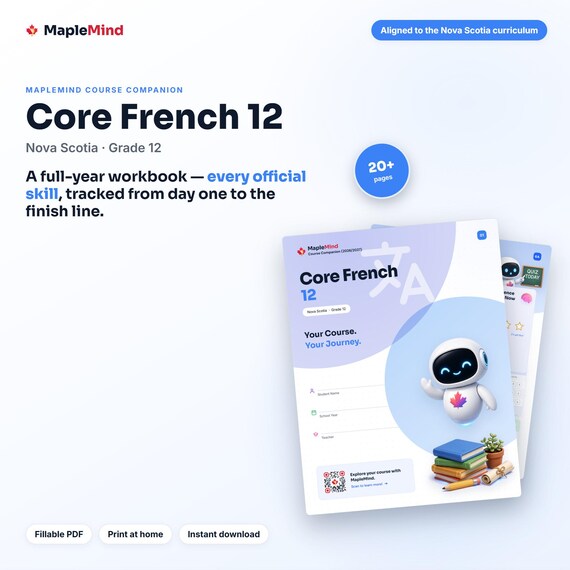
A Core French 12 workbook worth keeping
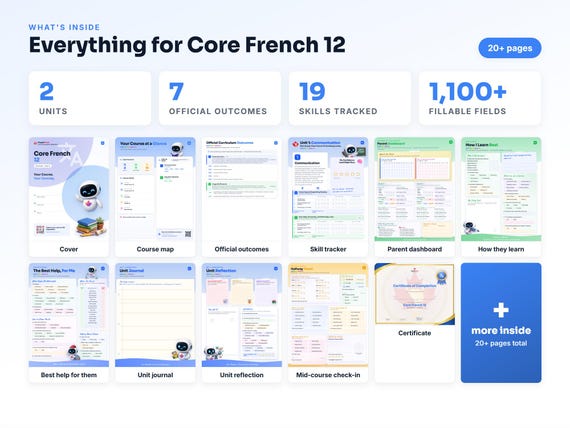
Built from the same official curriculum as this page. Before and after each skill above, your student colours in how sure they feel — so the two of you can see, on one page, what's clicking and what needs another look. It's a quiet way to follow how the year is really going.
By June it's full of their own handwriting: units worked through, confidence grown, a mid-year check-in, notes from parent-teacher night, and a certificate at the end. Less a worksheet, more a record of the year worth keeping on the shelf.
Instant download · see every page, reviews and the full description · five or more workbooks are $2.99 each
What it looks like in the app



Common questions
Can MapleMind help me with Core French 12?
Yes. MapleMind's AI tutor covers all 19 skills in Nova Scotia's Core French 12 — you pick the exact skill, and the tutor teaches it step by step: a short lesson, a worked example, solving together, then a skill check to show it stuck.
Is MapleMind aligned to Nova Scotia's official curriculum?
Yes. Every skill in this course maps to an official outcome code from Nova Scotia's Grade 12 French curriculum, and the ministry's own wording is quoted under each unit on this page — with the official government source linked so you can check it yourself.
What does MapleMind cost?
It's free to start — 5 tutoring chats and a practice quiz every day, no credit card. A Pro subscription ($9.99/month or $49.99/year CAD, 7-day free trial) unlocks unlimited tutoring, practice, and exam simulations.
What if I'm stuck on just one topic?
That's the point of skill-level tutoring: open Core French 12 in the app, tap the exact skill from the list on this page, and the tutor teaches just that — no wading through lessons you don't need.
Does MapleMind work in French or other languages?
Yes — 14 languages, including French. Both the app and the tutor's explanations switch to the language you choose.
Where can I see the official Nova Scotia curriculum for Core French 12?
The official source is linked on this page — Nova Scotia's official curriculum. The outline here follows it: every MapleMind skill carries its official outcome code, and the ministry's own wording is quoted under each unit.
Keep exploring
Ready when you are
Pick a skill from this page and see it taught properly — free, in the browser, in under a minute.