Get help with Physics 20
Most tutoring makes you sit through material you already know. MapleMind flips that: pick the exact skill that's causing trouble — any of the 24 below — and the tutor teaches just that one, step by step, as many times as it takes. Ask questions in plain words, any time of day, in English, French, or 12 other languages.
The official Saskatchewan Physics 20 curriculum
Saskatchewan defines Physics 20 by strands and outcomes. MapleMind teaches the same curriculum reorganized for one-skill-at-a-time tutoring — the table shows exactly where every official strand lands, and the ministry's own wording is quoted under each unit below.
Official source Saskatchewan's official curriculumRead it on the government site — curriculum.gov.sk.ca ↗| Official strand | Outcomes | Where MapleMind teaches it |
|---|---|---|
| Strand U1 | 1 | The Physics of Everyday Things |
| Strand U2 | 5 | Waves |
| Strand U3 | 7 | Light |
| Strand U4 | 3 | Heat |
Every skill below, taught one on one.
 Try the first session free
How MapleMind teaches Physics 20 — every unit, lesson, and skill
Every skill below runs as a short session: a plain-words lesson, a worked example, solving it together, then a five-question skill check that earns up to three stars. Guided Mode keeps it teaching instead of answer-handing — turning it off needs a parent's password.
Unit 1The Physics of Everyday ThingsOfficial strand · Strand U1
What physics studies and how physicists measure it: the SI system of units, significant figures and scientific notation, and reading meaning out of experimental data and graphs.
Measurement and the SI System
- Expressing quantities in SI unitsPHYS20-U1.C — Express physical quantities using a value, appropriate SI units, and direction, and distinguish fundamental from derived units.
- Precision, significant figures, and scientific notationPHYS20-U1.C — Recognize the limited accuracy of measurement and express numbers to the correct significant figures, in scientific notation, and by order of magnitude.
- Collecting data and reading graphsPHYS20-U1.C — Collect experimental data, graph numeric information, and interpret, interpolate, and extrapolate from a graph.
The official wording — 1 outcome in this unit
- PHYS20-U1.C
An internationally agreed upon standard system of units is needed to measure and represent a wide variety of physical quantities.
Unit 2WavesOfficial strand · Strand U2
The nature of waves as travelling energy: wave terminology, the universal wave equation, interference and superposition, and wave phenomena like reflection, refraction, diffraction, and standing waves.
Properties of Waves
- Wave terminology and periodic motionPHYS20-U2.A1 — Define wave, period, frequency, and related terms, and give examples of periodic motion.
- Solving period and frequency problemsPHYS20-U2.A1 — Apply the correct units for period and frequency and solve problems involving period, frequency, and wave motion.
- The universal wave equationPHYS20-U2.A2 — Explain that the universal wave equation applies to all wave types and apply it to solve problems.
- Superposition and interferencePHYS20-U2.A3 — State the Principle of Superposition and predict and illustrate constructive and destructive interference when waves meet.
Wave Phenomena
- Transmission, reflection, and refraction of wavesPHYS20-U2.B1 — Explain how a change of medium changes a wave's speed and wavelength, state the laws of reflection, and describe wave refraction.
- Diffraction, standing waves, and dispersionPHYS20-U2.B2 — Explain diffraction, standing-wave patterns with nodes and antinodes and resonant frequencies, and dispersion in a dispersive medium.
The official wording — 5 outcomes in this unit
- PHYS20-U2.A1
A wave is a transfer of energy, in the form of a disturbance, through some medium, without translocation of the medium.
- PHYS20-U2.A2
The universal wave equation is said to be universal because it applies to all types of waves.
- PHYS20-U2.A3
Wave interference occurs when two or more waves act simultaneously on a medium.
- PHYS20-U2.B1
Waves travel at a constant speed in a uniform medium. A change in medium, or a change in the condition of a medium, will usually result in a change in the speed of the wave.
- PHYS20-U2.B2
In a dispersive medium, the speed of the waves depends on the frequency.
Unit 3LightOfficial strand · Strand U3
The behaviour of light: how it travels and how fast, the laws of reflection in plane and curved mirrors, refraction and Snell's law, and total internal reflection.
Characteristics of Light
- How light travels: sources, shadows, and rectilinear propagationPHYS20-U3.A1 — Distinguish luminous from non-luminous and transparent/translucent/opaque materials, and explain that light travels in straight lines.
- The inverse-square law of light intensityPHYS20-U3.A1 — Apply the inverse-square law relating the intensity of light to distance from the source.
- Measuring the speed of light and index of refractionPHYS20-U3.A2 — Describe how Galileo, Roemer, and Michelson measured the speed of light, state its vacuum value, and use the index of refraction to find light's speed in a medium.
Reflection and Mirrors
- The laws of reflectionPHYS20-U3.B1 — State the laws of reflection, compare specular and diffuse reflection, and apply the laws in problem solving.
- Plane-mirror images: real and virtualPHYS20-U3.B2 — Identify the characteristics of a plane-mirror image and distinguish real from virtual images.
- Drawing plane-mirror ray diagramsPHYS20-U3.B2 — Draw scaled, correctly labelled ray diagrams using solid and dotted lines and conventional symbols to locate a plane-mirror image.
- Curved mirrors: ray diagrams and equationsPHYS20-U3.B3 — Draw ray diagrams for converging and diverging mirrors, relate focal length to radius of curvature, and apply the mirror and magnification equations.
Refraction
- Why light refracts and the laws of refractionPHYS20-U3.C1 — Explain why refraction occurs, state the three laws of refraction, and predict which way a ray bends.
- Applying Snell's lawPHYS20-U3.C1 — Apply Snell's law to solve problems relating to the refraction of light.
- Total internal reflection and the critical anglePHYS20-U3.C2 — Recognize when total internal reflection occurs and determine the critical angle between two media.
The official wording — 7 outcomes in this unit
- PHYS20-U3.A1
A careful examination of the behaviour of light is necessary before trying to theorize about its nature.
- PHYS20-U3.A2
Galileo's attempts to measure the speed of light were unsuccessful.
- PHYS20-U3.B1
An interface is boundary region between two media.
- PHYS20-U3.B2
A plane mirror is a planar reflecting surface, on which specular (regular) reflection is observed.
- PHYS20-U3.B3
A curved mirror can be thought of as consisting of a very large number of small plane mirrors oriented at slightly different angles.
- PHYS20-U3.C1
Refraction is the bending of light that takes place at a boundary between two materials having different indices of refraction.
- PHYS20-U3.C2
An incident ray striking a boundary from a more refractive medium to a less refractive medium at an angle greater than the critical angle experiences total internal reflection.
Unit 4HeatOfficial strand · Strand U4
Thermal energy explained by the kinetic molecular theory: heat versus temperature and thermal expansion, specific heat capacity and latent heat, and the laws of thermodynamics and heat exchange.
Heat and Temperature
- Kinetic molecular theory, heat, and temperaturePHYS20-U4.A — Use the kinetic molecular theory to distinguish heat from temperature, compare the Celsius and Kelvin scales, and convert between them.
- Thermal expansionPHYS20-U4.A — Explain thermal and linear expansion, the factors that determine it, and solve problems using the coefficient of linear expansion.
Specific and Latent Heat
- Specific heat capacityPHYS20-U4.B — Define specific heat capacity, use its correct units, and solve heating and cooling problems with Q = mc*deltaT.
- Latent heat and changes of statePHYS20-U4.B — Define specific latent heat of fusion and vaporization, use correct units, and solve problems using Q = mL.
Thermodynamics
- Heat exchange and the laws of thermodynamicsPHYS20-U4.C — State the Principle of Heat Exchange and the laws of thermodynamics, and explain why a perfect heat engine is impossible.
The official wording — 3 outcomes in this unit
- PHYS20-U4.A
The kinetic molecular theory is useful in describing thermal energy, heat, and temperature.
- PHYS20-U4.B
Specific heat capacity is the quantity of heat (c) required to raise the temperature of a unit of mass of a substance by a unit change in temperature.
- PHYS20-U4.C
A transfer of heat energy occurs when substances having different temperatures are allowed to mix.

Printable workbook · A keepsake of the year
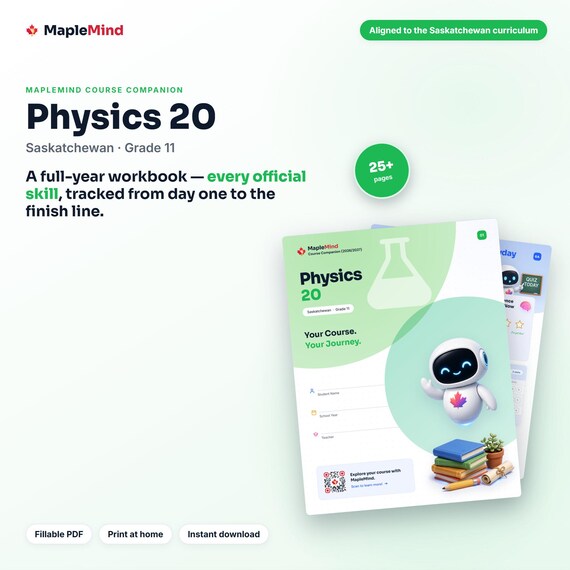
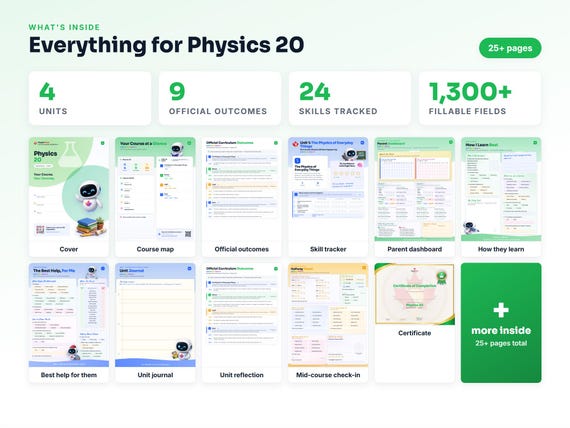
A Physics 20 workbook worth keeping
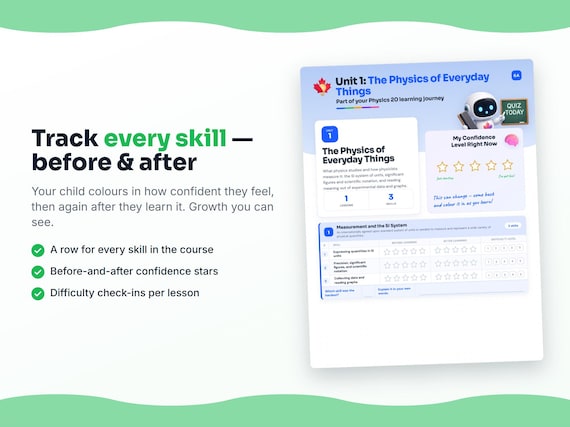
Built from the same official curriculum as this page. Before and after each skill above, your student colours in how sure they feel — so the two of you can see, on one page, what's clicking and what needs another look. It's a quiet way to follow how the year is really going.
By June it's full of their own handwriting: units worked through, confidence grown, a mid-year check-in, notes from parent-teacher night, and a certificate at the end. Less a worksheet, more a record of the year worth keeping on the shelf.
Instant download · see every page, reviews and the full description · five or more workbooks are $2.99 each
What it looks like in the app



Common questions
Can MapleMind help me with Physics 20?
Yes. MapleMind's AI tutor covers all 24 skills in Saskatchewan's Physics 20 — you pick the exact skill, and the tutor teaches it step by step: a short lesson, a worked example, solving together, then a skill check to show it stuck.
Is MapleMind aligned to Saskatchewan's official curriculum?
Yes. Every skill in this course maps to an official outcome code from Saskatchewan's Grade 11 Science curriculum, and the ministry's own wording is quoted under each unit on this page — with the official government source linked so you can check it yourself.
What does MapleMind cost?
It's free to start — 5 tutoring chats and a practice quiz every day, no credit card. A Pro subscription ($9.99/month or $49.99/year CAD, 7-day free trial) unlocks unlimited tutoring, practice, and exam simulations.
What if I'm stuck on just one topic?
That's the point of skill-level tutoring: open Physics 20 in the app, tap the exact skill from the list on this page, and the tutor teaches just that — no wading through lessons you don't need.
Does MapleMind work in French or other languages?
Yes — 14 languages, including French. Both the app and the tutor's explanations switch to the language you choose.
Where can I see the official Saskatchewan curriculum for Physics 20?
The official source is linked on this page — Saskatchewan's official curriculum. The outline here follows it: every MapleMind skill carries its official outcome code, and the ministry's own wording is quoted under each unit.
Keep exploring
Ready when you are
Pick a skill from this page and see it taught properly — free, in the browser, in under a minute.