Get help with Science, Grade 10
Most tutoring makes you sit through material you already know. MapleMind flips that: pick the exact skill that's causing trouble — any of the 34 below — and the tutor teaches just that one, step by step, as many times as it takes. Ask questions in plain words, any time of day, in English, French, or 12 other languages.
The official Saskatchewan Science, Grade 10 curriculum
Saskatchewan defines Science, Grade 10 by strands and outcomes. MapleMind teaches the same curriculum reorganized for one-skill-at-a-time tutoring — the table shows exactly where every official strand lands, and the ministry's own wording is quoted under each unit below.
Official source Saskatchewan's official curriculumRead it on the government site — curriculum.gov.sk.ca ↗| Official strand | Outcomes | Where MapleMind teaches it |
|---|---|---|
| Strand CI | 1 | Career Investigation |
| Strand CD | 4 | Climate and Ecosystem Dynamics |
| Strand CR | 4 | Chemical Reactions |
| Strand FM | 4 | Force and Motion in Our World |
Every skill below, taught one on one.
 Try the first session free
How MapleMind teaches Science, Grade 10 — every unit, lesson, and skill
Every skill below runs as a short session: a plain-words lesson, a worked example, solving it together, then a five-question skill check that earns up to three stars. Guided Mode keeps it teaching instead of answer-handing — turning it off needs a parent's password.
Unit 1Career InvestigationOfficial strand · Strand CI
Investigating career paths related to the branches and sub-branches of science.
Careers in Science
- Branches of science and career pathsSCI10-CI1 — Investigate career paths related to the branches and sub-branches of science and represent the range of career options.
- Profiling a science careerSCI10-CI1 — Develop a profile of a specific individual in a science career and research the educational qualifications of people in science-related careers.
The official wording — 1 outcome in this unit
- SCI10-CI1
Investigate career paths related to various branches and sub-branches of science.
Unit 2Climate and Ecosystem DynamicsOfficial strand · Strand CD
The implications of human actions on climate and ecosystem sustainability, the factors that influence Earth's climate system, biodiversity and interactions among populations, and feedback mechanisms in biogeochemical cycles.
Human Actions and Sustainability
- Perspectives on sustainabilitySCI10-CD1 — Assess perspectives on humanity's relationship with the environment and the responsibility to protect ecosystems.
- Climate change indicators and actionsSCI10-CD1 — Provide examples of human actions contributing to the anthropogenic greenhouse effect and how scientists track key indicators of climate change.
- Milestones and evidence in sustainabilitySCI10-CD1 — Evaluate the changing scientific worldview of sustainability using key milestones and analyze the validity of information from various sources.
Earth's Climate System
- Weather, climate, and the climate systemSCI10-CD2 — Differentiate weather from climate and describe how Earth's climate system results from the exchange of thermal energy and moisture.
- Global circulation and weather patternsSCI10-CD2 — Investigate how Earth's tilt and rotation drive global convection currents, the Coriolis effect, ocean circulation, and severe weather.
- The natural greenhouse effectSCI10-CD2 — Explain how greenhouse gases and surface albedo affect solar energy and how natural sources produce the natural greenhouse effect.
Biodiversity and Populations
- Biomes and biodiversitySCI10-CD3 — Discuss the importance of biodiversity and compare the biodiversity and climatic characteristics of Earth's major biomes.
- Sampling techniquesSCI10-CD3 — Estimate the abundance of organisms in a local ecosystem using quadrat, transect, and stratified sampling techniques and determine population density.
- Population dynamics and carrying capacitySCI10-CD3 — Interpret graphs of population dynamics and explain how populations maintain equilibrium relative to the carrying capacity of an ecosystem.
- Threats to biodiversity and bioaccumulationSCI10-CD3 — Examine how invasive species, habitat loss, and climate change threaten biodiversity and how bioaccumulation and biomagnification affect organisms.
Feedback and Biogeochemical Cycles
- Systems and feedback mechanismsSCI10-CD4 — Explain systems in terms of their type and equilibrium and create a representation of a feedback mechanism in a biogeochemical cycle.
- Cycling of carbon and nitrogenSCI10-CD4 — Examine the cycling of carbon and nitrogen through ecosystems and how human actions affect the cycling of matter and flow of energy.
- Indigenous knowledge and cycle interdependenceSCI10-CD4 — Explore Indigenous ways of understanding matter and energy in the environment and analyze the interdependence between the water cycle and other biogeochemical cycles.
The official wording — 4 outcomes in this unit
- SCI10-CD1
Assess the implications of human actions on the local and global climate and the sustainability of ecosystems.
- SCI10-CD2
Investigate factors that influence Earth’s climate system, including the role of the natural greenhouse effect.
- SCI10-CD3
Examine biodiversity through the analysis of interactions among populations within communities.
- SCI10-CD4
Investigate the role of feedback mechanisms in biogeochemical cycles and in maintaining stability in ecosystems.
Unit 3Chemical ReactionsOfficial strand · Strand CR
The properties of chemical reactions including energy changes and acids and bases, naming and writing chemical formulas, representing reactions and conservation of mass, and the rates of chemical reactions.
Properties of Chemical Reactions
- Reaction types and energy changesSCI10-CR1 — Observe and describe types of chemical reactions and investigate the properties of endothermic and exothermic reactions, following WHMIS 2015 safety.
- Chemistry in our livesSCI10-CR1 — Describe the prevalence of chemistry in our lives, how various cultures have transformed materials, and why it can be hard to classify a change as physical or chemical.
- Acids, bases, and pHSCI10-CR1 — Research practical examples of acid-base and neutralization reactions and the importance of pH measurement in various fields.
Naming and Writing Formulas
- Naming ionic compoundsSCI10-CR2 — Name and write formulas for common ionic compounds, including those with polyatomic ions, using the periodic table and a list of ions.
- Naming molecular and organic compoundsSCI10-CR2 — Classify substances as ionic or molecular and name and write formulas for molecular and simple organic compounds.
- Naming acids and basesSCI10-CR2 — Classify substances as acids, bases, or salts and name and write formulas for common acids and bases, using the pH scale to classify them.
Equations and Conservation of Mass
- Representing reactions and conservation of massSCI10-CR3 — Confirm and explain the conservation of mass and represent chemical reactions using models, word, and skeleton equations.
- Balancing chemical equationsSCI10-CR3 — Translate word equations to balanced chemical equations, using coefficients and subscripts correctly, and verify that equations are balanced.
- Categorizing reactions from equationsSCI10-CR3 — Categorize chemical reactions from their equations as synthesis, decomposition, combustion, single replacement, or double replacement, including neutralization.
Rates of Chemical Reactions
- Factors affecting reaction rateSCI10-CR4 — Predict how temperature, concentration, surface area, and catalysts affect reaction rate and explain the differences using the collision model.
- Investigating reaction ratesSCI10-CR4 — Design and perform an experiment to determine how factors affect reaction rate and interpret the data.
The official wording — 4 outcomes in this unit
- SCI10-CR1
Explore the properties of chemical reactions, including the role of energy changes, and applications of acids and bases.
- SCI10-CR2
Name and write formulas for common ionic and molecular chemical compounds, including acids and bases.
- SCI10-CR3
Represent chemical reactions and conservation of mass symbolically using models, word and skeleton equations and balanced chemical equations.
- SCI10-CR4
Investigate the rates of chemical reactions, including factors that affect the rate.
Unit 4Force and Motion in Our WorldOfficial strand · Strand FM
Motion-related technologies, the motion of objects at constant speed, accelerated motion, and the relationship between force and motion in one and two dimensions.
Motion-Related Technologies
- Development of motion technologiesSCI10-FM1 — Explore the development of motion-related technologies from various cultures and evaluate their impacts on self and society.
- Designing for motion and measuring the imperceptibleSCI10-FM1 — Design and evaluate a prototype that meets a motion-related need and describe how imperceptible motion can be measured with appropriate technologies.
Uniform Motion
- Representing uniform motionSCI10-FM2 — Represent the motion of objects moving at constant speed using displacement vectors and distance-time and velocity-time graphs.
- Solving uniform-motion problemsSCI10-FM2 — Describe and solve problems involving the relationship among distance, time, and speed for objects in uniform motion.
Accelerated Motion
- Representing accelerated motionSCI10-FM3 — Investigate the properties of accelerated motion and construct and analyze graphs that represent objects undergoing acceleration.
- Solving acceleration problemsSCI10-FM3 — Apply the concept of rate of change to define acceleration and solve problems using the equations of motion.
Force and Motion
- Net force and force vectorsSCI10-FM4 — Add force vectors in one and two dimensions to determine the net force acting on an object and investigate the effects of constant forces.
- Newton's laws and frictionSCI10-FM4 — Demonstrate the role of friction and describe Newton's three laws of motion in practical situations.
The official wording — 4 outcomes in this unit
- SCI10-FM1
Explore the development of motion- related technologies and their impacts on self and society.
- SCI10-FM2
Investigate and represent the motion of objects that travel at a constant speed in a straight line.
- SCI10-FM3
Investigate and represent the motion of objects that undergo acceleration.
- SCI10-FM4
Explore the relationship between force and motion for objects moving in one and two dimensions.

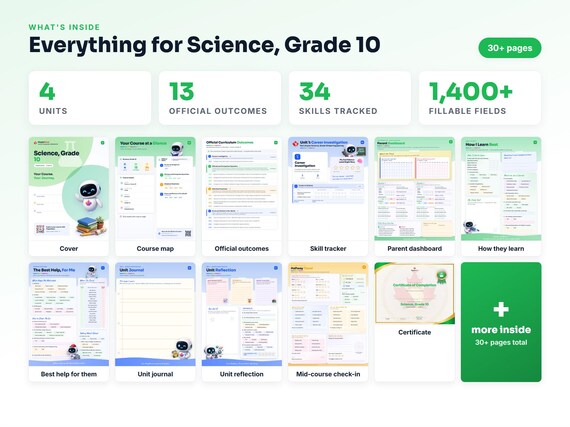


Printable workbook · A keepsake of the year
A Science, Grade 10 workbook worth keeping
Built from the same official curriculum as this page. Before and after each skill above, your student colours in how sure they feel — so the two of you can see, on one page, what's clicking and what needs another look. It's a quiet way to follow how the year is really going.
By June it's full of their own handwriting: units worked through, confidence grown, a mid-year check-in, notes from parent-teacher night, and a certificate at the end. Less a worksheet, more a record of the year worth keeping on the shelf.
Instant download · see every page, reviews and the full description · five or more workbooks are $2.99 each
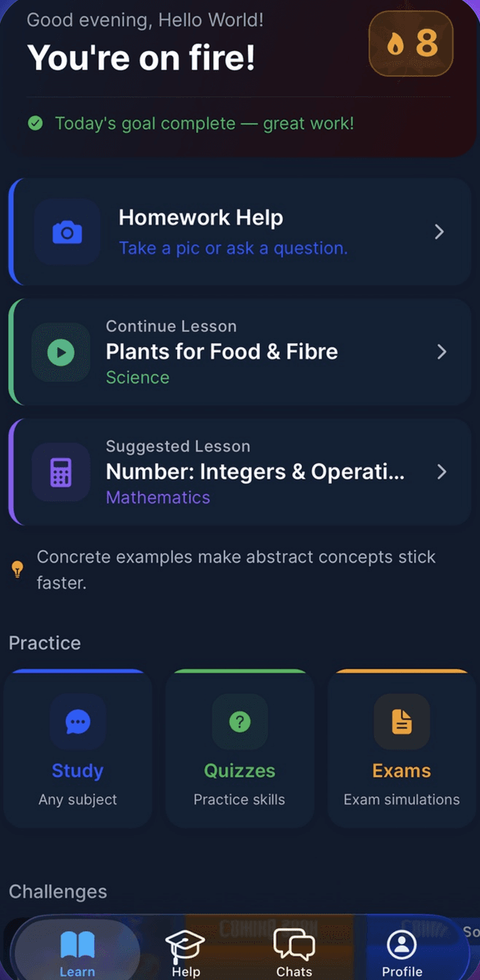
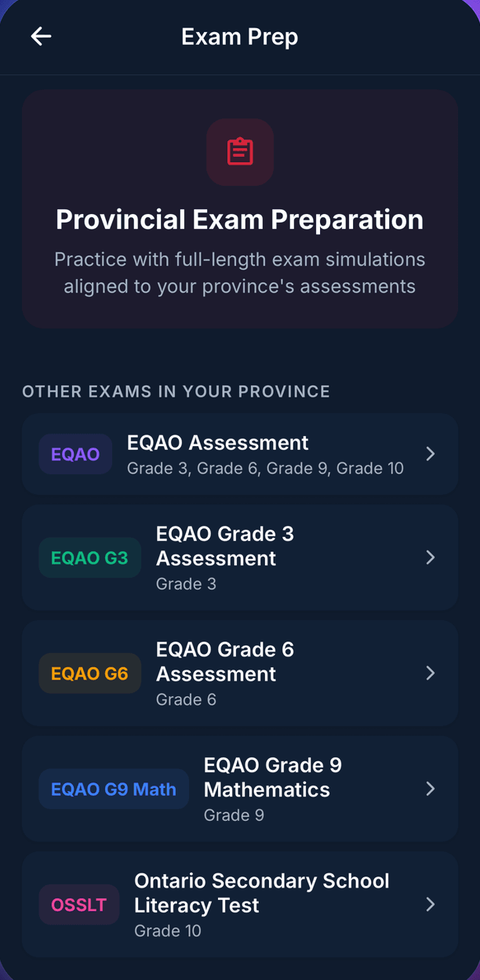
What it looks like in the app

Common questions
Can MapleMind help me with Science, Grade 10?
Yes. MapleMind's AI tutor covers all 34 skills in Saskatchewan's Science, Grade 10 — you pick the exact skill, and the tutor teaches it step by step: a short lesson, a worked example, solving together, then a skill check to show it stuck.
Is MapleMind aligned to Saskatchewan's official curriculum?
Yes. Every skill in this course maps to an official outcome code from Saskatchewan's Grade 10 Science curriculum, and the ministry's own wording is quoted under each unit on this page — with the official government source linked so you can check it yourself.
What does MapleMind cost?
It's free to start — 5 tutoring chats and a practice quiz every day, no credit card. A Pro subscription ($9.99/month or $49.99/year CAD, 7-day free trial) unlocks unlimited tutoring, practice, and exam simulations.
What if I'm stuck on just one topic?
That's the point of skill-level tutoring: open Science, Grade 10 in the app, tap the exact skill from the list on this page, and the tutor teaches just that — no wading through lessons you don't need.
Does MapleMind work in French or other languages?
Yes — 14 languages, including French. Both the app and the tutor's explanations switch to the language you choose.
Where can I see the official Saskatchewan curriculum for Science, Grade 10?
The official source is linked on this page — Saskatchewan's official curriculum. The outline here follows it: every MapleMind skill carries its official outcome code, and the ministry's own wording is quoted under each unit.
Keep exploring
Ready when you are
Pick a skill from this page and see it taught properly — free, in the browser, in under a minute.