Get help with Environmental Science 20
Most tutoring makes you sit through material you already know. MapleMind flips that: pick the exact skill that's causing trouble — any of the 26 below — and the tutor teaches just that one, step by step, as many times as it takes. Ask questions in plain words, any time of day, in English, French, or 12 other languages.
The official Saskatchewan Environmental Science 20 curriculum
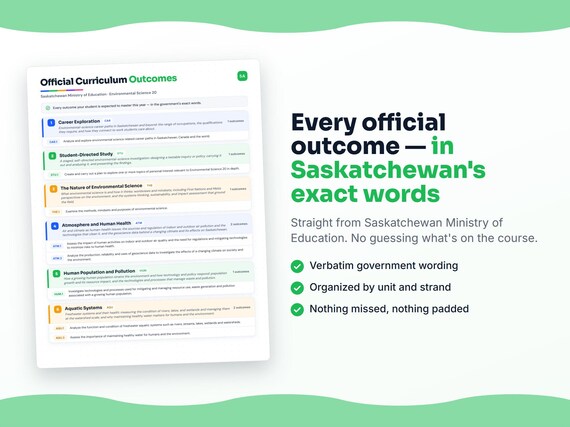
Saskatchewan defines Environmental Science 20 by strands and outcomes. MapleMind teaches the same curriculum reorganized for one-skill-at-a-time tutoring — the table shows exactly where every official strand lands, and the ministry's own wording is quoted under each unit below.
Official source Saskatchewan's official curriculumRead it on the government site — curriculum.gov.sk.ca ↗| Official strand | Outcomes | Where MapleMind teaches it |
|---|---|---|
| Strand CE | 1 | Career Exploration |
| SDS | 1 | Student-Directed Study |
| Strand ES | 1 | The Nature of Environmental Science |
| Strand AH | 2 | Atmosphere and Human Health |
| Strand HP | 1 | Human Population and Pollution |
| Strand AS | 2 | Aquatic Systems |
| Strand TE | 3 | Terrestrial Ecosystems |
Every skill below, taught one on one.
 Try the first session free
How MapleMind teaches Environmental Science 20 — every unit, lesson, and skill
Every skill below runs as a short session: a plain-words lesson, a worked example, solving it together, then a five-question skill check that earns up to three stars. Guided Mode keeps it teaching instead of answer-handing — turning it off needs a parent's password.
Unit 1Career ExplorationOfficial strand · Strand CE
Environmental-science career paths in Saskatchewan and beyond: the range of occupations, the qualifications they require, and how they connect to work students care about.
Environmental-Science Careers
- Environmental-science career paths and qualificationsES20-CE1 — Explore environmental-science occupations in Saskatchewan and beyond, their roles, and the education and qualifications they require.
The official wording — 1 outcome in this unit
- ES20-CE1
Analyze and explore environmental science related career paths in Saskatchewan, Canada and the world.
Unit 2Student-Directed StudyOfficial strand · SDS
A staged, self-directed environmental-science investigation: designing a testable inquiry or policy, carrying it out and analysing it, and presenting the findings.
Student-Directed Study Project
- Designing the investigation or policyES20-SDS1 — Design a scientific investigation or a policy on an Environmental Science 20 topic, grounded in a testable question or a defined environmental issue.
- Carrying out and analysingES20-SDS1 — Carry out the investigation following scientific protocols and analyse data, case studies, or an environmental impact assessment.
- Presenting and reflectingES20-SDS1 — Assemble and reflect on a portfolio and share the results through a display, presentation, demonstration, or action plan.
The official wording — 1 outcome in this unit
- ES20-SDS1
Create and carry out a plan to explore one or more topics of personal interest relevant to Environmental Science 20 in depth.
Unit 3The Nature of Environmental ScienceOfficial strand · Strand ES
What environmental science is and how it thinks: worldviews and mindsets, including First Nations and Metis perspectives on the environment, and the systems thinking, sustainability, and impact assessment that ground the field.
The Nature of Environmental Science
- Worldviews and mindsets in environmental scienceES20-ES1 — Analyze how different worldviews, including First Nations and Metis perspectives, shape environmental thinking and action.
- The field, systems thinking, and sustainabilityES20-ES1 — Recognize environmental science as an integrative field and apply systems thinking, sustainability, and impact assessment to environmental questions.
The official wording — 1 outcome in this unit
- ES20-ES1
Examine the methods, mindsets and purposes of environmental science.
Unit 4Atmosphere and Human HealthOfficial strand · Strand AH
Air and climate as human-health issues: the sources and regulation of indoor and outdoor air pollution and the technologies that clean it, and the geoscience data behind a changing climate and its effects on Saskatchewan.
Air Quality and Human Health
- Air pollutants and their sourcesES20-AH1 — Describe the sources of indoor and outdoor air pollutants and how ozone depletion and smog affect human health.
- Air-quality regulations and mitigating technologiesES20-AH1 — Analyze air-quality regulations and the technologies, such as scrubbers and catalytic converters, that reduce pollution and protect health.
Climate Change and Geoscience Data
- Sources and reliability of climate dataES20-AH2 — Examine how techniques and organizations produce climate data and how climate models simulate past and future climate.
- Climate change impacts on SaskatchewanES20-AH2 — Investigate the environmental, economic, and societal impacts of a changing climate on Saskatchewan and the adaptation and mitigation strategies in response.
- The Arctic, Indigenous knowledge, and climate consensusES20-AH2 — Investigate the Arctic as an indicator region, the role of Indigenous knowledge in climate policy, and the scientific consensus on anthropogenic climate change.
The official wording — 2 outcomes in this unit
- ES20-AH1
Assess the impact of human activities on indoor and outdoor air quality and the need for regulations and mitigating technologies to minimize risks to human health.
- ES20-AH2
Analyze the production, reliability and uses of geoscience data to investigate the effects of a changing climate on society and the environment.
Unit 5Human Population and PollutionOfficial strand · Strand HP
How a growing human population strains the environment and how technology and policy respond: population growth and its resource impact, and the technologies and processes that manage waste and pollution.
Human Population and Its Impact
- Population growth and environmental impactES20-HP1 — Identify factors driving human population growth and use models to relate population, consumption, and technology to environmental impact.
- Managing waste and pollutionES20-HP1 — Investigate technologies and processes - waste audits, treatment, composting, and recycling - used to manage waste and pollution from a growing population.
- Feeding a growing population sustainablyES20-HP1 — Assess how food security, medicine, and fertilizer support a growing population and their environmental trade-offs, including First Nations and Metis sustainable practices.
The official wording — 1 outcome in this unit
- ES20-HP1
Investigate technologies and processes used for mitigating and managing resource use, waste generation and pollution associated with a growing human population.
Unit 6Aquatic SystemsOfficial strand · Strand AS
Freshwater systems and their health: measuring the condition of rivers, lakes, and wetlands and managing them at the watershed scale, and why maintaining healthy water matters for humans and the environment.
The Health of Freshwater Systems
- Measuring the condition of aquatic ecosystemsES20-AS1 — Measure abiotic factors and use biological indicators to assess the condition and biodiversity of a freshwater aquatic ecosystem.
- Watersheds, wetlands, and riparian zonesES20-AS1 — Assess how an integrated watershed management approach and healthy wetlands and riparian zones protect water resources.
- Bacterial testing and lake eutrophicationES20-AS1 — Investigate bacterial content in surface water against safety standards and recognize the causes of lake eutrophication.
Maintaining Healthy Water
- Threats to water quality and standardsES20-AS2 — Analyze health challenges and pollution that threaten water quality and the rationale for water quality standards.
- Protecting drinking water and stewardshipES20-AS2 — Describe technologies and stewardship, including First Nations and Metis practices and the Water Security Agency, that protect and improve water.
- Irrigation, water use, and human impact on aquatic systemsES20-AS2 — Assess how irrigation and human activities affect food production, water availability, soil salinization, and aquatic systems.
The official wording — 2 outcomes in this unit
- ES20-AS1
Analyze the function and condition of freshwater aquatic systems such as rivers, streams, lakes, wetlands and watersheds.
- ES20-AS2
Assess the importance of maintaining healthy water for humans and the environment.
Unit 7Terrestrial EcosystemsOfficial strand · Strand TE
Life on land: soil as the foundation of terrestrial ecosystems, the roles of plants and how humans use them, and the intact habitat needed to support animal populations and biodiversity across Saskatchewan's ecozones.
Soil in Terrestrial Ecosystems
- Soil formation and characteristicsES20-TE1 — Explain how soil forms from parent material and relate soil characteristics to Saskatchewan's ecozones, including First Nations and Metis values.
- Soil quality, life, and degradationES20-TE1 — Investigate how soil quality is measured and monitored, the organisms and cycling within soil, and the causes and mitigation of soil degradation.
- Composting and building soil in urban ecosystemsES20-TE1 — Investigate composting systems and propose a landscaping or action plan that builds healthy soil in an urban ecosystem.
Plants, Habitat, and Biodiversity
- The roles of plants in ecosystemsES20-TE2 — Explain how plant morphology and physiology determine plants' ecological roles, including photosynthesis and net primary productivity.
- Human use of plants: agriculture and forestryES20-TE2 — Assess how agriculture and forestry practices use plants and affect ecosystems, and the impact of climate change on plants.
- Intact habitat and biodiversityES20-TE3 — Justify the need for intact habitat to support animal populations and biodiversity across Saskatchewan's ecozones.
The official wording — 3 outcomes in this unit
- ES20-TE1
Analyze the importance of soil as an integral component of terrestrial ecosystems.
- ES20-TE2
Examine the role plants play in an ecosystem, including ways in which humans use plants.
- ES20-TE3
Recognize the need for intact habitat to support animal populations and biodiversity.
Printable workbook · A keepsake of the year
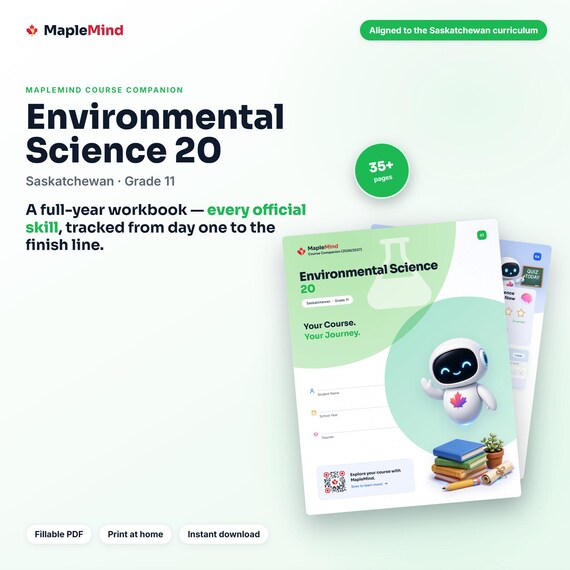
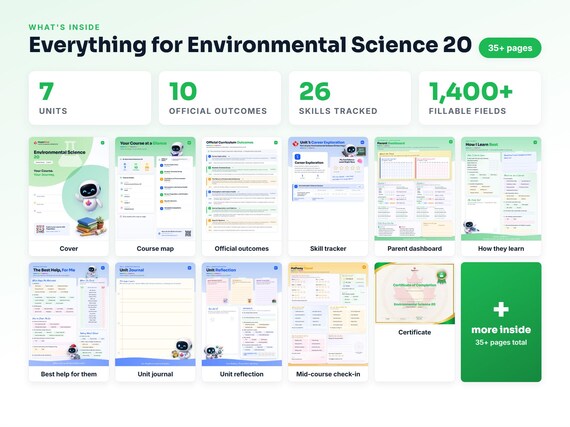
A Environmental Science 20 workbook worth keeping
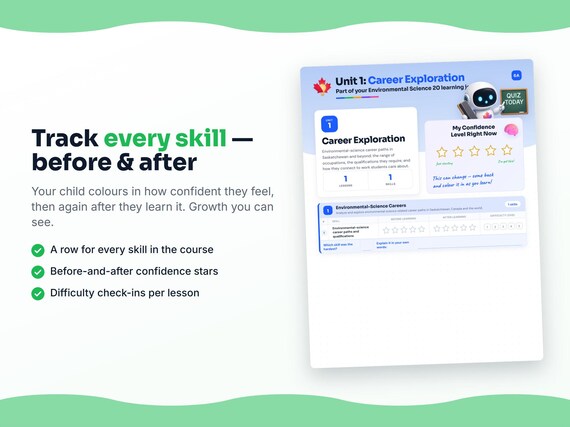
Built from the same official curriculum as this page. Before and after each skill above, your student colours in how sure they feel — so the two of you can see, on one page, what's clicking and what needs another look. It's a quiet way to follow how the year is really going.
By June it's full of their own handwriting: units worked through, confidence grown, a mid-year check-in, notes from parent-teacher night, and a certificate at the end. Less a worksheet, more a record of the year worth keeping on the shelf.
Instant download · see every page, reviews and the full description · five or more workbooks are $2.99 each
What it looks like in the app


Common questions
Can MapleMind help me with Environmental Science 20?
Yes. MapleMind's AI tutor covers all 26 skills in Saskatchewan's Environmental Science 20 — you pick the exact skill, and the tutor teaches it step by step: a short lesson, a worked example, solving together, then a skill check to show it stuck.
Is MapleMind aligned to Saskatchewan's official curriculum?
Yes. Every skill in this course maps to an official outcome code from Saskatchewan's Grade 11 Science curriculum, and the ministry's own wording is quoted under each unit on this page — with the official government source linked so you can check it yourself.
What does MapleMind cost?
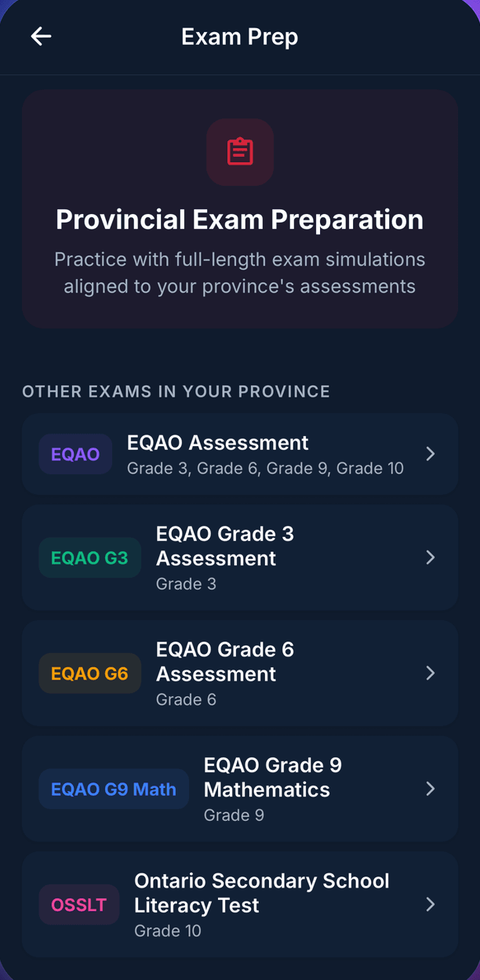
It's free to start — 5 tutoring chats and a practice quiz every day, no credit card. A Pro subscription ($9.99/month or $49.99/year CAD, 7-day free trial) unlocks unlimited tutoring, practice, and exam simulations.
What if I'm stuck on just one topic?
That's the point of skill-level tutoring: open Environmental Science 20 in the app, tap the exact skill from the list on this page, and the tutor teaches just that — no wading through lessons you don't need.
Does MapleMind work in French or other languages?
Yes — 14 languages, including French. Both the app and the tutor's explanations switch to the language you choose.
Where can I see the official Saskatchewan curriculum for Environmental Science 20?
The official source is linked on this page — Saskatchewan's official curriculum. The outline here follows it: every MapleMind skill carries its official outcome code, and the ministry's own wording is quoted under each unit.
Keep exploring
Ready when you are
Pick a skill from this page and see it taught properly — free, in the browser, in under a minute.