Get help with Biology 30
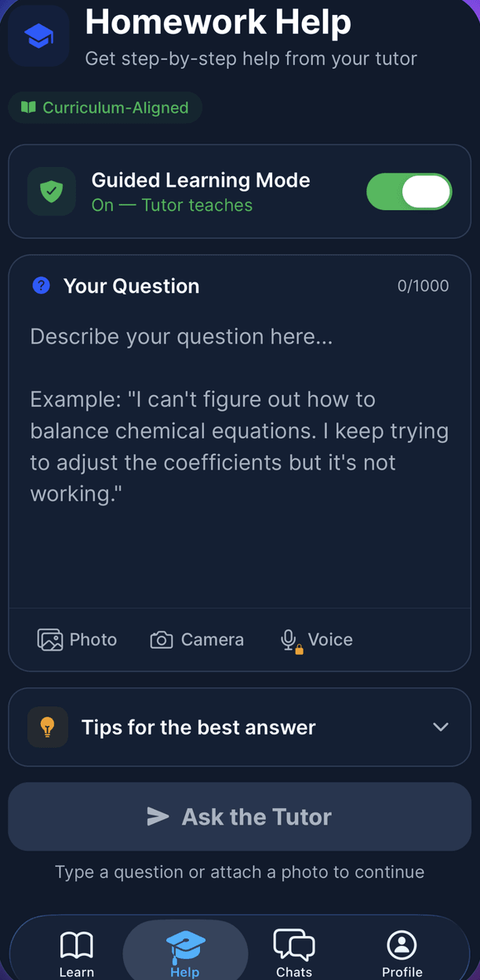
Most tutoring makes you sit through material you already know. MapleMind flips that: pick the exact skill that's causing trouble — any of the 20 below — and the tutor teaches just that one, step by step, as many times as it takes. Ask questions in plain words, any time of day, in English, French, or 12 other languages.
The official Saskatchewan Biology 30 curriculum
Saskatchewan defines Biology 30 by strands and outcomes. MapleMind teaches the same curriculum reorganized for one-skill-at-a-time tutoring — the table shows exactly where every official strand lands, and the ministry's own wording is quoted under each unit below.
Official source Saskatchewan's official curriculumRead it on the government site — curriculum.gov.sk.ca ↗| Official strand | Outcomes | Where MapleMind teaches it |
|---|---|---|
| SDS | 1 | Student-Directed Study |
| Strand LE | 2 | Life and Evolution |
| Strand OL | 3 | Organization of Life |
| Strand GB | 3 | Genetics and Biotechnology |
Every skill below, taught one on one.
 Try the first session free
How MapleMind teaches Biology 30 — every unit, lesson, and skill
Every skill below runs as a short session: a plain-words lesson, a worked example, solving it together, then a five-question skill check that earns up to three stars. Guided Mode keeps it teaching instead of answer-handing — turning it off needs a parent's password.
Unit 1Student-Directed StudyOfficial strand · SDS
A self-designed inquiry into a topic of personal interest relevant to Biology 30, carried out as a staged research project.
Designing the Inquiry
- Designing a scientific investigationBI30-SDS1 — Design a scientific investigation related to a Biology 30 topic, including a testable question, a hypothesis, an experimental design that tests the hypothesis, and detailed procedures for collecting and analyzing data.
Carrying Out and Analysing
- Carrying out and analysing the experimentBI30-SDS1 — Carry out an experiment following established scientific protocols to investigate the Biology 30 question, and analyse the resulting data.
Presenting the Study
- Portfolio and presentationBI30-SDS1 — Assemble and reflect on a portfolio demonstrating understanding of the topic, and share the results of the student-directed research through an appropriate presentation format.
The official wording — 1 outcome in this unit
- BI30-SDS1
Create and carry out a plan to explore one or more topics of personal interest relevant to Biology 30 in depth.
Unit 2Life and EvolutionOfficial strand · Strand LE
How scientific understandings of life change with new evidence, and evolution as the unifying theme of biology.
Defining Life
- How definitions of life changeBI30-LE1 — Explore how scientific understandings of life and its characteristics change in light of new evidence, including how definitions have shifted with technology and how different cultural perspectives approach the question of what constitutes life.
Principles and Processes of Evolution
- Principles and processes of evolutionBI30-LE2 — Examine the principles and processes of biological evolution — descent with modification, fitness through adaptation, natural selection, genetic drift, and selective breeding — and identify common misconceptions about evolution.
- Evidence for evolutionBI30-LE2 — Examine how scientists use the fossil record, radioactive dating, comparative embryology, and homologous and analogous structures as evidence of evolution, and interpret cladograms and phylogenetic trees to determine evolutionary relationships.
- Speciation and human evolutionBI30-LE2 — Explain how geographic, temporal, and behavioural isolation influence speciation, identify patterns evident over geological time, and explore human evolution in relation to other primates.
The official wording — 2 outcomes in this unit
- BI30-LE1
Explore how scientific understandings of life and its characteristics change in light of new evidence.
- BI30-LE2
Examine the significance of evolution as a key unifying theme in biology through the principles, processes and patterns of biological evolution.
Unit 3Organization of LifeOfficial strand · Strand OL
Cell structure and processes, the anatomy and physiology of multicellular organisms, and the dynamic nature of biological classification.
Cell Structure and Energy
- Energy synthesis and cell moleculesBI30-OL1 — Investigate cell processes of energy transfer, analysing how organisms from each kingdom synthesize ATP through chemosynthesis, photosynthesis, and cellular respiration, and how biologically important molecules form complex structures.
- Transport and homeostasis at the membraneBI30-OL1 — Investigate the transport of materials at the interface of the cell membrane, including passive and active transport, and demonstrate how osmotic pressure helps maintain homeostasis in cells.
Anatomy, Physiology, and Behaviour
- Comparing anatomy and reproductive strategiesBI30-OL2 — Compare the anatomies and physiologies of multicellular organisms using microscopy, simulations, or dissections, and analyse the evolutionary costs and benefits of various reproductive strategies.
- Homeostasis, defence, and exchangeBI30-OL2 — Explore behavioural, structural, and physiological adaptations that enable organisms to defend themselves, maintain homeostasis, and acquire, transport, and excrete materials, including through symbiotic relationships.
The Dynamic Nature of Classification
- Taxonomy and naming conventionsBI30-OL3 — Research the contributions of scientists such as Carl Linnaeus to scientific naming conventions, and discuss how the taxonomic hierarchy and different cultural systems represent relationships among organisms.
- Keys, cladograms, and critiquing systemsBI30-OL3 — Create and use dichotomous keys and cladograms to inform contemporary classification, and critique the strengths and limitations of historical and contemporary systems of classifying living things.
The official wording — 3 outcomes in this unit
- BI30-OL1
Investigate cell structure and processes, including energy transfer and transport of materials, in unicellular and multicellular organisms which are representative of each kingdom.
- BI30-OL2
Compare the anatomies, physiologies and behaviours of multicellular organisms including protists, fungi, plants and animals.
- BI30-OL3
Explore how the dynamic nature of biological classification reflects advances in scientific understanding of relationships among organisms.
Unit 4Genetics and BiotechnologyOfficial strand · Strand GB
Classical and chromosomal inheritance, molecular genetics, and the impacts of biotechnology on self, society, and the environment.
Classical and Chromosomal Inheritance
- Patterns of inheritanceBI30-GB1 — Explore Mendelian inheritance by distinguishing patterns of inheritance — dominant and recessive alleles, sex-linked traits, codominance, incomplete dominance, multiple alleles, and polygenic inheritance — and using probability and pedigrees to predict traits.
- Punnett squares and genotype to phenotypeBI30-GB1 — Determine an organism's phenotype from its genotype and vice versa, and construct Punnett squares for monohybrid crosses to determine genotypic and phenotypic frequencies for F1 and F2 generations.
- The chromosomal basis of inheritanceBI30-GB1 — Recognize chromosomes as the mechanism of Mendel's laws, investigate the role of meiosis and crossing-over in genetic variation, and identify chromosomal mutations and nondisjunction syndromes using karyotypes.
Molecular Genetics
- DNA structure, replication, and protein synthesisBI30-GB2 — Investigate how genetic information is stored, transmitted, and expressed by assessing the structure of DNA and modelling DNA replication and protein synthesis, including the roles of DNA, mRNA, tRNA, and rRNA.
- Mutations, expression, and lab techniquesBI30-GB2 — Discuss the types and effects of point mutations, the role of proofreading, repair, and epigenetic factors in gene expression, and model common molecular-genetics techniques such as gel electrophoresis and PCR.
Impacts of Biotechnology
- Biotechnology applicationsBI30-GB3 — Identify historical, current, and emerging biotechnologies and research a medical or industrial application, exploring how societal pressures drive their development.
- Ethics, society, and regulationBI30-GB3 — Explore the positive and negative impacts of specific biotechnologies on individuals and society, including antibiotic resistance, and analyse the role of regulation, legislation, and intellectual property rights.
The official wording — 3 outcomes in this unit
- BI30-GB1
Explore classical (i.e. Mendelian) and current (i.e. chromosomal) understandings of biological inheritance.
- BI30-GB2
Investigate how genetic information is stored, transmitted and expressed at the molecular level.
- BI30-GB3
Explore the impacts of historical, current and emerging biotechnologies on self, society and the environment.
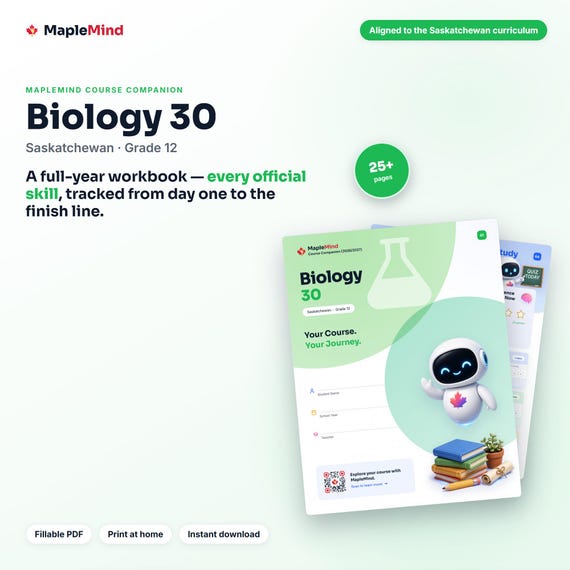
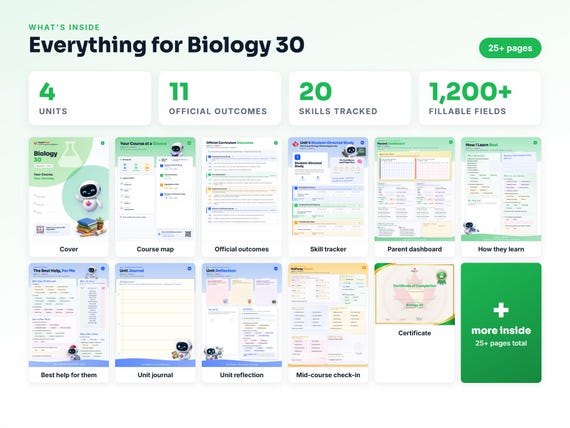

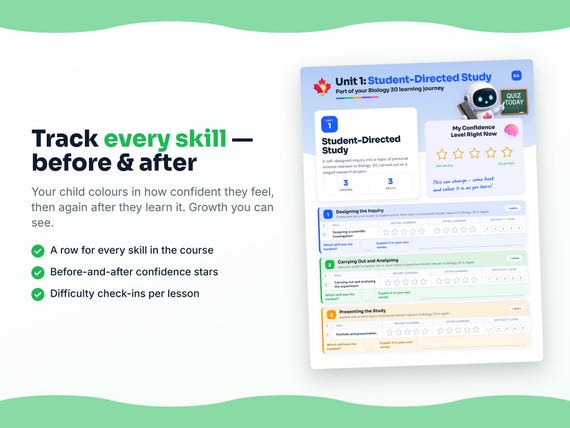
Printable workbook · A keepsake of the year
A Biology 30 workbook worth keeping
Built from the same official curriculum as this page. Before and after each skill above, your student colours in how sure they feel — so the two of you can see, on one page, what's clicking and what needs another look. It's a quiet way to follow how the year is really going.
By June it's full of their own handwriting: units worked through, confidence grown, a mid-year check-in, notes from parent-teacher night, and a certificate at the end. Less a worksheet, more a record of the year worth keeping on the shelf.
Instant download · see every page, reviews and the full description · five or more workbooks are $2.99 each
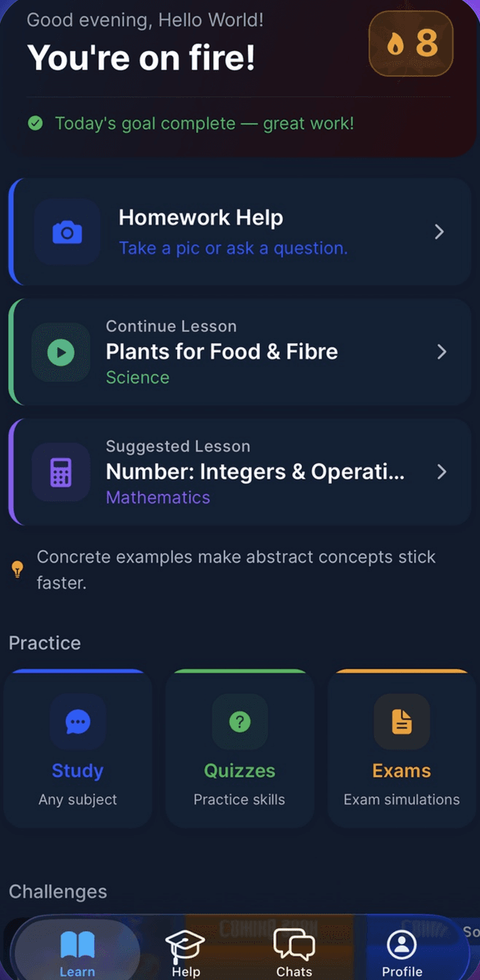
What it looks like in the app
Common questions
Can MapleMind help me with Biology 30?
Yes. MapleMind's AI tutor covers all 20 skills in Saskatchewan's Biology 30 — you pick the exact skill, and the tutor teaches it step by step: a short lesson, a worked example, solving together, then a skill check to show it stuck.
Is MapleMind aligned to Saskatchewan's official curriculum?
Yes. Every skill in this course maps to an official outcome code from Saskatchewan's Grade 12 Science curriculum, and the ministry's own wording is quoted under each unit on this page — with the official government source linked so you can check it yourself.
What does MapleMind cost?
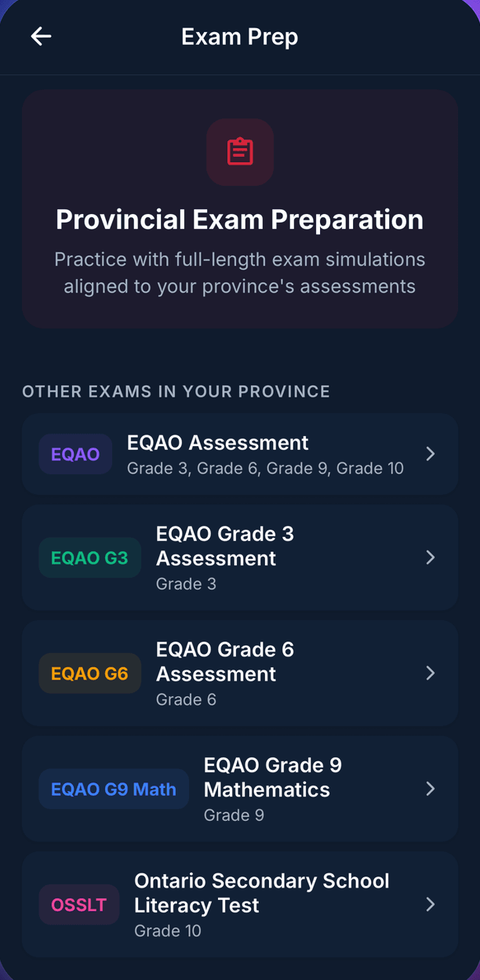
It's free to start — 5 tutoring chats and a practice quiz every day, no credit card. A Pro subscription ($9.99/month or $49.99/year CAD, 7-day free trial) unlocks unlimited tutoring, practice, and exam simulations.
What if I'm stuck on just one topic?
That's the point of skill-level tutoring: open Biology 30 in the app, tap the exact skill from the list on this page, and the tutor teaches just that — no wading through lessons you don't need.
Does MapleMind work in French or other languages?
Yes — 14 languages, including French. Both the app and the tutor's explanations switch to the language you choose.
Where can I see the official Saskatchewan curriculum for Biology 30?
The official source is linked on this page — Saskatchewan's official curriculum. The outline here follows it: every MapleMind skill carries its official outcome code, and the ministry's own wording is quoted under each unit.
Keep exploring
Ready when you are
Pick a skill from this page and see it taught properly — free, in the browser, in under a minute.