Get help with Biology 20
Most tutoring makes you sit through material you already know. MapleMind flips that: pick the exact skill that's causing trouble — any of the 26 below — and the tutor teaches just that one, step by step, as many times as it takes. Ask questions in plain words, any time of day, in English, French, or 12 other languages.
The official Saskatchewan Biology 20 curriculum
Saskatchewan defines Biology 20 by strands and outcomes. MapleMind teaches the same curriculum reorganized for one-skill-at-a-time tutoring — the table shows exactly where every official strand lands, and the ministry's own wording is quoted under each unit below.
Official source Saskatchewan's official curriculumRead it on the government site — curriculum.gov.sk.ca ↗| Official strand | Outcomes | Where MapleMind teaches it |
|---|---|---|
| Strand U1 | 3 | Introduction to Biology |
| Strand U2 | 6 | Ecological Organization |
| Strand U3 | 4 | The Diversity of Life |
| Strand U4 | 4 | Agricultural Botany of Saskatchewan |
Every skill below, taught one on one.
 Try the first session free
How MapleMind teaches Biology 20 — every unit, lesson, and skill
Every skill below runs as a short session: a plain-words lesson, a worked example, solving it together, then a five-question skill check that earns up to three stars. Guided Mode keeps it teaching instead of answer-handing — turning it off needs a parent's password.
Unit 1Introduction to BiologyOfficial strand · Strand U1
The nature of the study of biology, microscope technique, and the role of theory in biology.
The Nature of the Study of Biology
- The nature of biological studyBIO20-U1.1 — Understand the nature of the study of biology: the kinds of questions biologists investigate, how biology connects to daily life, and a working definition of biology.
Using the Microscope
- Examining cells with a microscopeBIO20-U1.2 — Use a light microscope to examine cells: handle and care for the instrument, prepare and view slides, sketch the field of view, and estimate object sizes.
Theory, Cell Theory, and Natural Selection
- The importance of theory in biologyBIO20-U1.3 — Explain the importance of theory in biology, using the development of cell theory and the principles of natural selection identified by Darwin and Wallace as worked examples of how theory explains and unifies observations and can change.
The official wording — 3 outcomes in this unit
- BIO20-U1.1
Understand the nature of the study of biology.
- BIO20-U1.2
Use a microscope to examine cells.
- BIO20-U1.3
Explain the importance of theory in biology.
Unit 2Ecological OrganizationOfficial strand · Strand U2
Ecosystems, communities, past ecosystems, populations and their changes, and ecological sequencing.
Soil, Climate, and Nutrient Cycles
- Soil components and plant growthBIO20-U2.1 — Identify the components of soil, describe Saskatchewan soil types, and determine how soil characteristics influence plant growth.
- Climate and plant growthBIO20-U2.1 — Describe how climatic variations in Saskatchewan influence plant growth, including how slope and microclimate produce variation in a community.
- Soil microorganisms and nutrient cyclesBIO20-U2.1 — Identify soil microorganisms and their importance, and describe the interrelationship of the water, carbon dioxide-oxygen, and nitrogen cycles.
Analyzing Communities and Ecosystems
- Niche, habitat, and community componentsBIO20-U2.2 — Analyze an ecosystem by distinguishing niche from habitat and identifying its biotic and abiotic components and their interactions.
- The human community and food websBIO20-U2.2 — Describe how the human community depends on soil, water, air, and climate, formulate food chains and webs involving humans, and compare natural and constructed communities.
- Relationships and successionBIO20-U2.2 — Identify symbiotic and competitive relationships among organisms, and describe succession in communities including how human activity such as agriculture and urbanization alters its rate.
Life in Past Ecosystems
- Evidence of life in the pastBIO20-U2.3 — Describe life in past ecosystems by examining fossil evidence, debating change and extinction theories, and considering the human role in altering the rate of ecological change.
Counting and Analyzing Populations
- Estimating populations by samplingBIO20-U2.4 — Explain how populations are counted by recalling the criteria that define a population and using sampling methods to estimate population size.
- Analyzing population changeBIO20-U2.5 — Analyze population changes by identifying factors that influence birth, death, immigration, and emigration, comparing cyclic and stable populations, and discussing Earth's carrying capacity for humans.
Ecological Sequencing and Biomes
- Levels of ecological organization and biomesBIO20-U2.6 — Recognize ecological sequencing by ordering biosphere, biome, ecosystem, community, and population, reviewing major biomes by their characteristic plants, and drawing and interpreting a climatogram.
The official wording — 6 outcomes in this unit
- BIO20-U2.1
Explain how the interactions among the soil, climate, and living organisms produce the ecosystems which can be observed.
- BIO20-U2.2
Analyze a variety of ecosystems.
- BIO20-U2.3
Describe life in past ecosystems.
- BIO20-U2.4
Explain how populations are counted.
- BIO20-U2.5
Analyze population changes.
- BIO20-U2.6
Recognize ecological sequencing.
Unit 3The Diversity of LifeOfficial strand · Strand U3
Principles of classification, the microbial and fungal kingdoms, the diversity of plants, and the diversity of animals.
Principles of Classification
- Classification and binomial nomenclatureBIO20-U3.1 — Describe the principles of classification: how organisms are grouped into kingdoms, the seven-level taxonomic hierarchy, binomial nomenclature, and using dichotomous keys to identify organisms.
Monera, Protists, and Fungi
- Viruses and bacteriaBIO20-U3.2 — Describe viral structure and activity and the classification, structure, roles, and diseases of bacteria, and distinguish prokaryotes from eukaryotes.
- The protist kingdomBIO20-U3.2 — Describe how the protist kingdom is classified, and collect, culture, and observe a variety of protists.
- The fungiBIO20-U3.2 — Describe the general characteristics of fungi and collect and observe some samples of fungi.
The Diversity of Plants
- Nonvascular and vascular plantsBIO20-U3.3 — Describe the diversity of plants by comparing nonvascular and vascular plants, describing how vascular plants are classified, and describing the grain and forage crops grown in Saskatchewan.
The Diversity of Animals
- The major animal phylaBIO20-U3.4 — Recognize the diversity of animals by describing the characteristics of the major animal phyla — mollusks, annelids, arthropods, and chordates — and identifying members native to Saskatchewan.
The official wording — 4 outcomes in this unit
- BIO20-U3.1
Describe the principles of classification.
- BIO20-U3.2
Recognize the role of monera, protists, and fungi in the ecosystem.
- BIO20-U3.3
Describe the diversity of plants.
- BIO20-U3.4
Recognize the diversity of animals.
Unit 4Agricultural Botany of SaskatchewanOfficial strand · Strand U4
Plant biological processes, Saskatchewan's biogeographical regions and agriculture, internal and external influences on plant growth, and the interconnectedness of agriculture and the environment.
Biological Processes in Plants
- Plant reproduction and transportBIO20-U4.1 — Recognize biological processes in plant systems by comparing sexual and asexual reproduction in angiosperms, describing pollination, fertilization, and seed formation, and describing how solutions are transported through plants.
- Crop systems and growth influencesBIO20-U4.1 — Describe the major plant systems of cereal, oilseed, pulse, forage, or native crops and identify the effects of climate and pest on different stages of crop development.
- Plant structures and tissuesBIO20-U4.1 — Review the three major plant structures — root, stem, and leaf — and their functions, and identify the four broad tissue areas: meristematic, protective, vascular, and fundamental.
Biogeographical Regions and Agriculture
- Saskatchewan's biogeographical regionsBIO20-U4.2 — Appreciate the relation of Saskatchewan's biogeographical regions and agricultural activity by identifying the characteristics of each region, comparing grain and forage crops, and identifying native trees, shrubs, plants, and grasses.
Internal and External Influences on Plant Growth
- Hormones, tropisms, and soil chemistryBIO20-U4.3 — Describe internal and external influences on plant growth: the function of cytokinins, auxins, and gibberellins; tropisms versus turgor responses; plant responses to fertilizers and herbicides; and soil degradation.
Agriculture and the Environment
- Agriculture and the environmentBIO20-U4.4 — Recognize the interconnectedness of agriculture and the environment by describing the impact of agriculture on the local environment and identifying local and global issues such as soil degradation and world hunger.
The official wording — 4 outcomes in this unit
- BIO20-U4.1
Recognize the various biological processes associated with plant systems.
- BIO20-U4.2
Appreciate the relation of Saskatchewan's biogeographical regions and agricultural activity.
- BIO20-U4.3
Describe the internal and external influences on plant growth.
- BIO20-U4.4
Recognize the interconnectedness of agriculture and the environment.
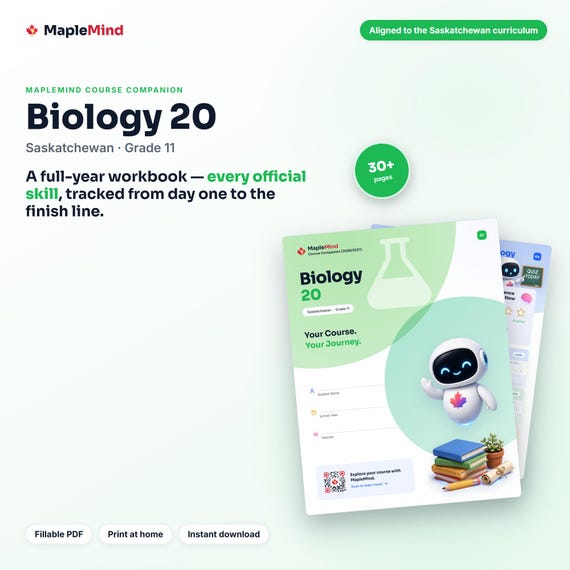



Printable workbook · A keepsake of the year
A Biology 20 workbook worth keeping
Built from the same official curriculum as this page. Before and after each skill above, your student colours in how sure they feel — so the two of you can see, on one page, what's clicking and what needs another look. It's a quiet way to follow how the year is really going.
By June it's full of their own handwriting: units worked through, confidence grown, a mid-year check-in, notes from parent-teacher night, and a certificate at the end. Less a worksheet, more a record of the year worth keeping on the shelf.
Instant download · see every page, reviews and the full description · five or more workbooks are $2.99 each
What it looks like in the app



Common questions
Can MapleMind help me with Biology 20?
Yes. MapleMind's AI tutor covers all 26 skills in Saskatchewan's Biology 20 — you pick the exact skill, and the tutor teaches it step by step: a short lesson, a worked example, solving together, then a skill check to show it stuck.
Is MapleMind aligned to Saskatchewan's official curriculum?
Yes. Every skill in this course maps to an official outcome code from Saskatchewan's Grade 11 Science curriculum, and the ministry's own wording is quoted under each unit on this page — with the official government source linked so you can check it yourself.
What does MapleMind cost?
It's free to start — 5 tutoring chats and a practice quiz every day, no credit card. A Pro subscription ($9.99/month or $49.99/year CAD, 7-day free trial) unlocks unlimited tutoring, practice, and exam simulations.
What if I'm stuck on just one topic?
That's the point of skill-level tutoring: open Biology 20 in the app, tap the exact skill from the list on this page, and the tutor teaches just that — no wading through lessons you don't need.
Does MapleMind work in French or other languages?
Yes — 14 languages, including French. Both the app and the tutor's explanations switch to the language you choose.
Where can I see the official Saskatchewan curriculum for Biology 20?
The official source is linked on this page — Saskatchewan's official curriculum. The outline here follows it: every MapleMind skill carries its official outcome code, and the ministry's own wording is quoted under each unit.
Keep exploring
Ready when you are
Pick a skill from this page and see it taught properly — free, in the browser, in under a minute.