Get help with Chemistry 30
Most tutoring makes you sit through material you already know. MapleMind flips that: pick the exact skill that's causing trouble — any of the 26 below — and the tutor teaches just that one, step by step, as many times as it takes. Ask questions in plain words, any time of day, in English, French, or 12 other languages.
The official Saskatchewan Chemistry 30 curriculum
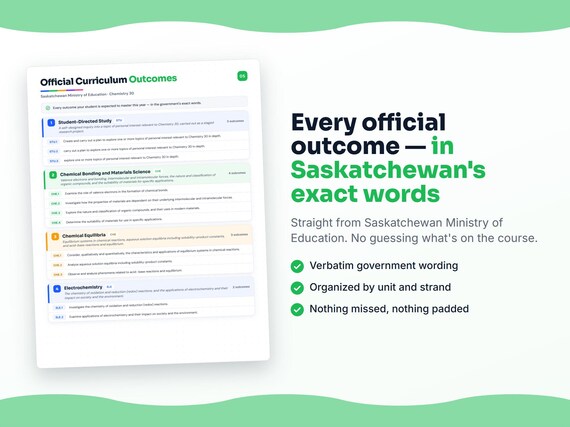
Saskatchewan defines Chemistry 30 by strands and outcomes. MapleMind teaches the same curriculum reorganized for one-skill-at-a-time tutoring — the table shows exactly where every official strand lands, and the ministry's own wording is quoted under each unit below.
Official source Saskatchewan's official curriculumRead it on the government site — curriculum.gov.sk.ca ↗| Official strand | Outcomes | Where MapleMind teaches it |
|---|---|---|
| SDS | 1 | Student-Directed Study |
| Strand MS | 4 | Chemical Bonding and Materials Science |
| Strand EQ | 3 | Chemical Equilibria |
| Strand EC | 2 | Electrochemistry |
Every skill below, taught one on one.
 Try the first session free
How MapleMind teaches Chemistry 30 — every unit, lesson, and skill
Every skill below runs as a short session: a plain-words lesson, a worked example, solving it together, then a five-question skill check that earns up to three stars. Guided Mode keeps it teaching instead of answer-handing — turning it off needs a parent's password.
Unit 1Student-Directed StudyOfficial strand · SDS
A self-designed inquiry into a topic of personal interest relevant to Chemistry 30, carried out as a staged research project.
Designing the Inquiry
- Designing a scientific investigationCH30-SDS1 — Design a scientific investigation related to a Chemistry 30 topic, including a testable question, a hypothesis, an experimental design that tests the hypothesis, and detailed procedures for collecting and analyzing data.
Carrying Out and Analysing
- Carrying out and analysing the experimentCH30-SDS1 — Carry out an experiment following established scientific protocols to investigate the Chemistry 30 question, and analyse the resulting data.
Presenting the Study
- Portfolio and presentationCH30-SDS1 — Assemble and reflect on a portfolio demonstrating understanding of the topic, and share the results of the student-directed research through an appropriate presentation format.
The official wording — 1 outcome in this unit
- CH30-SDS1
Create and carry out a plan to explore one or more topics of personal interest relevant to Chemistry 30 in depth.
Unit 2Chemical Bonding and Materials ScienceOfficial strand · Strand MS
Valence electrons and bonding, intermolecular and intramolecular forces, the nature and classification of organic compounds, and the suitability of materials for specific applications.
Valence Electrons and Chemical Bonds
- The atomic model and valence electronsCH30-MS1 — Examine the role of valence electrons by tracing the atomic model from Bohr to the quantum understanding and relating an element's periodic-table position to its valence electrons and the octet rule.
- Lewis structures and molecular shapeCH30-MS1 — Draw Lewis structures to represent covalent- and ionic-bonded molecules, predict molecular geometry using VSEPR theory, and predict the nature of chemical bonds using electronegativity.
Forces and Material Properties
- Intermolecular and intramolecular forcesCH30-MS2 — Investigate how material properties depend on underlying forces by predicting molecular polarity and differentiating intermolecular forces (van der Waals, ionic crystal, network-covalent) from intramolecular forces.
- Testing and classifying materialsCH30-MS2 — Identify and compare physical and chemical properties of ionic, molecular, metallic, and network-covalent substances, and construct and apply a classification system that determines the dominant intermolecular force in a tested material.
Organic Compounds and Materials
- Carbon's diversity and organic modelsCH30-MS3 — Explore the nature of organic compounds by explaining how the valence structure of carbon leads to the large number and diversity of organic compounds, and comparing models used to represent organic molecules.
- IUPAC naming of hydrocarbonsCH30-MS3 — Write the molecular and structural formulas and provide the IUPAC names for straight-chain and branched alkanes, alkenes, and alkynes with up to ten carbon atoms.
- IsomerismCH30-MS3 — Discuss the importance of isomerization, including geometric and optical isomerism, in materials science and biological applications.
- Functional-group classesCH30-MS3 — Identify various classes of organic compounds based on functional groups — including alcohols, aldehydes, ketones, ethers, esters, and organic acids — and describe their applications, including compounds important to biological systems.
- Polymers and petrochemicalsCH30-MS3 — Describe processes of polymerization and the significance of natural and synthetic polymers, and provide examples of consumer and industrial products derived from the refining of fossil fuels.
Suitability of Materials
- Selecting materials for applicationsCH30-MS4 — Determine the suitability of materials for specific applications by matching a material's properties to product specifications and justifying the choice against identified criteria such as cost, availability, and source.
- Life cycle and modern materialsCH30-MS4 — Evaluate the risks and benefits to society and the environment of a product throughout its life cycle, and investigate the potential of modern materials such as graphene, aerogels, and carbon nanotubes.
The official wording — 4 outcomes in this unit
- CH30-MS1
Examine the role of valence electrons in the formation of chemical bonds.
- CH30-MS2
Investigate how the properties of materials are dependent on their underlying intermolecular and intramolecular forces.
- CH30-MS3
Explore the nature and classification of organic compounds, and their uses in modern materials.
- CH30-MS4
Determine the suitability of materials for use in specific applications.
Unit 3Chemical EquilibriaOfficial strand · Strand EQ
Equilibrium systems in chemical reactions, aqueous solution equilibria including solubility-product constants, and acid-base reactions and equilibrium.
Equilibrium Systems
- The nature of equilibriumCH30-EQ1 — Consider the characteristics of equilibrium systems: why most chemical reactions do not proceed to completion, the criteria that characterize an equilibrium system, and the analysis of concentration-time graphs.
- The equilibrium constant and calculationsCH30-EQ1 — Write the equilibrium constant (Keq) expression for chemical reactions, interpret Keq values, and perform calculations of equilibrium concentrations using ICE charts.
- Le Chatelier's principle and applicationsCH30-EQ1 — Predict the shifts in equilibrium caused by changes in temperature, pressure, volume, concentration, or catalyst using Le Chatelier's principle, and describe the Haber process and how industry manipulates equilibrium.
Aqueous Solution Equilibria
- Solubility and the common ion effectCH30-EQ2 — Analyze aqueous solution equilibria by discussing the conditions for equilibrium in aqueous solutions and how temperature and the common ion effect influence solubility, and interpreting solubility curves.
- Solubility product and precipitationCH30-EQ2 — Calculate the solubility product constant (Ksp) for saturated solutions and the solubility of substances given Ksp, and predict whether a precipitate will form in a double replacement reaction.
Acid-Base Reactions and Equilibrium
- Acid-base theories and strengthCH30-EQ3 — Observe acid-base reactions and analyze the historical development of Arrhenius, Bronsted-Lowry, and Lewis theories, identify conjugate acids and bases, and differentiate strength from concentration using Ka and Kb.
- pH, pOH, and equilibrium calculationsCH30-EQ3 — Discuss the relationship between hydrogen and hydroxide ion concentrations in the dissociation of water to explain Kw, and solve problems involving pH, pOH, hydrogen and hydroxide ion concentrations, Kw, Ka, and Kb.
- Titrations and indicatorsCH30-EQ3 — Perform acid-base titrations and relevant calculations, explain how acid-base indicators function, and interpret pH titration curves by identifying endpoints and choosing appropriate indicators.
The official wording — 3 outcomes in this unit
- CH30-EQ1
Consider, qualitatively and quantitatively, the characteristics and applications of equilibrium systems in chemical reactions.
- CH30-EQ2
Analyze aqueous solution equilibria including solubility-product constants.
- CH30-EQ3
Observe and analyze phenomena related to acid- base reactions and equilibrium.
Unit 4ElectrochemistryOfficial strand · Strand EC
The chemistry of oxidation and reduction (redox) reactions, and the applications of electrochemistry and their impact on society and the environment.
Oxidation and Reduction
- Redox reactions and balancingCH30-EC1 — Investigate the chemistry of redox reactions by comparing them with other reaction types, defining oxidation and reduction in terms of electron transfer, and writing and balancing redox equations using the half-reaction and oxidation-number methods.
- Electrochemical and electrolytic cellsCH30-EC1 — Illustrate and label the parts of electrochemical and electrolytic cells, differentiate them in terms of spontaneity and electron flow, and predict cell potential and spontaneity using reduction potentials.
Applications of Electrochemistry
- Redox in nature and industryCH30-EC2 — Examine applications of electrochemistry by providing examples of redox reactions in nature and technology, investigating corrosion and its prevention, and examining the role of oxidation and reduction in biological processes.
- Batteries and energy storageCH30-EC2 — Explain how electrical energy is produced in hydrogen fuel cells and various battery types, and discuss energy storage as a barrier to large-scale adoption of renewable energy, including the environmental impact of the electrochemical industry.
The official wording — 2 outcomes in this unit
- CH30-EC1
Investigate the chemistry of oxidation and reduction (redox) reactions.
- CH30-EC2
Examine applications of electrochemistry and their impact on society and the environment.

Printable workbook · A keepsake of the year
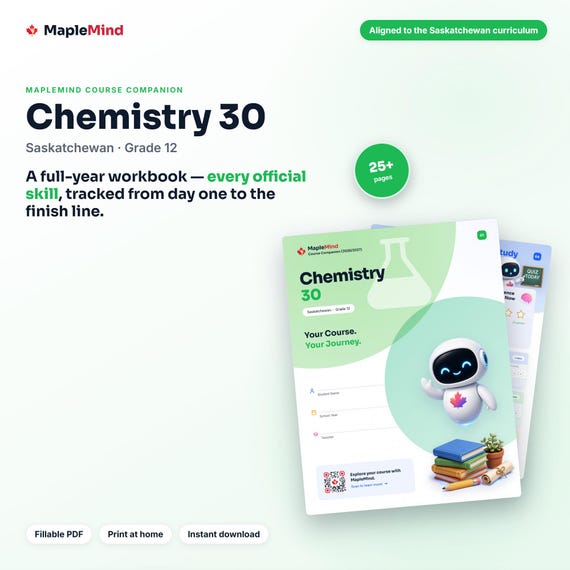
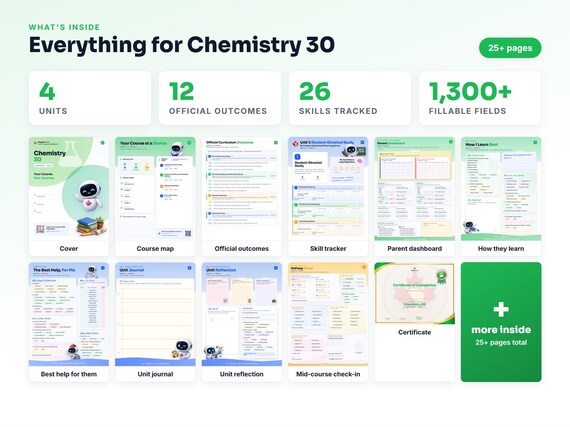
A Chemistry 30 workbook worth keeping
Built from the same official curriculum as this page. Before and after each skill above, your student colours in how sure they feel — so the two of you can see, on one page, what's clicking and what needs another look. It's a quiet way to follow how the year is really going.
By June it's full of their own handwriting: units worked through, confidence grown, a mid-year check-in, notes from parent-teacher night, and a certificate at the end. Less a worksheet, more a record of the year worth keeping on the shelf.
Instant download · see every page, reviews and the full description · five or more workbooks are $2.99 each
What it looks like in the app



Common questions
Can MapleMind help me with Chemistry 30?
Yes. MapleMind's AI tutor covers all 26 skills in Saskatchewan's Chemistry 30 — you pick the exact skill, and the tutor teaches it step by step: a short lesson, a worked example, solving together, then a skill check to show it stuck.
Is MapleMind aligned to Saskatchewan's official curriculum?
Yes. Every skill in this course maps to an official outcome code from Saskatchewan's Grade 12 Science curriculum, and the ministry's own wording is quoted under each unit on this page — with the official government source linked so you can check it yourself.
What does MapleMind cost?
It's free to start — 5 tutoring chats and a practice quiz every day, no credit card. A Pro subscription ($9.99/month or $49.99/year CAD, 7-day free trial) unlocks unlimited tutoring, practice, and exam simulations.
What if I'm stuck on just one topic?
That's the point of skill-level tutoring: open Chemistry 30 in the app, tap the exact skill from the list on this page, and the tutor teaches just that — no wading through lessons you don't need.
Does MapleMind work in French or other languages?
Yes — 14 languages, including French. Both the app and the tutor's explanations switch to the language you choose.
Where can I see the official Saskatchewan curriculum for Chemistry 30?
The official source is linked on this page — Saskatchewan's official curriculum. The outline here follows it: every MapleMind skill carries its official outcome code, and the ministry's own wording is quoted under each unit.
Keep exploring
Ready when you are
Pick a skill from this page and see it taught properly — free, in the browser, in under a minute.