Get help with Physics 30
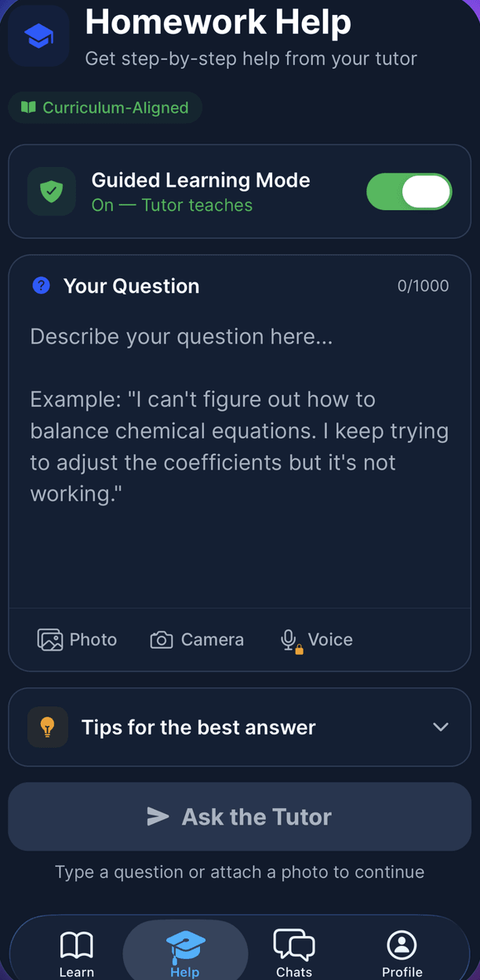
Most tutoring makes you sit through material you already know. MapleMind flips that: pick the exact skill that's causing trouble — any of the 25 below — and the tutor teaches just that one, step by step, as many times as it takes. Ask questions in plain words, any time of day, in English, French, or 12 other languages.
The official Saskatchewan Physics 30 curriculum
Saskatchewan defines Physics 30 by strands and outcomes. MapleMind teaches the same curriculum reorganized for one-skill-at-a-time tutoring — the table shows exactly where every official strand lands, and the ministry's own wording is quoted under each unit below.
Official source Saskatchewan's official curriculumRead it on the government site — curriculum.gov.sk.ca ↗| Official strand | Outcomes | Where MapleMind teaches it |
|---|---|---|
| SDS | 1 | Student-Directed Study |
| Strand MP | 2 | Modern Physics |
| Strand FM | 2 | Forces and Motion |
| Strand CO | 2 | Conservation Laws |
| Strand FI | 2 | Fields |
Every skill below, taught one on one.
 Try the first session free
How MapleMind teaches Physics 30 — every unit, lesson, and skill
Every skill below runs as a short session: a plain-words lesson, a worked example, solving it together, then a five-question skill check that earns up to three stars. Guided Mode keeps it teaching instead of answer-handing — turning it off needs a parent's password.
Unit 1Student-Directed StudyOfficial strand · SDS
A staged, self-directed physics investigation: designing a testable inquiry, carrying it out and analysing the data, and presenting the findings as a portfolio or demonstration.
Student-Directed Study Project
- Designing the investigationPH30-SDS1 — Design a scientific investigation on a Physics 30 topic of interest, with a testable question, hypothesis, and experimental design.
- Carrying out and analysingPH30-SDS1 — Carry out the experiment following scientific protocols and analyse and interpret the resulting data.
- Presenting and reflectingPH30-SDS1 — Assemble and reflect on a portfolio and share the results of the study through a display, presentation, or demonstration.
The official wording — 1 outcome in this unit
- PH30-SDS1
Create and carry out a plan to explore one or more topics of personal interest relevant to Physics 30 in depth.
Unit 2Modern PhysicsOfficial strand · Strand MP
The physics of the very fast and the very small: special and general relativity, the quantum nature of light and matter, and radioactivity, nuclear reactions, and their impact on society.
Relativity
- Scales of physics: Newtonian, quantum, and relativisticPH30-MP1 — Differentiate how Newtonian mechanics, quantum mechanics, and relativity describe the universe on different scales.
- Special and general relativityPH30-MP1 — Distinguish special from general relativity with respect to space and time, including time dilation and length contraction.
- Quantum phenomena and wave-particle dualityPH30-MP1 — Explain phenomena such as the photoelectric effect and black-body radiation that reveal the quantum, wave-particle nature of light and matter.
Radioactivity and Nuclear Technology
- Types of radiation and radioactive decayPH30-MP2 — Compare the characteristics of alpha, beta, and gamma radiation and identify natural and artificial sources.
- Decay equations and half-lifePH30-MP2 — Represent alpha, beta, and gamma decay using equations, and explain radioactive decay and half-life.
- Fission, fusion, and mass-energyPH30-MP2 — Model nuclear fission and chain reactions and examine nuclear fusion, the nuclear forces, mass defect, and E = mc^2.
- Societal and environmental impacts of nuclear technologyPH30-MP2 — Assess the short- and long-term implications of radiation and analyse the societal and environmental impacts of nuclear technologies.
The official wording — 2 outcomes in this unit
- PH30-MP1
Analyze the importance of relativistic principles and quantum mechanics in our world.
- PH30-MP2
Assess the effects of radioactivity and nuclear technology on society and the environment.
Unit 3Forces and MotionOfficial strand · Strand FM
Kinematics and dynamics in one and two dimensions: uniform and accelerated motion, projectile and circular motion, and Newton's laws applied to forces, friction, and the forces behind circular and projectile paths.
Kinematics in One and Two Dimensions
- Uniform and uniformly accelerated motionPH30-FM1 — Solve problems involving uniform and uniformly accelerated motion in one dimension using graphs and kinematics equations.
- Projectile motionPH30-FM1 — Analyse the horizontal and vertical components of projectile motion and solve projectile and free-fall problems.
- Uniform circular motionPH30-FM1 — Determine the characteristics of uniform circular motion and apply them to satellites and celestial orbits.
Forces and Newton's Laws
- Newton's laws and force problemsPH30-FM2 — Apply Newton's three laws using free-body diagrams to solve problems involving force, mass, and acceleration.
- Friction and balanced and unbalanced forcesPH30-FM2 — Describe the effect of friction and air resistance, including terminal velocity, and investigate balanced and unbalanced forces.
- Forces in circular and projectile motionPH30-FM2 — Examine the vertical and horizontal forces involved in circular motion and acting on a projectile through its trajectory.
The official wording — 2 outcomes in this unit
- PH30-FM1
Analyze motion in one- and two-dimensions, including uniform motion, uniformly accelerated motion, circular motion, and projectile motion.
- PH30-FM2
Analyze the effects of forces on objects undergoing uniform motion, uniformly accelerated motion and circular motion.
Unit 4Conservation LawsOfficial strand · Strand CO
The bookkeeping of physics: work, mechanical energy and efficiency under the law of conservation of energy, and impulse, momentum, and the law of conservation of momentum in collisions.
Energy and Conservation of Energy
- Work, energy, and conservation of energyPH30-CO1 — Define work and mechanical energy and solve problems using kinetic, potential, and total mechanical energy under conservation of energy.
- Efficiency in mechanical systemsPH30-CO1 — Investigate the efficiency of energy transformations with reference to useful work, friction, and waste heat, sound, and light.
Momentum and Collisions
- Impulse and momentumPH30-CO2 — Derive impulse from Newton's second law and investigate how force and time change an object's momentum.
- Conservation of momentum in collisionsPH30-CO2 — Apply the law of conservation of momentum to one- and two-dimensional collisions and explosions.
The official wording — 2 outcomes in this unit
- PH30-CO1
Investigate the nature of mechanical energy and efficiency in mechanical systems, including the law of conservation of energy.
- PH30-CO2
Analyze the motion of objects and interactions between objects using momentum concepts, including the law of conservation of momentum.
Unit 5FieldsOfficial strand · Strand FI
Action at a distance explained by fields: gravitational fields and universal gravitation, and electric and magnetic fields, Coulomb's law, and electromagnetism.
Gravitational Fields
- The field concept and gravitational fieldsPH30-FI1 — Explain the concept of fields and describe the gravitational force and its large-scale effects, distinguishing weight from mass.
- Universal gravitation and field strengthPH30-FI1 — Explain the inverse-square dependence of gravitational field strength and solve problems using Newton's law of universal gravitation.
Electric and Magnetic Fields
- Electric fields and Coulomb's lawPH30-FI2 — Describe electric fields and field lines and solve problems using Coulomb's law and the inverse-square dependence of field strength.
- Magnetic fields and hand rulesPH30-FI2 — Represent magnetic fields with field lines and use the hand rules for the field around current-carrying conductors.
- Electromagnetism and its applicationsPH30-FI2 — Analyse how the interrelationship of electric and magnetic fields leads to technologies and influences society and the environment.
The official wording — 2 outcomes in this unit
- PH30-FI1
Investigate gravitational fields and their interactions with matter.
- PH30-FI2
Investigate electric and magnetic fields and their interactions with matter.
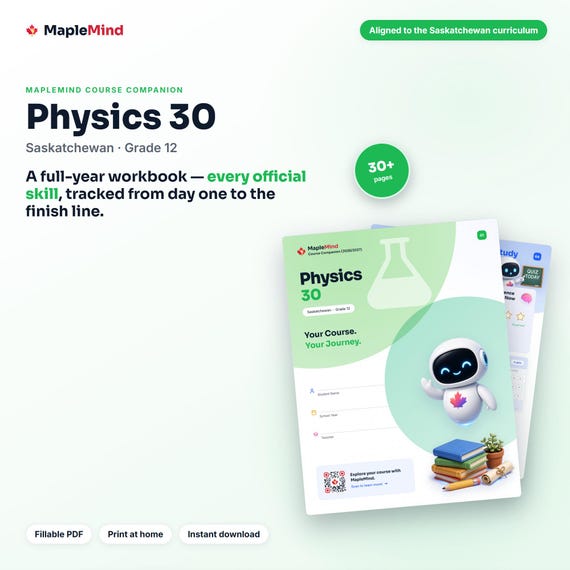
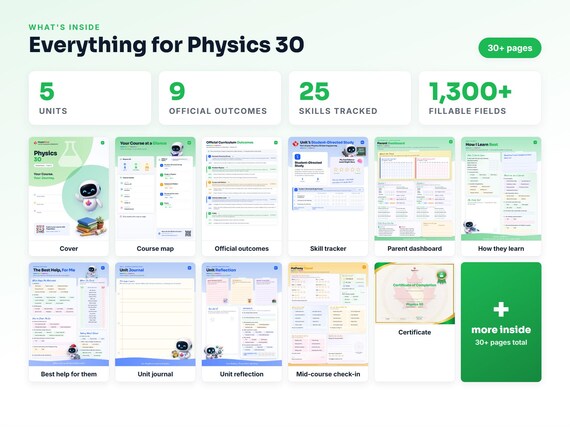
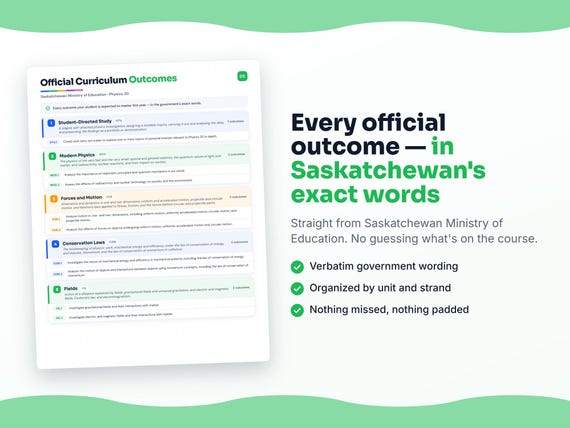

Printable workbook · A keepsake of the year
A Physics 30 workbook worth keeping
Built from the same official curriculum as this page. Before and after each skill above, your student colours in how sure they feel — so the two of you can see, on one page, what's clicking and what needs another look. It's a quiet way to follow how the year is really going.
By June it's full of their own handwriting: units worked through, confidence grown, a mid-year check-in, notes from parent-teacher night, and a certificate at the end. Less a worksheet, more a record of the year worth keeping on the shelf.
Instant download · see every page, reviews and the full description · five or more workbooks are $2.99 each
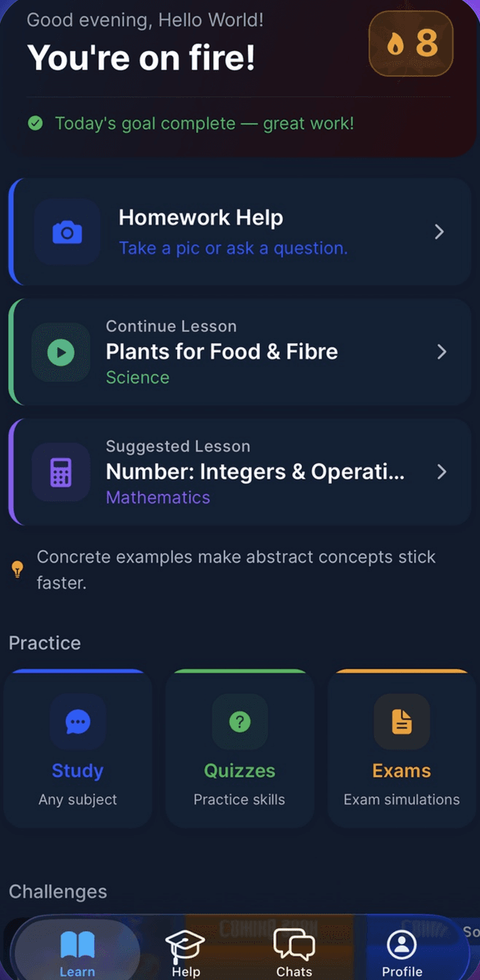
What it looks like in the app
Common questions
Can MapleMind help me with Physics 30?
Yes. MapleMind's AI tutor covers all 25 skills in Saskatchewan's Physics 30 — you pick the exact skill, and the tutor teaches it step by step: a short lesson, a worked example, solving together, then a skill check to show it stuck.
Is MapleMind aligned to Saskatchewan's official curriculum?
Yes. Every skill in this course maps to an official outcome code from Saskatchewan's Grade 12 Science curriculum, and the ministry's own wording is quoted under each unit on this page — with the official government source linked so you can check it yourself.
What does MapleMind cost?
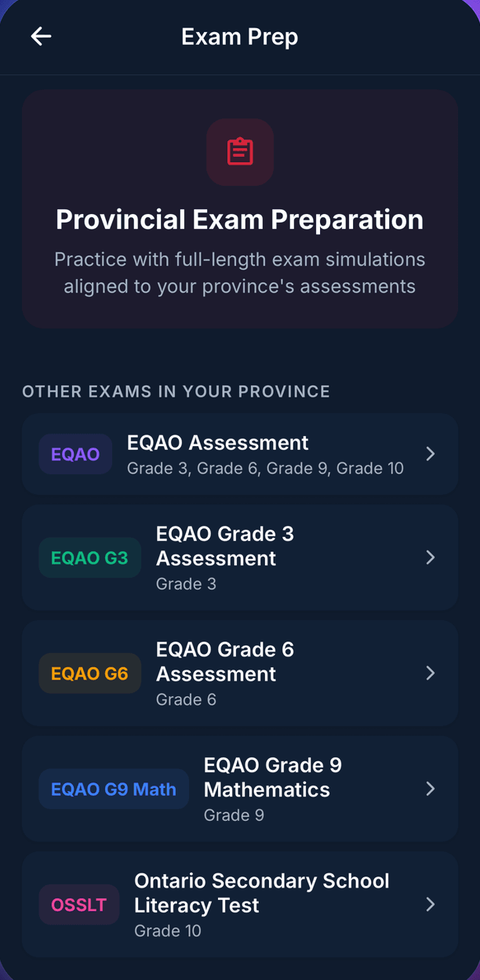
It's free to start — 5 tutoring chats and a practice quiz every day, no credit card. A Pro subscription ($9.99/month or $49.99/year CAD, 7-day free trial) unlocks unlimited tutoring, practice, and exam simulations.
What if I'm stuck on just one topic?
That's the point of skill-level tutoring: open Physics 30 in the app, tap the exact skill from the list on this page, and the tutor teaches just that — no wading through lessons you don't need.
Does MapleMind work in French or other languages?
Yes — 14 languages, including French. Both the app and the tutor's explanations switch to the language you choose.
Where can I see the official Saskatchewan curriculum for Physics 30?
The official source is linked on this page — Saskatchewan's official curriculum. The outline here follows it: every MapleMind skill carries its official outcome code, and the ministry's own wording is quoted under each unit.
Keep exploring
Ready when you are
Pick a skill from this page and see it taught properly — free, in the browser, in under a minute.