Get help with Chemistry 20
Most tutoring makes you sit through material you already know. MapleMind flips that: pick the exact skill that's causing trouble — any of the 18 below — and the tutor teaches just that one, step by step, as many times as it takes. Ask questions in plain words, any time of day, in English, French, or 12 other languages.
The official Saskatchewan Chemistry 20 curriculum
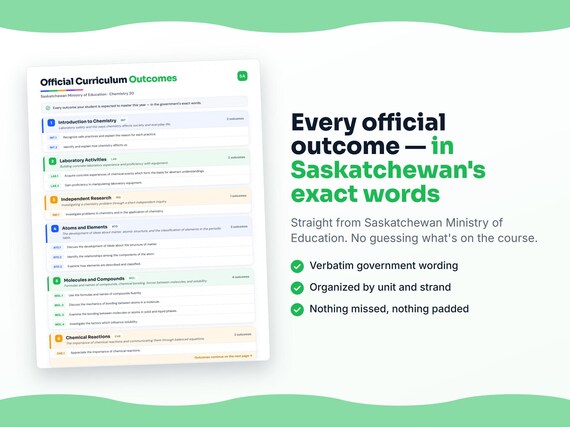
Saskatchewan defines Chemistry 20 by strands and outcomes. MapleMind teaches the same curriculum reorganized for one-skill-at-a-time tutoring — the table shows exactly where every official strand lands, and the ministry's own wording is quoted under each unit below.
Official source Saskatchewan's official curriculumRead it on the government site — curriculum.gov.sk.ca ↗| Official strand | Outcomes | Where MapleMind teaches it |
|---|---|---|
| Strand U1 | 2 | Introduction to Chemistry |
| Strand U2 | 2 | Laboratory Activities |
| Strand U3 | 1 | Independent Research |
| Strand U4 | 3 | Atoms and Elements |
| Strand U5 | 4 | Molecules and Compounds |
| Strand U6 | 2 | Chemical Reactions |
| Strand U7 | 3 | Mole Concept and Stoichiometry |
Every skill below, taught one on one.
 Try the first session free
How MapleMind teaches Chemistry 20 — every unit, lesson, and skill
Every skill below runs as a short session: a plain-words lesson, a worked example, solving it together, then a five-question skill check that earns up to three stars. Guided Mode keeps it teaching instead of answer-handing — turning it off needs a parent's password.
Unit 1Introduction to ChemistryOfficial strand · Strand U1
Laboratory safety and the ways chemistry affects society and everyday life.
Laboratory Safety
- Safe laboratory practicesCHEM20-U1.1 — Recognize safe laboratory practices — locating and using safety equipment, eye protection, handling and disposing of chemicals, and burner use — and explain the reason for each practice.
How Chemistry Affects Us
- Chemistry and societyCHEM20-U1.2 — Identify and explain how chemistry affects us: how advances in chemistry lead to new products, their societal impact, and the relationship between science and technology.
The official wording — 2 outcomes in this unit
- CHEM20-U1.1
Recognize safe practices and explain the reason for each practice.
- CHEM20-U1.2
Identify and explain how chemistry affects us.
Unit 2Laboratory ActivitiesOfficial strand · Strand U2
Building concrete laboratory experience and proficiency with equipment.
Concrete Laboratory Experience
- Concrete experience of chemical eventsCHEM20-U2.1 — Acquire concrete experiences of chemical events which form the basis for abstract understandings, connecting hands-on observations to the underlying chemistry.
Laboratory Equipment Proficiency
- Manipulating laboratory equipmentCHEM20-U2.2 — Gain proficiency in manipulating laboratory equipment, including measuring and dispensing apparatus used in chemistry investigations.
The official wording — 2 outcomes in this unit
- CHEM20-U2.1
Acquire concrete experiences of chemical events which form the basis for abstract understandings.
- CHEM20-U2.2
Gain proficiency in manipulating laboratory equipment.
Unit 3Independent ResearchOfficial strand · Strand U3
Investigating a chemistry problem through a short independent inquiry.
Investigating Chemistry Problems
- Investigating problems in chemistryCHEM20-U3.1 — Investigate problems in chemistry and in the application of chemistry through a short independent research inquiry.
The official wording — 1 outcome in this unit
- CHEM20-U3.1
Investigate problems in chemistry and in the application of chemistry.
Unit 4Atoms and ElementsOfficial strand · Strand U4
The development of ideas about matter, atomic structure, and the classification of elements in the periodic table.
Ideas About the Structure of Matter
- Development of ideas about matterCHEM20-U4.1 — Discuss the development of ideas about the structure of matter, from Aristotle and the alchemists through the contributions of scientists such as Dalton, Thomson, Rutherford, and Bohr.
Components of the Atom
- Components of the atom and isotopesCHEM20-U4.2 — Identify the relationships among the components of the atom — protons, neutrons, and electrons — draw Lewis diagrams, distinguish isotopes, and calculate average atomic mass from isotope abundances.
Describing and Classifying Elements
- Properties and classification of elementsCHEM20-U4.3 — Examine how elements are described and classified by recognizing that elements have characteristic properties and classifying and identifying some elements by their properties.
- Organization and trends of the periodic tableCHEM20-U4.3 — Describe the development of the periodic table by Mendeleev, explain its principles of organization, identify periodic trends and patterns, and use the periodic table to determine the valences of elements.
The official wording — 3 outcomes in this unit
- CHEM20-U4.1
Discuss the development of ideas about the structure of matter.
- CHEM20-U4.2
Identify the relationships among the components of the atom.
- CHEM20-U4.3
Examine how elements are described and classified.
Unit 5Molecules and CompoundsOfficial strand · Strand U5
Formulas and names of compounds, chemical bonding, forces between molecules, and solubility.
Formulas and Names of Compounds
- Writing formulas and names fluentlyCHEM20-U5.1 — Use the formulas and names of compounds fluently, using the periodic table and a table of common ions to write formulas and names of binary and polyatomic inorganic compounds and to apply the alkane and alkene general formulas.
Bonding Between Atoms
- Ionic and covalent bondingCHEM20-U5.2 — Discuss the mechanics of bonding between atoms, contrasting shared-electron (covalent) with electron-transfer (ionic) bonding, applying the octet rule, drawing Lewis structures, and using VSEPR theory to predict molecular shapes.
Forces in Solids and Liquids
- Bonding in solids and liquidsCHEM20-U5.3 — Examine the bonding between molecules or atoms in solid and liquid phases, describing the physical properties of ionic, metallic, covalent, and van der Waals solids and relating force strength to melting and boiling points.
Factors Influencing Solubility
- Factors influencing solubilityCHEM20-U5.4 — Investigate the factors which influence solubility, recognizing the importance of water as a solvent, using solubility terminology, and comparing the solubilities of several solute-solvent combinations.
The official wording — 4 outcomes in this unit
- CHEM20-U5.1
Use the formulas and names of compounds fluently.
- CHEM20-U5.2
Discuss the mechanics of bonding between atoms in a molecule.
- CHEM20-U5.3
Examine the bonding between molecules or atoms in solid and liquid phases.
- CHEM20-U5.4
Investigate the factors which influence solubility.
Unit 6Chemical ReactionsOfficial strand · Strand U6
The importance of chemical reactions and communicating them through balanced equations.
The Importance of Chemical Reactions
- Recognizing and valuing chemical reactionsCHEM20-U6.1 — Appreciate the importance of chemical reactions by identifying changes that indicate a reaction has occurred and reactions that maintain, harm, or affect living organisms and the environment.
Communicating Reactions with Equations
- Writing and balancing chemical equationsCHEM20-U6.2 — Acquire ability to communicate chemical information through equations by writing and balancing chemical equations for atoms and charge, applying the Law of Conservation of Mass, developing net ionic equations, and showing energy terms.
The official wording — 2 outcomes in this unit
- CHEM20-U6.1
Appreciate the importance of chemical reactions.
- CHEM20-U6.2
Acquire ability to communicate chemical information through equations for reactions.
Unit 7Mole Concept and StoichiometryOfficial strand · Strand U7
Avogadro's number and the mole, mass-based calculations, and stoichiometric problem solving.
Avogadro's Number and the Mole
- Avogadro's number and the moleCHEM20-U7.1 — Explore the concepts which relate to Avogadro's number, explaining the concept of a mole and calculating the number of moles in a given mass and the mass of a given number of moles.
Composition and Concentration Calculations
- Percentage composition and concentrationCHEM20-U7.2 — Apply knowledge about atomic mass to calculations dealing with molecules, calculating percentage composition and empirical formulas from mass data and calculating solution concentrations in mol/L.
Stoichiometric Calculations
- Performing stoichiometric calculationsCHEM20-U7.3 — Perform stoichiometric calculations by extracting information from balanced equations, relating moles of reactants and products, and identifying limiting reagents in reactions with non-stoichiometric masses.
The official wording — 3 outcomes in this unit
- CHEM20-U7.1
Explore the concepts which relate to Avogadro's number.
- CHEM20-U7.2
Apply knowledge about atomic mass to calculations dealing with molecules.
- CHEM20-U7.3
Perform stoichiometric calculations.
Printable workbook · A keepsake of the year
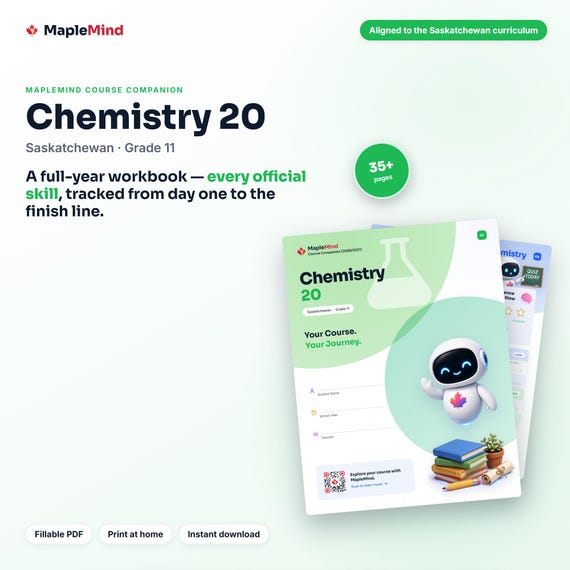
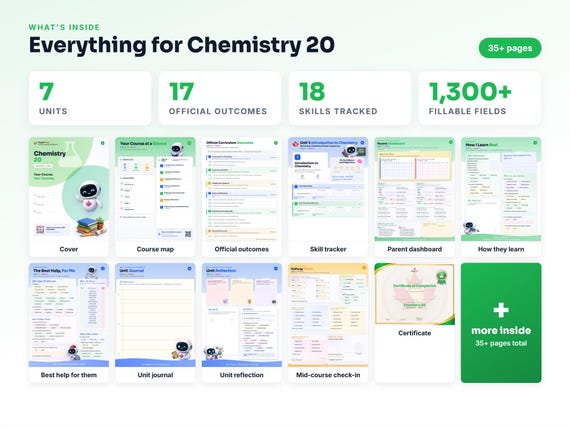
A Chemistry 20 workbook worth keeping
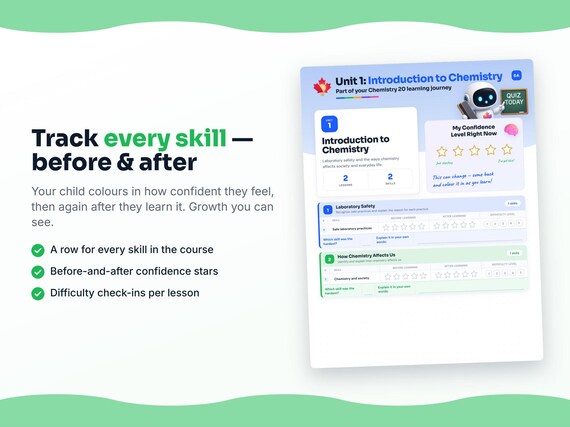
Built from the same official curriculum as this page. Before and after each skill above, your student colours in how sure they feel — so the two of you can see, on one page, what's clicking and what needs another look. It's a quiet way to follow how the year is really going.
By June it's full of their own handwriting: units worked through, confidence grown, a mid-year check-in, notes from parent-teacher night, and a certificate at the end. Less a worksheet, more a record of the year worth keeping on the shelf.
Instant download · see every page, reviews and the full description · five or more workbooks are $2.99 each
What it looks like in the app



Common questions
Can MapleMind help me with Chemistry 20?
Yes. MapleMind's AI tutor covers all 18 skills in Saskatchewan's Chemistry 20 — you pick the exact skill, and the tutor teaches it step by step: a short lesson, a worked example, solving together, then a skill check to show it stuck.
Is MapleMind aligned to Saskatchewan's official curriculum?
Yes. Every skill in this course maps to an official outcome code from Saskatchewan's Grade 11 Science curriculum, and the ministry's own wording is quoted under each unit on this page — with the official government source linked so you can check it yourself.
What does MapleMind cost?
It's free to start — 5 tutoring chats and a practice quiz every day, no credit card. A Pro subscription ($9.99/month or $49.99/year CAD, 7-day free trial) unlocks unlimited tutoring, practice, and exam simulations.
What if I'm stuck on just one topic?
That's the point of skill-level tutoring: open Chemistry 20 in the app, tap the exact skill from the list on this page, and the tutor teaches just that — no wading through lessons you don't need.
Does MapleMind work in French or other languages?
Yes — 14 languages, including French. Both the app and the tutor's explanations switch to the language you choose.
Where can I see the official Saskatchewan curriculum for Chemistry 20?
The official source is linked on this page — Saskatchewan's official curriculum. The outline here follows it: every MapleMind skill carries its official outcome code, and the ministry's own wording is quoted under each unit.
Keep exploring
Ready when you are
Pick a skill from this page and see it taught properly — free, in the browser, in under a minute.