Get help with Science, Grade 9
Most tutoring makes you sit through material you already know. MapleMind flips that: pick the exact skill that's causing trouble — any of the 34 below — and the tutor teaches just that one, step by step, as many times as it takes. Ask questions in plain words, any time of day, in English, French, or 12 other languages.
The official Saskatchewan Science, Grade 9 curriculum
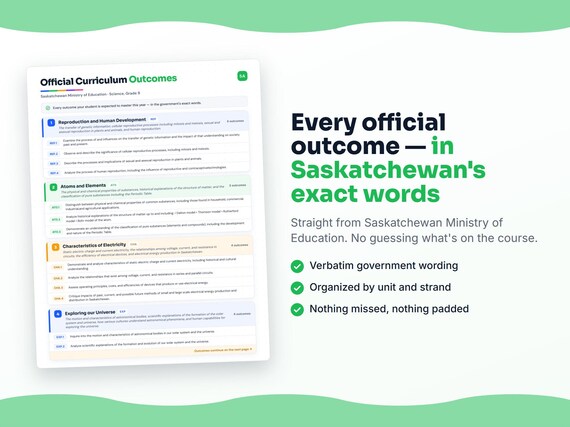
Saskatchewan defines Science, Grade 9 by strands and outcomes. MapleMind teaches the same curriculum reorganized for one-skill-at-a-time tutoring — the table shows exactly where every official strand lands, and the ministry's own wording is quoted under each unit below.
Official source Saskatchewan's official curriculumRead it on the government site — curriculum.gov.sk.ca ↗| Official strand | Outcomes | Where MapleMind teaches it |
|---|---|---|
| Strand RE | 4 | Reproduction and Human Development |
| Strand AE | 3 | Atoms and Elements |
| Strand CE | 4 | Characteristics of Electricity |
| Strand EU | 4 | Exploring our Universe |
Every skill below, taught one on one.
 Try the first session free
How MapleMind teaches Science, Grade 9 — every unit, lesson, and skill
Every skill below runs as a short session: a plain-words lesson, a worked example, solving it together, then a five-question skill check that earns up to three stars. Guided Mode keeps it teaching instead of answer-handing — turning it off needs a parent's password.
Unit 1Reproduction and Human DevelopmentOfficial strand · Strand RE
The transfer of genetic information, cellular reproductive processes including mitosis and meiosis, sexual and asexual reproduction in plants and animals, and human reproduction.
The Transfer of Genetic Information
- Chromosomes, genes, DNA, and traitsRE9.1 — Identify the relationship among chromosomes, genes, and DNA in transmitting genetic information and examples of dominant and recessive traits.
- Genetics in society and careersRE9.1 — Illustrate how developments in genetics have affected society and describe careers that require an understanding of genetics or reproductive biology.
Cellular Reproduction: Mitosis and Meiosis
- Cell division and the cell cycleRE9.2 — Observe and represent the basic process of cell division as part of the cell cycle, including changes to the cell membrane and nucleus.
- Mitosis versus meiosisRE9.2 — Compare binary fission, mitosis, and meiosis, distinguishing the processes and the diploid and haploid cells they create.
Sexual and Asexual Reproduction
- Asexual reproductionRE9.3 — Describe methods of asexual reproduction in plant and animal species and their applications in Saskatchewan agriculture and forestry.
- Sexual reproduction and pollinationRE9.3 — Describe sexual reproduction in seed plants and animals, including pollination, and compare the advantages of sexual and asexual reproduction.
Human Reproduction
- Reproductive systems and human developmentRE9.4 — Compare the male and female reproductive systems and describe the major stages of human development from conception to birth.
- Reproductive and contraceptive technologiesRE9.4 — Provide examples of reproductive and contraceptive technologies and examine the social and cultural issues related to their use.
The official wording — 4 outcomes in this unit
- RE9.1
Examine the process of and influences on the transfer of genetic information and the impact of that understanding on society past and present.
- RE9.2
Observe and describe the significance of cellular reproductive processes, including mitosis and meiosis.
- RE9.3
Describe the processes and implications of sexual and asexual reproduction in plants and animals.
- RE9.4
Analyze the process of human reproduction, including the influence of reproductive and contraceptivetechnologies.
Unit 2Atoms and ElementsOfficial strand · Strand AE
The physical and chemical properties of substances, historical explanations of the structure of matter, and the classification of pure substances including the Periodic Table.
Physical and Chemical Properties
- Physical properties and classifying substancesAE9.1 — Describe common materials by their physical properties and classify household, commercial, industrial, and agricultural substances, following WHMIS safety.
- Physical versus chemical changesAE9.1 — Investigate the indicators of chemical change and differentiate physical from chemical properties and changes based on observable evidence.
- Properties, research, and societyAE9.1 — Provide examples of how society's needs for new products drive research based on the understanding of physical and chemical properties.
Historical Models of the Atom
- The changing model of the atomAE9.2 — Analyze the major shifts in understanding the structure of matter up to and including the Bohr model, using appropriate terminology.
- Building atomic modelsAE9.2 — Construct models to illustrate the structure of matter and discuss the strengths and limitations of atomic models.
Pure Substances and the Periodic Table
- Elements, compounds, and mixturesAE9.3 — Differentiate elements, compounds, and mixtures, classify pure substances, and write chemical formulae including the diatomic molecules.
- Bohr models of the first 18 elementsAE9.3 — Construct Bohr model representations of the first 18 elements based on their atomic structure.
- The periodic table and periodicityAE9.3 — Trace the development of the periodic table and interpret its structure, including periods, groups, metals, non-metals, and metalloids.
- Protons, electrons, and isotopesAE9.3 — Determine the number of protons, electrons, and neutrons in an atom or isotope using its atomic number and mass number.
The official wording — 3 outcomes in this unit
- AE9.1
Distinguish between physical and chemical properties of common substances, including those found in household, commercial, industrial,and agricultural applications.
- AE9.2
Analyze historical explanations of the structure of matter up to and including: • Dalton model • Thomson model • Rutherford model • Bohr model of the atom.
- AE9.3
Demonstrate an understanding of the classification of pure substances (elements and compounds), including the development and nature of the Periodic Table.
Unit 3Characteristics of ElectricityOfficial strand · Strand CE
Static electric charge and current electricity, the relationships among voltage, current, and resistance in circuits, the efficiency of electrical devices, and electrical energy production in Saskatchewan.
Static and Current Electricity
- Static electric chargeCE9.1 — Demonstrate and analyze the characteristics of static electric charge, including charging by friction, conduction, and induction.
- Current electricity and resistanceCE9.1 — Investigate the resistance of various materials and differentiate conductors, insulators, and superconductors, and describe the flow of charge in a circuit.
- Electrical dangers and safety technologiesCE9.1 — Identify the dangers of static charge and current electricity to the human body and describe technologies designed to minimize those dangers.
Voltage, Current, and Resistance
- Measuring series and parallel circuitsCE9.2 — Use an ammeter, voltmeter, or multimeter to measure current and voltage in series and parallel circuits and display the data.
- Ohm's LawCE9.2 — Calculate unknown quantities in electric circuits using Ohm's Law and model circuits with standard symbols.
Electrical Devices and Efficiency
- Energy transformations and efficiencyCE9.3 — Explain the energy transformations in electrical devices and calculate the efficiency of common energy-converting devices.
- Cost and design of appliancesCE9.3 — Calculate the cost of operating household appliances and evaluate their design to make informed decisions about electrical energy use.
Electrical Energy Production in Saskatchewan
- Producing and storing electrical energyCE9.4 — Compare the operating principles, efficiency, and safety of technologies that produce and store electrical energy and describe how energy is distributed.
- Generation methods and their impactsCE9.4 — Critique the impacts of large-scale methods of electrical energy generation in Saskatchewan, including alternative energy sources.
The official wording — 4 outcomes in this unit
- CE9.1
Demonstrate and analyze characteristics of static electric charge and current electricity, including historical and cultural understanding.
- CE9.2
Analyze the relationships that exist among voltage, current, and resistance in series and parallel circuits.
- CE9.3
Assess operating principles, costs, and efficiencies of devices that produce or use electrical energy.
- CE9.4
Critique impacts of past, current, and possible future methods of small and large scale electrical energy production and distribution in Saskatchewan.
Unit 4Exploring our UniverseOfficial strand · Strand EU
The motion and characteristics of astronomical bodies, scientific explanations of the formation of the solar system and universe, how various cultures understand astronomical phenomena, and human capabilities for exploring the universe.
Motion and Characteristics of Astronomical Bodies
- Real and apparent motionEU9.1 — Compare historical and modern explanations for the real and apparent motion of celestial bodies, including retrograde motion and models of planetary motion.
- Characteristics of astronomical bodiesEU9.1 — Compare the composition and physical characteristics of astronomical bodies and classify the major components of the universe.
- Solar phenomena and astronomical predictionsEU9.1 — Describe the effects of solar phenomena on Earth and state predictions and hypotheses about astronomical phenomena from observed patterns.
Formation of the Solar System and Universe
- Formation of the solar systemEU9.2 — Describe scientific theories on the formation of the solar system, including the planets, moons, asteroids, and comets.
- Origin of the universe and life cycle of starsEU9.2 — Describe theories of the origin and evolution of the universe and the observational evidence that supports them, and the life cycle of stars.
Cultures and Astronomical Phenomena
- Cultures and astronomical phenomenaEU9.3 — Examine how various cultures, past and present, including First Nations and Métis, understand and represent astronomical phenomena.
Human Exploration of the Universe
- Space programs and technologiesEU9.4 — Analyze the major advances and technologies of space programs that enable space probes and human spaceflight.
- Distances, positions, and space careersEU9.4 — Calculate travel times to distant astronomical objects, apply coordinate systems to locate objects, and research space-science careers.
The official wording — 4 outcomes in this unit
- EU9.1
Inquire into the motion and characteristics of astronomical bodies in our solar system and the universe.
- EU9.2
Analyze scientific explanations of the formation and evolution of our solar system and the universe.
- EU9.3
Examine how various cultures, past and present, including First Nations and Métis, understand and represent astronomical phenomenon.
- EU9.4
Analyze human capabilities for exploring and understanding the universe, including technologies and programs that support such exploration.

Printable workbook · A keepsake of the year
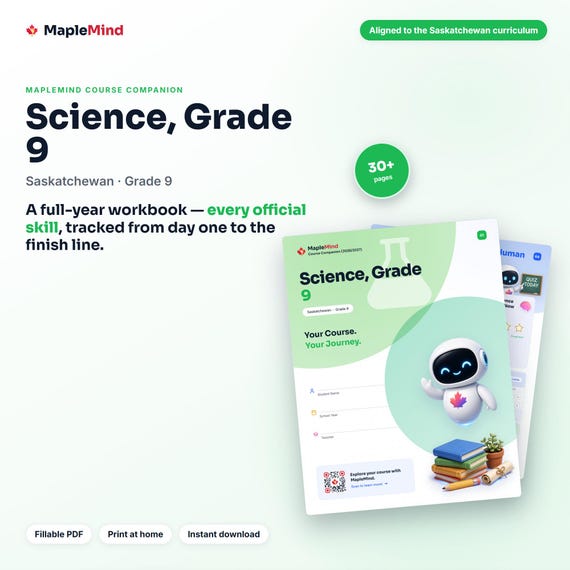
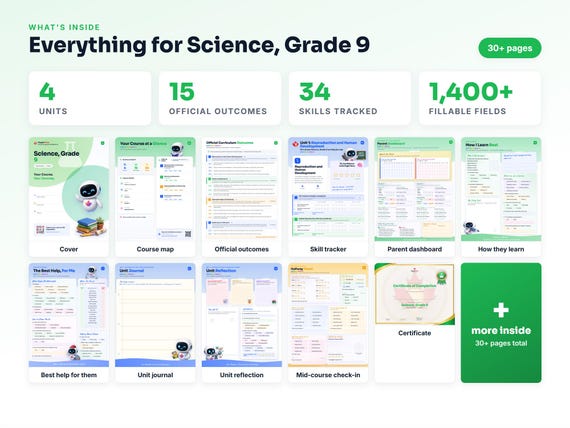
A Science, Grade 9 workbook worth keeping
Built from the same official curriculum as this page. Before and after each skill above, your student colours in how sure they feel — so the two of you can see, on one page, what's clicking and what needs another look. It's a quiet way to follow how the year is really going.
By June it's full of their own handwriting: units worked through, confidence grown, a mid-year check-in, notes from parent-teacher night, and a certificate at the end. Less a worksheet, more a record of the year worth keeping on the shelf.
Instant download · see every page, reviews and the full description · five or more workbooks are $2.99 each
What it looks like in the app



Common questions
Can MapleMind help me with Science, Grade 9?
Yes. MapleMind's AI tutor covers all 34 skills in Saskatchewan's Science, Grade 9 — you pick the exact skill, and the tutor teaches it step by step: a short lesson, a worked example, solving together, then a skill check to show it stuck.
Is MapleMind aligned to Saskatchewan's official curriculum?
Yes. Every skill in this course maps to an official outcome code from Saskatchewan's Grade 9 Science curriculum, and the ministry's own wording is quoted under each unit on this page — with the official government source linked so you can check it yourself.
What does MapleMind cost?
It's free to start — 5 tutoring chats and a practice quiz every day, no credit card. A Pro subscription ($9.99/month or $49.99/year CAD, 7-day free trial) unlocks unlimited tutoring, practice, and exam simulations.
What if I'm stuck on just one topic?
That's the point of skill-level tutoring: open Science, Grade 9 in the app, tap the exact skill from the list on this page, and the tutor teaches just that — no wading through lessons you don't need.
Does MapleMind work in French or other languages?
Yes — 14 languages, including French. Both the app and the tutor's explanations switch to the language you choose.
Where can I see the official Saskatchewan curriculum for Science, Grade 9?
The official source is linked on this page — Saskatchewan's official curriculum. The outline here follows it: every MapleMind skill carries its official outcome code, and the ministry's own wording is quoted under each unit.
Keep exploring
Ready when you are
Pick a skill from this page and see it taught properly — free, in the browser, in under a minute.