Get help with Science, Grade 8
Most tutoring makes you sit through material you already know. MapleMind flips that: pick the exact skill that's causing trouble — any of the 32 below — and the tutor teaches just that one, step by step, as many times as it takes. Ask questions in plain words, any time of day, in English, French, or 12 other languages.
The official Saskatchewan Science, Grade 8 curriculum
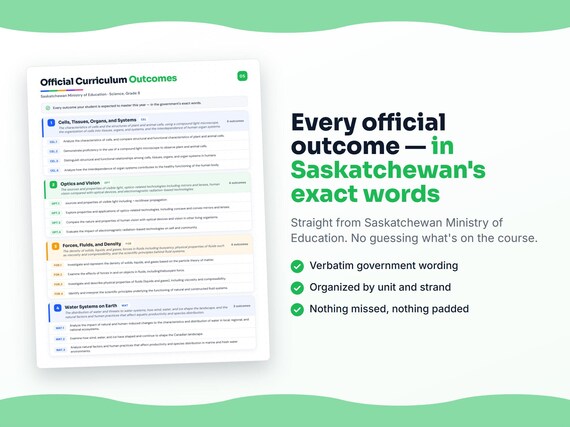
Saskatchewan defines Science, Grade 8 by strands and outcomes. MapleMind teaches the same curriculum reorganized for one-skill-at-a-time tutoring — the table shows exactly where every official strand lands, and the ministry's own wording is quoted under each unit below.
Official source Saskatchewan's official curriculumRead it on the government site — curriculum.gov.sk.ca ↗| Official strand | Outcomes | Where MapleMind teaches it |
|---|---|---|
| Strand CS | 4 | Cells, Tissues, Organs, and Systems |
| Strand OP | 4 | Optics and Vision |
| Strand FD | 4 | Forces, Fluids, and Density |
| Strand WS | 3 | Water Systems on Earth |
Every skill below, taught one on one.
 Try the first session free
How MapleMind teaches Science, Grade 8 — every unit, lesson, and skill
Every skill below runs as a short session: a plain-words lesson, a worked example, solving it together, then a five-question skill check that earns up to three stars. Guided Mode keeps it teaching instead of answer-handing — turning it off needs a parent's password.
Unit 1Cells, Tissues, Organs, and SystemsOfficial strand · Strand CS
The characteristics of cells and the structures of plant and animal cells, using a compound light microscope, the organization of cells into tissues, organs, and systems, and the interdependence of human organ systems.
The Characteristics of Cells
- The cell as a living systemCS8.1 — Explain that the cell is a living system exhibiting the characteristics of life, and model diffusion and osmosis across cell membranes.
- Single-celled, multicellular, and cell divisionCS8.1 — Categorize organisms as single-celled or multicellular and explain how growth and reproduction depend on cell division.
- Plant and animal cell structuresCS8.1 — Observe and identify cell structures, explain their functions, and compare which structures are found in plant and animal cells.
Using a Compound Light Microscope
- Microscope proficiencyCS8.2 — Demonstrate proficiency in using a compound light microscope to prepare and observe plant and animal cells, including calculating magnification.
From Cells to Organ Systems
- Levels of organization in the bodyCS8.3 — Distinguish the structural and functional relationships among cells, tissues, organs, and organ systems in humans.
- Careers in health and the human bodyCS8.3 — Describe Saskatchewan careers that require an understanding of cells and human body systems.
Interdependence of Organ Systems
- Systems working togetherCS8.4 — Analyze how the interdependence of organ systems contributes to the healthy functioning of the human body.
- Lifestyle and body systemsCS8.4 — Analyze the impact of personal lifestyle choices on body systems and investigate how activity affects heart rate, breathing rate, or blood pressure.
- The body's responses and support technologiesCS8.4 — Provide examples of how the body reacts to internal and external stimuli and discuss ethical issues related to technologies that support or replace body systems.
The official wording — 4 outcomes in this unit
- CS8.1
Analyze the characteristics of cells, and compare structural and functional characteristics of plant and animal cells.
- CS8.2
Demonstrate proficiency in the use of a compound light microscope to observe plant and animal cells.
- CS8.3
Distinguish structural and functional relationships among cells, tissues, organs, and organ systems in humans
- CS8.4
Analyze how the interdependence of organ systems contributes to the healthy functioning of the human body.
Unit 2Optics and VisionOfficial strand · Strand OP
The sources and properties of visible light, optics-related technologies including mirrors and lenses, human vision compared with optical devices, and electromagnetic radiation-based technologies.
The Properties of Visible Light
- Light travels in straight linesOP8.1 — Demonstrate that light is a form of energy that travels in straight lines, using shadows as evidence.
- ReflectionOP8.1 — Estimate and measure angles of incidence and reflection and determine their quantitative relationship.
- RefractionOP8.1 — Describe qualitatively how visible light is refracted when passing between substances of different refractive index and predict how it will bend.
Mirrors and Lenses
- Concave and convex mirrors and lensesOP8.2 — Investigate how light interacts with concave and convex mirrors and lenses, including the formation of real and virtual images.
- Ray diagrams and optical devicesOP8.2 — Draw geometric ray diagrams to illustrate how light travels within optical devices and design a prototype optical device.
Human Vision
- The eye as an optical instrumentOP8.3 — Illustrate how the human eye sees objects and compare its operation to a camera and to vision in other organisms.
- Colour and vision technologiesOP8.3 — Explain how the eye detects colour, how colours are produced using additive and subtractive models, and describe technologies that enhance vision.
Electromagnetic Radiation
- The electromagnetic spectrumOP8.4 — Describe and compare the characteristics of different types of electromagnetic radiation, from radio waves to X-rays.
- Radiation-based technologiesOP8.4 — Analyze the design and function of an electromagnetic radiation-based technology and defend a position on its impact on self and community.
The official wording — 4 outcomes in this unit
- OP8.1
sources and properties of visible light including: • rectilinear propagation
- OP8.2
Explore properties and applications of optics-related technologies, including concave and convex mirrors and lenses.
- OP8.3
Compare the nature and properties of human vision with optical devices and vision in other living organisms.
- OP8.4
Evaluate the impact of electromagnetic radiation-based technologies on self and community.
Unit 3Forces, Fluids, and DensityOfficial strand · Strand FD
The density of solids, liquids, and gases, forces in fluids including buoyancy, physical properties of fluids such as viscosity and compressibility, and the scientific principles behind fluid systems.
Density
- Measuring densityFD8.1 — Investigate and represent the density of solids, liquids, and gases based on the particle theory of matter, including measuring by water displacement.
- Calculating density and temperature effectsFD8.1 — Calculate the density of materials using d = m/v, compare densities to water, and explain how temperature affects density.
Forces in Fluids and Buoyancy
- Buoyancy and Archimedes' PrincipleFD8.2 — Examine the buoyant force and how buoyancy is controlled in nature and in constructed devices.
- Forces and pressure in fluidsFD8.2 — Illustrate the forces acting on objects in fluids using force diagrams and express the relationship between pressure, force, and area.
- Designing a floating cargo vesselFD8.2 — Use a technological problem-solving process to design, construct, and evaluate a prototype of an object that floats and carries the greatest amount of cargo.
Properties of Fluids
- ViscosityFD8.3 — Investigate and compare the viscosity of various fluids and the effect of temperature on viscosity.
- Compressibility and pressureFD8.3 — Use the particle theory to explain differences in compressibility between liquids and gases and the effect of external pressure.
Fluid Systems
- Hydraulic and pneumatic systemsFD8.4 — Identify and interpret the scientific principles behind natural and constructed hydraulic and pneumatic fluid systems and model one with a prototype.
The official wording — 4 outcomes in this unit
- FD8.1
Investigate and represent the density of solids, liquids, and gases based on the particle theory of matter.
- FD8.2
Examine the effects of forces in and on objects in fluids, includingthebuoyant force.
- FD8.3
Investigate and describe physical properties of fluids (liquids and gases), including viscosity and compressibility.
- FD8.4
Identify and interpret the scientific principles underlying the functioning of natural and constructed fluid systems.
Unit 4Water Systems on EarthOfficial strand · Strand WS
The distribution of water and threats to water systems, how wind, water, and ice shape the landscape, and the natural factors and human practices that affect aquatic productivity and species distribution.
Water Distribution and Threats
- Water distribution and the water cycleWS8.1 — Construct representations of the distribution of water in Saskatchewan and of the water cycle, including its significance to First Nations and Métis people.
- Threats to water systemsWS8.1 — Identify the consequences of natural changes and human practices that threaten surface and ground water systems in Saskatchewan.
Shaping the Landscape
- Weathering, erosion, and deposition by waterWS8.2 — Explain how weathering, erosion, and deposition result from water movement and wave action and shape environments.
- Glaciation and icecapsWS8.2 — Relate glacier formation and reduction to the glacial landforms of Saskatchewan and examine the effects of icecap changes.
Aquatic Productivity and Water Quality
- Factors affecting aquatic lifeWS8.3 — Identify the natural factors and human practices that affect productivity and species distribution in marine and fresh water environments.
- Measuring water qualityWS8.3 — Measure and interpret indicators of water quality and describe technologies used to assess it.
The official wording — 3 outcomes in this unit
- WS8.1
Analyze the impact of natural and human-induced changes to the characteristics and distribution of water in local, regional, and national ecosystems.
- WS8.2
Examine how wind, water, and ice have shaped and continue to shape the Canadian landscape.
- WS8.3
Analyze natural factors and human practices that affect productivity and species distribution in marine and fresh water environments.
Printable workbook · A keepsake of the year
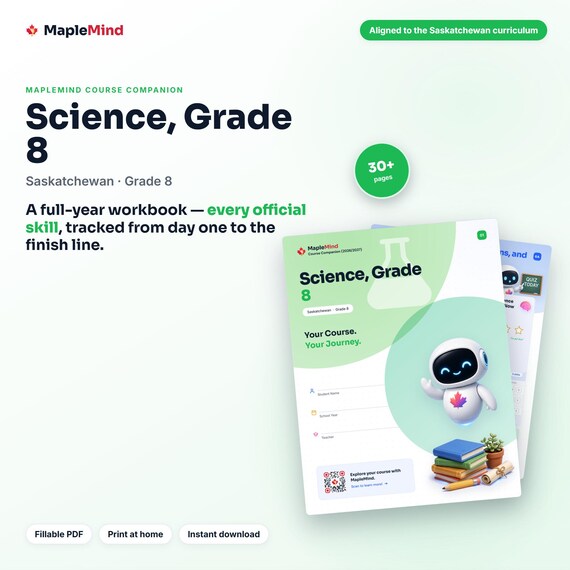
A Science, Grade 8 workbook worth keeping
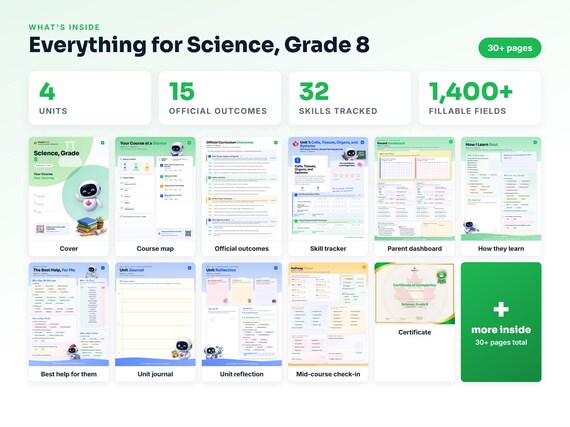
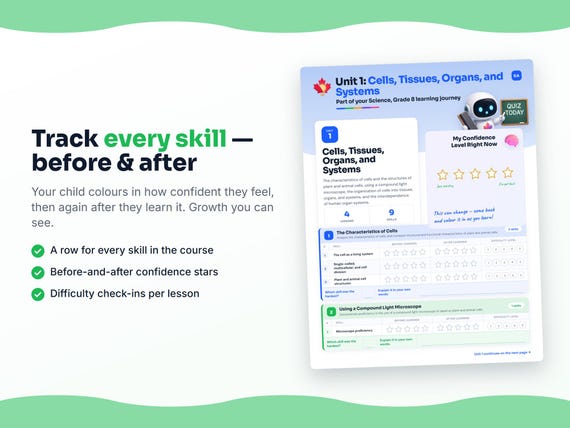
Built from the same official curriculum as this page. Before and after each skill above, your student colours in how sure they feel — so the two of you can see, on one page, what's clicking and what needs another look. It's a quiet way to follow how the year is really going.
By June it's full of their own handwriting: units worked through, confidence grown, a mid-year check-in, notes from parent-teacher night, and a certificate at the end. Less a worksheet, more a record of the year worth keeping on the shelf.
Instant download · see every page, reviews and the full description · five or more workbooks are $2.99 each
What it looks like in the app



Common questions
Can MapleMind help me with Science, Grade 8?
Yes. MapleMind's AI tutor covers all 32 skills in Saskatchewan's Science, Grade 8 — you pick the exact skill, and the tutor teaches it step by step: a short lesson, a worked example, solving together, then a skill check to show it stuck.
Is MapleMind aligned to Saskatchewan's official curriculum?
Yes. Every skill in this course maps to an official outcome code from Saskatchewan's Grade 8 Science curriculum, and the ministry's own wording is quoted under each unit on this page — with the official government source linked so you can check it yourself.
What does MapleMind cost?
It's free to start — 5 tutoring chats and a practice quiz every day, no credit card. A Pro subscription ($9.99/month or $49.99/year CAD, 7-day free trial) unlocks unlimited tutoring, practice, and exam simulations.
What if I'm stuck on just one topic?
That's the point of skill-level tutoring: open Science, Grade 8 in the app, tap the exact skill from the list on this page, and the tutor teaches just that — no wading through lessons you don't need.
Does MapleMind work in French or other languages?
Yes — 14 languages, including French. Both the app and the tutor's explanations switch to the language you choose.
Where can I see the official Saskatchewan curriculum for Science, Grade 8?
The official source is linked on this page — Saskatchewan's official curriculum. The outline here follows it: every MapleMind skill carries its official outcome code, and the ministry's own wording is quoted under each unit.
Keep exploring
Ready when you are
Pick a skill from this page and see it taught properly — free, in the browser, in under a minute.