Get help with Science, Grade 7
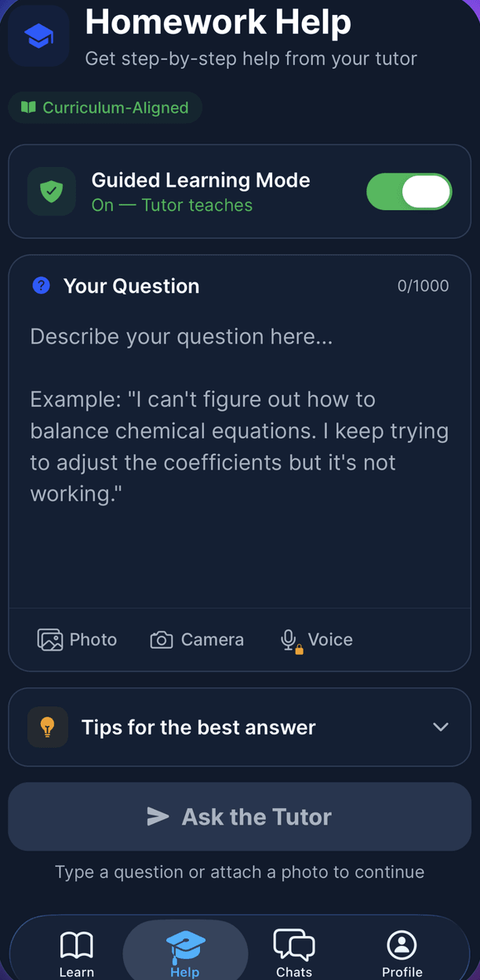
Most tutoring makes you sit through material you already know. MapleMind flips that: pick the exact skill that's causing trouble — any of the 30 below — and the tutor teaches just that one, step by step, as many times as it takes. Ask questions in plain words, any time of day, in English, French, or 12 other languages.
The official Saskatchewan Science, Grade 7 curriculum
Saskatchewan defines Science, Grade 7 by strands and outcomes. MapleMind teaches the same curriculum reorganized for one-skill-at-a-time tutoring — the table shows exactly where every official strand lands, and the ministry's own wording is quoted under each unit below.
Official source Saskatchewan's official curriculumRead it on the government site — curriculum.gov.sk.ca ↗| Official strand | Outcomes | Where MapleMind teaches it |
|---|---|---|
| Strand IE | 4 | Interactions within Ecosystems |
| Strand MS | 3 | Mixtures and Solutions |
| Strand HT | 3 | Heat and Temperature |
| Strand EC | 3 | Earth's Crust and Resources |
Every skill below, taught one on one.
 Try the first session free
How MapleMind teaches Science, Grade 7 — every unit, lesson, and skill
Every skill below runs as a short session: a plain-words lesson, a worked example, solving it together, then a five-question skill check that earns up to three stars. Guided Mode keeps it teaching instead of answer-handing — turning it off needs a parent's password.
Unit 1Interactions within EcosystemsOfficial strand · Strand IE
Indigenous knowledge of ecosystems, food webs and communities, biogeochemical cycles and energy flow, and how ecosystems change in response to natural and human influences.
Indigenous Knowledge and Ecosystems
- Indigenous knowledge of ecosystemsIE7.1 — Relate key aspects of Indigenous knowledge to an understanding of ecosystems and the interactions of their components.
Organisms, Food Webs, and Communities
- Organizing life in ecosystemsIE7.2 — Illustrate the ecological organization of life and conduct a field study to identify the biotic and abiotic components of a local ecosystem.
- Producers, consumers, and decomposersIE7.2 — Classify organisms in ecosystems as producers, consumers, or decomposers, and further classify consumers by feeding type.
- Food chains and food websIE7.2 — Construct food chains and food webs to illustrate the interdependence of producers, consumers, and decomposers in an ecosystem.
Energy Flow and Biogeochemical Cycles
- Energy flow through ecosystemsIE7.3 — Illustrate how energy is supplied to and flows through a food web using the concept of ecological pyramids.
- Carbon, nitrogen, and water cyclesIE7.3 — Model the carbon, nitrogen, and water cycles to illustrate how matter cycles through ecosystems, including the role of decomposers.
- Photosynthesis and respirationIE7.3 — Describe how energy passes through ecosystems during photosynthesis and cellular respiration and investigate conditions for plant growth.
How Ecosystems Change
- Ecological successionIE7.4 — Identify evidence of ecological succession using the concepts of pioneer species, climax community, and primary and secondary succession.
- Reducing human impactIE7.4 — Analyze how human influences change ecosystems and propose a course of action to reduce the impact of human behaviour on a specific ecosystem.
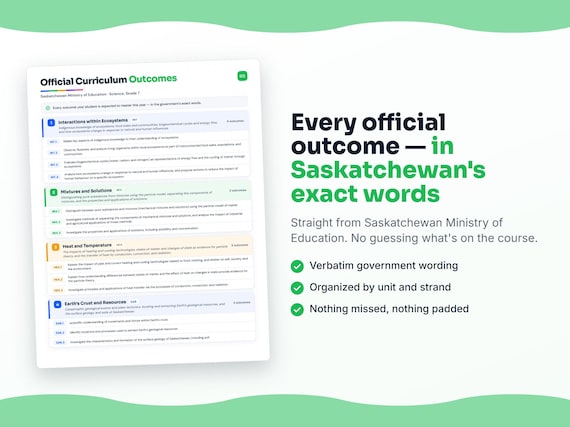
The official wording — 4 outcomes in this unit
- IE7.1
Relate key aspects of Indigenous knowledge to their understanding of ecosystems.
- IE7.2
Observe, illustrate, and analyze living organisms within local ecosystems as part of interconnected food webs, populations, and communities.
- IE7.3
Evaluate biogeochemical cycles (water, carbon, and nitrogen) as representations of energy flow and the cycling of matter through ecosystems.
- IE7.4
Analyze how ecosystems change in response to natural and human influences, and propose actions to reduce the impact of human behaviour on a specific ecosystem.
Unit 2Mixtures and SolutionsOfficial strand · Strand MS
Distinguishing pure substances from mixtures using the particle model, separating the components of mixtures, and the properties and applications of solutions.
Pure Substances and Mixtures
- Classifying matterMS7.1 — Describe and classify common substances as pure substances, mechanical mixtures, or solutions.
- The particle model of matterMS7.1 — State the main ideas of the particle model of matter and use it to represent pure substances, mechanical mixtures, and solutions.
Separating Mixtures
- Methods of separationMS7.2 — Describe and investigate methods used to separate the components of mechanical mixtures and solutions, following safe lab practices.
- Separation in industry and agricultureMS7.2 — Describe the scientific principles behind industrial and agricultural separation technologies and analyze their impacts.
- Designing a separation deviceMS7.2 — Use a technological problem-solving process to design, construct, and evaluate a prototype device for separating a mechanical mixture or solution.
Solutions, Solubility, and Concentration
- Solutes, solvents, and solubilityMS7.3 — Describe solutions using the terms solute, solvent, soluble, and insoluble, based on the particle model of matter.
- Concentration of solutionsMS7.3 — Create and describe the concentration of solutions using qualitative terms and quantitative measurements.
- Factors affecting solubilityMS7.3 — Investigate the factors that affect how quickly a solute dissolves and how temperature affects solubility, and predict from solubility curves.
The official wording — 3 outcomes in this unit
- MS7.1
Distinguish between pure substances and mixtures (mechanical mixtures and solutions) using the particle model of matter.
- MS7.2
Investigate methods of separating the components of mechanical mixtures and solutions, and analyze the impact of industrial and agricultural applications of those methods.
- MS7.3
Investigate the properties and applications of solutions, including solubility and concentration.
Unit 3Heat and TemperatureOfficial strand · Strand HT
The impacts of heating and cooling technologies, states of matter and changes of state as evidence for particle theory, and the transfer of heat by conduction, convection, and radiation.
Heating and Cooling Technologies
- Heating and cooling through historyHT7.1 — Illustrate the historical development and underlying principles of heating and cooling technologies and compare the heat capacities of common materials.
- Insulation and prototypesHT7.1 — Evaluate the efficiency of home insulation and design and evaluate a prototype of a device that solves a heating or cooling problem.
States of Matter and Particle Theory
- States of matter and changes of stateHT7.2 — Investigate the effects of heat on states of matter, construct a heating curve, and explain changes of state using the particle model.
- Heat versus temperatureHT7.2 — Distinguish between heat and temperature using the concept of kinetic energy and the particle model of matter.
Heat Transfer
- Conduction, convection, and radiationHT7.3 — Demonstrate and explain how heat is transferred by conduction, convection, and radiation in solids, liquids, and gases.
- Controlling heat transferHT7.3 — Assess the impacts of heat transfer and evaluate technologies designed to enhance or restrict conduction, convection, and radiation.
The official wording — 3 outcomes in this unit
- HT7.1
Assess the impact of past and current heating and cooling technologies related to food, clothing, and shelter on self, society, and the environment.
- HT7.2
Explain how understanding differences between states of matter and the effect of heat on changes in state provide evidence for the particle theory.
- HT7.3
Investigate principles and applications of heat transfer via the processes of conduction, convection, and radiation.
Unit 4Earth's Crust and ResourcesOfficial strand · Strand EC
Catastrophic geological events and plate tectonics, locating and extracting Earth's geological resources, and the surface geology and soils of Saskatchewan.
Earth's Crust and Catastrophic Events
- Plate tectonics and Earth's structureEC7.1 — Trace the development of plate tectonics theory and describe Earth's structure and the movements at plate boundaries.
- Catastrophic geological eventsEC7.1 — Describe the societal and environmental impacts of catastrophic geological events and the tools scientists use to measure them.
Geological Resources
- Rocks, minerals, and Saskatchewan's resourcesEC7.2 — Distinguish between rocks and minerals, classify minerals by physical properties, and identify Saskatchewan's primary mineral resources.
- Extracting resources and its impactsEC7.2 — Relate extraction processes to the type and depth of a resource and suggest solutions to environmental issues related to extraction in Saskatchewan.
- Careers in resource explorationEC7.2 — Research Saskatchewan careers directly and indirectly related to geological resource exploration.
Surface Geology and Soil of Saskatchewan
- The rock cycle and weatheringEC7.3 — Model the formation of the three major rock types and construct a representation of the rock cycle, distinguishing weathering from erosion.
- Soils and land useEC7.3 — Examine and classify local soils by their characteristics and identify correlations between Saskatchewan soil types and land uses.
The official wording — 3 outcomes in this unit
- EC7.1
scientific understanding of movements and forces within Earth’s crust.
- EC7.2
Identify locations and processes used to extract Earth’s geological resources
- EC7.3
Investigate the characteristics and formation of the surface geology of Saskatchewan, including soil
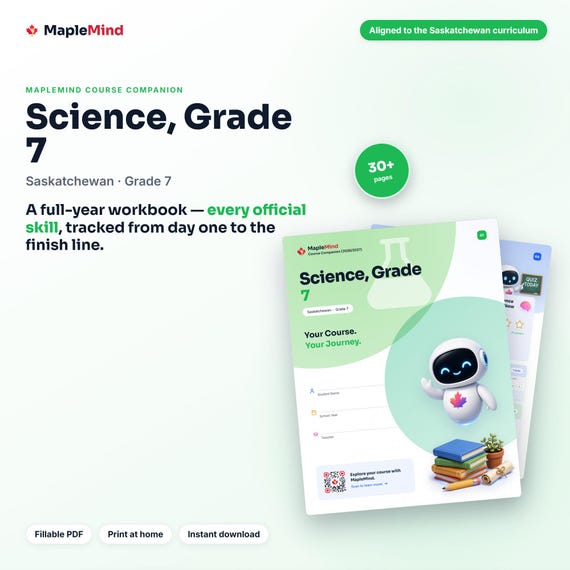
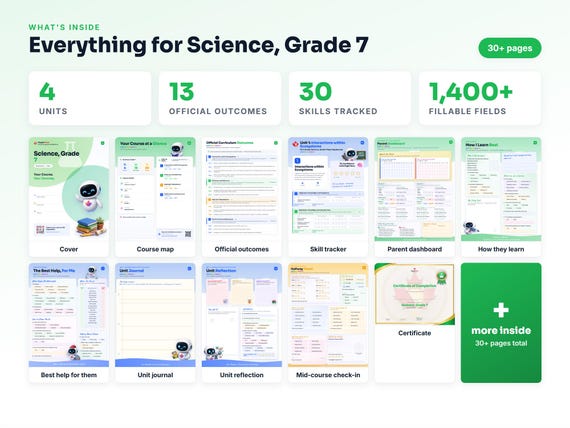

Printable workbook · A keepsake of the year
A Science, Grade 7 workbook worth keeping
Built from the same official curriculum as this page. Before and after each skill above, your student colours in how sure they feel — so the two of you can see, on one page, what's clicking and what needs another look. It's a quiet way to follow how the year is really going.
By June it's full of their own handwriting: units worked through, confidence grown, a mid-year check-in, notes from parent-teacher night, and a certificate at the end. Less a worksheet, more a record of the year worth keeping on the shelf.
Instant download · see every page, reviews and the full description · five or more workbooks are $2.99 each
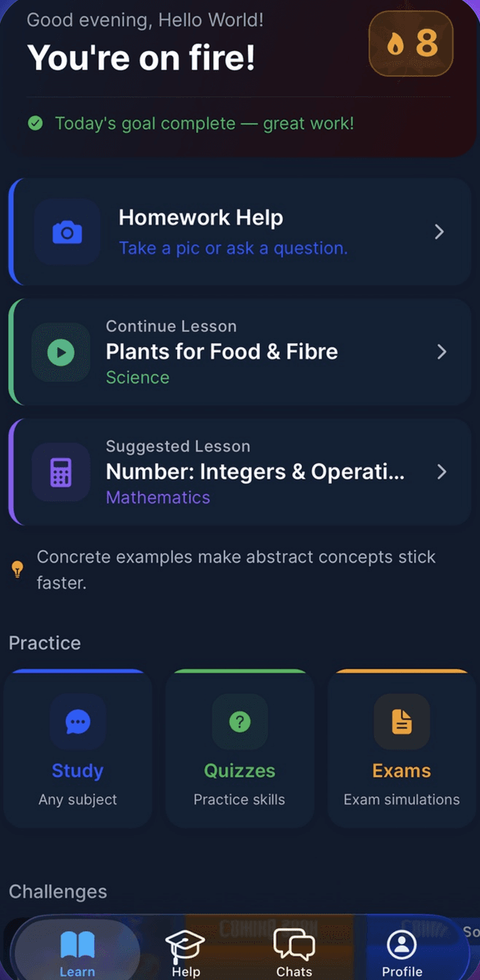
What it looks like in the app
Common questions
Can MapleMind help me with Science, Grade 7?
Yes. MapleMind's AI tutor covers all 30 skills in Saskatchewan's Science, Grade 7 — you pick the exact skill, and the tutor teaches it step by step: a short lesson, a worked example, solving together, then a skill check to show it stuck.
Is MapleMind aligned to Saskatchewan's official curriculum?
Yes. Every skill in this course maps to an official outcome code from Saskatchewan's Grade 7 Science curriculum, and the ministry's own wording is quoted under each unit on this page — with the official government source linked so you can check it yourself.
What does MapleMind cost?
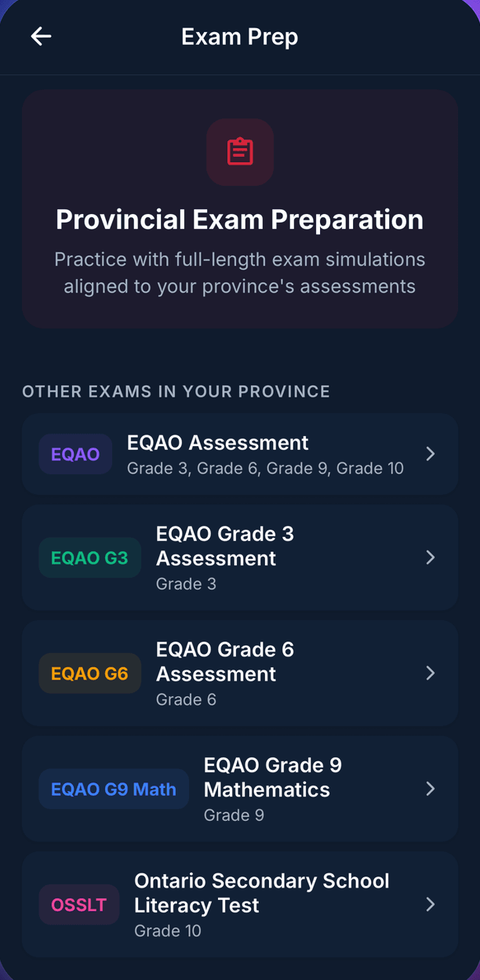
It's free to start — 5 tutoring chats and a practice quiz every day, no credit card. A Pro subscription ($9.99/month or $49.99/year CAD, 7-day free trial) unlocks unlimited tutoring, practice, and exam simulations.
What if I'm stuck on just one topic?
That's the point of skill-level tutoring: open Science, Grade 7 in the app, tap the exact skill from the list on this page, and the tutor teaches just that — no wading through lessons you don't need.
Does MapleMind work in French or other languages?
Yes — 14 languages, including French. Both the app and the tutor's explanations switch to the language you choose.
Where can I see the official Saskatchewan curriculum for Science, Grade 7?
The official source is linked on this page — Saskatchewan's official curriculum. The outline here follows it: every MapleMind skill carries its official outcome code, and the ministry's own wording is quoted under each unit.
Keep exploring
Ready when you are
Pick a skill from this page and see it taught properly — free, in the browser, in under a minute.