Get help with Science, Grade 6
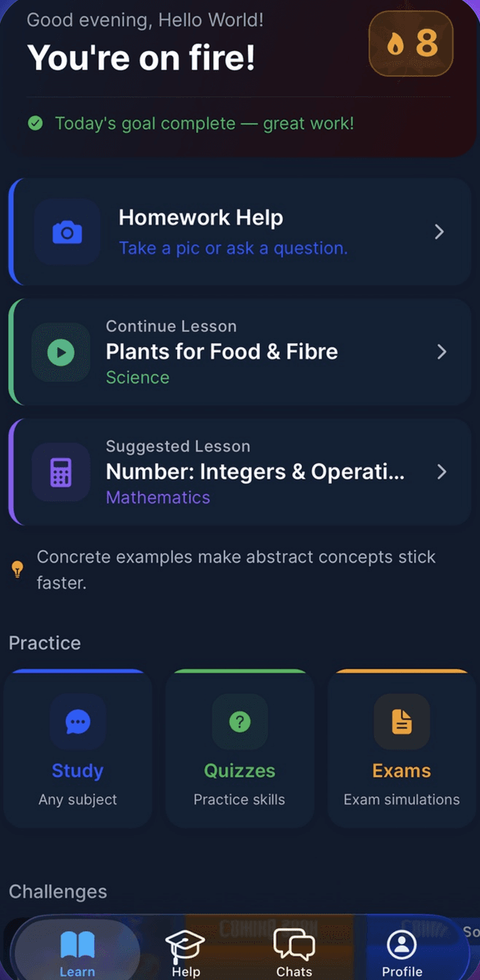
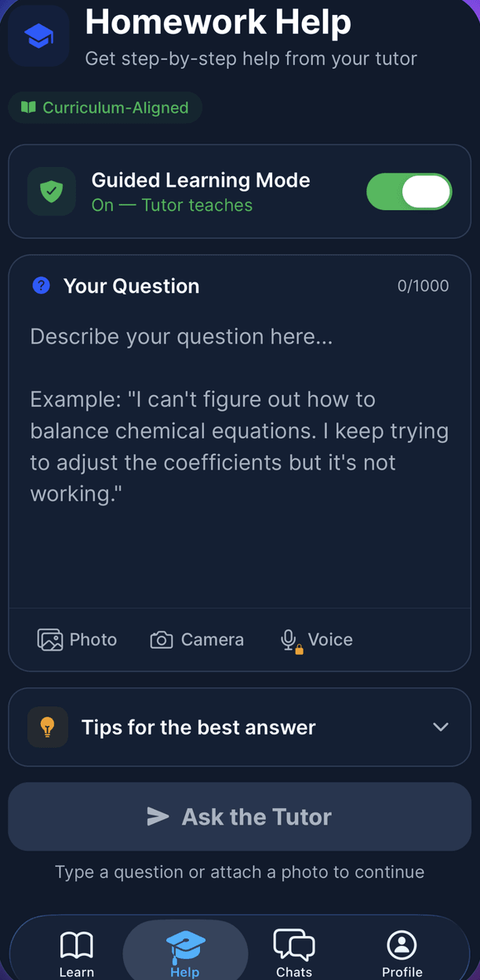
Most tutoring makes your child sit through material your child already knows. MapleMind flips that: pick the exact skill that's causing trouble — any of the 30 below — and the tutor teaches just that one, step by step, as many times as it takes. Ask questions in plain words, any time of day, in English, French, or 12 other languages.
The official Saskatchewan Science, Grade 6 curriculum
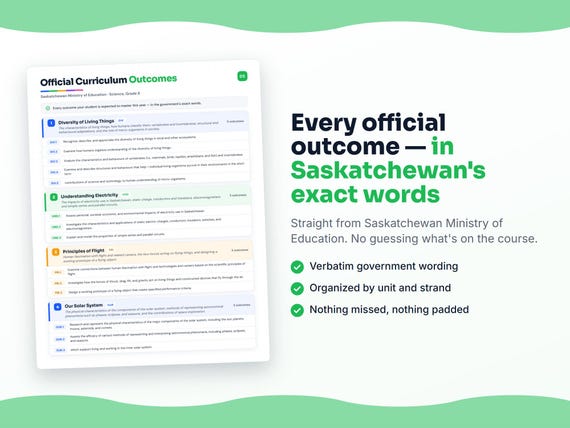
Saskatchewan defines Science, Grade 6 by strands and outcomes. MapleMind teaches the same curriculum reorganized for one-skill-at-a-time tutoring — the table shows exactly where every official strand lands, and the ministry's own wording is quoted under each unit below.
Official source Saskatchewan's official curriculumRead it on the government site — curriculum.gov.sk.ca ↗| Official strand | Outcomes | Where MapleMind teaches it |
|---|---|---|
| Strand DL | 5 | Diversity of Living Things |
| Strand EL | 3 | Understanding Electricity |
| Strand FL | 3 | Principles of Flight |
| Strand SS | 3 | Our Solar System |
Every skill below, taught one on one.
 Try the first session free
How MapleMind teaches Science, Grade 6 — every unit, lesson, and skill
Every skill below runs as a short session: a plain-words lesson, a worked example, solving it together, then a five-question skill check that earns up to three stars. Guided Mode keeps it teaching instead of answer-handing — turning it off needs a parent's password.
Unit 1Diversity of Living ThingsOfficial strand · Strand DL
The characteristics of living things, how humans classify them, vertebrates and invertebrates, structural and behavioural adaptations, and the role of micro-organisms in society.
The Diversity of Living Things
- What makes something a living thingDL6.1 — Recognize, describe, and appreciate the diversity of living things in local and other ecosystems by identifying the characteristics that define all living things.
- Careers that study living thingsDL6.1 — Explore science and technology related careers and workplaces that require an understanding of the diversity of living things.
Classifying Living Things
- How humans build classification systemsDL6.2 — Examine how humans organize understanding of the diversity of living things by constructing, using, and refining classification systems.
- Five kingdoms and Indigenous ways of knowingDL6.2 — Illustrate the five-kingdom taxonomic model and explore First Nations and Métis methods of organizing understanding of living things.
Vertebrates and Invertebrates
- Sorting animals by backboneDL6.3 — Identify the characteristics of vertebrates and invertebrates and classify animals as one or the other from drawings, videos, and observations.
- Comparing animal bodies and behavioursDL6.3 — Compare and represent the characteristics and behaviours of chosen vertebrate and invertebrate examples, including major invertebrate groups.
Structures, Behaviours, and Adaptation
- Surviving in the short termDL6.4 — Examine and describe structures and behaviours, including seasonal changes, that help individual living organisms survive in their environments in the short term.
- Adapting over the long termDL6.4 — Examine and describe adaptations that help species adapt to their environments in the long term, using fossils and comparisons of related species as evidence.
Micro-organisms
- Observing tiny living thingsDL6.5 — Use appropriate tools to observe and represent the characteristics of micro-organisms from collected water samples.
- How micro-organisms live and break down matterDL6.5 — Explain how micro-organisms meet their basic needs and investigate the factors that influence how quickly they break down organic matter.
- Micro-organisms in societyDL6.5 — Assess the positive and negative effects of micro-organisms on past and present society, including scientific contributions to understanding them.
The official wording — 5 outcomes in this unit
- DL6.1
Recognize, describe, and appreciate the diversity of living things in local and other ecosystems
- DL6.2
Examine how humans organize understanding of the diversity of living things.
- DL6.3
Analyze the characteristics and behaviours of vertebrates (i.e., mammals, birds, reptiles, amphibians, and fish) and invertebrates.
- DL6.4
Examine and describe structures and behaviours that help: • individual living organisms survive in their environments in the short term
- DL6.5
contributions of science and technology to human understanding of micro-organisms.
Unit 2Understanding ElectricityOfficial strand · Strand EL
The impacts of electricity use in Saskatchewan, static charge, conductors and insulators, electromagnetism, and simple series and parallel circuits.
Electricity in Saskatchewan
- How Saskatchewan makes electricityEL6.1 — Describe how electrical energy is generated from various sources in Saskatchewan and categorize those sources as renewable or non-renewable.
- Reducing the impacts of electricity useEL6.1 — Assess the impacts of electricity use and propose methods of decreasing electrical energy consumption to conserve resources and protect the environment.
Static, Conductors, and Electromagnets
- Static electric chargeEL6.2 — Investigate the characteristics and applications of static electric charges, including attraction, repulsion, and discharge.
- Conductors and insulatorsEL6.2 — Test the conductivity of a variety of solids and liquids to identify which materials are conductors and which are insulators.
- ElectromagnetsEL6.2 — Describe the operation of an electromagnet, contrast magnets and electromagnets, and plan a fair test of electromagnet strength.
Series and Parallel Circuits
- What a circuit needsEL6.3 — State the required characteristics of a simple electric circuit and contrast closed, open, and short circuits.
- Series versus parallelEL6.3 — Construct and test series and parallel circuits, draw circuit diagrams using symbols, and compare how the two behave.
The official wording — 3 outcomes in this unit
- EL6.1
Assess personal, societal, economic, and environmental impacts of electricity use in Saskatchewan
- EL6.2
Investigate the characteristics and applications of static electric charges, conductors, insulators, switches, and electromagnetism.
- EL6.3
Explain and model the properties of simple series and parallel circuits.
Unit 3Principles of FlightOfficial strand · Strand FL
Human fascination with flight and related careers, the four forces acting on flying things, and designing a working prototype of a flying object.
The Fascination with Flight
- Flight in nature and inventionFL6.1 — Examine connections between human fascination with flight, the flight of living things, and the development of flying technologies.
- Careers in flightFL6.1 — Describe career opportunities in Canada related to the science and technology of flight.
The Four Forces of Flight
- Lift against gravityFL6.2 — Investigate how lift overcomes gravity and how the shape of a surface affects lift.
- DragFL6.2 — Describe and represent methods for altering drag in flying devices, such as a bird spreading its wings or an airplane using flaps.
- ThrustFL6.2 — Compare the sources of thrust of various constructed flying devices, including the propeller, jet engine, and rocket.
Designing a Flying Prototype
- Building and testing a flying objectFL6.3 — Design, construct, test, and improve a working prototype of a flying object that meets specified performance criteria.
The official wording — 3 outcomes in this unit
- FL6.1
Examine connections between human fascination with flight and technologies and careers based on the scientific principles of flight.
- FL6.2
Investigate how the forces of thrust, drag, lift, and gravity act on living things and constructed devices that fly through the air.
- FL6.3
Design a working prototype of a flying object that meets specified performance criteria.
Unit 4Our Solar SystemOfficial strand · Strand SS
The physical characteristics of the components of the solar system, methods of representing astronomical phenomena such as phases, eclipses, and seasons, and the contributions of space exploration.
The Components of the Solar System
- Researching the solar systemSS6.1 — Research and represent the physical characteristics of the major components of the solar system, including the sun, planets, moons, asteroids, and comets.
- Modelling the solar system to scaleSS6.1 — Create and evaluate scale-distance and scale-size models to represent the major components of the solar system.
Phases, Eclipses, and Seasons
- Modelling sky eventsSS6.2 — Assess methods of representing and interpreting astronomical phenomena by modelling the causes of phases, eclipses, and seasons.
- Cultures and the skySS6.2 — Examine how people of different cultures, including First Nations, have recorded and used understandings of astronomical phenomena.
Space Exploration
- Living and working in spaceSS6.3 — Investigate how astronauts meet their basic needs and the work roles required to support human spaceflight.
- Weighing space explorationSS6.3 — Evaluate past, current, and possible future contributions of space exploration programs and identify barriers to living and working in space.
The official wording — 3 outcomes in this unit
- SS6.1
Research and represent the physical characteristics of the major components of the solar system, including the sun, planets, moons, asteroids, and comets.
- SS6.2
Assess the efficacy of various methods of representing and interpreting astronomical phenomena, including phases, eclipses, and seasons.
- SS6.3
which support living and working in the inner solar system.
Printable workbook · A keepsake of the year
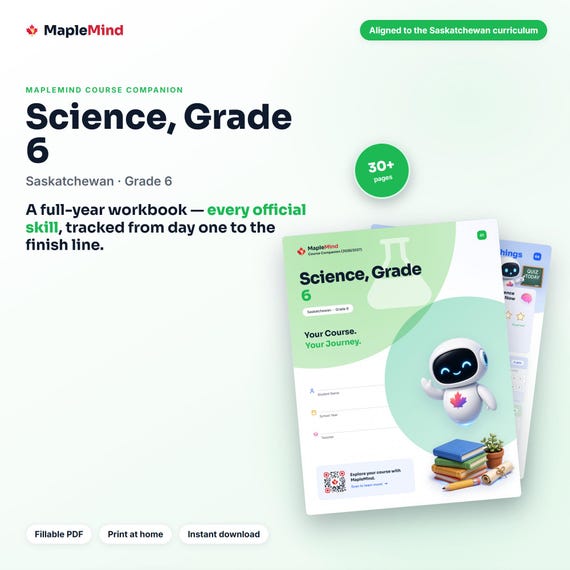
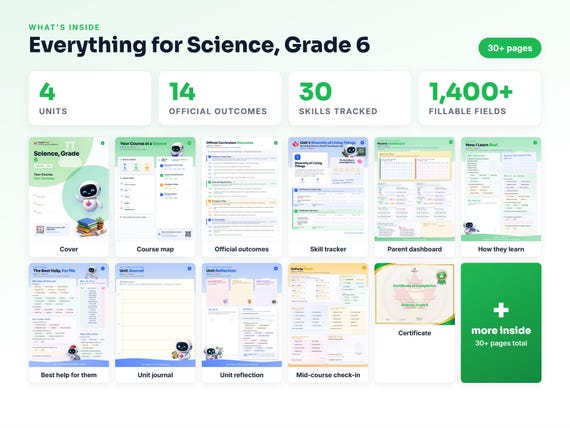
A Science, Grade 6 workbook worth keeping
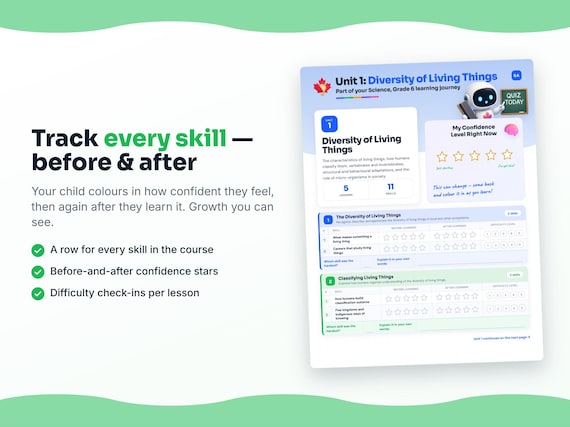
Built from the same official curriculum as this page. Before and after each skill above, your student colours in how sure they feel — so the two of you can see, on one page, what's clicking and what needs another look. It's a quiet way to follow how the year is really going.
By June it's full of their own handwriting: units worked through, confidence grown, a mid-year check-in, notes from parent-teacher night, and a certificate at the end. Less a worksheet, more a record of the year worth keeping on the shelf.
Instant download · see every page, reviews and the full description · five or more workbooks are $2.99 each
What it looks like in the app
Common questions
Can MapleMind help my child with Science, Grade 6?
Yes. MapleMind's AI tutor covers all 30 skills in Saskatchewan's Science, Grade 6 — your child picks the exact skill, and the tutor teaches it step by step: a short lesson, a worked example, solving together, then a skill check to show it stuck.
Is MapleMind aligned to Saskatchewan's official curriculum?
Yes. Every skill in this course maps to an official outcome code from Saskatchewan's Grade 6 Science curriculum, and the ministry's own wording is quoted under each unit on this page — with the official government source linked so you can check it yourself.
What does MapleMind cost?
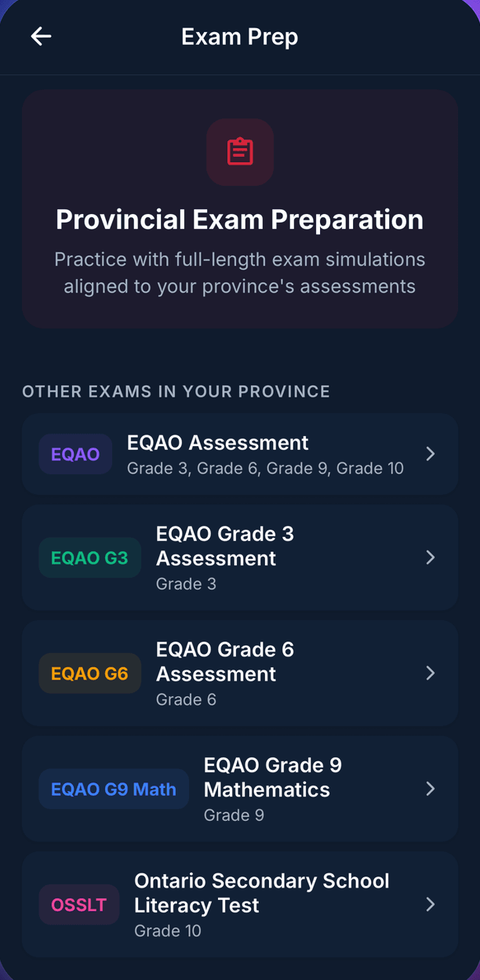
It's free to start — 5 tutoring chats and a practice quiz every day, no credit card. A Pro subscription ($9.99/month or $49.99/year CAD, 7-day free trial) unlocks unlimited tutoring, practice, and exam simulations.
What if my child is stuck on just one topic?
That's the point of skill-level tutoring: open Science, Grade 6 in the app, tap the exact skill from the list on this page, and the tutor teaches just that — no wading through lessons your child doesn't need.
Does MapleMind work in French or other languages?
Yes — 14 languages, including French. Both the app and the tutor's explanations switch to the language your child chooses.
Where can I see the official Saskatchewan curriculum for Science, Grade 6?
The official source is linked on this page — Saskatchewan's official curriculum. The outline here follows it: every MapleMind skill carries its official outcome code, and the ministry's own wording is quoted under each unit.
Keep exploring
Ready when you are
Pick a skill from this page and see it taught properly — free, in the browser, in under a minute.