Get help with Science, Grade 5
Most tutoring makes your child sit through material your child already knows. MapleMind flips that: pick the exact skill that's causing trouble — any of the 31 below — and the tutor teaches just that one, step by step, as many times as it takes. Ask questions in plain words, any time of day, in English, French, or 12 other languages.
The official Saskatchewan Science, Grade 5 curriculum
Saskatchewan defines Science, Grade 5 by strands and outcomes. MapleMind teaches the same curriculum reorganized for one-skill-at-a-time tutoring — the table shows exactly where every official strand lands, and the ministry's own wording is quoted under each unit below.
Official source Saskatchewan's official curriculumRead it on the government site — curriculum.gov.sk.ca ↗| Official strand | Outcomes | Where MapleMind teaches it |
|---|---|---|
| Strand HB | 3 | Life Science — Human Body Systems |
| Strand MC | 6 | Physical Science — Materials, Forces, and Simple Machines |
| Strand WE | 3 | Earth and Space Science — Weather |
Every skill below, taught one on one.
 Try the first session free
How MapleMind teaches Science, Grade 5 — every unit, lesson, and skill
Every skill below runs as a short session: a plain-words lesson, a worked example, solving it together, then a five-question skill check that earns up to three stars. Guided Mode keeps it teaching instead of answer-handing — turning it off needs a parent's password.
Unit 1Life Science — Human Body SystemsOfficial strand · Strand HB
How the human body stays healthy, the major body systems and their organs, and how the systems work together to move, grow, and react.
Keeping the Body Healthy
- The body's defencesHB5.1 — Analyze how the skin and the body's defences, such as tears, saliva, and certain blood cells, protect against infection.
- Diseases and the organs they affectHB5.1 — Relate common diseases to the organs or body systems they affect, and predict the effect of an organ failing.
- Choices for a healthy bodyHB5.1 — Assess how lifestyle choices such as activity, nutrition, sleep, and hygiene help maintain a healthy body.
The Body's Systems
- Body systems and their organsHB5.2 — Explain the functions and locate the major organs of human body systems such as the digestive, respiratory, and circulatory systems.
- Modelling a body systemHB5.2 — Model the structure or function of a human organ or body system, and critique the model.
- Investigating a body systemHB5.2 — Design and carry out a fair-test investigation of a body system, such as the effect of exercise on heart rate.
Systems Working Together
- Systems that team upHB5.3 — Assess how skeletal, muscular, respiratory, digestive, and circulatory systems work together to move and nourish the body.
- The nervous system in controlHB5.3 — Investigate how the nervous system works with other systems to react to stimuli and control the body.
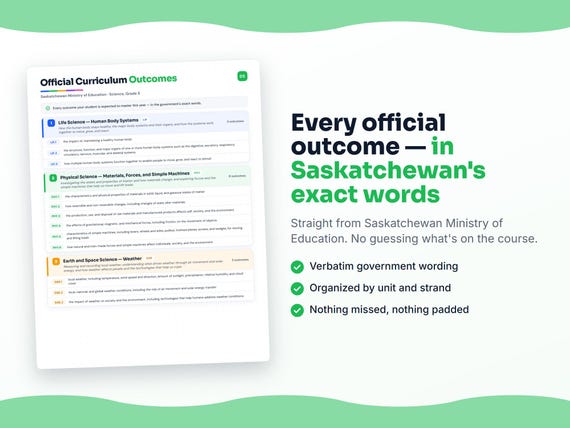
The official wording — 3 outcomes in this unit
- HB5.1
the impact of, maintaining a healthy human body
- HB5.2
the structure, function, and major organs of one or more human body systems such as the digestive, excretory, respiratory, circulatory, nervous, muscular, and skeletal systems
- HB5.3
how multiple human body systems function together to enable people to move, grow, and react to stimuli
Unit 2Physical Science — Materials, Forces, and Simple MachinesOfficial strand · Strand MC
Investigating the states and properties of matter and how materials change, and exploring forces and the simple machines that help us move and lift loads.
States and Properties of Matter
- What matter isMC5.1 — Recognize that matter is anything that has mass and takes up space, and compare the mass of an object with its parts.
- Solids, liquids, and gasesMC5.1 — Classify materials as solids, liquids, or gases and determine the characteristics that distinguish them.
- Telling materials apartMC5.1 — Observe and record physical properties and use them to distinguish one material from another.
Changing Materials
- Reversible and non-reversible changesMC5.2 — Observe and classify changes to materials as reversible or non-reversible.
- The six changes of stateMC5.2 — Provide evidence of the six changes of state and show that changes of state are reversible with heat.
- Fast and slow changesMC5.2 — Differentiate rapid changes from slow changes and investigate whether the mass of materials changes during a change.
Raw Materials and Products
- From raw material to productMC5.3 — Differentiate raw materials from manufactured products and research how a product is made.
- Making, using, and throwing awayMC5.3 — Assess how the production, use, and disposal of products affects society and the environment.
Forces and Motion
- Contact and non-contact forcesFM5.1 — Differentiate contact forces like push, pull, and friction from non-contact forces like gravity and magnetism.
- Balanced and unbalanced forcesFM5.1 — Diagram forces with arrows and differentiate the effects of balanced and unbalanced forces on motion.
- Investigating frictionFM5.1 — Conduct a fair test to compare the effects of friction on the movement of objects over different surfaces.
Simple Machines
- LeversFM5.2 — Investigate how levers reduce effort, including the roles of the fulcrum, load, and applied force.
- Wheels, axles, and pulleysFM5.2 — Compare wheel-and-axle mechanisms and pulley systems for moving and lifting loads.
- Ramps, screws, wedges, and building a machineFM5.2 — Explain the inclined plane, and design and build a simple machine to accomplish a task.
Machines in Our Lives
- Simple machines around usFM5.3 — Provide examples of simple machines used at home, school, and community, and their benefits.
- Complex machines and their impactFM5.3 — Analyze how simple machines combine into complex machines and assess their impacts on society and the environment.
The official wording — 6 outcomes in this unit
- MC5.1
the characteristics and physical properties of materials in solid, liquid, and gaseous states of matter
- MC5.2
how reversible and non-reversible changes, including changes of state, alter materials
- MC5.3
the production, use, and disposal of raw materials and manufactured products affects self, society, and the environment
- FM5.1
the effects of gravitational, magnetic, and mechanical forces, including friction, on the movement of objects
- FM5.2
characteristics of simple machines, including levers, wheels and axles, pulleys, inclined planes, screws, and wedges, for moving and lifting loads
- FM5.3
how natural and man-made forces and simple machines affect individuals, society, and the environment
Unit 3Earth and Space Science — WeatherOfficial strand · Strand WE
Measuring and recording local weather, understanding what drives weather through air movement and solar energy, and how weather affects people and the technologies that help us cope.
Measuring the Weather
- Weather instrumentsWE5.1 — Design and build simple weather instruments and explain what each measures.
- Recording and mapping weatherWE5.1 — Record local weather data over time, construct a weather map, and analyze the patterns.
What Drives the Weather
- Moving air and pressureWE5.2 — Demonstrate properties of air — that it takes up space, has weight, rises when heated, and moves from high to low pressure.
- The sun heats the EarthWE5.2 — Investigate how solar energy heats different surfaces at different rates and warms the Earth.
- Severe weatherWE5.2 — Describe severe weather events such as tornadoes, blizzards, and hurricanes, and the role of air and solar energy.
Weather and People
- Forecasts and weather's effectsWE5.3 — Explain how weather forecasts are made and used and how weather affects people's lives and livelihoods.
- Technologies for coping with weatherWE5.3 — Research technologies and products people develop to address different weather conditions.
The official wording — 3 outcomes in this unit
- WE5.1
local weather, including temperature, wind speed and direction, amount of sunlight, precipitation, relative humidity, and cloud cover
- WE5.2
local, national, and global weather conditions, including the role of air movement and solar energy transfer
- WE5.3
the impact of weather on society and the environment, including technologies that help humans address weather conditions
Printable workbook · A keepsake of the year
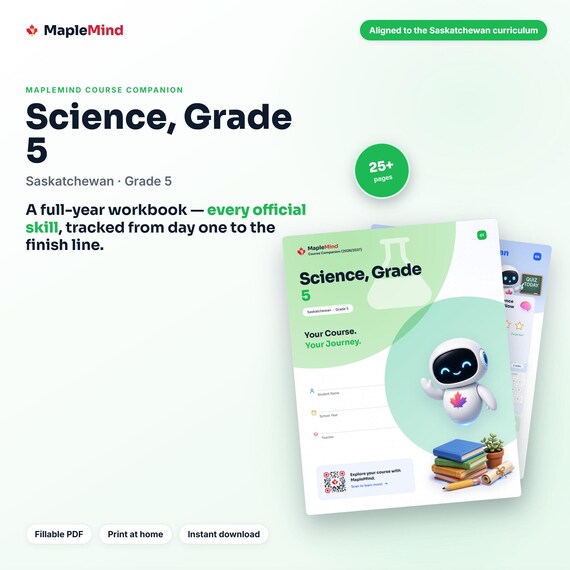
A Science, Grade 5 workbook worth keeping
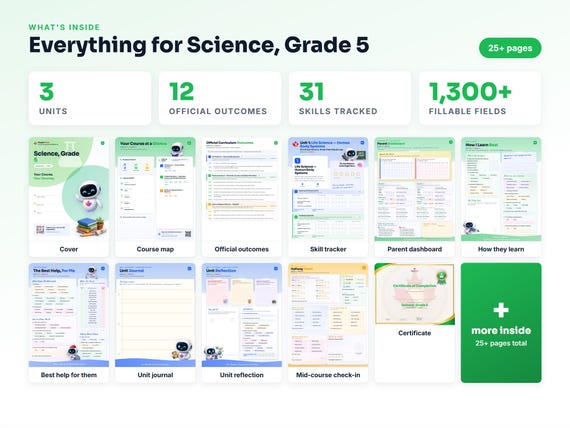
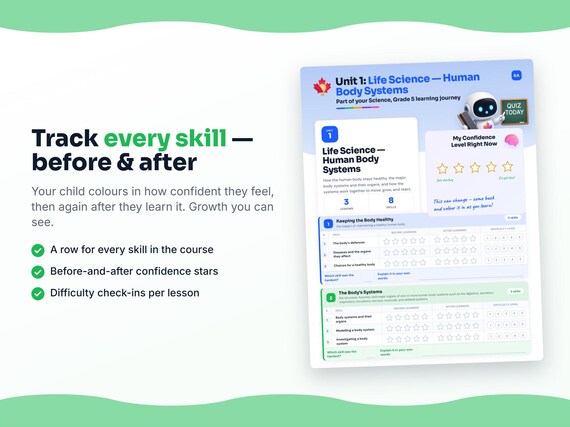
Built from the same official curriculum as this page. Before and after each skill above, your student colours in how sure they feel — so the two of you can see, on one page, what's clicking and what needs another look. It's a quiet way to follow how the year is really going.
By June it's full of their own handwriting: units worked through, confidence grown, a mid-year check-in, notes from parent-teacher night, and a certificate at the end. Less a worksheet, more a record of the year worth keeping on the shelf.
Instant download · see every page, reviews and the full description · five or more workbooks are $2.99 each
What it looks like in the app



Common questions
Can MapleMind help my child with Science, Grade 5?
Yes. MapleMind's AI tutor covers all 31 skills in Saskatchewan's Science, Grade 5 — your child picks the exact skill, and the tutor teaches it step by step: a short lesson, a worked example, solving together, then a skill check to show it stuck.
Is MapleMind aligned to Saskatchewan's official curriculum?
Yes. Every skill in this course maps to an official outcome code from Saskatchewan's Grade 5 Science curriculum, and the ministry's own wording is quoted under each unit on this page — with the official government source linked so you can check it yourself.
What does MapleMind cost?
It's free to start — 5 tutoring chats and a practice quiz every day, no credit card. A Pro subscription ($9.99/month or $49.99/year CAD, 7-day free trial) unlocks unlimited tutoring, practice, and exam simulations.
What if my child is stuck on just one topic?
That's the point of skill-level tutoring: open Science, Grade 5 in the app, tap the exact skill from the list on this page, and the tutor teaches just that — no wading through lessons your child doesn't need.
Does MapleMind work in French or other languages?
Yes — 14 languages, including French. Both the app and the tutor's explanations switch to the language your child chooses.
Where can I see the official Saskatchewan curriculum for Science, Grade 5?
The official source is linked on this page — Saskatchewan's official curriculum. The outline here follows it: every MapleMind skill carries its official outcome code, and the ministry's own wording is quoted under each unit.
Keep exploring
Ready when you are
Pick a skill from this page and see it taught properly — free, in the browser, in under a minute.