Get help with Science, Grade 4
Most tutoring makes your child sit through material your child already knows. MapleMind flips that: pick the exact skill that's causing trouble — any of the 30 below — and the tutor teaches just that one, step by step, as many times as it takes. Ask questions in plain words, any time of day, in English, French, or 12 other languages.
The official Saskatchewan Science, Grade 4 curriculum
Saskatchewan defines Science, Grade 4 by strands and outcomes. MapleMind teaches the same curriculum reorganized for one-skill-at-a-time tutoring — the table shows exactly where every official strand lands, and the ministry's own wording is quoted under each unit below.
Official source Saskatchewan's official curriculumRead it on the government site — curriculum.gov.sk.ca ↗| Official strand | Outcomes | Where MapleMind teaches it |
|---|---|---|
| Strand HC | 3 | Life Science — Habitats and Communities |
| Strand LI | 6 | Physical Science — Light and Sound |
| Strand RM | 3 | Earth and Space Science — Rocks, Minerals, and Erosion |
Every skill below, taught one on one.
 Try the first session free
How MapleMind teaches Science, Grade 4 — every unit, lesson, and skill
Every skill below runs as a short session: a plain-words lesson, a worked example, solving it together, then a five-question skill check that earns up to three stars. Guided Mode keeps it teaching instead of answer-handing — turning it off needs a parent's password.
Unit 1Life Science — Habitats and CommunitiesOfficial strand · Strand HC
How plants and animals live together in habitats and communities, the structures and behaviours that help them survive, and how natural and human activities change habitats.
Living Together in Habitats
- Populations, communities, and habitatsHC4.1 — Differentiate between populations, communities, and habitats using local and regional examples.
- Food chains and food websHC4.1 — Classify living things by their role in food chains and food webs, and construct a food chain.
- What happens if one is removedHC4.1 — Predict how the removal of one plant or animal population can affect the whole community.
Built to Survive
- Structures and behaviours for survivingHC4.2 — Analyze the structures and behaviours of plants and animals that help them meet their needs in a habitat.
- Investigating a habitatHC4.2 — Develop and carry out a plan to investigate the plants and animals of a habitat, recording and displaying data.
- Adaptations for a habitatHC4.2 — Predict the structural and behavioural adaptations a plant or animal needs to live in a particular habitat.
Protecting Habitats
- How people change habitatsHC4.3 — Assess the intended and unintended effects of natural and human activities on habitats and communities.
- Habitat loss and extinctionHC4.3 — Relate habitat loss to the endangerment and extinction of plants and animals in Saskatchewan and beyond.
- Restoring and protecting habitatsHC4.3 — Propose and carry out actions to preserve or restore a local habitat, and identify organizations that help.
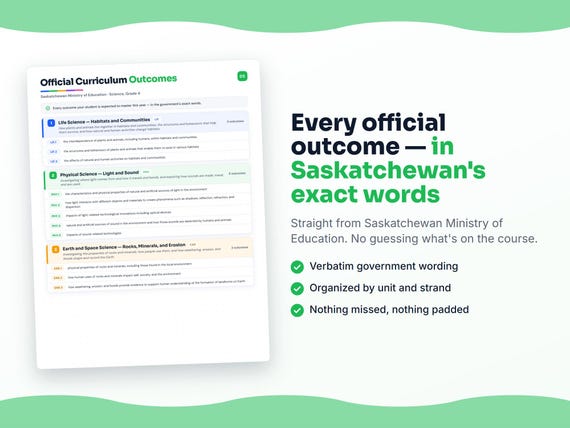
The official wording — 3 outcomes in this unit
- HC4.1
the interdependence of plants and animals, including humans, within habitats and communities
- HC4.2
the structures and behaviours of plants and animals that enable them to exist in various habitats
- HC4.3
the effects of natural and human activities on habitats and communities
Unit 2Physical Science — Light and SoundOfficial strand · Strand LI
Investigating where light comes from and how it travels and bends, and exploring how sounds are made, travel, and are used.
Sources of Light
- Natural and artificial lightLI4.1 — Differentiate between natural and artificial sources of light and examine the energy they emit.
- How light travelsLI4.1 — Investigate how light travels — in straight lines, in all directions from a source, and bending in water.
- Making shadowsLI4.1 — Predict and test how a shadow's location, shape, and size change as an object moves relative to a light source.
Light and Materials
- Opaque, transparent, translucentLI4.2 — Classify materials as opaque, transparent, or translucent based on how light passes through them.
- Reflecting lightLI4.2 — Investigate how light reflects off surfaces of different shapes and textures.
- Bending light and rainbowsLI4.2 — Demonstrate how transparent media bend light, and how a prism disperses white light into colours.
Light Technology
- Optical devices that help us seeLI4.3 — Compare optical devices such as magnifiers, glasses, microscopes, and telescopes that extend our ability to observe.
- Choosing light and saving energyLI4.3 — Assess different light sources and how choosing the right lighting can conserve energy.
Exploring Sound
- Natural and artificial soundsSO4.1 — Identify and classify natural and artificial sounds in the environment and how people use them.
- Making and hearing soundSO4.1 — Explain how humans create and detect sound, and how animals use sounds for different purposes.
- Sound comes from vibrationsSO4.2 — Demonstrate that sound comes from vibrating objects and travels through solids, liquids, and gases.
- Pitch and loudnessSO4.2 — Draw conclusions about the pitch and loudness of sound and how they can be changed.
Sound and Us
- Devices that work with soundSO4.3 — Explain devices that enhance our ability to produce, transmit, and detect sound, and how materials absorb or reflect sound.
- Loud sounds and hearing protectionSO4.3 — Identify issues around loud and sustained sounds and practices that protect hearing.
The official wording — 6 outcomes in this unit
- LI4.1
the characteristics and physical properties of natural and artificial sources of light in the environment
- LI4.2
how light interacts with different objects and materials to create phenomena such as shadows, reflection, refraction, and dispersion
- LI4.3
impacts of light-related technological innovations including optical devices
- SO4.1
natural and artificial sources of sound in the environment and how those sounds are detected by humans and animals
- SO4.2
the characteristics and physical properties of sound, including pitch and loudness, based on observation
- SO4.3
impacts of sound-related technologies
Unit 3Earth and Space Science — Rocks, Minerals, and ErosionOfficial strand · Strand RM
Investigating the properties of rocks and minerals, how people use them, and how weathering, erosion, and fossils shape and record the Earth.
Rocks and Minerals
- Properties of rocks and mineralsRM4.1 — Observe and record the physical properties of rocks and minerals, such as colour, lustre, and hardness.
- Sorting rocks and testing hardnessRM4.1 — Classify rocks and minerals, test mineral hardness, and differentiate rocks from minerals.
How We Use Rocks and Minerals
- Everyday uses of rocks and mineralsRM4.2 — Identify everyday objects made from rocks and minerals and their historical and contemporary uses.
- Mining in SaskatchewanRM4.2 — Identify where minerals like potash and uranium are mined in Saskatchewan and the effects of mining.
Weathering, Erosion, and Fossils
- Weathering and erosionRM4.3 — Describe how weathering and erosion by wind, water, and ice change landforms, and ways to control erosion.
- Three kinds of rockRM4.3 — Explain how rocks are classified as igneous, sedimentary, or metamorphic based on how they form.
- Fossils and the story of the landRM4.3 — Explain how fossils provide evidence of Earth's history and the formation of landforms.
The official wording — 3 outcomes in this unit
- RM4.1
physical properties of rocks and minerals, including those found in the local environment
- RM4.2
how human uses of rocks and minerals impact self, society, and the environment
- RM4.3
how weathering, erosion, and fossils provide evidence to support human understanding of the formation of landforms on Earth
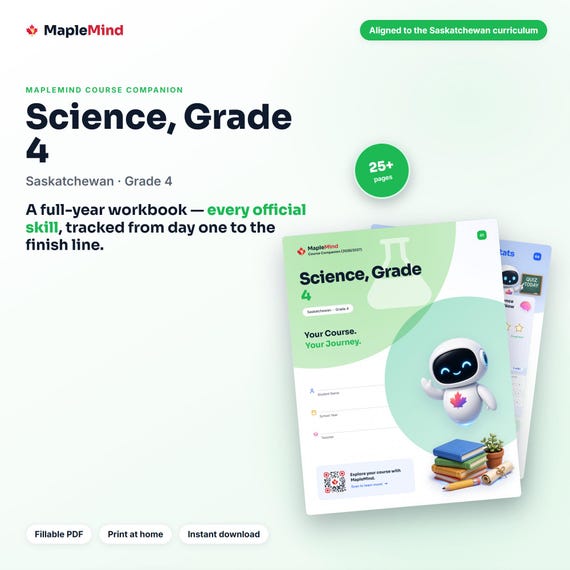
Printable workbook · A keepsake of the year
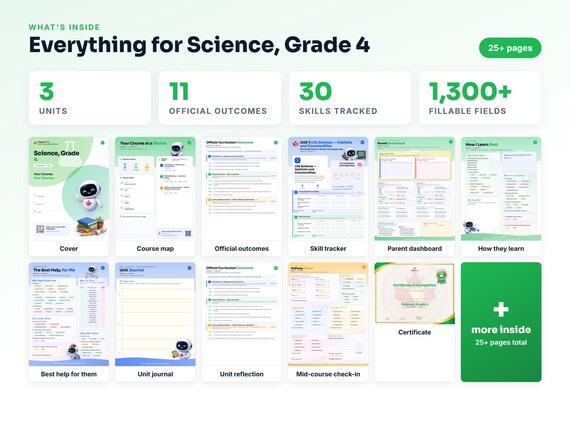
A Science, Grade 4 workbook worth keeping
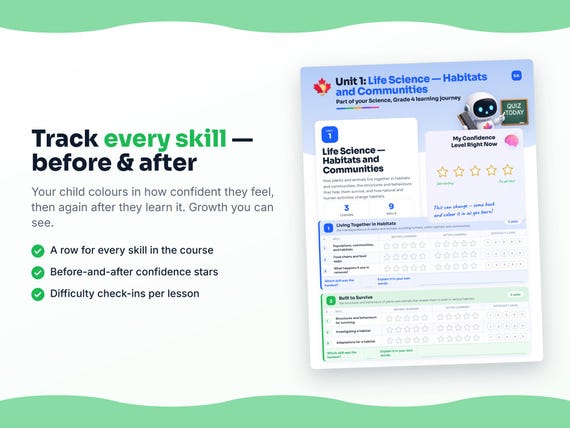
Built from the same official curriculum as this page. Before and after each skill above, your student colours in how sure they feel — so the two of you can see, on one page, what's clicking and what needs another look. It's a quiet way to follow how the year is really going.
By June it's full of their own handwriting: units worked through, confidence grown, a mid-year check-in, notes from parent-teacher night, and a certificate at the end. Less a worksheet, more a record of the year worth keeping on the shelf.
Instant download · see every page, reviews and the full description · five or more workbooks are $2.99 each
What it looks like in the app



Common questions
Can MapleMind help my child with Science, Grade 4?
Yes. MapleMind's AI tutor covers all 30 skills in Saskatchewan's Science, Grade 4 — your child picks the exact skill, and the tutor teaches it step by step: a short lesson, a worked example, solving together, then a skill check to show it stuck.
Is MapleMind aligned to Saskatchewan's official curriculum?
Yes. Every skill in this course maps to an official outcome code from Saskatchewan's Grade 4 Science curriculum, and the ministry's own wording is quoted under each unit on this page — with the official government source linked so you can check it yourself.
What does MapleMind cost?
It's free to start — 5 tutoring chats and a practice quiz every day, no credit card. A Pro subscription ($9.99/month or $49.99/year CAD, 7-day free trial) unlocks unlimited tutoring, practice, and exam simulations.
What if my child is stuck on just one topic?
That's the point of skill-level tutoring: open Science, Grade 4 in the app, tap the exact skill from the list on this page, and the tutor teaches just that — no wading through lessons your child doesn't need.
Does MapleMind work in French or other languages?
Yes — 14 languages, including French. Both the app and the tutor's explanations switch to the language your child chooses.
Where can I see the official Saskatchewan curriculum for Science, Grade 4?
The official source is linked on this page — Saskatchewan's official curriculum. The outline here follows it: every MapleMind skill carries its official outcome code, and the ministry's own wording is quoted under each unit.
Keep exploring
Ready when you are
Pick a skill from this page and see it taught properly — free, in the browser, in under a minute.