Saskatchewan · For parents

What your child learns in Grade 9 in Saskatchewan

Every subject, unit by unit, from Saskatchewan’s curriculum: 132 skills in plain words.

Subjects
5
Skills
132
Provincial exams
1
Official curriculum
curriculum.gov.sk.ca

Math in Grade 9

Mathematics, Grade 9

4 units · 31 skills

  1. Unit 1

    Number

    A power is repeated multiplication: 2³ means 2 x 2 x 2.

    • Representing powers
    • Evaluating powers and the zero exponent
    • Exponent laws and situational questions
    4 more skills
    • Comparing and ordering rational numbers
    • Operations with rational numbers
    • Square roots of perfect-square rationals
    • Estimating square roots of rationals
  2. Unit 2

    Patterns and Relations

    A linear relation graphs as a straight line, which may be horizontal or vertical.

    • Graphing and analyzing linear relations
    • Interpolating and extrapolating
    • Writing linear equations
    7 more skills
    • Solving one- and two-step equations
    • Variable on both sides and brackets
    • Solving and verifying inequalities
    • Comparing and graphing inequalities
    • Modeling and identifying polynomials
    • Adding and subtracting polynomials
    • Multiplying and dividing by a monomial
  3. Unit 3

    Shape and Space

    A perpendicular from the centre of a circle to a chord bisects the chord.

    • Chord and tangent properties
    • Inscribed and central angles
    • Surface area of composite objects
    5 more skills
    • Composite problems and approximation
    • Similar polygons
    • Scale diagrams and scale factors
    • Line symmetry
    • Rotation symmetry
  4. Unit 4

    Statistics and Probability

    Wording, timing, cost, and who is asked can bias the data collected.

    • Bias, language, and ethics in data collection
    • Population versus sample
    • Planning and collecting data
    3 more skills
    • Displaying, analysing, and presenting
    • How probability is used in society
    • Researching probability in First Nations and Métis lifestyles
Science in Grade 9

Science, Grade 9

4 units · 34 skills

  1. Unit 1

    Reproduction and Human Development

    The nucleus holds genetic information; chromosomes contain genes made of DNA.

    • Chromosomes, genes, DNA, and traits
    • Genetics in society and careers
    • Cell division and the cell cycle
    5 more skills
    • Mitosis versus meiosis
    • Asexual reproduction
    • Sexual reproduction and pollination
    • Reproductive systems and human development
    • Reproductive and contraceptive technologies
  2. Unit 2

    Atoms and Elements

    Physical properties include colour, melting and boiling point, density, solubility, conductivity, hardness, and lustre.

    • Physical properties and classifying substances
    • Physical versus chemical changes
    • Properties, research, and society
    6 more skills
    • The changing model of the atom
    • Building atomic models
    • Elements, compounds, and mixtures
    • Bohr models of the first 18 elements
    • The periodic table and periodicity
    • Protons, electrons, and isotopes
  3. Unit 3

    Characteristics of Electricity

    Static charge is transferred by friction, conduction, and induction, and released as electrostatic discharge.

    • Static electric charge
    • Current electricity and resistance
    • Electrical dangers and safety technologies
    6 more skills
    • Measuring series and parallel circuits
    • Ohm's Law
    • Energy transformations and efficiency
    • Cost and design of appliances
    • Producing and storing electrical energy
    • Generation methods and their impacts
  4. Unit 4

    Exploring our Universe

    Celestial bodies show real and apparent motion, including apparent retrograde motion.

    • Real and apparent motion
    • Characteristics of astronomical bodies
    • Solar phenomena and astronomical predictions
    5 more skills
    • Formation of the solar system
    • Origin of the universe and life cycle of stars
    • Cultures and astronomical phenomena
    • Space programs and technologies
    • Distances, positions, and space careers

English in Grade 9

English Language Arts, Grade 9

3 units · 38 skills

  1. Unit 1

    Comprehend and Respond

    Semester A explores three themes together: identity (The Search for Self), social responsibility (Our Shared Narratives), and efficacy (Doing the Right Thing).

    • Responding to Semester A theme texts
    • Adjusting strategies before, during, and after (Semester A)
    • Using cueing systems for thesis and argument (Semester A)
    13 more skills
    • Viewing multimedia to glean ideas (Semester A)
    • Listening to analyze and evaluate (Semester A)
    • Reading to develop an insightful interpretation (Semester A)
    • Reading information texts independently (Semester A)
    • Reading with fluency and expression (Semester A)
    • Responding to Semester B theme texts
    • Adjusting strategies before, during, and after (Semester B)
    • Using cueing systems for thesis and argument (Semester B)
    • Viewing multimedia to synthesize sources (Semester B)
    • Listening to recognize train of thought and technique (Semester B)
    • Reading to develop an insightful interpretation (Semester B)
    • Reading information texts independently (Semester B)
    • Reading with fluency and expression (Semester B)
  2. Unit 2

    Compose and Create

    Semester A creating explores The Search for Self, Our Shared Narratives, and Doing the Right Thing.

    • Creating texts on Semester A themes
    • Creating an individual researched inquiry (Semester A)
    • Using strategies to communicate meaning (Semester A)
    15 more skills
    • Using cues to communicate meaning (Semester A)
    • Creating multimedia presentations for an audience (Semester A)
    • Using oral language to interact in discussions (Semester A)
    • Using oral language to express ideas formally (Semester A)
    • Writing to describe, narrate, inform, and persuade (Semester A)
    • Experimenting with forms and techniques (Semester A)
    • Creating texts on Semester B themes
    • Creating an individual researched inquiry (Semester B)
    • Using strategies to communicate meaning (Semester B)
    • Using cues to communicate meaning (Semester B)
    • Creating a presentation for multiple audiences (Semester B)
    • Using oral language to interact in discussions (Semester B)
    • Using oral language to express ideas formally (Semester B)
    • Writing to describe, narrate, inform, and persuade (Semester B)
    • Experimenting with forms and techniques (Semester B)
  3. Unit 3

    Assess and Reflect

    Assessing personal strengths and needs covers all the roles: viewer, listener, reader, representer, speaker, writer — plus your contribution to the community of learners.

    • Assessing strengths and developing goals (Semester A)
    • Assessing work for clarity, correctness, and impact (Semester A)
    • Assessing strengths and developing goals (Semester B)
    1 more skill
    • Assessing work for clarity, correctness, and impact (Semester B)

French in Grade 9

Core French 9

4 units · 15 skills

  1. Unit 1

    Communication Skills

    The main idea (l'idée principale) is what the whole presentation is about — one sentence that covers everything; specific details (les détails) are the facts that support it.

    • Understanding oral French presentations
    • Reading multi-paragraph French texts
    • Discussing in French
    1 more skill
    • Writing multi-paragraph texts
  2. Unit 2

    General Language Strategies

    Before: set a purpose, make predictions, activate what you know (Je sais que… On peut voir la tour Eiffel à Paris.), connect to your own experience.

    • Listening and viewing strategies
    • Reading strategies
    • Speaking strategies
    1 more skill
    • The writing process
  3. Unit 3

    Language Knowledge

    Two-part recipe: auxiliary (avoir or être in the present) + past participle — J'ai travaillé (I worked); parler→parlé, finir→fini, vendre→vendu.

    • Passé composé of regular verbs
    • Passé composé of irregular verbs
    • Adjective agreement
    2 more skills
    • Numbers to 1 000 000
    • Negation with de, que/qui, and vous
  4. Unit 4

    Culture

    Four cultures shape contemporary Canadian life in visible ways: clothing and regalia, storytelling, celebrations, food, greetings, gatherings, and decision making.

    • Cultural influences, then and now
    • Events that shaped French Canada

Social studies in Grade 9

Social Studies, Grade 9

4 units · 14 skills

  1. Unit 1

    Interactions and Interdependence

    A society has institutions, roles, cultural traditions, and means of sustenance that meet the needs of its people.

    • What constitutes a society
    • Factors that shape worldviews
    • Worldview expressed in daily life
    1 more skill
    • Worldview and a society's choices
  2. Unit 2

    Dynamic Relationships

    We learn about the past from oral accounts, archaeology, literature, art, and artifacts, each with advantages and limitations.

    • Learning about past societies
    • The significance of key historical events
    • The environment and a society's development
    1 more skill
    • Past societies' influence on Canada
  3. Unit 3

    Power and Authority

    Systems of government — democracy, consensus, monarchy, autocracy, and military regime — differ in who holds power and how it is obtained and exercised.

    • Power and authority in governance
    • Empire-building and indigenous populations
    • Roles, responsibilities, and citizenship
  4. Unit 4

    Resources and Wealth

    Societies used different strategies to acquire and distribute resources, with real consequences for their populations.

    • Acquiring and distributing resources and wealth
    • Trade and transportation
    • Technologies of past societies

Provincial exams in Grade 9

MapleMind

See Grade 9 in MapleMind

Real screens from the app your child would use.

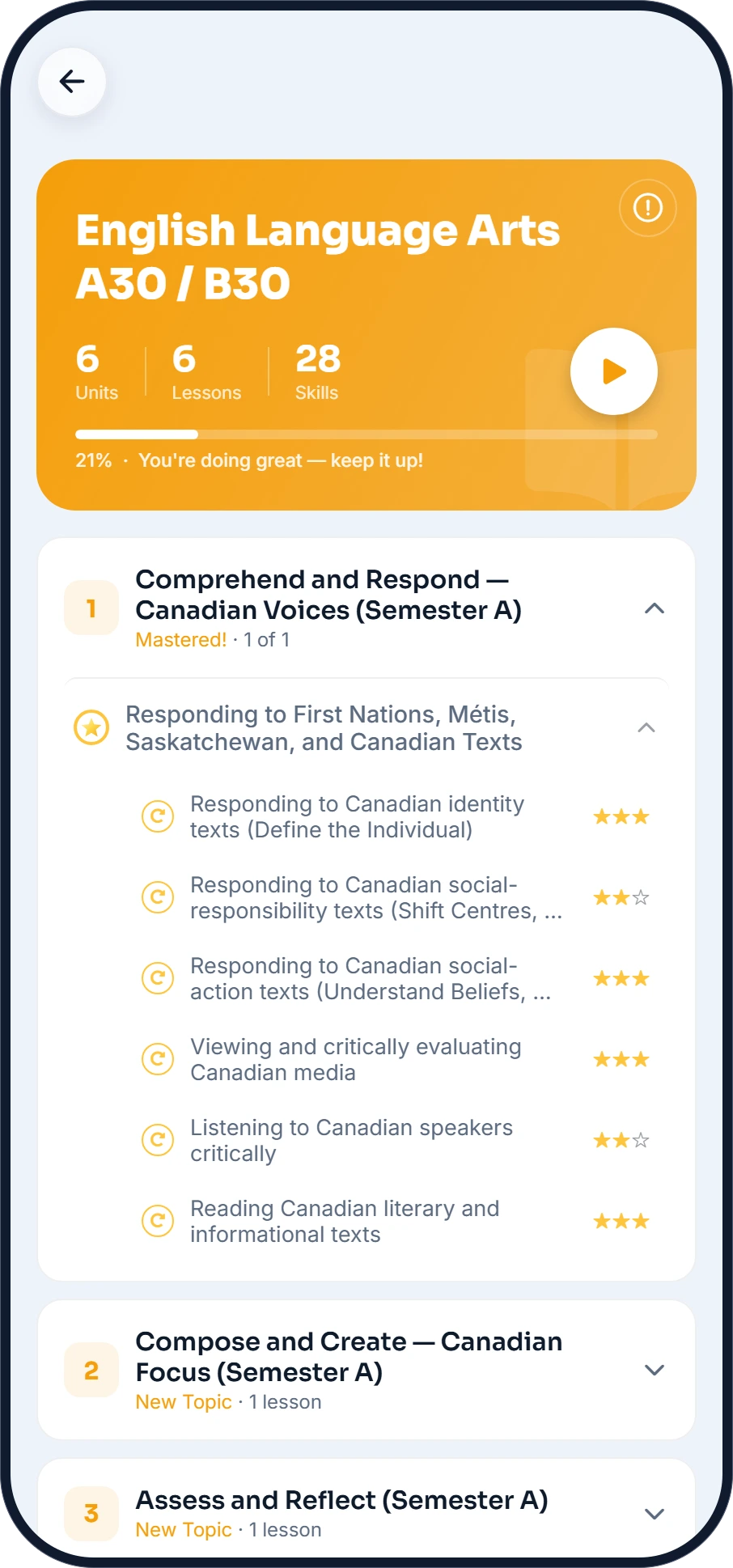
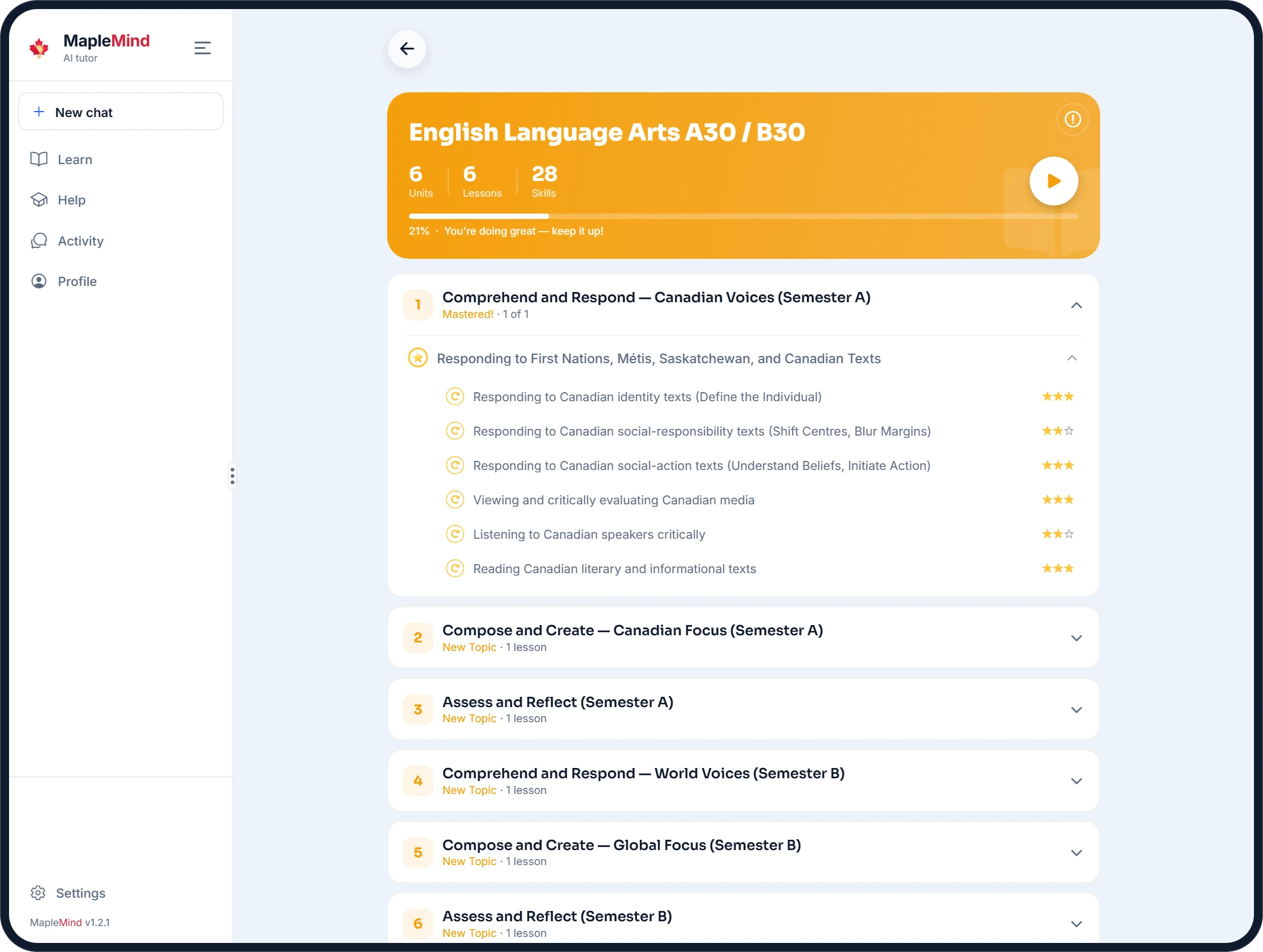
English Language Arts A30 / B30 in MapleMind on a tablet: its units and lessons in order, a student partway through.English Language Arts A30 / B30 in MapleMind on a phone: its units and lessons in order, a student partway through.
Their course, unit by unit, the way Saskatchewan teaches it.Shown: English Language Arts A30 / B30
Homework Help on a tablet: a photo of a worksheet, the tutor’s worked example of a two-step equation, and a question back to the student.Homework Help on a phone: a photo of a worksheet, the tutor’s worked example of a two-step equation, and a question back to the student.
Homework Help: they take a photo of the question, and the tutor works through it with them.
The Parent Dashboard on a tablet: a student’s days studied, streak, lessons, quiz average and recent activity.The Parent Dashboard on a phone: a student’s days studied, streak, lessons, quiz average and recent activity.
The Parent Dashboard: how each child’s week went, in lessons, quizzes and days studied.
A Grade 9 provincial mathematics exam on a tablet: a readiness score, the exam’s time and its next sitting.A Grade 9 provincial mathematics exam on a phone: a readiness score, the exam’s time and its next sitting.
A provincial exam: a practice sitting under the real time, and how ready they are.
The Learn tab on a tablet: a four-day streak, the week’s days, Homework Help, the next lesson and a review.The Learn tab on a phone: a four-day streak, the week’s days, Homework Help, the next lesson and a review.
The Learn tab: their week so far, and the next thing to do.

Help at home

Questions parents ask

What will my child learn in Grade 9 in Saskatchewan?

Math: Mathematics, Grade 9. Science: Science, Grade 9. English: English Language Arts, Grade 9. French: Core French 9. Social studies: Social Studies, Grade 9. That’s 132 skills in all, from Saskatchewan’s curriculum.

When is the Saskatchewan Student Assessment: Grade 9 Mathematics?

It’s written June 1, 2027 to June 30, 2027.

Where does this list come from?

From Saskatchewan’s official curriculum, the documents its education ministry publishes for each course. Each skill here is one of their expectations, written in plain words.

Can MapleMind help my child in Grade 9?

Yes. Every course on this page is in MapleMind, with lessons, practice and a tutor that works through each step with them. A free account gets 30 messages and 4 activities a day.

Help with Grade 9, one skill at a time.

Every course on this page is in MapleMind, free with daily limits.