Saskatchewan · For parents

What your child learns in Grade 1 in Saskatchewan

Every subject, unit by unit, from Saskatchewan’s curriculum: 93 skills in plain words.

Subjects
5
Skills
93
Provincial exams
None
Official curriculum
curriculum.gov.sk.ca

Math in Grade 1

Mathematics, Grade 1

3 units · 32 skills

  1. Unit 1

    Number

    Counting has an order: each number is one more than the one before it.

    • Counting by 1s forwards and backwards
    • Skip counting by 2s
    • Skip counting by 5s and 10s
    16 more skills
    • Seeing how many at a glance
    • The last number tells how many
    • Counting on from a number I know
    • Counting with equal groups
    • Building numbers to 20
    • Reading and describing numbers to 20
    • Comparing sets using a group I know
    • Comparing sets by matching one to one
    • Estimating how many
    • Making equal groups with some left over
    • One more, two more, one less, two less
    • Telling addition and subtraction stories
    • Making and solving add and take-away problems
    • Showing and writing add and subtract
    • Clever ways to add
    • Using addition to subtract
  2. Unit 2

    Patterns and Relations

    A repeating pattern has a part that repeats over and over, called the core, like red-blue-red-blue.

    • Describing and copying patterns
    • Continuing a pattern
    • Making my own patterns
    3 more skills
    • Showing a pattern a new way
    • Balance and equal groups
    • Writing the equal sign
  3. Unit 3

    Shape and Space

    Objects can be compared by different attributes: length, height, mass (heaviness), and area (how much surface).

    • Comparing by length, mass, and area
    • Comparing by filling, covering, and matching
    • Sorting solid objects
    4 more skills
    • Sorting flat shapes
    • Building flat shapes from smaller shapes
    • Building solid objects from smaller objects
    • Finding flat shapes on solid objects

Science in Grade 1

Science, Grade 1

3 units · 22 skills

  1. Unit 1

    Life Science — Needs and Characteristics of Living Things

    Living things can be sorted into groups by what we can see, like their colour, shape, and the way they move.

    • Telling living things apart
    • What makes each person special
    • How plants and animals look and grow
    3 more skills
    • The things living things need
    • Finding food and shelter where you live
    • Moving to find what you need
  2. Unit 2

    Physical Science — Objects, Materials, and Our Senses

    Some objects and materials are natural — they come from nature, like a rock, a leaf, or water.

    • From nature or made by people
    • Looking, feeling, sorting materials
    • Why the right material matters
    8 more skills
    • Changing how a material looks and feels
    • Sticking and joining materials
    • Building something useful
    • The five senses and their parts
    • Describing what we sense
    • Sorting things with our senses
    • Exploring places with our senses
    • Sense helpers and animal super-senses
  3. Unit 3

    Earth and Space Science — Daily and Seasonal Changes

    Time has patterns: seven days make a week, twelve months make a year, and there are four seasons.

    • Days of the week and seasons of the year
    • The sun, heat, light, and shadows
    • The moon and objects in the sky
    2 more skills
    • How plants and animals get ready
    • How people get ready

English in Grade 1

English Language Arts, Grade 1

3 units · 14 skills

  1. Unit 1

    Comprehend and Respond

    Stories can be about who we are — what we like, our families, and what makes us special. That is called identity.

    • Responding to stories about who I am
    • Responding to stories about the people around us
    • Responding to stories about caring for our world
    3 more skills
    • Understanding pictures and picture-videos
    • Listening and retelling what I heard
    • Reading and understanding stories and information
  2. Unit 2

    Compose and Create

    We can share our own thoughts about who we are — our feelings and what makes us special.

    • Sharing my thoughts about who I am
    • Sharing my thoughts about the people around us
    • Sharing my thoughts about caring for our world
    3 more skills
    • Showing ideas with pictures, drama, and models
    • Speaking clearly so others understand
    • Writing a short story or information text
  3. Unit 3

    Assess and Reflect

    Good readers, listeners, and writers use helpful habits, like looking at pictures or checking their work.

    • Noticing what good readers and writers do
    • Setting a little goal to get better

French in Grade 1

Core French 1

4 units · 13 skills

  1. Unit 1

    Communication Skills

    Bonjour (hello) and Au revoir (goodbye) are how French speakers greet and part.

    • Understanding hellos, goodbyes, and questions about me
    • Following French classroom instructions
    • Matching spoken French words to pictures and things
    3 more skills
    • Saying my name, age, and feelings in French
    • Naming things and using polite words
    • Copying and labeling with French words
  2. Unit 2

    General Language Strategies

    Before listening: stop, look at the teacher, and think about what the pictures show.

    • Using picture and sound clues to understand
    • Being a brave word-tryer
  3. Unit 3

    Language Knowledge

    Un, deux, trois, quatre, cinq — the first five carry you into every count.

    • Recognizing French numbers
    • Hearing the difference: asking or telling?
    • Key words from my themes
  4. Unit 4

    Culture

    A comptine is a French rhyme-song — like a nursery rhyme.

    • French songs, greetings, and forms of address
    • First Nations and Métis culture words

Social studies in Grade 1

Social Studies, Grade 1

4 units · 12 skills

  1. Unit 1

    Interactions and Interdependence

    Everyone has family traditions, celebrations, and stories, and they can be different.

    • Traditions, celebrations, and stories we share
    • Same and different in our families
    • How groups help us
  2. Unit 2

    Dynamic Relationships

    Families have events and stories from the recent and distant past.

    • Family stories from the past
    • Kinship and the Medicine Wheel
    • The land helps meet our needs
    2 more skills
    • Globes, maps, land, and water
    • Where and when in my world
  3. Unit 3

    Power and Authority

    Kind actions like sharing and taking turns support peace and harmony.

    • Actions and rules that keep the peace
    • Fixing problems and returning to harmony
  4. Unit 4

    Resources and Wealth

    People have physical, spiritual, emotional, and intellectual needs and wants.

    • Different kinds of needs and wants
    • Sharing the work

MapleMind

See Grade 1 in MapleMind

Real screens from the app your child would use.

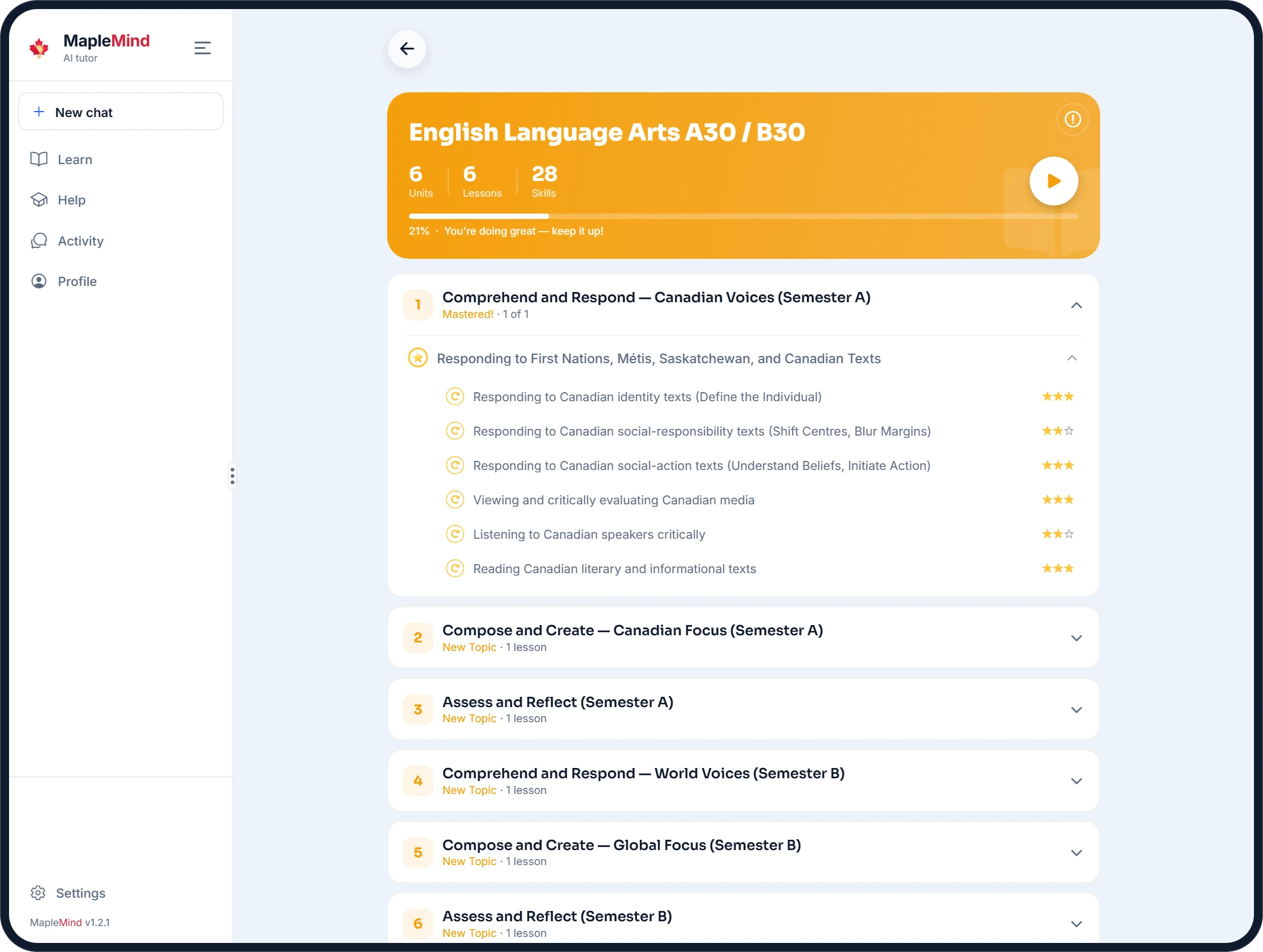
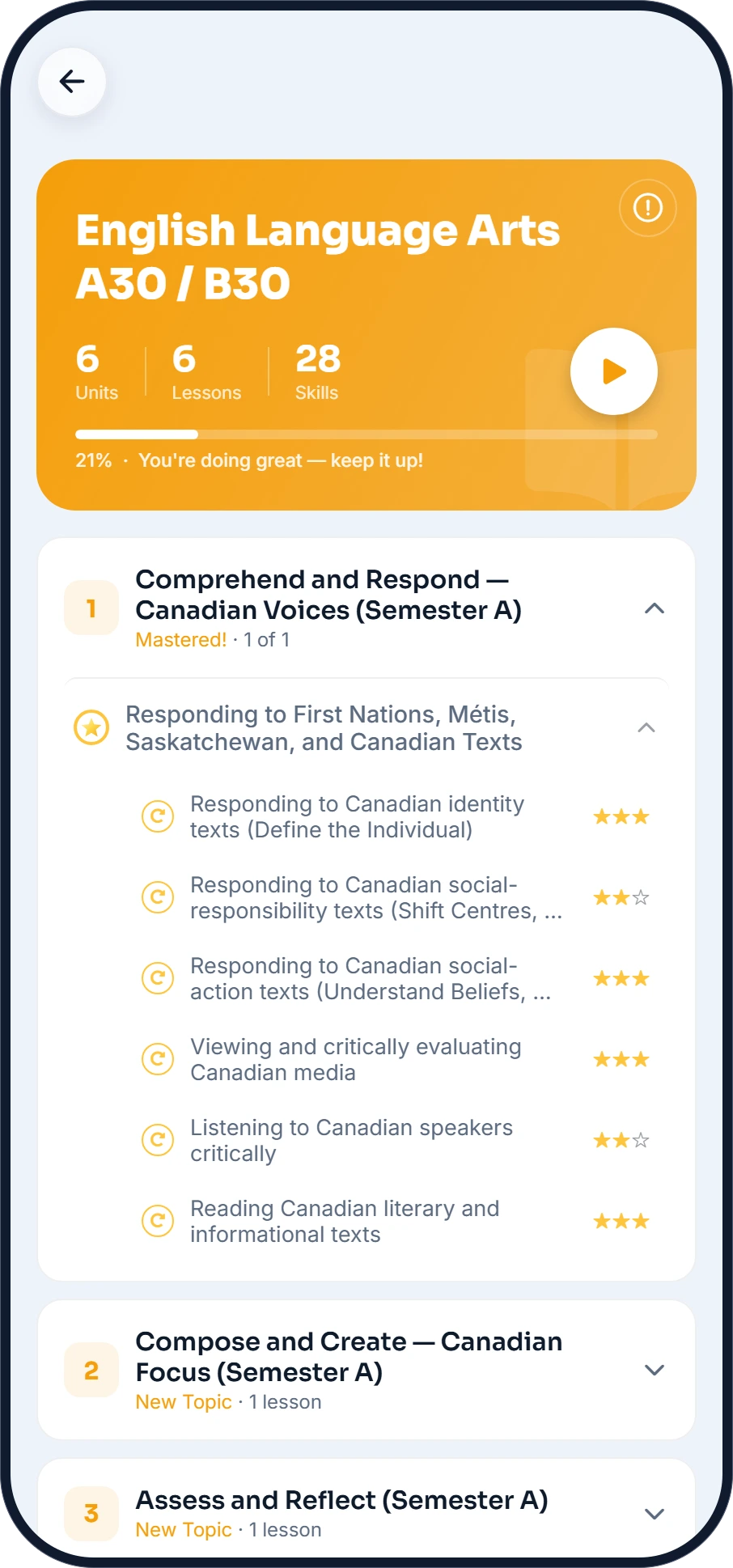
English Language Arts A30 / B30 in MapleMind on a tablet: its units and lessons in order, a student partway through.English Language Arts A30 / B30 in MapleMind on a phone: its units and lessons in order, a student partway through.
Their course, unit by unit, the way Saskatchewan teaches it.Shown: English Language Arts A30 / B30
Homework Help on a tablet: a photo of a worksheet, the tutor’s worked example of a two-step equation, and a question back to the student.Homework Help on a phone: a photo of a worksheet, the tutor’s worked example of a two-step equation, and a question back to the student.
Homework Help: they take a photo of the question, and the tutor works through it with them.
The Parent Dashboard on a tablet: a student’s days studied, streak, lessons, quiz average and recent activity.The Parent Dashboard on a phone: a student’s days studied, streak, lessons, quiz average and recent activity.
The Parent Dashboard: how each child’s week went, in lessons, quizzes and days studied.
A Grade 9 provincial mathematics exam on a tablet: a readiness score, the exam’s time and its next sitting.A Grade 9 provincial mathematics exam on a phone: a readiness score, the exam’s time and its next sitting.
A provincial exam: a practice sitting under the real time, and how ready they are.
The Learn tab on a tablet: a four-day streak, the week’s days, Homework Help, the next lesson and a review.The Learn tab on a phone: a four-day streak, the week’s days, Homework Help, the next lesson and a review.
The Learn tab: their week so far, and the next thing to do.

Help at home

Questions parents ask

What will my child learn in Grade 1 in Saskatchewan?

Math: Mathematics, Grade 1. Science: Science, Grade 1. English: English Language Arts, Grade 1. French: Core French 1. Social studies: Social Studies, Grade 1. That’s 93 skills in all, from Saskatchewan’s curriculum.

Does my child write a provincial exam in Grade 1?

No. Saskatchewan has no provincial exam in Grade 1.

Where does this list come from?

From Saskatchewan’s official curriculum, the documents its education ministry publishes for each course. Each skill here is one of their expectations, written in plain words.

Can MapleMind help my child in Grade 1?

Yes. Every course on this page is in MapleMind, with lessons, practice and a tutor that works through each step with them. A free account gets 30 messages and 4 activities a day.

Help with Grade 1, one skill at a time.

Every course on this page is in MapleMind, free with daily limits.