Saskatchewan · For parents

What your child learns in Grade 6 in Saskatchewan

Every subject, unit by unit, from Saskatchewan’s curriculum: 119 skills in plain words.

Subjects
5
Skills
119
Provincial exams
None
Official curriculum
curriculum.gov.sk.ca

Math in Grade 6

Mathematics, Grade 6

4 units · 39 skills

  1. Unit 1

    Number

    Place value keeps repeating in groups of ones, tens, and hundreds — millions, billions, and beyond follow the same pattern.

    • Numbers greater than one million
    • Numbers less than one thousandth
    • Finding factors and multiples
    15 more skills
    • Factors, multiples, multiplication and division
    • Prime and composite numbers
    • Why we need a standard order
    • Applying and checking the order
    • Multiplying decimals
    • Dividing decimals
    • Representing percent
    • Percent, fractions, and decimals
    • Representing integers
    • Comparing and ordering integers
    • Converting improper fractions and mixed numbers
    • Placing fractions on a number line
    • Writing and representing ratios
    • Solving ratio problems
    • Researching quantity in First Nations and Métis lifestyles
  2. Unit 2

    Patterns and Relations

    Consecutive values in a column can change by a steady amount.

    • Working with tables of values
    • Graphs and how they relate to tables
    • Keeping an equation balanced
    2 more skills
    • Expressions versus equations
    • Generalizing formulas with variables
  3. Unit 3

    Shape and Space

    Angles are classified as acute, right, obtuse, straight, or reflex.

    • Classifying and estimating angles
    • Measuring and drawing angles
    • Angles in triangles and quadrilaterals
    9 more skills
    • Perimeter of polygons and area of rectangles
    • Volume of right rectangular prisms
    • Comparing measures and solving problems
    • Classifying triangles and polygons
    • Congruent polygons
    • Plotting points in the first quadrant
    • Points on the axes and distances
    • Identifying and describing transformations
    • Performing transformations
  4. Unit 4

    Statistics and Probability

    Continuous data (like temperature over time) suits a line graph.

    • Line graphs and graphs of discrete data
    • Collecting data and interpolating
    • Sample space and theoretical probability
    1 more skill
    • Experimental probability and comparing
Science in Grade 6

Science, Grade 6

4 units · 30 skills

  1. Unit 1

    Diversity of Living Things

    All living things are made of one or more cells, need energy, respond to their environment, and can reproduce.

    • What makes something a living thing
    • Careers that study living things
    • How humans build classification systems
    8 more skills
    • Five kingdoms and Indigenous ways of knowing
    • Sorting animals by backbone
    • Comparing animal bodies and behaviours
    • Surviving in the short term
    • Adapting over the long term
    • Observing tiny living things
    • How micro-organisms live and break down matter
    • Micro-organisms in society
  2. Unit 2

    Understanding Electricity

    Electricity is generated from hydroelectric, coal, natural gas, nuclear, geothermal, biomass, solar, and wind sources.

    • How Saskatchewan makes electricity
    • Reducing the impacts of electricity use
    • Static electric charge
    4 more skills
    • Conductors and insulators
    • Electromagnets
    • What a circuit needs
    • Series versus parallel
  3. Unit 3

    Principles of Flight

    Birds, insects, and bats have physical features and adaptations that enable flight.

    • Flight in nature and invention
    • Careers in flight
    • Lift against gravity
    3 more skills
    • Drag
    • Thrust
    • Building and testing a flying object
  4. Unit 4

    Our Solar System

    The solar system's major components — the sun, planets, moons, asteroids, and comets — each have distinct physical characteristics.

    • Researching the solar system
    • Modelling the solar system to scale
    • Modelling sky events
    3 more skills
    • Cultures and the sky
    • Living and working in space
    • Weighing space exploration

English in Grade 6

English Language Arts, Grade 6

3 units · 24 skills

  1. Unit 1

    Comprehend and Respond

    Identity texts in Grade 6 explore growing up — how we change and what shapes who we are.

    • Responding to identity texts
    • Responding to social-responsibility texts
    • Responding to making-a-difference texts
    7 more skills
    • Using before, during, and after strategies
    • Using cueing systems to construct meaning
    • Viewing multimedia texts and their features
    • Listening to understand and analyze
    • Reading prose, poetry, and plays
    • Reading information texts independently
    • Reading with fluency and expression
  2. Unit 2

    Compose and Create

    Identity texts like 'Your Choices' explore how the choices we make shape who we are.

    • Creating identity texts
    • Creating social-responsibility texts
    • Creating making-a-difference texts
    8 more skills
    • Using strategies to communicate meaning
    • Using cues to communicate meaning
    • Creating representations to inform, persuade, and entertain
    • Using oral language to interact in groups
    • Using oral language to express in formal situations
    • Writing for many purposes
    • Experimenting with text forms and techniques
    • Preparing a teacher-guided inquiry report
  3. Unit 3

    Assess and Reflect

    Different tasks call for different strategies — the best strategy for skimming an article isn't the best for editing a poem.

    • Choosing the best strategies for each task
    • Appraising my skills and setting goals
    • Appraising work for clarity

French in Grade 6

Core French 6

4 units · 13 skills

  1. Unit 1

    Communication Skills

    The main idea is what the WHOLE presentation is about.

    • Landing the main idea of a presentation
    • Discussing information on familiar topics
    • Main idea and details in 70-100 word texts
    1 more skill
    • Writing a 50-60 word paragraph or short script
  2. Unit 2

    General Language Strategies

    The set: question, predict, verify, connect, visualize, summarize, synthesize, analyze.

    • Using the named listening strategies
    • Climbing from modeled to independent speech
    • Reading strategies at paragraph scale
    1 more skill
    • Idea generation to publishing
  3. Unit 3

    Language Knowledge

    Hundreds stack like tens did: cent, deux cents, trois cents... mille.

    • Counting to 1000 and ordering with ordinals
    • -er verbs in the present — singular and plural
    • Adjective placement and jouer/faire prepositions
  4. Unit 4

    Culture

    Maps hold language history — every name was given by someone.

    • Languages written into place names
    • Cultural contributions to how we live

Social studies in Grade 6

Social Studies, Grade 6

4 units · 13 skills

  1. Unit 1

    Interactions and Interdependence

    The culture and place a person grows up in shape their roles, responsibilities, beliefs, and values.

    • How culture and place shape beliefs
    • Social and cultural diversity in the world
    • Global interdependence in daily life
    1 more skill
    • Cultural change over time
  2. Unit 2

    Dynamic Relationships

    Climate and vegetation zones shape lifestyles — travel, housing, dress, sport, and economic activity — in Canada and Atlantic-bordering countries.

    • How natural environments shape ways of life
    • Land and human settlement
    • Finding our place in time and space
    1 more skill
    • Today's issues, yesterday's roots
  3. Unit 3

    Power and Authority

    Power takes different forms — force, authority, and influence (voice) — in personal life and in the community.

    • My power and the power of others
    • The distribution of power and privilege
    • Injustice and the abuse of power
  4. Unit 4

    Resources and Wealth

    Quality of life depends on both material factors (shelter, food, health care, technology) and non-material factors, and needs differ from wants.

    • What contributes to quality of life
    • Guiding change toward sustainability

MapleMind

See Grade 6 in MapleMind

Real screens from the app your child would use.

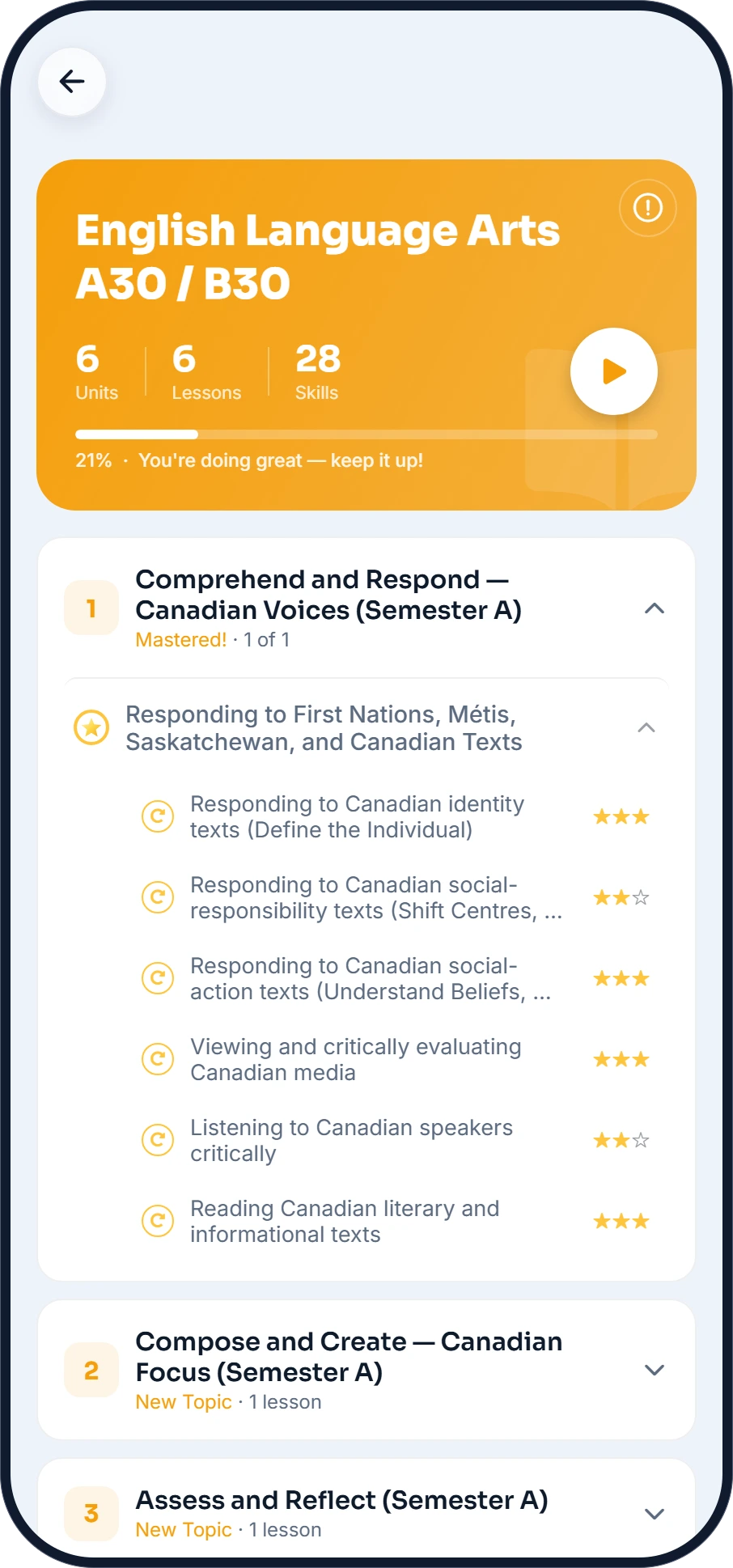
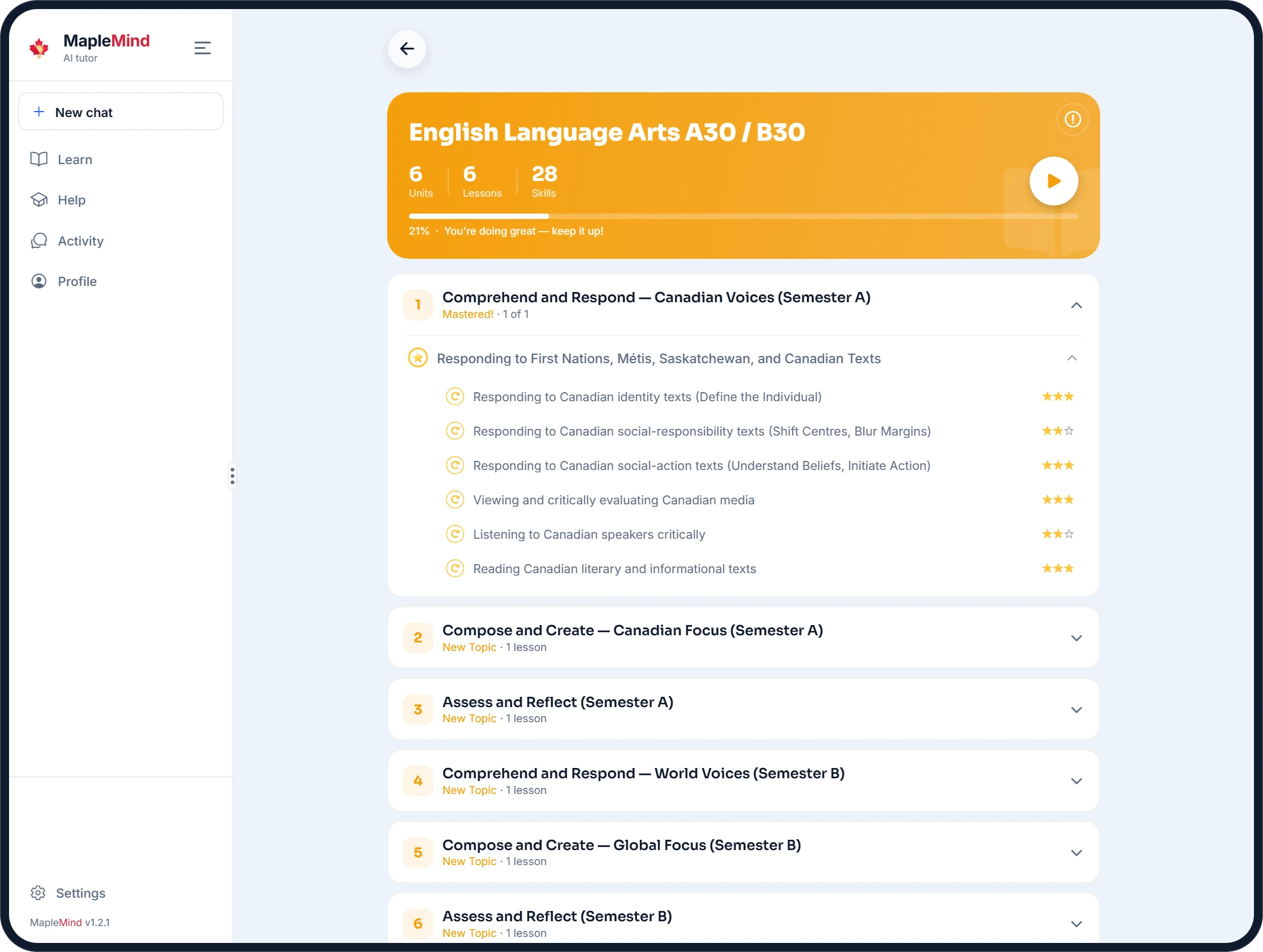
English Language Arts A30 / B30 in MapleMind on a tablet: its units and lessons in order, a student partway through.English Language Arts A30 / B30 in MapleMind on a phone: its units and lessons in order, a student partway through.
Their course, unit by unit, the way Saskatchewan teaches it.Shown: English Language Arts A30 / B30
Homework Help on a tablet: a photo of a worksheet, the tutor’s worked example of a two-step equation, and a question back to the student.Homework Help on a phone: a photo of a worksheet, the tutor’s worked example of a two-step equation, and a question back to the student.
Homework Help: they take a photo of the question, and the tutor works through it with them.
The Parent Dashboard on a tablet: a student’s days studied, streak, lessons, quiz average and recent activity.The Parent Dashboard on a phone: a student’s days studied, streak, lessons, quiz average and recent activity.
The Parent Dashboard: how each child’s week went, in lessons, quizzes and days studied.
A Grade 9 provincial mathematics exam on a tablet: a readiness score, the exam’s time and its next sitting.A Grade 9 provincial mathematics exam on a phone: a readiness score, the exam’s time and its next sitting.
A provincial exam: a practice sitting under the real time, and how ready they are.
The Learn tab on a tablet: a four-day streak, the week’s days, Homework Help, the next lesson and a review.The Learn tab on a phone: a four-day streak, the week’s days, Homework Help, the next lesson and a review.
The Learn tab: their week so far, and the next thing to do.

Help at home

Questions parents ask

What will my child learn in Grade 6 in Saskatchewan?

Math: Mathematics, Grade 6. Science: Science, Grade 6. English: English Language Arts, Grade 6. French: Core French 6. Social studies: Social Studies, Grade 6. That’s 119 skills in all, from Saskatchewan’s curriculum.

Does my child write a provincial exam in Grade 6?

No. Saskatchewan has no provincial exam in Grade 6.

Where does this list come from?

From Saskatchewan’s official curriculum, the documents its education ministry publishes for each course. Each skill here is one of their expectations, written in plain words.

Can MapleMind help my child in Grade 6?

Yes. Every course on this page is in MapleMind, with lessons, practice and a tutor that works through each step with them. A free account gets 30 messages and 4 activities a day.

Help with Grade 6, one skill at a time.

Every course on this page is in MapleMind, free with daily limits.