Get help with Social Studies, Grade 6
Most tutoring makes your child sit through material your child already knows. MapleMind flips that: pick the exact skill that's causing trouble — any of the 13 below — and the tutor teaches just that one, step by step, as many times as it takes. Ask questions in plain words, any time of day, in English, French, or 12 other languages.
The official Saskatchewan Social Studies, Grade 6 curriculum
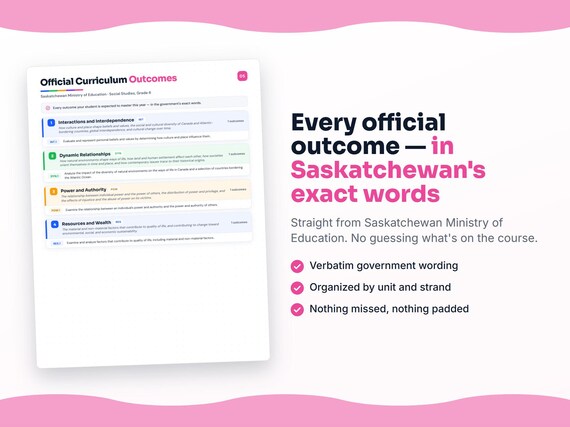
Saskatchewan defines Social Studies, Grade 6 by strands and outcomes. MapleMind teaches the same curriculum reorganized for one-skill-at-a-time tutoring — the table shows exactly where every official strand lands, and the ministry's own wording is quoted under each unit below.
Official source Saskatchewan's official curriculumRead it on the government site — curriculum.gov.sk.ca ↗| Official strand | Outcomes | Where MapleMind teaches it |
|---|---|---|
| Strand IN | 4 | Interactions and Interdependence |
| Strand DR | 4 | Dynamic Relationships |
| Strand PA | 3 | Power and Authority |
| Strand RW | 2 | Resources and Wealth |
Every skill below, taught one on one.
 Try the first session free
How MapleMind teaches Social Studies, Grade 6 — every unit, lesson, and skill
Every skill below runs as a short session: a plain-words lesson, a worked example, solving it together, then a five-question skill check that earns up to three stars. Guided Mode keeps it teaching instead of answer-handing — turning it off needs a parent's password.
Unit 1Interactions and InterdependenceOfficial strand · Strand IN
How culture and place shape beliefs and values, the social and cultural diversity of Canada and Atlantic-bordering countries, global interdependence, and cultural change over time.
Culture, Diversity, and a Connected World
- How culture and place shape beliefsIN6.1 — Evaluate and represent personal beliefs and values by determining how culture and place influence them, comparing Canada with Atlantic-bordering countries.
- Global interdependence in daily lifeIN6.3 — Develop an understanding that global interdependence impacts individual daily life in Canada and a selection of countries bordering the Atlantic Ocean.
- Cultural change over timeIN6.4 — Explore aspects of cultural change over time, including its reasons, examples, and how it affects and is responded to by youth.
The official wording — 4 outcomes in this unit
- IN6.1
Evaluate and represent personal beliefs and values by determining how culture and place influence them.
- IN6.2
Examine the social and cultural diversity that exists in the world, as exemplified in Canada and a selection of countries bordering the Atlantic Ocean.
- IN6.3
Develop an understanding that global interdependence impacts individual daily life in Canada and a selection of countries bordering the Atlantic Ocean.
- IN6.4
Explore aspects of cultural change over time, including: • reasons for cultural change • examples of cultural change • how cultural change affects youth • how youth respond to cultural change.
Unit 2Dynamic RelationshipsOfficial strand · Strand DR
How natural environments shape ways of life, how land and human settlement affect each other, how societies orient themselves in time and place, and how contemporary issues trace to their historical origins.
Land, Settlement, Time, and History
- How natural environments shape ways of lifeDR6.1 — Analyze the impact of the diversity of natural environments on the ways of life in Canada and a selection of countries bordering the Atlantic Ocean.
- Land and human settlementDR6.2 — Analyze ways in which the land affects human settlement patterns and social organization, and ways in which human habitation affects land.
- Finding our place in time and spaceDR6.3 — Appraise the strategies human societies have used to orient themselves within time and place in the natural environment.
- Today's issues, yesterday's rootsDR6.4 — Relate contemporary issues to their historical origins in Canada and a selection of countries bordering the Atlantic Ocean.
The official wording — 4 outcomes in this unit
- DR6.1
Analyze the impact of the diversity of natural environments on the ways of life in Canada and a selection of countries bordering the Atlantic Ocean.
- DR6.2
Analyze ways in which the land affects human settlement patterns and social organization, and ways in which human habitation affects land.
- DR6.3
Appraise the strategies human societies have used to orient themselves within time and place in the natural environment.
- DR6.4
Relate contemporary issues to their historical origins in Canada and a selection of countries bordering the Atlantic Ocean.
Unit 3Power and AuthorityOfficial strand · Strand PA
The relationship between individual power and the power of others, the distribution of power and privilege, and the effects of injustice and the abuse of power on its victims.
Power, Privilege, and Injustice
- My power and the power of othersPA6.1 — Examine the relationship between an individual's power and authority and the power and authority of others.
- The distribution of power and privilegePA6.2 — Analyze the distribution of power and privilege in Canada and a selection of countries bordering the Atlantic Ocean.
- Injustice and the abuse of powerPA6.3 — Explore the effects of injustice or abuse of power on its victims, including victims of the Holocaust.
The official wording — 3 outcomes in this unit
- PA6.1
Examine the relationship between an individual’s power and authority and the power and authority of others.
- PA6.2
Analyze the distribution of power and privilege in Canada and a selection of countries bordering the Atlantic Ocean.
- PA6.3
Explore the effects of injustice or abuse of power on its victims, including victims of the Holocaust.
Unit 4Resources and WealthOfficial strand · Strand RW
The material and non-material factors that contribute to quality of life, and contributing to change toward environmental, social, and economic sustainability.
Quality of Life and Sustainability
- What contributes to quality of lifeRW6.1 — Examine and analyze factors that contribute to quality of life, including material and non-material factors.
- Guiding change toward sustainabilityRW6.2 — Contribute to initiating and guiding change in local and global communities regarding environmental, social, and economic sustainability.
The official wording — 2 outcomes in this unit
- RW6.1
Examine and analyze factors that contribute to quality of life, including material and non-material factors.
- RW6.2
Contribute to initiating and guiding change in local and global communities regarding environmental, social, and economic sustainability.
Printable workbook · A keepsake of the year
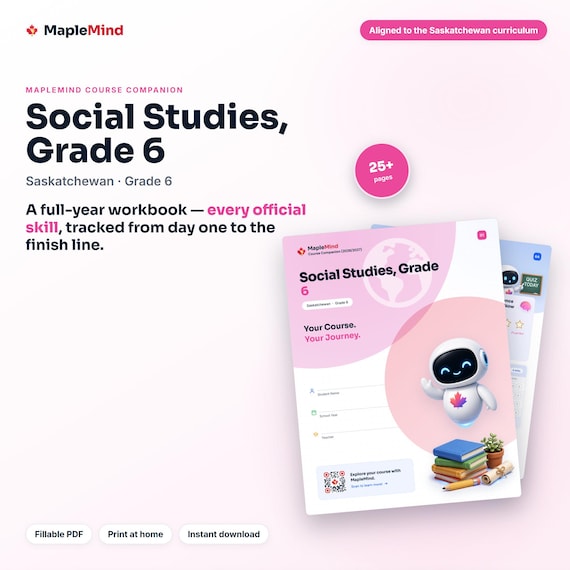
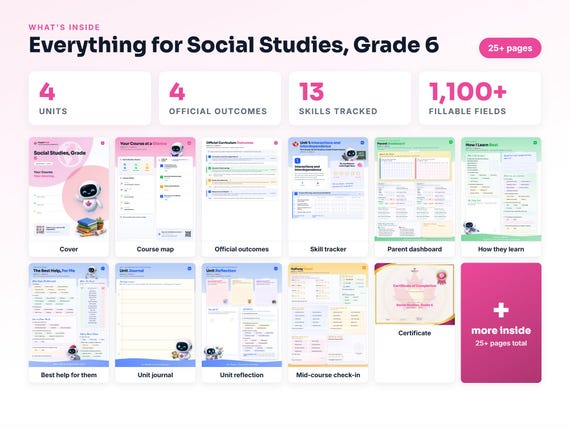
A Social Studies, Grade 6 workbook worth keeping
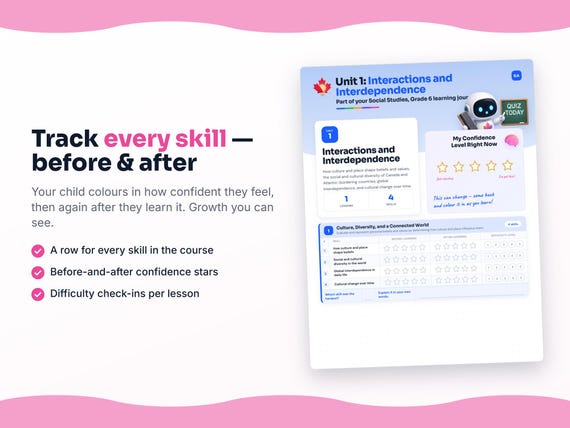
Built from the same official curriculum as this page. Before and after each skill above, your student colours in how sure they feel — so the two of you can see, on one page, what's clicking and what needs another look. It's a quiet way to follow how the year is really going.
By June it's full of their own handwriting: units worked through, confidence grown, a mid-year check-in, notes from parent-teacher night, and a certificate at the end. Less a worksheet, more a record of the year worth keeping on the shelf.
Instant download · see every page, reviews and the full description · five or more workbooks are $2.99 each
What it looks like in the app



Common questions
Can MapleMind help my child with Social Studies, Grade 6?
Yes. MapleMind's AI tutor covers all 13 skills in Saskatchewan's Social Studies, Grade 6 — your child picks the exact skill, and the tutor teaches it step by step: a short lesson, a worked example, solving together, then a skill check to show it stuck.
Is MapleMind aligned to Saskatchewan's official curriculum?
Yes. Every skill in this course maps to an official outcome code from Saskatchewan's Grade 6 Social Studies curriculum, and the ministry's own wording is quoted under each unit on this page — with the official government source linked so you can check it yourself.
What does MapleMind cost?
It's free to start — 5 tutoring chats and a practice quiz every day, no credit card. A Pro subscription ($9.99/month or $49.99/year CAD, 7-day free trial) unlocks unlimited tutoring, practice, and exam simulations.
What if my child is stuck on just one topic?
That's the point of skill-level tutoring: open Social Studies, Grade 6 in the app, tap the exact skill from the list on this page, and the tutor teaches just that — no wading through lessons your child doesn't need.
Does MapleMind work in French or other languages?
Yes — 14 languages, including French. Both the app and the tutor's explanations switch to the language your child chooses.
Where can I see the official Saskatchewan curriculum for Social Studies, Grade 6?
The official source is linked on this page — Saskatchewan's official curriculum. The outline here follows it: every MapleMind skill carries its official outcome code, and the ministry's own wording is quoted under each unit.
Keep exploring
Ready when you are
Pick a skill from this page and see it taught properly — free, in the browser, in under a minute.