

Get help with Core French 6
Most tutoring makes your child sit through material your child already knows. MapleMind flips that: pick the exact skill that's causing trouble — any of the 13 below — and the tutor teaches just that one, step by step, as many times as it takes. Ask questions in plain words, any time of day, in English, French, or 12 other languages.
The official Saskatchewan Core French 6 curriculum
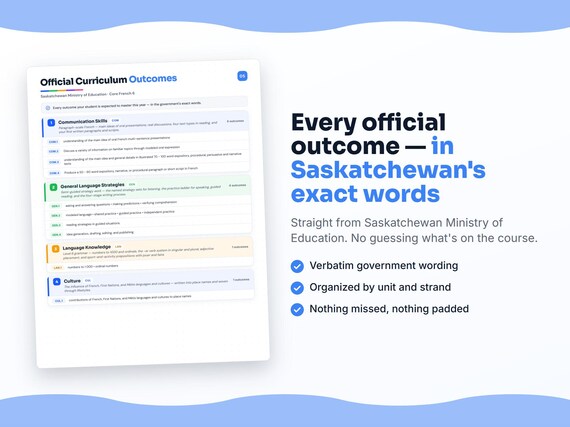
Saskatchewan defines Core French 6 by strands and outcomes. MapleMind teaches the same curriculum reorganized for one-skill-at-a-time tutoring — the table shows exactly where every official strand lands, and the ministry's own wording is quoted under each unit below.
Official source Saskatchewan's official curriculumRead it on the government site — curriculum.gov.sk.ca ↗| Official strand | Outcomes | Where MapleMind teaches it |
|---|---|---|
| Strand CS | 4 | Communication Skills |
| Strand GL | 4 | General Language Strategies |
| Strand LK | 1 | Language Knowledge |
| Strand C | 1 | Culture |
Every skill below, taught one on one.
 Try the first session free
How MapleMind teaches Core French 6 — every unit, lesson, and skill
Every skill below runs as a short session: a plain-words lesson, a worked example, solving it together, then a five-question skill check that earns up to three stars. Guided Mode keeps it teaching instead of answer-handing — turning it off needs a parent's password.
Unit 1Communication SkillsOfficial strand · Strand CS
Paragraph-scale French — main ideas of oral presentations, real discussions, four text types in reading, and your first written paragraphs and scripts.
Main Ideas of Oral Presentations
- Landing the main idea of a presentation6.CS.1 — Show understanding of the main idea of oral French multi-sentence presentations on a variety of familiar topics in structured situations.
Discussing in French
- Discussing information on familiar topics6.CS.2 — Discuss a variety of information on familiar topics through modeled oral expression in highly structured situations — bringing information, responding to a partner's, and keeping the discussion moving.
Reading Four Text Types
- Main idea and details in 70-100 word texts6.CS.3 — Show understanding of the main idea and general details in illustrated 70-100 word French texts across four types — expository, procedural, persuasive, and narrative.
Writing Paragraphs and Scripts
- Writing a 50-60 word paragraph or short script6.CS.4 — Produce a 50-60 word French expository, narrative, or procedural paragraph — or a short script — based on a combination of models.
The official wording — 4 outcomes in this unit
- 6.CS.1
understanding of the main idea of oral French multi-sentence presentations
- 6.CS.2
Discuss a variety of information on familiar topics through modeled oral expression
- 6.CS.3
understanding of the main idea and general details in illustrated 70 - 100 word expository, procedural, persuasive and narrative texts
- 6.CS.4
Produce a 50 - 60 word expository, narrative, or procedural paragraph or short script in French
Unit 2General Language StrategiesOfficial strand · Strand GL
Semi-guided strategy work — the named strategy sets for listening, the practice ladder for speaking, guided reading, and the four-stage writing process.
The Listening Strategy Set
- Using the named listening strategies6.GL.1 — Use listening and viewing strategies in semi-guided situations — asking and answering questions, making predictions, verifying comprehension, making connections, visualizing, summarizing, synthesizing, and analyzing.
The Practice Ladder
- Climbing from modeled to independent speech6.GL.2 — Use speaking strategies in semi-guided situations across the practice ladder — modeled language, shared practice, guided practice, and independent practice — including building fluency with repetition and developing your own scripts from two models.
Guided Reading
- Reading strategies at paragraph scale6.GL.3 — Use reading strategies in guided situations on paragraph-length French texts — predicting, connecting, cognate-spotting, referencing, and verifying across 70-100 word texts.
The Four-Stage Writing Process
- Idea generation to publishing6.GL.4 — Implement the four stages of the writing process in guided situations — generating ideas in French, planning and drafting with organizers, editing, and publishing.
The official wording — 4 outcomes in this unit
- 6.GL.1
asking and answering questions • making predictions • verifying comprehension
- 6.GL.2
modeled language • shared practice • guided practice • independent practice
- 6.GL.3
reading strategies in guided situations
- 6.GL.4
idea generation, drafting, editing, and publishing
Unit 3Language KnowledgeOfficial strand · Strand LK
Level 6 grammar — numbers to 1000 and ordinals, the -er verb system in singular and plural, adjective placement, and sport-and-activity prepositions with jouer and faire.
Numbers to 1000 and Ordinals
- Counting to 1000 and ordering with ordinals6.LK.1 — Identify French numbers to 1000 and use ordinal numbers — premièrement, deuxièmement, troisièmement — to show the order of events.
- -er verbs in the present — singular and plural6.LK.1 — Conjugate theme-related regular -er verbs in the present tense across singular and plural forms — and handle the irregular -er verbs the themes need.
- Adjective placement and jouer/faire prepositions6.LK.1 — Place and agree common adjectives correctly, and use the prepositions à la, au, aux, du, and de la with jouer and faire — je joue au hockey, je fais de la natation.
The official wording — 1 outcome in this unit
- 6.LK.1
numbers to 1 000 • ordinal numbers
Unit 4CultureOfficial strand · Strand C
The influence of French, First Nations, and Métis languages and cultures — written into place names and woven through lifestyles.
Names on the Map, Ways of Life
- Languages written into place names6.C.1 — Relate the influence of French, First Nations, and Métis languages to place names — decoding names like Qu'Appelle, Montmartre, Saskatoon, and Wanuskewin on the map.
- Cultural contributions to how we live6.C.1 — Relate the contributions of French, First Nations, and Métis cultures to lifestyles — the foods, activities, words, and traditions from all three cultures that shape everyday Saskatchewan life.
The official wording — 1 outcome in this unit
- 6.C.1
contributions of French, First Nations, and Métis languages and cultures to place names
Printable workbook · A keepsake of the year
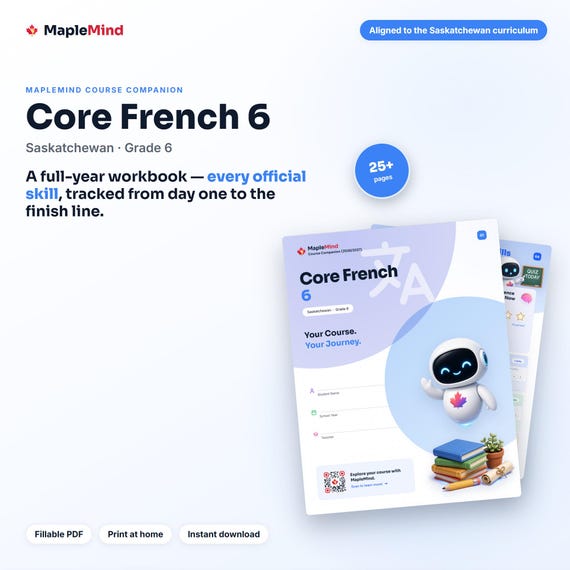
A Core French 6 workbook worth keeping
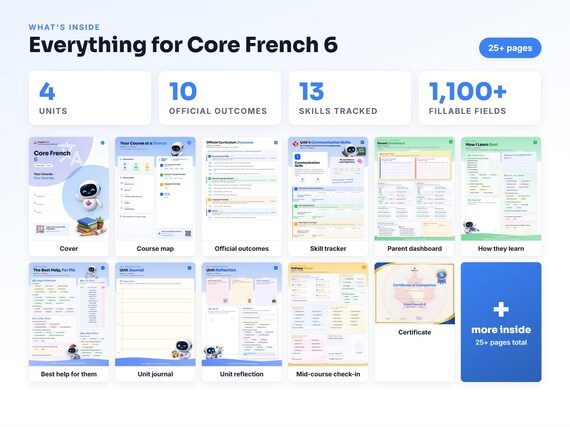
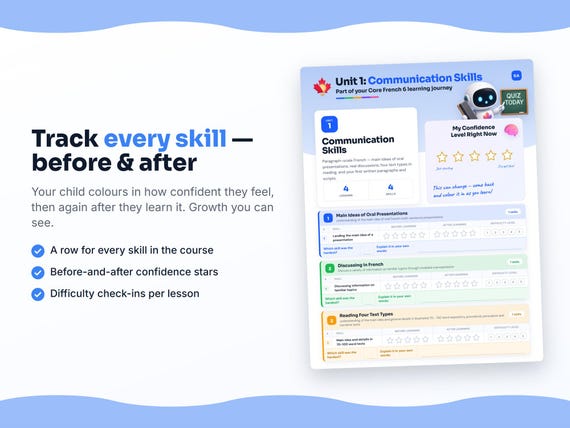
Built from the same official curriculum as this page. Before and after each skill above, your student colours in how sure they feel — so the two of you can see, on one page, what's clicking and what needs another look. It's a quiet way to follow how the year is really going.
By June it's full of their own handwriting: units worked through, confidence grown, a mid-year check-in, notes from parent-teacher night, and a certificate at the end. Less a worksheet, more a record of the year worth keeping on the shelf.
Instant download · see every page, reviews and the full description · five or more workbooks are $2.99 each
What it looks like in the app



Common questions
Can MapleMind help my child with Core French 6?
Yes. MapleMind's AI tutor covers all 13 skills in Saskatchewan's Core French 6 — your child picks the exact skill, and the tutor teaches it step by step: a short lesson, a worked example, solving together, then a skill check to show it stuck.
Is MapleMind aligned to Saskatchewan's official curriculum?
Yes. Every skill in this course maps to an official outcome code from Saskatchewan's Grade 6 French as a Second Language curriculum, and the ministry's own wording is quoted under each unit on this page — with the official government source linked so you can check it yourself.
What does MapleMind cost?
It's free to start — 5 tutoring chats and a practice quiz every day, no credit card. A Pro subscription ($9.99/month or $49.99/year CAD, 7-day free trial) unlocks unlimited tutoring, practice, and exam simulations.
What if my child is stuck on just one topic?
That's the point of skill-level tutoring: open Core French 6 in the app, tap the exact skill from the list on this page, and the tutor teaches just that — no wading through lessons your child doesn't need.
Does MapleMind work in French or other languages?
Yes — 14 languages, including French. Both the app and the tutor's explanations switch to the language your child chooses.
Where can I see the official Saskatchewan curriculum for Core French 6?
The official source is linked on this page — Saskatchewan's official curriculum. The outline here follows it: every MapleMind skill carries its official outcome code, and the ministry's own wording is quoted under each unit.
Keep exploring
Ready when you are
Pick a skill from this page and see it taught properly — free, in the browser, in under a minute.