

Get help with Core French 5
Most tutoring makes your child sit through material your child already knows. MapleMind flips that: pick the exact skill that's causing trouble — any of the 16 below — and the tutor teaches just that one, step by step, as many times as it takes. Ask questions in plain words, any time of day, in English, French, or 12 other languages.
The official Saskatchewan Core French 5 curriculum
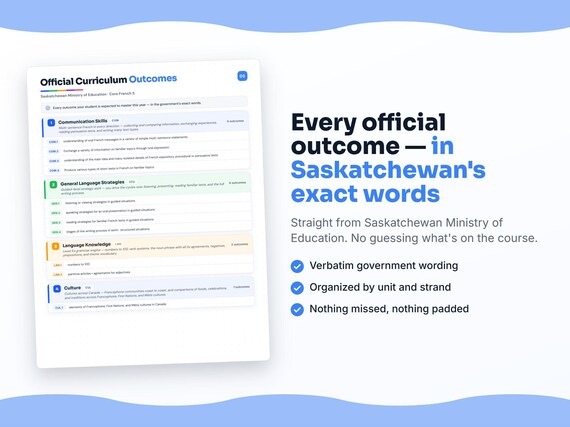
Saskatchewan defines Core French 5 by strands and outcomes. MapleMind teaches the same curriculum reorganized for one-skill-at-a-time tutoring — the table shows exactly where every official strand lands, and the ministry's own wording is quoted under each unit below.
Official source Saskatchewan's official curriculumRead it on the government site — curriculum.gov.sk.ca ↗| Official strand | Outcomes | Where MapleMind teaches it |
|---|---|---|
| Strand CS | 4 | Communication Skills |
| Strand GL | 4 | General Language Strategies |
| Strand LK | 1 | Language Knowledge |
| Strand C | 1 | Culture |
Every skill below, taught one on one.
 Try the first session free
How MapleMind teaches Core French 5 — every unit, lesson, and skill
Every skill below runs as a short session: a plain-words lesson, a worked example, solving it together, then a five-question skill check that earns up to three stars. Guided Mode keeps it teaching instead of answer-handing — turning it off needs a parent's password.
Unit 1Communication SkillsOfficial strand · Strand CS
Multi-sentence French in every direction — collecting and comparing information, exchanging experiences, reading persuasive texts, and writing many text types.
Collecting and Comparing Information
- Collecting details and comparing what you hear5.CS.1 — Collect information from oral French presentations using graphic organizers, compare and contrast items like schedules and menus from what you hear, and retrieve specific details — like a destination — from a simple conversation.
- Showing understanding and answering five question types5.CS.1 — Show your understanding of French in many ways — drawings, movements, charts, concept maps — respond to questions beginning with est-ce que, qu'est-ce que, qui, où, and quand, and follow procedure directions like constructing a poster or making a recipe.
Exchanging Information
- Telling experiences and rallying questions5.CS.2 — Exchange information with a partner — telling about an experience like a vacation, describing an important detail from a model like La robe rouge est fantastique!, and asking and answering questions including Quelle heure est-il?
- Agreeing, disagreeing, and encouraging5.CS.2 — Use French expressions to negotiate with others — agreeing with D'accord and Bonne idée, disagreeing politely, encouraging teammates, and keeping group work respectful and moving.
Reading Texts That Explain and Persuade
- Main idea and many details across text types5.CS.3 — Show understanding of French expository, procedural, and persuasive texts on familiar topics — identifying the main idea and many isolated details.
Writing Many Kinds of Texts
- Writing different text types from models5.CS.4 — Produce various types of short French texts in a structured and modeled fashion — one-sentence answers and questions, four-to-five sentence descriptions, and other text types on familiar topics.
The official wording — 4 outcomes in this unit
- 5.CS.1
understanding of oral French messages in a variety of simple multi-sentence statements
- 5.CS.2
Exchange a variety of information on familiar topics through oral expression
- 5.CS.3
understanding of the main idea and many isolated details of French expository, procedural or persuasive texts
- 5.CS.4
Produce various types of short texts in French on familiar topics
Unit 2General Language StrategiesOfficial strand · Strand GL
Guided-level strategy work — you drive the cycles now: listening, presenting, reading familiar texts, and the full writing process.
Guided Listening
- Driving the listening cycle yourself5.GL.1 — Use listening and viewing strategies in guided situations — describing contextual clues and predicting with a French sentence before, sharing the general sense of message segments during, and verifying and evaluating after.
Presenting in Guided Mode
- Owning your oral presentation5.GL.2 — Use speaking strategies for an oral presentation in guided situations — planning content and supports, presenting with previously learned vocabulary, incorporating feedback, and self-evaluating against criteria.
Guided Reading
- Reading familiar texts with your own strategies5.GL.3 — Use reading strategies for familiar French texts in guided situations — predicting and connecting before, using cognates, visuals, and references during, and verifying and evaluating after.
The Full Writing Process
- Running the stages of the writing process5.GL.4 — Implement stages of the writing process in semi-structured situations — planning ideas, drafting, checking and revising with references, and sharing finished writing.
The official wording — 4 outcomes in this unit
- 5.GL.1
listening or viewing strategies in guided situations
- 5.GL.2
speaking strategies for an oral presentation in guided situations
- 5.GL.3
reading strategies for familiar French texts in guided situations
- 5.GL.4
stages of the writing process in semi- structured situations
Unit 3Language KnowledgeOfficial strand · Strand LK
Level 5's grammar engine — numbers to 100, verb systems, the noun phrase with all its agreements, negatives, prepositions, and theme vocabulary.
Numbers to 100 and Complete Sentences
- Numbers to 100, sentences, and questions5.LK.1 — Count and use French numbers to 100, and build simple complete sentences and questions orally and in writing.
- Verb systems — regular, irregular, and commands5.LK.1 — Use a range of regular -er verbs, some irregular verbs, and the imperative form of common verbs in your French sentences.
The Noun Phrase — Agreements and Replacements
- Articles, adjective agreement, plurals, and possessives5.LK.1 — Build correct French noun phrases — partitive articles like du and de la for food and quantities, adjectives that agree in gender and number, plural noun forms, and possessive pronouns.
- Saying no, placing things, and theme vocabulary5.LK.1 — Build affirmative and negative sentences with ne...pas, replace nouns with pronouns, place things with prepositions, and use key vocabulary from the Level 5 themes.
The official wording — 1 outcome in this unit
- 5.LK.1
numbers to 100
Unit 4CultureOfficial strand · Strand C
Cultures across Canada — Francophone communities coast to coast, and comparisons of foods, celebrations, and traditions across Francophone, First Nations, and Métis cultures.
Cultures Across Canada
- Francophone culture from coast to coast5.C.1 — Represent Canadian Francophone cultures — reciting French poems and singing songs, and exploring Francophone communities and culture across Canada.
- Comparing foods, celebrations, and traditions across Canada5.C.1 — Compare foods, celebrations, and traditions of Francophone, First Nations, and Métis cultures across Canada — from tourtière and sugar shacks to bannock, powwows, and Métis fiddle traditions.
The official wording — 1 outcome in this unit
- 5.C.1
elements of Francophone, First Nations, and Métis cultures in Canada
Printable workbook · A keepsake of the year
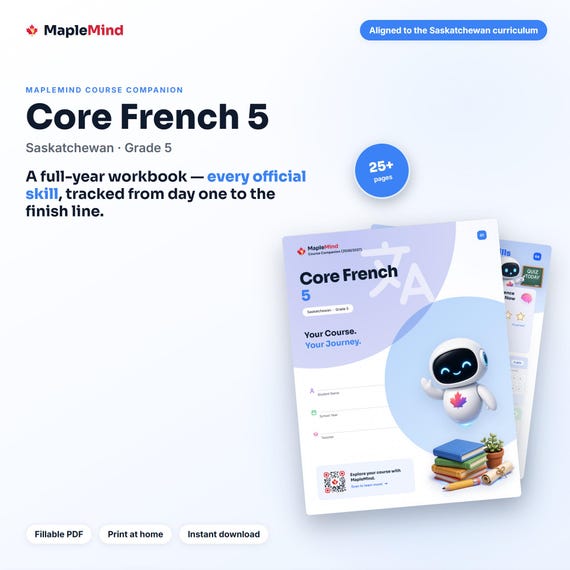
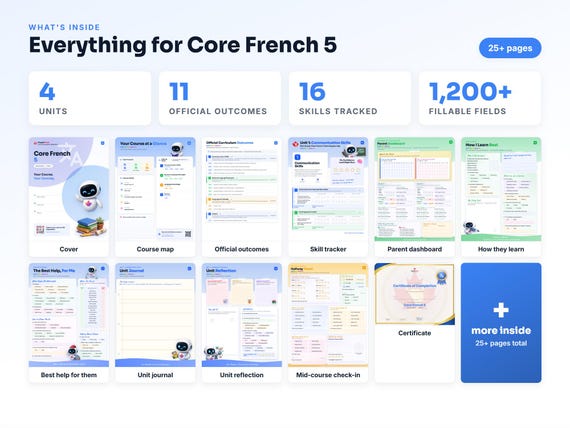
A Core French 5 workbook worth keeping
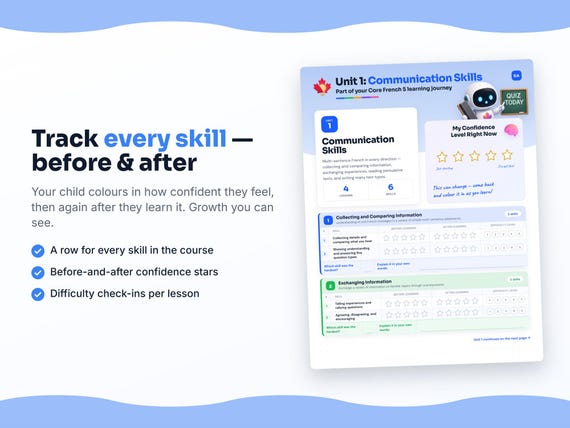
Built from the same official curriculum as this page. Before and after each skill above, your student colours in how sure they feel — so the two of you can see, on one page, what's clicking and what needs another look. It's a quiet way to follow how the year is really going.
By June it's full of their own handwriting: units worked through, confidence grown, a mid-year check-in, notes from parent-teacher night, and a certificate at the end. Less a worksheet, more a record of the year worth keeping on the shelf.
Instant download · see every page, reviews and the full description · five or more workbooks are $2.99 each
What it looks like in the app



Common questions
Can MapleMind help my child with Core French 5?
Yes. MapleMind's AI tutor covers all 16 skills in Saskatchewan's Core French 5 — your child picks the exact skill, and the tutor teaches it step by step: a short lesson, a worked example, solving together, then a skill check to show it stuck.
Is MapleMind aligned to Saskatchewan's official curriculum?
Yes. Every skill in this course maps to an official outcome code from Saskatchewan's Grade 5 French as a Second Language curriculum, and the ministry's own wording is quoted under each unit on this page — with the official government source linked so you can check it yourself.
What does MapleMind cost?
It's free to start — 5 tutoring chats and a practice quiz every day, no credit card. A Pro subscription ($9.99/month or $49.99/year CAD, 7-day free trial) unlocks unlimited tutoring, practice, and exam simulations.
What if my child is stuck on just one topic?
That's the point of skill-level tutoring: open Core French 5 in the app, tap the exact skill from the list on this page, and the tutor teaches just that — no wading through lessons your child doesn't need.
Does MapleMind work in French or other languages?
Yes — 14 languages, including French. Both the app and the tutor's explanations switch to the language your child chooses.
Where can I see the official Saskatchewan curriculum for Core French 5?
The official source is linked on this page — Saskatchewan's official curriculum. The outline here follows it: every MapleMind skill carries its official outcome code, and the ministry's own wording is quoted under each unit.
Keep exploring
Ready when you are
Pick a skill from this page and see it taught properly — free, in the browser, in under a minute.