Saskatchewan · For parents

What your child learns in Grade 5 in Saskatchewan

Every subject, unit by unit, from Saskatchewan’s curriculum: 110 skills in plain words.

Subjects
5
Skills
110
Provincial exams
1
Official curriculum
curriculum.gov.sk.ca

Math in Grade 5

Mathematics, Grade 5

4 units · 38 skills

  1. Unit 1

    Number

    Place value extends to hundred thousands and millions: 934 567 has 9 hundred thousands.

    • Representing numbers to one million
    • Comparing and describing large numbers
    • Multiplication facts to 81
    13 more skills
    • Multiplying by multiples of ten
    • Multiplying two 2-digit numbers
    • Dividing 3-digit numbers
    • Making sense of remainders
    • Estimation strategies
    • Choosing an estimation strategy
    • Making equivalent fractions
    • Comparing fractions with unlike denominators
    • Understanding decimals to thousandths
    • Connecting decimals and fractions to thousandths
    • Comparing and ordering decimals
    • Adding and subtracting decimals
    • Solving decimal problems
  2. Unit 2

    Patterns and Relations

    We can describe a pattern with words ('one more each time') and symbols (like r + 1).

    • Describing patterns with math language
    • Predicting and solving with patterns
    • Understanding single-variable equations
    1 more skill
    • Solving and verifying equations
  3. Unit 3

    Shape and Space

    Perimeter is the distance around a rectangle.

    • Rectangles from a given perimeter
    • Rectangles from a given area
    • Measuring in millimetres
    10 more skills
    • Referents and estimating volume
    • Measuring volume and building prisms
    • Referents for millilitres and litres
    • Estimating and measuring capacity
    • Parallel, perpendicular, and other lines
    • Sketching lines on shapes and objects
    • Identifying and sorting quadrilaterals
    • How quadrilaterals are related
    • Sliding, turning, and flipping shapes
    • Describing and predicting transformations
  4. Unit 4

    Statistics and Probability

    First-hand data is collected by you (like a survey); second-hand data comes from another source (like a website).

    • First-hand and second-hand data
    • Constructing double bar graphs
    • Interpreting double bar graphs
    2 more skills
    • How likely is it?
    • Predicting and testing probability

Science in Grade 5

Science, Grade 5

3 units · 31 skills

  1. Unit 1

    Life Science — Human Body Systems

    The skin protects the body and helps control heat.

    • The body's defences
    • Diseases and the organs they affect
    • Choices for a healthy body
    5 more skills
    • Body systems and their organs
    • Modelling a body system
    • Investigating a body system
    • Systems that team up
    • The nervous system in control
  2. Unit 2

    Physical Science — Materials, Forces, and Simple Machines

    Matter is anything that has mass and takes up space.

    • What matter is
    • Solids, liquids, and gases
    • Telling materials apart
    13 more skills
    • Reversible and non-reversible changes
    • The six changes of state
    • Fast and slow changes
    • From raw material to product
    • Making, using, and throwing away
    • Contact and non-contact forces
    • Balanced and unbalanced forces
    • Investigating friction
    • Levers
    • Wheels, axles, and pulleys
    • Ramps, screws, wedges, and building a machine
    • Simple machines around us
    • Complex machines and their impact
  3. Unit 3

    Earth and Space Science — Weather

    Weather instruments measure different things: a thermometer measures temperature, a rain gauge measures precipitation, a wind vane shows wind direction.

    • Weather instruments
    • Recording and mapping weather
    • Moving air and pressure
    4 more skills
    • The sun heats the Earth
    • Severe weather
    • Forecasts and weather's effects
    • Technologies for coping with weather

English in Grade 5

English Language Arts, Grade 5

3 units · 14 skills

  1. Unit 1

    Comprehend and Respond

    Analyzing means looking closely at HOW a text works — its structure, features, and the choices the creator made — not just what it says.

    • Analyzing and responding to identity texts
    • Analyzing and responding to community texts
    • Analyzing and responding to fairness texts
    3 more skills
    • Evaluating persuasive techniques in visual texts
    • Listening to evaluate and draw conclusions
    • Reading contemporary and classical texts
  2. Unit 2

    Compose and Create

    Inquiry means starting from a real question, gathering ideas, forming a conclusion, and sharing what you found.

    • Creating identity texts through inquiry
    • Creating our-planet texts through inquiry
    • Creating teamwork texts through inquiry
    3 more skills
    • Communicating understanding in many forms
    • Speaking to express and support ideas
    • Writing multi-paragraph compositions with a process
  3. Unit 3

    Assess and Reflect

    Everyone has strengths in some areas — you might be a strong reader but still growing as a speaker.

    • Identifying my language strengths
    • Setting goals and taking steps

French in Grade 5

Core French 5

4 units · 16 skills

  1. Unit 1

    Communication Skills

    Graphic organizers catch information as it flies by — check items off.

    • Collecting details and comparing what you hear
    • Showing understanding and answering five question types
    • Telling experiences and rallying questions
    3 more skills
    • Agreeing, disagreeing, and encouraging
    • Main idea and many details across text types
    • Writing different text types from models
  2. Unit 2

    General Language Strategies

    Describe context clues out loud: pictures, titles, sidebars, familiar words.

    • Driving the listening cycle yourself
    • Owning your oral presentation
    • Reading familiar texts with your own strategies
    1 more skill
    • Running the stages of the writing process
  3. Unit 3

    Language Knowledge

    The road to cent: soixante-dix (70), quatre-vingts (80), quatre-vingt-dix (90), cent (100)

    • Numbers to 100, sentences, and questions
    • Verb systems — regular, irregular, and commands
    • Articles, adjective agreement, plurals, and possessives
    1 more skill
    • Saying no, placing things, and theme vocabulary
  4. Unit 4

    Culture

    Francophone Canada is bigger than Québec: Acadian communities, Franco-Manitoban, Franco-Albertan, Fransaskois...

    • Francophone culture from coast to coast
    • Comparing foods, celebrations, and traditions across Canada

Social studies in Grade 5

Social Studies, Grade 5

4 units · 11 skills

  1. Unit 1

    Interactions and Interdependence

    Before Europeans arrived, diverse First Nations and Inuit peoples lived across distinct regions — the Northwest Pacific Coast, Interior Plateau, Plains, Eastern Woodland, Sub-Arctic, and Arctic — each with its own way of life.

    • The Aboriginal heritage of Canada
    • Canada as a multicultural nation
  2. Unit 2

    Dynamic Relationships

    Canada has distinct physical regions — Western Cordilleran, Interior Plains, Canadian Shield, Great Lakes/St. Lawrence Lowlands, Appalachian, and Arctic/Innuitian — each with its own landforms and resources.

    • People and the land in Canada
    • How the environment shapes lives in Canada
    • European influence on early Canada
  3. Unit 3

    Power and Authority

    Canada grew from 1608 to 1867 and then from 1867 onward, as provinces and territories joined Confederation at different times.

    • Canada's political evolution
    • First Nations governance in Canada
    • The Westminster parliamentary system
    1 more skill
    • The treaty relationship in Canada
  4. Unit 4

    Resources and Wealth

    Renewable resources (forests, fish, water) can be replaced; non-renewable resources (oil, minerals, potash) cannot.

    • Sustainable management of the environment
    • Canada's economic future

Provincial exams in Grade 5

MapleMind

See Grade 5 in MapleMind

Real screens from the app your child would use.

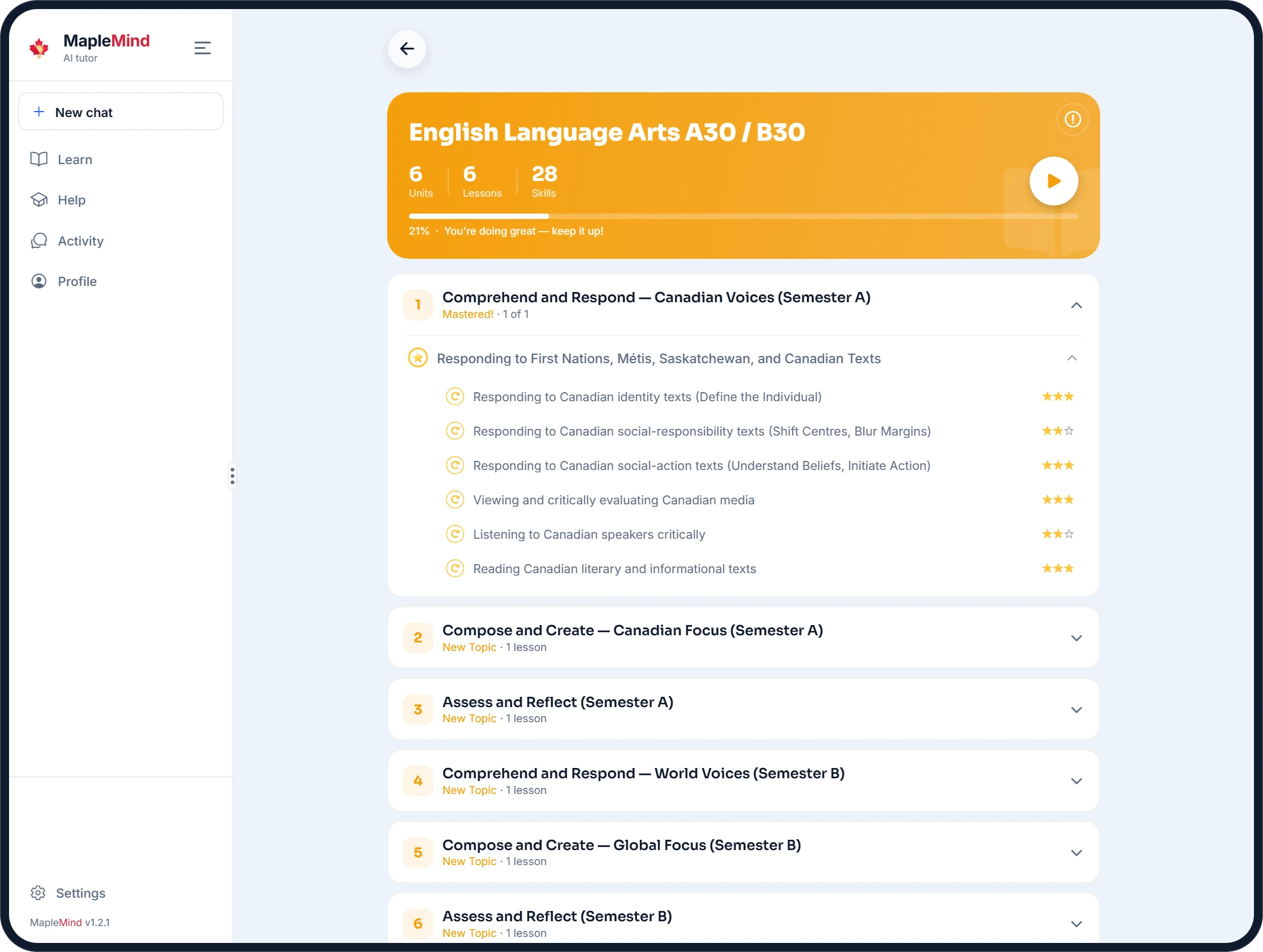
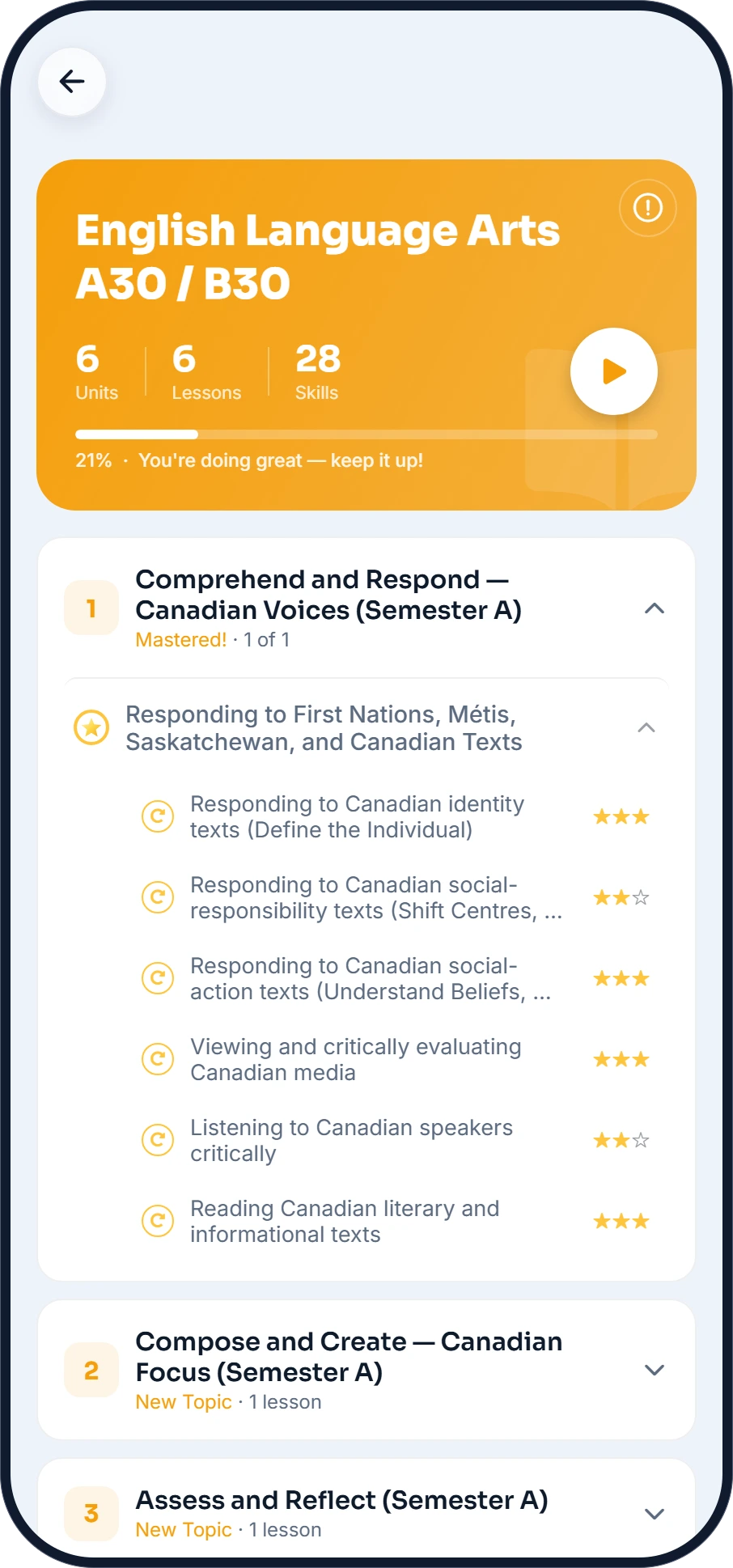
English Language Arts A30 / B30 in MapleMind on a tablet: its units and lessons in order, a student partway through.English Language Arts A30 / B30 in MapleMind on a phone: its units and lessons in order, a student partway through.
Their course, unit by unit, the way Saskatchewan teaches it.Shown: English Language Arts A30 / B30
Homework Help on a tablet: a photo of a worksheet, the tutor’s worked example of a two-step equation, and a question back to the student.Homework Help on a phone: a photo of a worksheet, the tutor’s worked example of a two-step equation, and a question back to the student.
Homework Help: they take a photo of the question, and the tutor works through it with them.
The Parent Dashboard on a tablet: a student’s days studied, streak, lessons, quiz average and recent activity.The Parent Dashboard on a phone: a student’s days studied, streak, lessons, quiz average and recent activity.
The Parent Dashboard: how each child’s week went, in lessons, quizzes and days studied.
A Grade 9 provincial mathematics exam on a tablet: a readiness score, the exam’s time and its next sitting.A Grade 9 provincial mathematics exam on a phone: a readiness score, the exam’s time and its next sitting.
A provincial exam: a practice sitting under the real time, and how ready they are.
The Learn tab on a tablet: a four-day streak, the week’s days, Homework Help, the next lesson and a review.The Learn tab on a phone: a four-day streak, the week’s days, Homework Help, the next lesson and a review.
The Learn tab: their week so far, and the next thing to do.

Help at home

Questions parents ask

What will my child learn in Grade 5 in Saskatchewan?

Math: Mathematics, Grade 5. Science: Science, Grade 5. English: English Language Arts, Grade 5. French: Core French 5. Social studies: Social Studies, Grade 5. That’s 110 skills in all, from Saskatchewan’s curriculum.

When is the Saskatchewan Student Assessment: Grade 5 Mathematics?

It’s written June 1, 2027 to June 30, 2027.

Where does this list come from?

From Saskatchewan’s official curriculum, the documents its education ministry publishes for each course. Each skill here is one of their expectations, written in plain words.

Can MapleMind help my child in Grade 5?

Yes. Every course on this page is in MapleMind, with lessons, practice and a tutor that works through each step with them. A free account gets 30 messages and 4 activities a day.

Help with Grade 5, one skill at a time.

Every course on this page is in MapleMind, free with daily limits.