Get help with Français, langue seconde (Core), Grade 5
Most tutoring makes your child sit through material your child already knows. MapleMind flips that: pick the exact skill that's causing trouble — any of the 20 below — and the tutor teaches just that one, step by step, as many times as it takes. Ask questions in plain words, any time of day, in English, French, or 12 other languages.
The official Quebec Français, langue seconde (Core), Grade 5 curriculum
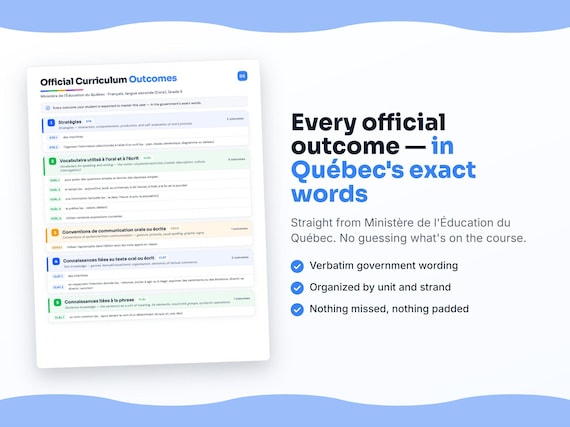
Quebec defines Français, langue seconde (Core), Grade 5 by strands and outcomes. MapleMind teaches the same curriculum reorganized for one-skill-at-a-time tutoring — the table shows exactly where every official strand lands, and the ministry's own wording is quoted under each unit below.
Official source Québec's official education programRead it on the government site — quebec.ca ↗| Official strand | Outcomes | Where MapleMind teaches it |
|---|---|---|
| Course outcomes | 20 | Stratégies · Vocabulaire utilisé à l’oral et à l’écrit · Conventions de communication orale ou écrite · Connaissances liées au texte oral ou écrit · Connaissances liées à la phrase |
Every skill below, taught one on one.
 Try the first session free
How MapleMind teaches Français, langue seconde (Core), Grade 5 — every unit, lesson, and skill
Every skill below runs as a short session: a plain-words lesson, a worked example, solving it together, then a five-question skill check that earns up to three stars. Guided Mode keeps it teaching instead of answer-handing — turning it off needs a parent's password.
Unit 1Stratégies
Strategies — interaction, comprehension, production, and self-evaluation of one’s process.
Comprehension strategies
- Use: des intertitresB.1.g — Mastery of « des intertitres » (Comprehension strategies) at Grade 5 FSL (A2).
- Use: en repérant les signes qui délimitent la phrase (majuscule, B.4.b — Mastery of « en repérant les signes qui délimitent la phrase (majuscule, point, pause, arrêt) » (Comprehension strategies) at Grade 5 FSL (A2).
- Use: en organisant les informations à l'aide d'un outilB.4.c — Mastery of « en organisant les informations à l'aide d'un outil » (Comprehension strategies) at Grade 5 FSL (A2).
- Use: en faisant ressortir des informations implicites à partir deB.4.d — Mastery of « en faisant ressortir des informations implicites à partir des indices du texte ou de ses connaissances générales » (Comprehension strategies) at Grade 5 FSL (A2).
- Use: en reformulant des informations dans ses propres motsB.4.e — Mastery of « en reformulant des informations dans ses propres mots » (Comprehension strategies) at Grade 5 FSL (A2).
Production strategies
- Use: Organiser l’information sélectionnée à l’aide d’un outil (exC.3 — Mastery of « Organiser l’information sélectionnée à l’aide d’un outil (ex. : plan, réseau sémantique, diagramme ou tableau) » (Production strategies) at Grade 5 FSL (A2).
The official wording — 6 outcomes in this unit
- B.1.g
des intertitres
- B.4.b
en repérant les signes qui délimitent la phrase (majuscule, point, pause, arrêt)
- B.4.c
en organisant les informations à l'aide d'un outil (ex. : carte sémantique)
- B.4.d
en faisant ressortir des informations implicites à partir des indices du texte ou de ses connaissances générales
- B.4.e
en reformulant des informations dans ses propres mots
- C.3
Organiser l’information sélectionnée à l’aide d’un outil (ex. : plan, réseau sémantique, diagramme ou tableau)
Unit 2Vocabulaire utilisé à l’oral et à l’écrit
Vocabulary for speaking and writing — the notion-clustered word lists (needs, description, culture, interrogation).
Vocabulary for expressing needs
- Using French for expressing needsVB.2.l — Mastery of « pour poser des questions simples et donner des réponses simples » (Vocabulary for expressing needs) at Grade 5 FSL (A2).
Vocabulary for notions (time, space, quantity)
- Using French for notions (time, space, quantity) (1)VC.1.b — Mastery of « le temps (ex. : aujourd’hui, jeudi, au printemps, à dix heures, à Noël, à la fin de la journée) » (Vocabulary for notions (time, space, quantity)) at Grade 5 FSL (A2).
- Using French for notions (time, space, quantity) (2)VC.1.c — Mastery of « l’espace » (Vocabulary for notions (time, space, quantity)) at Grade 5 FSL (A2).
Vocabulary for giving information
- Using French for giving information (1)VE.1.c — Mastery of « une information factuelle » (Vocabulary for giving information) at Grade 5 FSL (A2).
- Using French for giving information (2)VE.2.c — Mastery of « une information factuelle » (Vocabulary for giving information) at Grade 5 FSL (A2).
Vocabulary-building strategies
- Using French for vocabulary-building strategies (1)VJ.8.a — Mastery of « le préfixe » (Vocabulary-building strategies) at Grade 5 FSL (A2).
- Using French for vocabulary-building strategies (2)VJ.8.b — Mastery of « le suffixe » (Vocabulary-building strategies) at Grade 5 FSL (A2).
Everyday expressions
- Discovering French for everyday expressionsVH.2 — Guided introduction of « Utiliser certaines expressions courantes » (Everyday expressions) at Grade 5 FSL (A2).
The official wording — 8 outcomes in this unit
- VB.2.l
pour poser des questions simples et donner des réponses simples
- VC.1.b
le temps (ex. : aujourd’hui, jeudi, au printemps, à dix heures, à Noël, à la fin de la journée)
- VC.1.c
l’espace (ex. : sur, sous, à droite, à l’avant de, en face, à côté, derrière)
- VE.1.c
une information factuelle (ex. : la date, l’heure, le prix, la population)
- VE.2.c
une information factuelle
- VJ.8.a
le préfixe (ex. : refaire, défaire)
- VJ.8.b
le suffixe (ex. : fille, fillette)
- VH.2
Utiliser certaines expressions courantes
Unit 3Conventions de communication orale ou écrite
Conventions of spoken/written communication — gesture, prosody, usual spelling, graphic signs.
Graphic signs and punctuation
- Use: Utiliser l’apostrophe dans l’élision avec les mots appris enCD.5 — Mastery of « Utiliser l’apostrophe dans l’élision avec les mots appris en classe » (Graphic signs and punctuation) at Grade 5 FSL (A2).
The official wording — 1 outcome in this unit
- CD.5
Utiliser l’apostrophe dans l’élision avec les mots appris en classe
Unit 4Connaissances liées au texte oral ou écrit
Text knowledge — genres, textual/visual/sonic organisation, elements of textual coherence.
Textual, visual and sonic organisation
- Use: des intertitresTB.1.d — Mastery of « des intertitres » (Textual, visual and sonic organisation) at Grade 5 FSL (A2).
- Discover: les intertitresTB.2.d — Guided introduction of « les intertitres » (Textual, visual and sonic organisation) at Grade 5 FSL (A2).
Elements of text coherence
- Use: en respectant l'intention donnée (ex. : informer, inciter à TC.2.b — Mastery of « en respectant l'intention donnée (ex. : informer, inciter à agir ou à réagir, exprimer des sentiments ou des émotions, divertir, se divertir, raconter) » (Elements of text coherence) at Grade 5 FSL (A2).
- Discover: les mots génériques/spécifiquesTC.6.c — Guided introduction of « les mots génériques/spécifiques » (Elements of text coherence) at Grade 5 FSL (A2).
The official wording — 4 outcomes in this unit
- TB.1.d
des intertitres
- TB.2.d
les intertitres
- TC.2.b
en respectant l'intention donnée (ex. : informer, inciter à agir ou à réagir, exprimer des sentiments ou des émotions, divertir, se divertir, raconter)
- TC.6.c
les mots génériques/spécifiques
Unit 5Connaissances liées à la phrase
Sentence knowledge — the sentence as a unit of meaning, its elements, noun/verb groups, syntactic operations.
Syntactic operations
- Discover: un nom commun (ex. : ajout devant le nom d’un déterminant tePE.1.b.i — Guided introduction of « un nom commun (ex. : ajout devant le nom d’un déterminant tel que un, une, des) » (Syntactic operations) at Grade 5 FSL (A2).
The official wording — 1 outcome in this unit
- PE.1.b.i
un nom commun (ex. : ajout devant le nom d’un déterminant tel que un, une, des)
Printable workbook · A keepsake of the year
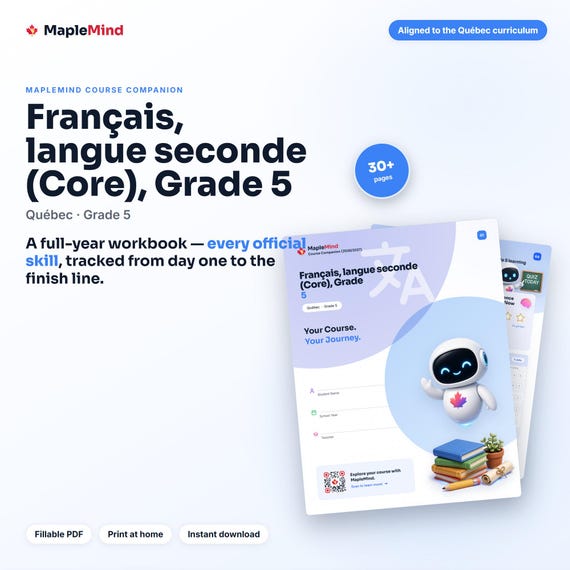
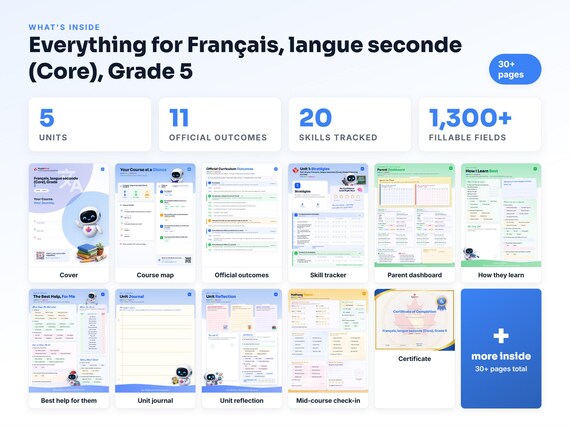
A Français, langue seconde (Core), Grade 5 workbook worth keeping
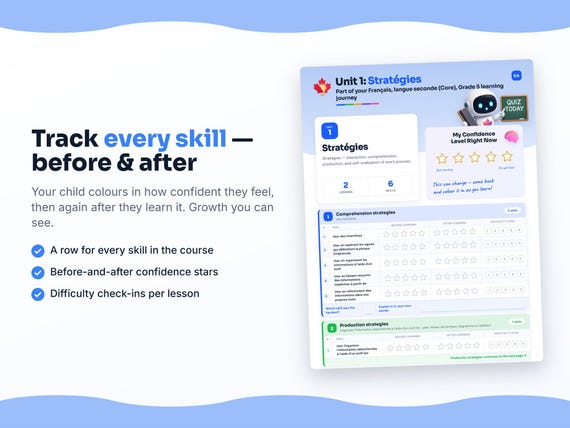
Built from the same official curriculum as this page. Before and after each skill above, your student colours in how sure they feel — so the two of you can see, on one page, what's clicking and what needs another look. It's a quiet way to follow how the year is really going.
By June it's full of their own handwriting: units worked through, confidence grown, a mid-year check-in, notes from parent-teacher night, and a certificate at the end. Less a worksheet, more a record of the year worth keeping on the shelf.
Instant download · see every page, reviews and the full description · five or more workbooks are $2.99 each
What it looks like in the app



Common questions
Can MapleMind help my child with Français, langue seconde (Core), Grade 5?
Yes. MapleMind's AI tutor covers all 20 skills in Quebec's Français, langue seconde (Core), Grade 5 — your child picks the exact skill, and the tutor teaches it step by step: a short lesson, a worked example, solving together, then a skill check to show it stuck.
Is MapleMind aligned to Quebec's official curriculum?
Yes. Every skill in this course maps to an official outcome code from Quebec's Grade 5 French as a Second Language curriculum, and the ministry's own wording is quoted under each unit on this page — with the official government source linked so you can check it yourself.
What does MapleMind cost?
It's free to start — 5 tutoring chats and a practice quiz every day, no credit card. A Pro subscription ($9.99/month or $49.99/year CAD, 7-day free trial) unlocks unlimited tutoring, practice, and exam simulations.
What if my child is stuck on just one topic?
That's the point of skill-level tutoring: open Français, langue seconde (Core), Grade 5 in the app, tap the exact skill from the list on this page, and the tutor teaches just that — no wading through lessons your child doesn't need.
Does MapleMind work in French or other languages?
Yes — 14 languages, including French. Both the app and the tutor's explanations switch to the language your child chooses.
Where can I see the official Quebec curriculum for Français, langue seconde (Core), Grade 5?
The official source is linked on this page — Québec's official education program. The outline here follows it: every MapleMind skill carries its official outcome code, and the ministry's own wording is quoted under each unit.
Keep exploring
Ready when you are
Pick a skill from this page and see it taught properly — free, in the browser, in under a minute.