

Get help with Core French 4
Most tutoring makes your child sit through material your child already knows. MapleMind flips that: pick the exact skill that's causing trouble — any of the 16 below — and the tutor teaches just that one, step by step, as many times as it takes. Ask questions in plain words, any time of day, in English, French, or 12 other languages.
The official Saskatchewan Core French 4 curriculum
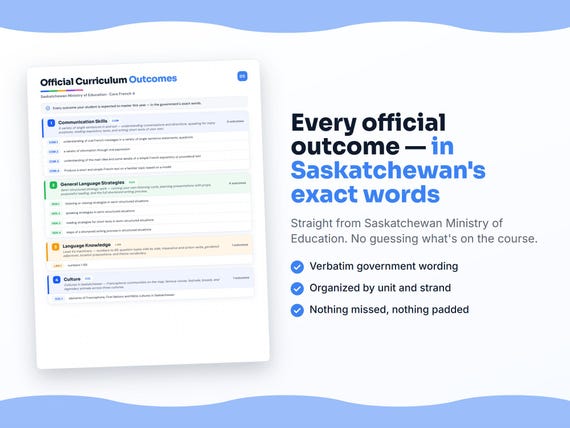
Saskatchewan defines Core French 4 by strands and outcomes. MapleMind teaches the same curriculum reorganized for one-skill-at-a-time tutoring — the table shows exactly where every official strand lands, and the ministry's own wording is quoted under each unit below.
Official source Saskatchewan's official curriculumRead it on the government site — curriculum.gov.sk.ca ↗| Official strand | Outcomes | Where MapleMind teaches it |
|---|---|---|
| Strand CS | 4 | Communication Skills |
| Strand GL | 4 | General Language Strategies |
| Strand LK | 1 | Language Knowledge |
| Strand C | 1 | Culture |
Every skill below, taught one on one.
 Try the first session free
How MapleMind teaches Core French 4 — every unit, lesson, and skill
Every skill below runs as a short session: a plain-words lesson, a worked example, solving it together, then a five-question skill check that earns up to three stars. Guided Mode keeps it teaching instead of answer-handing — turning it off needs a parent's password.
Unit 1Communication SkillsOfficial strand · Strand CS
A variety of single sentences in and out — understanding conversations and directions, speaking for many purposes, reading expository texts, and writing short texts of your own.
Understanding All Kinds of Messages
- Catching details and answering question types4.CS.1 — Show understanding of varied oral French — retrieving two details from a simple conversation, drawing an oral story, signalling understanding with words like D'accord, and responding to questions beginning with est-ce que, qu'est-ce que, and qui.
- Following directions to places and through procedures4.CS.1 — Follow spoken French directions — to a place in the classroom, school, or community, through the steps of a procedure like a pizza recipe or a dance, and when a courtesy request asks you to complete an action.
Speaking for Many Purposes
- Greetings, courtesies, congratulations, and encouragement4.CS.2 — Use the right French social expression for every moment — greetings including Allo! on the phone, farewells like À demain, apologies like Désolé and Pardon, congratulations like Félicitations!, and game encouragement like Allez! and Vas-y!
- Questions, answers, details, and preferences4.CS.2 — Ask and answer questions with modeled sentences, tell three important details about an event or person, state what you like AND don't like — J'aime la pizza au fromage, Je n'aime pas la pizza hawaïenne — and say what you want with Je veux.
- Giving directions — places and procedures4.CS.2 — Give directions in French — guiding someone to a place in the school or community with à gauche, à droite, and tout droit, and walking others through simple procedures like making a pizza or performing a dance step.
Reading Texts That Explain
- Finding the main idea and details in explaining texts4.CS.3 — Show understanding of a simple French expository or procedural text — identifying the main idea of a 4-5 sentence illustrated text and answering familiar questions about its details.
Writing Short Texts
- Writing descriptions and recipes from models4.CS.4 — Produce short, simple French texts from models — sentences with starters like J'aime and Je préfère, a four-sentence description of a friend, a four-step recipe, and group expository or procedural texts.
The official wording — 4 outcomes in this unit
- 4.CS.1
understanding of oral French messages in a variety of single sentence statements, questions
- 4.CS.2
a variety of information through oral expression
- 4.CS.3
understanding of the main idea and some details of a simple French expository or procedural text
- 4.CS.4
Produce a short and simple French text on a familiar topic based on a model
Unit 2General Language StrategiesOfficial strand · Strand GL
Semi-structured strategy work — running your own listening cycle, planning presentations with props, purposeful reading, and the full shortened writing process.
Your Listening Cycle
- Running the listening cycle with less support4.GL.1 — Use listening and viewing strategies in semi-structured situations — describing and predicting before, identifying key words, naming the speaker's non-verbal clues, and using context to guess unknown words during, then verifying, identifying the main idea, and self-evaluating after.
Building a Presentation
- Planning, giving, and improving a presentation4.GL.2 — Use speaking strategies in semi-structured situations — brainstorming success criteria and choosing props before, presenting with visual supports and self-correcting with feedback during, then self-evaluating against the criteria and setting goals after.
Reading with a Purpose
- Setting a purpose and reading with strategies4.GL.3 — Use reading strategies for short texts in semi-structured situations — predicting, connecting, and suggesting the PURPOSE for reading before, then using key words, cognates, illustrations, and references during shared reading.
The Writing Process, Step by Step
- Implementing the writing process4.GL.4 — Implement steps of a shortened writing process in structured situations — naming and sharing idea words before, drafting a four-to-five sentence text from a template with dictionary and reference support during, then checking spelling and self-evaluating after.
The official wording — 4 outcomes in this unit
- 4.GL.1
listening or viewing strategies in semi-structured situations
- 4.GL.2
speaking strategies in semi-structured situations
- 4.GL.3
reading strategies for short texts in semi-structured situations
- 4.GL.4
steps of a shortened writing process in structured situations
Unit 3Language KnowledgeOfficial strand · Strand LK
Level 4's machinery — numbers to 69, question types side by side, imperative and action verbs, gendered adjectives, location prepositions, and theme vocabulary.
Numbers to 69 and Question Types
- Counting to 69 and telling question types apart4.LK.1 — Count and name the French numbers 1 to 69, and tell apart the question types beginning with où, qui, est-ce que, and qu'est-ce que.
- Complete sentences, commands, and action verbs4.LK.1 — Make complete French sentences orally and in writing, give commands with the imperative form of verbs like aller, tourner, arrêter, and dessiner, and use -er verbs plus prendre and vouloir in your sentences.
- Describing words, position words, and theme vocabulary4.LK.1 — Describe people and animals with gender-matching adjectives, show where things are with prepositions like dans, au milieu, and en avant, and use key words from the Level 4 themes in simple sentences.
The official wording — 1 outcome in this unit
- 4.LK.1
numbers 1-69
Unit 4CultureOfficial strand · Strand C
Cultures in Saskatchewan — Francophone communities on the map, famous voices, festivals, breads, and legendary animals across three cultures.
Francophone Saskatchewan
- French culture across our province4.C.1 — Explore Francophone culture in Saskatchewan — locating communities like Gravelbourg and Zenon Park and sites like Batoche and Wanuskewin on a map, meeting provincial artists like Carmen Campagne and Allen Sapp, and spotting French in books, signs, and media around the province.
- Breads, legends, festivals, and dances across cultures4.C.1 — Compare cultures side by side — French breads from baguette to brioche beside bannock, legendary animals from le loup garou to Coyote and Eagle, festivals from Back to Batoche Days to Gravelbourg's winter festival, and dances from la gigue to the Hoop Dance.
The official wording — 1 outcome in this unit
- 4.C.1
elements of Francophone, First Nations and Métis cultures in Saskatchewan
Printable workbook · A keepsake of the year
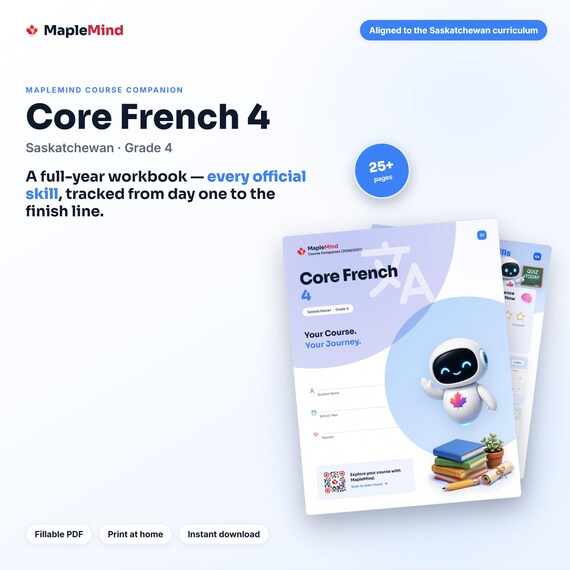
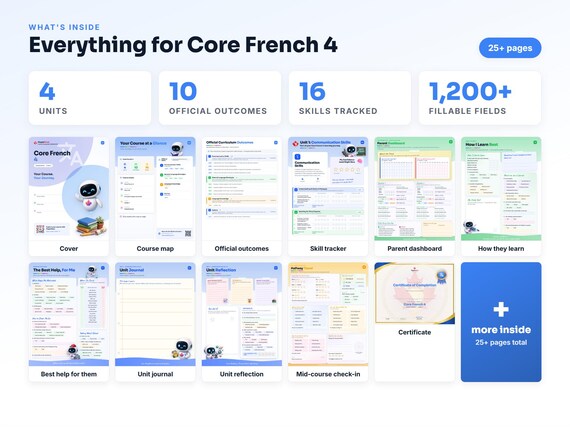
A Core French 4 workbook worth keeping
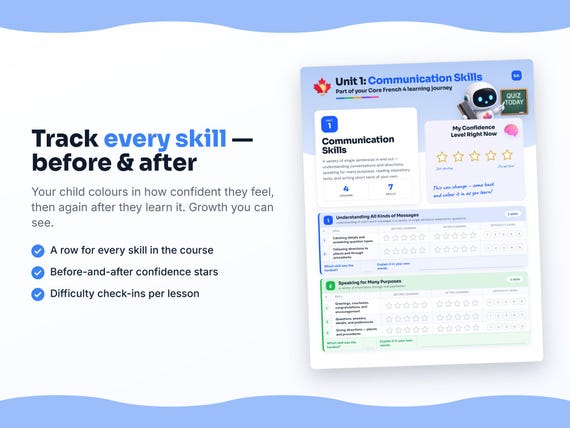
Built from the same official curriculum as this page. Before and after each skill above, your student colours in how sure they feel — so the two of you can see, on one page, what's clicking and what needs another look. It's a quiet way to follow how the year is really going.
By June it's full of their own handwriting: units worked through, confidence grown, a mid-year check-in, notes from parent-teacher night, and a certificate at the end. Less a worksheet, more a record of the year worth keeping on the shelf.
Instant download · see every page, reviews and the full description · five or more workbooks are $2.99 each
What it looks like in the app



Common questions
Can MapleMind help my child with Core French 4?
Yes. MapleMind's AI tutor covers all 16 skills in Saskatchewan's Core French 4 — your child picks the exact skill, and the tutor teaches it step by step: a short lesson, a worked example, solving together, then a skill check to show it stuck.
Is MapleMind aligned to Saskatchewan's official curriculum?
Yes. Every skill in this course maps to an official outcome code from Saskatchewan's Grade 4 French as a Second Language curriculum, and the ministry's own wording is quoted under each unit on this page — with the official government source linked so you can check it yourself.
What does MapleMind cost?
It's free to start — 5 tutoring chats and a practice quiz every day, no credit card. A Pro subscription ($9.99/month or $49.99/year CAD, 7-day free trial) unlocks unlimited tutoring, practice, and exam simulations.
What if my child is stuck on just one topic?
That's the point of skill-level tutoring: open Core French 4 in the app, tap the exact skill from the list on this page, and the tutor teaches just that — no wading through lessons your child doesn't need.
Does MapleMind work in French or other languages?
Yes — 14 languages, including French. Both the app and the tutor's explanations switch to the language your child chooses.
Where can I see the official Saskatchewan curriculum for Core French 4?
The official source is linked on this page — Saskatchewan's official curriculum. The outline here follows it: every MapleMind skill carries its official outcome code, and the ministry's own wording is quoted under each unit.
Keep exploring
Ready when you are
Pick a skill from this page and see it taught properly — free, in the browser, in under a minute.