

Get help with Core French 3
Most tutoring makes your child sit through material your child already knows. MapleMind flips that: pick the exact skill that's causing trouble — any of the 15 below — and the tutor teaches just that one, step by step, as many times as it takes. Ask questions in plain words, any time of day, in English, French, or 12 other languages.
The official Saskatchewan Core French 3 curriculum
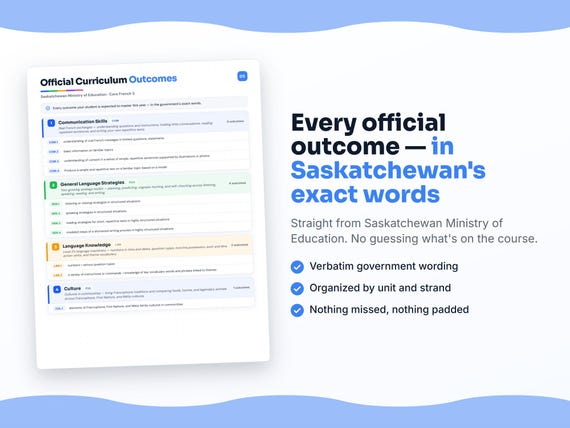
Saskatchewan defines Core French 3 by strands and outcomes. MapleMind teaches the same curriculum reorganized for one-skill-at-a-time tutoring — the table shows exactly where every official strand lands, and the ministry's own wording is quoted under each unit below.
Official source Saskatchewan's official curriculumRead it on the government site — curriculum.gov.sk.ca ↗| Official strand | Outcomes | Where MapleMind teaches it |
|---|---|---|
| Strand CS | 4 | Communication Skills |
| Strand GL | 4 | General Language Strategies |
| Strand LK | 1 | Language Knowledge |
| Strand C | 1 | Culture |
Every skill below, taught one on one.
 Try the first session free
How MapleMind teaches Core French 3 — every unit, lesson, and skill
Every skill below runs as a short session: a plain-words lesson, a worked example, solving it together, then a five-question skill check that earns up to three stars. Guided Mode keeps it teaching instead of answer-handing — turning it off needs a parent's password.
Unit 1Communication SkillsOfficial strand · Strand CS
Real French exchanges — understanding questions and instructions, holding little conversations, reading repeated sentences, and writing your own repetitive texts.
Understanding Questions and Directions
- Understanding descriptions, directions, and question words3.CS.1 — Show that you understand oral French messages — simple directions, basic descriptions of familiar things, and questions beginning with où, qui, and qu'est-ce que.
- Politeness, praise, and following task instructions3.CS.1 — Respond to courtesy requests with polite answers, react to praise like Bravo! and Formidable!, and follow clear multi-step instructions to complete a task, a game, or a dance.
Little Conversations
- Keeping polite conversations going3.CS.2 — Keep polite French exchanges going — answering Merci! with De rien, returning Comment ça va? with Et toi?, replying to offers with Oui, merci beaucoup! or Non, merci!, and using farewells like À bientôt!
- Asking, telling, describing, and instructing3.CS.2 — Ask and answer simple questions in structured sentences, tell a classmate what to do, describe a scenario with a list — like what's packed in your suitcase — and connect what you have to how you feel.
Reading Repeated Sentences
- Understanding a series of repeated sentences3.CS.3 — Show that you understand a series of simple, repetitive French sentences supported by illustrations — following short written directions, reading personal-information texts, and pulling basic information from posters, invitations, and messages.
Writing Repeated Texts
- Writing a repetitive text from a model3.CS.4 — Produce a simple, repetitive French text on a familiar topic from a model — lunch descriptions with J'ai..., filling in forms with your details, short postcard or blog messages, and labeled posters with descriptive sentences.
The official wording — 4 outcomes in this unit
- 3.CS.1
understanding of oral French messages in limited questions, statements
- 3.CS.2
basic information on familiar topics
- 3.CS.3
understanding of content in a series of simple, repetitive sentences supported by illustrations or photos
- 3.CS.4
Produce a simple and repetitive text on a familiar topic based on a model
Unit 2General Language StrategiesOfficial strand · Strand GL
Your growing strategy toolkit — planning, predicting, cognate-hunting, and self-checking across listening, speaking, reading, and writing.
Listening Strategies in Action
- Listening strategies before, during, and after3.GL.1 — Use listening and viewing strategies in structured situations — describing pictures and predicting before, spotting key words, cognates, gestures, and intonation during, and verifying predictions and naming strategies after.
Planning What to Say
- Planning and supporting my speaking3.GL.2 — Use speaking strategies in structured situations — planning what to say with key words or a partner, using charts, models, and diagrams as supports, practicing requests and feelings with a partner, and self-evaluating.
Reading Strategies for Repeated Texts
- Reading strategies with repeated texts3.GL.3 — Use reading strategies for short, repetitive texts — predicting from key words and titles, using cognates, illustrations, charts, and dictionaries during reading, reading along on the re-read, and rating your comprehension after.
The Shortened Writing Process
- Following the modeled writing process3.GL.4 — Follow modeled steps of a shortened writing process — offering words as the teacher writes, using personal dictionaries and references, discussing word ideas with a partner, substituting words in a modeled text, and self-evaluating.
The official wording — 4 outcomes in this unit
- 3.GL.1
listening or viewing strategies in structured situations
- 3.GL.2
speaking strategies in structured situations
- 3.GL.3
reading strategies for short, repetitive texts in highly structured situations
- 3.GL.4
modeled steps of a shortened writing process in highly structured situations
Unit 3Language KnowledgeOfficial strand · Strand LK
Level 3's language machinery — numbers in time and dates, question types, mon/ma possession, avoir and être, action verbs, and theme vocabulary.
Numbers in Time and Question Types
- Numbers for time, dates, and question types3.LK.1 — Use French numbers for clock times and calendar dates — C'est 4 heures, C'est le 25 novembre — and respond to the question types beginning with où, qui, and que.
- Mine! — possession with mon/ma, avoir, and être3.LK.1 — Show what belongs to you with mon and ma, use the verb avoir to say what you have — J'ai une pomme — and use the verb être to describe yourself and others — Je suis grand, Elle est petite.
Action Verbs and Theme Words
- Action verbs and this year's theme words3.LK.1 — Use the action verbs chercher, mettre, and aller to show you understand instructions — Je cherche un crayon, Je vais à la toilette — and use key words from the Level 3 themes in simple oral sentences.
The official wording — 1 outcome in this unit
- 3.LK.1
numbers • various question types
Unit 4CultureOfficial strand · Strand C
Cultures in communities — living Francophone traditions and comparing foods, homes, and legendary animals across Francophone, First Nations, and Métis cultures.
Cultures in Our Communities
- Living Francophone culture — songs, meals, and books3.C.1 — Live Francophone culture — reciting comptines and singing songs, spotting French culture around your school, learning how meals are named in different Francophone communities, and responding to authentic French picture books.
- Comparing foods, homes, and legendary animals3.C.1 — Compare elements across cultures — traditional Francophone foods like croissants and fromage beside First Nations and Métis foods like berries and bannock, housing from villas and ice hotels to tipis and cabins, and legendary animals from Memphré to Coyote.
The official wording — 1 outcome in this unit
- 3.C.1
elements of Francophone, First Nations, and Métis family cultures in communities
Printable workbook · A keepsake of the year
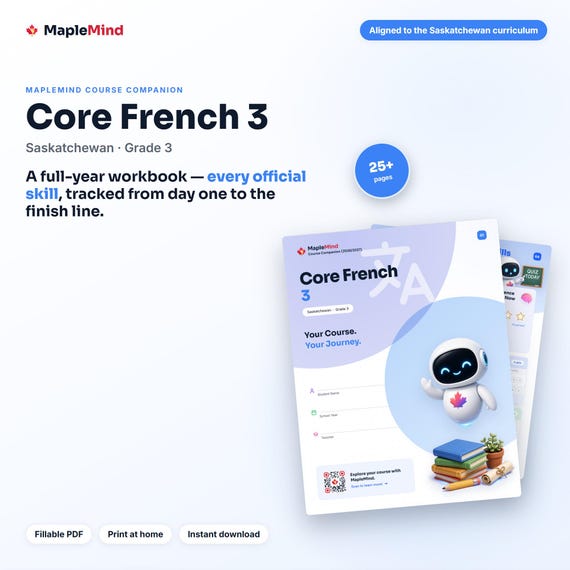
A Core French 3 workbook worth keeping
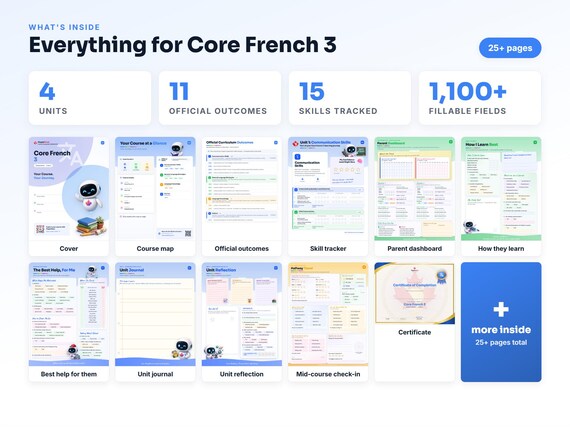
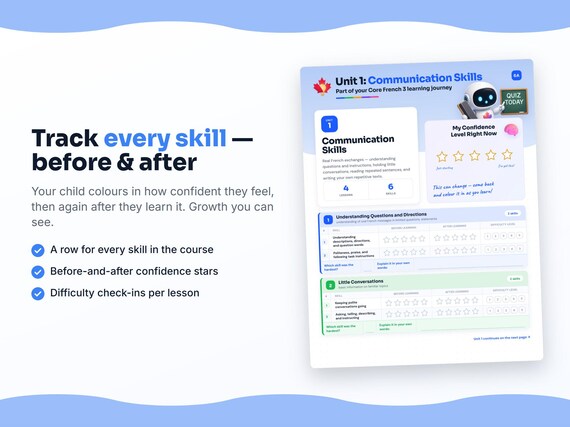
Built from the same official curriculum as this page. Before and after each skill above, your student colours in how sure they feel — so the two of you can see, on one page, what's clicking and what needs another look. It's a quiet way to follow how the year is really going.
By June it's full of their own handwriting: units worked through, confidence grown, a mid-year check-in, notes from parent-teacher night, and a certificate at the end. Less a worksheet, more a record of the year worth keeping on the shelf.
Instant download · see every page, reviews and the full description · five or more workbooks are $2.99 each
What it looks like in the app



Common questions
Can MapleMind help my child with Core French 3?
Yes. MapleMind's AI tutor covers all 15 skills in Saskatchewan's Core French 3 — your child picks the exact skill, and the tutor teaches it step by step: a short lesson, a worked example, solving together, then a skill check to show it stuck.
Is MapleMind aligned to Saskatchewan's official curriculum?
Yes. Every skill in this course maps to an official outcome code from Saskatchewan's Grade 3 French as a Second Language curriculum, and the ministry's own wording is quoted under each unit on this page — with the official government source linked so you can check it yourself.
What does MapleMind cost?
It's free to start — 5 tutoring chats and a practice quiz every day, no credit card. A Pro subscription ($9.99/month or $49.99/year CAD, 7-day free trial) unlocks unlimited tutoring, practice, and exam simulations.
What if my child is stuck on just one topic?
That's the point of skill-level tutoring: open Core French 3 in the app, tap the exact skill from the list on this page, and the tutor teaches just that — no wading through lessons your child doesn't need.
Does MapleMind work in French or other languages?
Yes — 14 languages, including French. Both the app and the tutor's explanations switch to the language your child chooses.
Where can I see the official Saskatchewan curriculum for Core French 3?
The official source is linked on this page — Saskatchewan's official curriculum. The outline here follows it: every MapleMind skill carries its official outcome code, and the ministry's own wording is quoted under each unit.
Keep exploring
Ready when you are
Pick a skill from this page and see it taught properly — free, in the browser, in under a minute.