Get help with Social Studies, Grade 1
Most tutoring makes your child sit through material your child already knows. MapleMind flips that: pick the exact skill that's causing trouble — any of the 12 below — and the tutor teaches just that one, step by step, as many times as it takes. Ask questions in plain words, any time of day, in English, French, or 12 other languages.
The official Saskatchewan Social Studies, Grade 1 curriculum
Saskatchewan defines Social Studies, Grade 1 by strands and outcomes. MapleMind teaches the same curriculum reorganized for one-skill-at-a-time tutoring — the table shows exactly where every official strand lands, and the ministry's own wording is quoted under each unit below.
Official source Saskatchewan's official curriculumRead it on the government site — curriculum.gov.sk.ca ↗| Official strand | Outcomes | Where MapleMind teaches it |
|---|---|---|
| Strand IN | 3 | Interactions and Interdependence |
| Strand DR | 5 | Dynamic Relationships |
| Strand PA | 2 | Power and Authority |
| Strand RW | 2 | Resources and Wealth |
Every skill below, taught one on one.
 Try the first session free
How MapleMind teaches Social Studies, Grade 1 — every unit, lesson, and skill
Every skill below runs as a short session: a plain-words lesson, a worked example, solving it together, then a five-question skill check that earns up to three stars. Guided Mode keeps it teaching instead of answer-handing — turning it off needs a parent's password.
Unit 1Interactions and InterdependenceOfficial strand · Strand IN
How the people around us — family, classroom, and school — are diverse and how our relationships help meet everyone's needs.
Belonging Together
- Same and different in our familiesIN1.2 — Talk about the cultural diversity in your family and classroom, exploring how families are similar and different.
- How groups help usIN1.3 — Look at how the relationships and groups we belong to help meet human needs.
The official wording — 3 outcomes in this unit
- IN1.1
Describe the diversity of traditions, celebrations, or stories of individuals in the classroom and school.
- IN1.2
Discuss cultural diversity in the family and classroom, including exploration of similarities and differences.
- IN1.3
Assess ways in which relationships help to meet human needs.
Unit 2Dynamic RelationshipsOfficial strand · Strand DR
Our place in time and on the land: family stories from the past, kinship and the Medicine Wheel, how the natural world meets our needs, and finding places on maps and globes.
Our Family, Our Past, Our Place
- Family stories from the pastDR1.1 — Connect family events and stories from the past to your place in family life today.
- Kinship and the Medicine WheelDR1.2 — Describe kinship patterns of the past and present, including how some cultures use the Medicine Wheel teachings to understand the stages of life.
- The land helps meet our needsDR1.3 — Show how people rely on the natural environment to meet needs, and how where we live affects how families meet needs and wants.
- Globes, maps, land, and waterDR1.4 — Recognize globes and maps as pictures of the Earth's surface and tell land apart from water on them.
- Where and when in my worldDR1.5 — Identify and show where (in space) and when (in time) important places and events are in your life, including finding Saskatchewan and Canada.
The official wording — 5 outcomes in this unit
- DR1.1
Relate family events and stories of the recent or distant past to the student’s place in present day family life.
- DR1.2
Describe kinship patterns of the past and present and describe according to traditional teachings (e.g., Medicine Wheel teachings).
- DR1.3
Demonstrate awareness of humans’ reliance on the natural environment to meet needs, and how location affects families in meeting needs and wants.
- DR1.4
Recognize globes and maps as representations of the surface of the Earth, and distinguish land and water masses on globes and maps.
- DR1.5
Identify and represent the orientation in space (where) and time (when) of significant places and events in the lives of students.
Unit 3Power and AuthorityOfficial strand · Strand PA
Getting along together: the rules and choices that keep our family, classroom, and playground peaceful, and how we return to harmony when things go wrong.
Keeping the Peace
- Actions and rules that keep the peacePA1.1 — Look at the actions, rules, and decision-making in the family, classroom, and playground that support peace and harmony.
- Fixing problems and returning to harmonyPA1.2 — Explore what causes disharmony and the ways we can return to harmony.
The official wording — 2 outcomes in this unit
- PA1.1
Analyze actions and practices in the family, classroom, and on the playground that support peace and harmony, including rules and decision-making processes.
- PA1.2
Analyze the causes of disharmony and ways of returning to harmony.
Unit 4Resources and WealthOfficial strand · Strand RW
Meeting our needs and wants: what different kinds of needs feel like, how First Nations traditional teachings guide meeting them, and how work is shared in families, schools, and groups.
Needs, Wants, and Work
- Different kinds of needs and wantsRW1.1 — Describe how physical, spiritual, emotional, and intellectual needs and wants affect personal well-being, including how First Nations traditional teachings guide meeting them.
- Sharing the workRW1.2 — Talk about how work is managed and shared in families, schools, and groups.
The official wording — 2 outcomes in this unit
- RW1.1
Describe the influence of physical, spiritual, emotional, and intellectual needs and wants on personal well-being.
- RW1.2
Discuss ways in which work may be managed and distributed in families, schools, and groups.
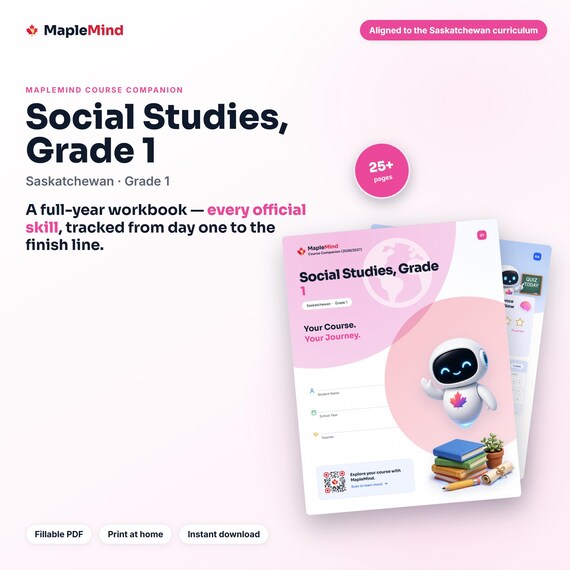
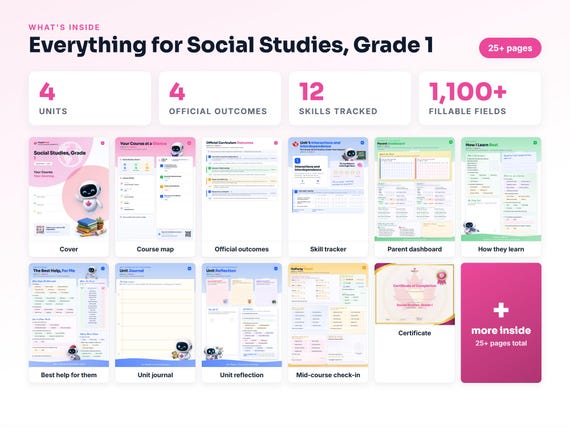
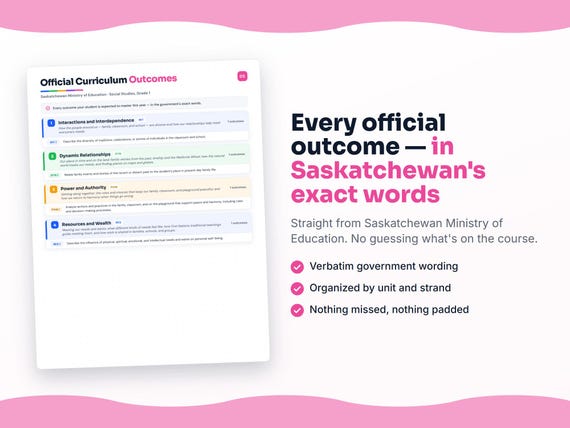
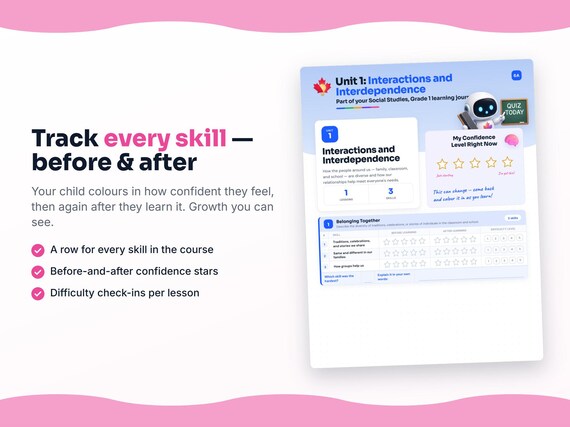
Printable workbook · A keepsake of the year
A Social Studies, Grade 1 workbook worth keeping
Built from the same official curriculum as this page. Before and after each skill above, your student colours in how sure they feel — so the two of you can see, on one page, what's clicking and what needs another look. It's a quiet way to follow how the year is really going.
By June it's full of their own handwriting: units worked through, confidence grown, a mid-year check-in, notes from parent-teacher night, and a certificate at the end. Less a worksheet, more a record of the year worth keeping on the shelf.
Instant download · see every page, reviews and the full description · five or more workbooks are $2.99 each
What it looks like in the app



Common questions
Can MapleMind help my child with Social Studies, Grade 1?
Yes. MapleMind's AI tutor covers all 12 skills in Saskatchewan's Social Studies, Grade 1 — your child picks the exact skill, and the tutor teaches it step by step: a short lesson, a worked example, solving together, then a skill check to show it stuck.
Is MapleMind aligned to Saskatchewan's official curriculum?
Yes. Every skill in this course maps to an official outcome code from Saskatchewan's Grade 1 Social Studies curriculum, and the ministry's own wording is quoted under each unit on this page — with the official government source linked so you can check it yourself.
What does MapleMind cost?
It's free to start — 5 tutoring chats and a practice quiz every day, no credit card. A Pro subscription ($9.99/month or $49.99/year CAD, 7-day free trial) unlocks unlimited tutoring, practice, and exam simulations.
What if my child is stuck on just one topic?
That's the point of skill-level tutoring: open Social Studies, Grade 1 in the app, tap the exact skill from the list on this page, and the tutor teaches just that — no wading through lessons your child doesn't need.
Does MapleMind work in French or other languages?
Yes — 14 languages, including French. Both the app and the tutor's explanations switch to the language your child chooses.
Where can I see the official Saskatchewan curriculum for Social Studies, Grade 1?
The official source is linked on this page — Saskatchewan's official curriculum. The outline here follows it: every MapleMind skill carries its official outcome code, and the ministry's own wording is quoted under each unit.
Keep exploring
Ready when you are
Pick a skill from this page and see it taught properly — free, in the browser, in under a minute.