Get help with English Language Arts, Grade 9
Most tutoring makes you sit through material you already know. MapleMind flips that: pick the exact skill that's causing trouble — any of the 38 below — and the tutor teaches just that one, step by step, as many times as it takes. Ask questions in plain words, any time of day, in English, French, or 12 other languages.
The official Saskatchewan English Language Arts, Grade 9 curriculum
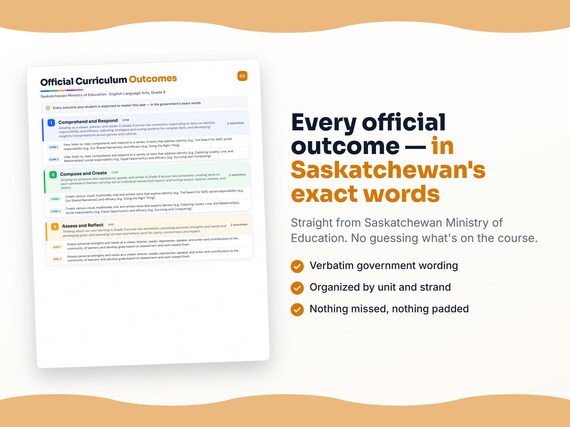
Saskatchewan defines English Language Arts, Grade 9 by strands and outcomes. MapleMind teaches the same curriculum reorganized for one-skill-at-a-time tutoring — the table shows exactly where every official strand lands, and the ministry's own wording is quoted under each unit below.
Official source Saskatchewan's official curriculumRead it on the government site — curriculum.gov.sk.ca ↗| Official strand | Outcomes | Where MapleMind teaches it |
|---|---|---|
| Strand CR | 16 | Comprehend and Respond |
| Strand CC | 18 | Compose and Create |
| Strand AR | 4 | Assess and Reflect |
Every skill below, taught one on one.
 Try the first session free
How MapleMind teaches English Language Arts, Grade 9 — every unit, lesson, and skill
Every skill below runs as a short session: a plain-words lesson, a worked example, solving it together, then a five-question skill check that earns up to three stars. Guided Mode keeps it teaching instead of answer-handing — turning it off needs a parent's password.
Unit 1Comprehend and RespondOfficial strand · Strand CR
Growing as a viewer, listener, and reader in Grade 9 across two semesters: responding to texts on identity, responsibility, and efficacy; adjusting strategies and cueing systems for complex texts; and developing insightful interpretations across genres and cultures.
Comprehend and Respond — Semester A
- Responding to Semester A theme textsCR9.1a — View, listen to, read, comprehend, and respond to texts that address identity (The Search for Self), social responsibility (Our Shared Narratives), and efficacy (Doing the Right Thing).
- Adjusting strategies before, during, and after (Semester A)CR9.2a — Select and use strategies to construct meaning before, during, and after viewing, listening, and reading, including formulating focus questions, adjusting rate, and analyzing and evaluating.
- Using cueing systems for thesis and argument (Semester A)CR9.3a — Use pragmatic, textual, syntactic, semantic/lexical/morphological, graphophonic, and other cues to construct and confirm meaning, including the author's thesis and argument.
- Viewing multimedia to glean ideas (Semester A)CR9.4a — View and understand and evaluate visual and multimedia texts, such as illustrations, maps, charts, graphs, pamphlets, photography, art works, video clips, and dramatizations, to glean ideas for an identified audience and purpose.
- Listening to analyze and evaluate (Semester A)CR9.5a — Listen purposefully to understand, analyze, and evaluate oral information and ideas from a range of texts, including conversations, discussions, interviews, and speeches.
- Reading to develop an insightful interpretation (Semester A)CR9.6a — Read and understand and interpret grade-level prose fiction, poetry, and plays, including First Nations and Métis texts, to develop an insightful interpretation and response.
- Reading information texts independently (Semester A)CR9.7a — Read independently and understand a variety of information texts, including expository essays, historical accounts, news articles, and scientific writing.
- Reading with fluency and expression (Semester A)CR9.8a — Read Grade 9 appropriate texts to increase fluency and expression (150+ words correct per minute orally; 215-260 silently).
Comprehend and Respond — Semester B
- Responding to Semester B theme textsCR9.1b — View, listen to, read, comprehend, and respond to texts that address identity (Exploring Loyalty, Love, and Relationships), social responsibility (Equal Opportunity), and efficacy (Surviving and Conquering).
- Adjusting strategies before, during, and after (Semester B)CR9.2b — Select and use strategies to construct meaning before, during, and after viewing, listening, and reading, including formulating focus questions, adjusting rate, and analyzing and evaluating.
- Using cueing systems for thesis and argument (Semester B)CR9.3b — Use pragmatic, textual, syntactic, semantic/lexical/morphological, graphophonic, and other cues to construct and confirm meaning, including the author's thesis and argument.
- Viewing multimedia to synthesize sources (Semester B)CR9.4b — View and understand visual and multimedia texts to synthesize and summarize ideas from multiple visual and multimedia sources.
- Listening to recognize train of thought and technique (Semester B)CR9.5b — Listen purposefully to understand, analyze, and evaluate oral information and ideas from directions and speeches, recognizing train of thought, main points, and presentation techniques.
- Reading to develop an insightful interpretation (Semester B)CR9.6b — Read and understand and interpret grade-level prose fiction, poetry, and plays, including First Nations and Métis texts, to develop an insightful interpretation and response.
- Reading information texts independently (Semester B)CR9.7b — Read independently and understand a variety of information texts, including expository essays, historical accounts, news articles, and scientific writing.
- Reading with fluency and expression (Semester B)CR9.8b — Read Grade 9 appropriate texts to increase fluency and expression (150+ words correct per minute orally; 215-260 silently).
The official wording — 16 outcomes in this unit
- CR9.1a
View, listen to, read, comprehend, and respond to a variety of texts that address identity (e.g., The Search for Self), social responsibility (e.g., Our Shared Narratives), and efficacy (e.g., Doing the Right Thing).
- CR9.2a
Select and use appropriate strategies to construct meaning before (e.g., formulating focus questions), during (e.g., adjusting rate to the specific purpose and difficulty of the text), and after (e.g., analyzing and evaluating) viewing, listening, and reading.
- CR9.3a
Use pragmatic (e.g., language suitable for intended audience), textual (e.g., author’s thesis or argument, how author organized text to achieve unity, coherence, and effect), syntactic (e.g., parallel structures), semantic/lexical/morphological (e.g., connotation and denotation), graphophonic (e.g., common spellings and variants for effect or dialect), and other cues (e.g., fonts, colour) to construct and to confirm meaning.
- CR9.4a
View and demonstrate comprehension and evaluation of visual and multimedia texts including illustrations, maps, charts, graphs, pamphlets, photography, art works, video clips, and dramatizations to glean ideas suitable for identified audience and purpose.
- CR9.5a
Listen purposefully to understand, analyze, and evaluate oral information and ideas from a range of texts including conversations, discussions, interviews, and speeches.
- CR9.6a
Read and demonstrate comprehension and interpretation of grade-level appropriate texts including traditional and contemporary prose fiction, poetry, and plays from First Nations, Métis, and other cultures to develop an insightful interpretation and response.
- CR9.7a
Read independently and demonstrate comprehension of a variety of information texts including expository essays, historical accounts, news articles, and scientific writing.
- CR9.8a
Read Grade 9 appropriate texts to increase fluency and expression (150+wcpm orally; 215-260 silently).
- CR9.1b
View, listen to, read, comprehend, and respond to a variety of texts that address identity (e.g., Exploring Loyalty, Love, and Relationships), social responsibility (e.g., Equal Opportunity), and efficacy (e.g., Surviving and Conquering).
- CR9.2b
Select and use appropriate strategies to construct meaning before (e.g., formulating focus questions), during (e.g., adjusting rate to the specific purpose and difficulty of the text), and after (e.g., analyzing and evaluating) viewing, listening, and reading.
- CR9.3b
Use pragmatic (e.g., language suitable for intended audience), textual (e.g., author’s thesis or argument, how author organized text to achieve unity, coherence, and effect), syntactic (e.g., parallel structures), semantic/lexical/morphological (e.g., connotation and denotation), graphophonic (e.g., common spellings and variants for effect or dialect), and other cues (e.g., fonts, colour) to construct and to confirm meaning.
- CR9.4b
View and demonstrate comprehension of visual and multimedia texts to synthesize and summarize ideas from multiple visual and multimedia sources.
- CR9.5b
Listen purposefully to understand, analyze, and evaluate oral information and ideas from a range of texts including directions and speeches, recognizing train of thought, main points, and presentation techniques.
- CR9.6b
Read and demonstrate comprehension and interpretation of grade-level appropriate texts including traditional and contemporary prose fiction, poetry, and plays from First Nations, Métis, and other cultures to develop an insightful interpretation and response.
- CR9.7b
Read independently and demonstrate comprehension of a variety of information texts including expository essays, historical accounts, news articles, and scientific writing.
- CR9.8b
Read Grade 9 appropriate texts to increase fluency and expression (150+wcpm orally; 215-260 silently).
Unit 2Compose and CreateOfficial strand · Strand CC
Growing as someone who represents, speaks, and writes in Grade 9 across two semesters: creating texts on each semester's themes; carrying out an individual researched inquiry; and writing essays, reports, reviews, and letters.
Compose and Create — Semester A
- Creating texts on Semester A themesCC9.1a — Create visual, multimedia, oral, and written texts that explore identity (The Search for Self), social responsibility (Our Shared Narratives), and efficacy (Doing the Right Thing).
- Creating an individual researched inquiry (Semester A)CC9.2a — Create and present an individual researched inquiry project related to a topic, theme, or issue studied in English language arts.
- Using strategies to communicate meaning (Semester A)CC9.3a — Select and use strategies to communicate meaning before, during, and after speaking, writing, and representing, such as valuing your own ideas as sources, reshaping drafts, and ensuring all parts support the thesis.
- Using cues to communicate meaning (Semester A)CC9.4a — Use pragmatic, textual, syntactic, semantic/lexical/morphological, graphophonic, and other cues to construct and communicate meaning, including inclusive language, strong leads, and subordination.
- Creating multimedia presentations for an audience (Semester A)CC9.5a — Create and present a variety of visual and multimedia presentations to best represent a message for an intended audience and purpose.
- Using oral language to interact in discussions (Semester A)CC9.6a — Use oral language to interact purposefully, confidently, and appropriately in one-to-one, small group, and large group discussions, including solving problems, building consensus, and explaining a viewpoint.
- Using oral language to express ideas formally (Semester A)CC9.7a — Use oral language intentionally to express a range of information and ideas in formal and informal situations, including dramatic readings and presenting reasoned arguments of opposing viewpoints.
- Writing to describe, narrate, inform, and persuade (Semester A)CC9.8a — Write to describe a character profile, narrate a narrative essay, explain and inform in a researched report, and persuade in a review.
- Experimenting with forms and techniques (Semester A)CC9.9a — Experiment with a variety of text forms, such as debates, poetry, a précis, a short script, an advice column, or a video documentary, and techniques like tone, persona, imagery, and figurative language.
Compose and Create — Semester B
- Creating texts on Semester B themesCC9.1b — Create visual, multimedia, oral, and written texts that explore identity (Exploring Loyalty, Love, and Relationships), social responsibility (Equal Opportunity), and efficacy (Surviving and Conquering).
- Creating an individual researched inquiry (Semester B)CC9.2b — Create and present an individual researched inquiry project related to a topic, theme, or issue studied in English language arts.
- Using strategies to communicate meaning (Semester B)CC9.3b — Select and use strategies to communicate meaning before, during, and after speaking, writing, and representing, such as valuing your own ideas as sources, reshaping drafts, and ensuring all parts support the thesis.
- Using cues to communicate meaning (Semester B)CC9.4b — Use pragmatic, textual, syntactic, semantic/lexical/morphological, graphophonic, and other cues to construct and communicate meaning, including inclusive language, strong leads, and subordination.
- Creating a presentation for multiple audiences (Semester B)CC9.5b — Create and present a variety of visual and multimedia presentations, including addressing various audiences for one proposal.
- Using oral language to interact in discussions (Semester B)CC9.6b — Use oral language to interact purposefully, confidently, and appropriately in one-to-one, small group, and large group discussions, including solving problems, building consensus, and explaining a viewpoint.
- Using oral language to express ideas formally (Semester B)CC9.7b — Use oral language intentionally to express a range of information and ideas in formal and informal situations, including dramatic readings and presenting reasoned arguments of opposing viewpoints.
- Writing to describe, narrate, inform, and persuade (Semester B)CC9.8b — Write to describe a scene, narrate a personal essay, explain and inform in a multi-paragraph letter, and persuade in a letter to the editor.
- Experimenting with forms and techniques (Semester B)CC9.9b — Experiment with a variety of text forms, such as debates, poetry, a précis, a short script, an advice column, or a video documentary, and techniques like tone, persona, imagery, and figurative language.
The official wording — 18 outcomes in this unit
- CC9.1a
Create various visual, multimedia, oral, and written texts that explore identity (e.g., The Search for Self), social responsibility (e.g., Our Shared Narratives), and efficacy (e.g., Doing the Right Thing).
- CC9.2a
Create and present an individual researched inquiry project related to a topic, theme, or issue studied in English language arts.
- CC9.3a
Select and use appropriate strategies to communicate meaning before (e.g., considering and valuing own observations, experiences, ideas, and opinions as sources for ideas), during (e.g., shaping and reshaping drafts with audience and purpose in mind), and after (e.g., ensuring that all parts support the main idea or thesis) speaking, writing, and other representing activities.
- CC9.4a
Use pragmatic (e.g., inclusive language that supports people across cultures, genders, ages, and abilities), textual (e.g., strong leads, coherent body, and effective endings), syntactic (e.g., subordination to show more precisely the relationships between ideas), semantic/lexical/morphological (e.g., both the denotative and connotative meaning of words), graphophonic (e.g., knowledge of spelling patterns and rules to identify, analyze, and correct spelling errors), and other cues (e.g., combine print and visuals to enhance presentations) to construct and to communicate meaning.
- CC9.5a
Create and present a variety of visual and multimedia presentations to best represent message for an intended audience and purpose.
- CC9.6a
Use oral language to interact purposefully, confidently, and appropriately in a variety of situations including participating in one-to-one, small group, and large group discussions (e.g., prompting and supporting others, solving problems, resolving conflicts, building consensus, articulating and explaining personal viewpoint, discussing preferences, speaking to extend current understanding, and celebrating special events and accomplishments).
- CC9.7a
Use oral language intentionally to express a range of information and ideas in formal and informal situations including dramatic readings of poems, monologues, scenes from plays, and stories and presenting reasoned arguments of opposing viewpoints.
- CC9.8a
Write to describe (a profile of a character), to narrate (a narrative essay), to explain and inform (a researched report), and to persuade (a review).
- CC9.9a
Experiment with a variety of text forms (e.g., debates, meetings, presentations to unfamiliar audiences, poetry, précis, short script, advice column, video documentary, comic strip) and techniques (e.g., tone, persona, point of view, imagery, dialogue, figurative language).
- CC9.1b
Create various visual, multimedia, oral, and written texts that explore identity (e.g., Exploring Loyalty, Love, and Relationships), social responsibility (e.g., Equal Opportunity), and efficacy (e.g., Surviving and Conquering).
- CC9.2b
Create and present an individual researched inquiry project related to a topic, theme, or issue studied in English language arts.
- CC9.3b
Select and use appropriate strategies to communicate meaning before (e.g., considering and valuing own observations, experiences, ideas, and opinions as sources for ideas), during (e.g., shaping and reshaping drafts with audience and purpose in mind), and after (e.g., ensuring that all parts support the main idea or thesis) speaking, writing, and other representing activities.
- CC9.4b
Use pragmatic (e.g., inclusive language that supports people across cultures, genders, ages, and abilities), textual (e.g., strong leads, coherent body, and effective endings), syntactic (e.g., subordination to show more precisely the relationships between ideas), semantic/lexical/morphological (e.g., both the denotative and connotative meaning of words), graphophonic (e.g., knowledge of spelling patterns and rules to identify, analyze, and correct spelling errors), and other cues (e.g., combine print and visuals to enhance presentations) to construct and to communicate meaning.
- CC9.5b
Create and present a variety of visual and multimedia presentations including addressing various audiences for one proposal.
- CC9.6b
Use oral language to interact purposefully, confidently, and appropriately in a variety of situations including participating in one-to-one, small group, and large group discussions (e.g., prompting and supporting others, solving problems, resolving conflicts, building consensus, articulating and explaining personal viewpoint, discussing preferences, speaking to extend current understanding, and celebrating special events and accomplishments).
- CC9.7b
Use oral language intentionally to express a range of information and ideas in formal and informal situations including dramatic readings of poems, monologues, scenes from plays, and stories and presenting reasoned arguments of opposing viewpoints.
- CC9.8b
Write to describe (a description of a scene), to narrate (a personal essay), to explain and inform (a multi-paragraph letter), and to persuade (a letter to the editor).
- CC9.9b
Experiment with a variety of text forms (e.g., debates, meetings, presentations to unfamiliar audiences, poetry, précis, short script, advice column, video documentary, comic strip) and techniques (e.g., tone, persona, point of view, imagery, dialogue, figurative language).
Unit 3Assess and ReflectOfficial strand · Strand AR
Thinking about our own learning in Grade 9 across two semesters: assessing personal strengths and needs and developing goals, and assessing our own and others' work for clarity, correctness, and impact.
Assess and Reflect — Semester A
- Assessing strengths and developing goals (Semester A)AR9.1a — Assess personal strengths and needs as a viewer, listener, reader, representer, speaker, and writer and contributions to the community of learners, and develop and work toward goals.
- Assessing work for clarity, correctness, and impact (Semester A)AR9.2a — Assess your own and others' work for clarity, correctness, and impact.
Assess and Reflect — Semester B
- Assessing strengths and developing goals (Semester B)AR9.1b — Assess personal strengths and needs as a viewer, listener, reader, representer, speaker, and writer and contributions to the community of learners, and develop and work toward goals.
- Assessing work for clarity, correctness, and impact (Semester B)AR9.2b — Assess your own and others' work for clarity, correctness, and impact.
The official wording — 4 outcomes in this unit
- AR9.1a
Assess personal strengths and needs as a viewer, listener, reader, representer, speaker, and writer and contributions to the community of learners, and develop goals based on assessment and work toward them.
- AR9.2a
Assess own and others’work for clarity, correctness, and impact.
- AR9.1b
Assess personal strengths and needs as a viewer, listener, reader, representer, speaker, and writer and contributions to the community of learners, and develop goals based on assessment and work toward them.
- AR9.2b
Assess own and others’work for clarity, correctness, and impact.
Printable workbook · A keepsake of the year
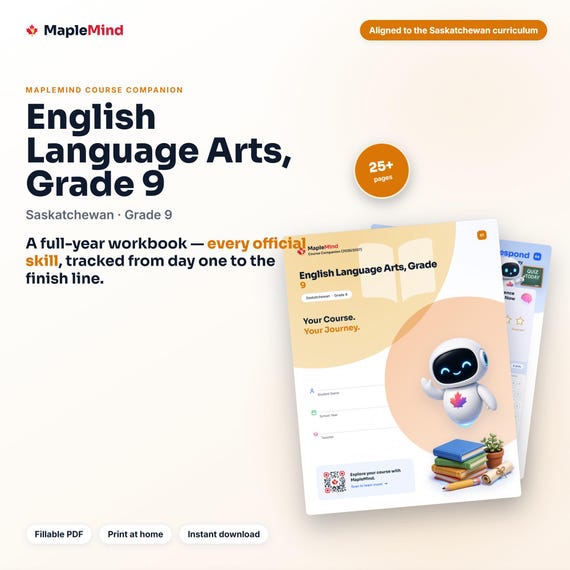
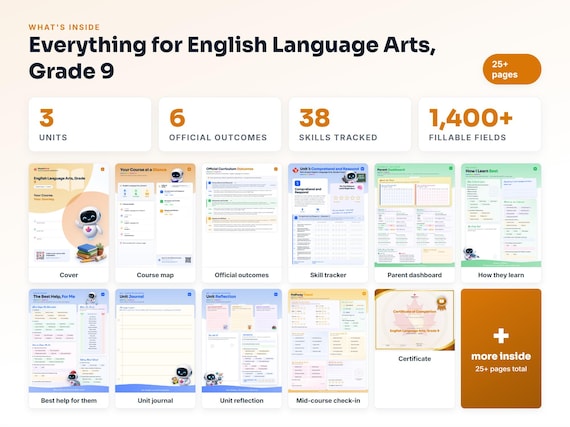
A English Language Arts, Grade 9 workbook worth keeping
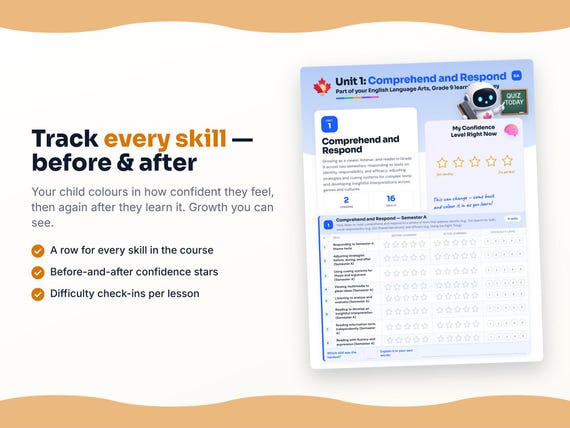
Built from the same official curriculum as this page. Before and after each skill above, your student colours in how sure they feel — so the two of you can see, on one page, what's clicking and what needs another look. It's a quiet way to follow how the year is really going.
By June it's full of their own handwriting: units worked through, confidence grown, a mid-year check-in, notes from parent-teacher night, and a certificate at the end. Less a worksheet, more a record of the year worth keeping on the shelf.
Instant download · see every page, reviews and the full description · five or more workbooks are $2.99 each
What it looks like in the app
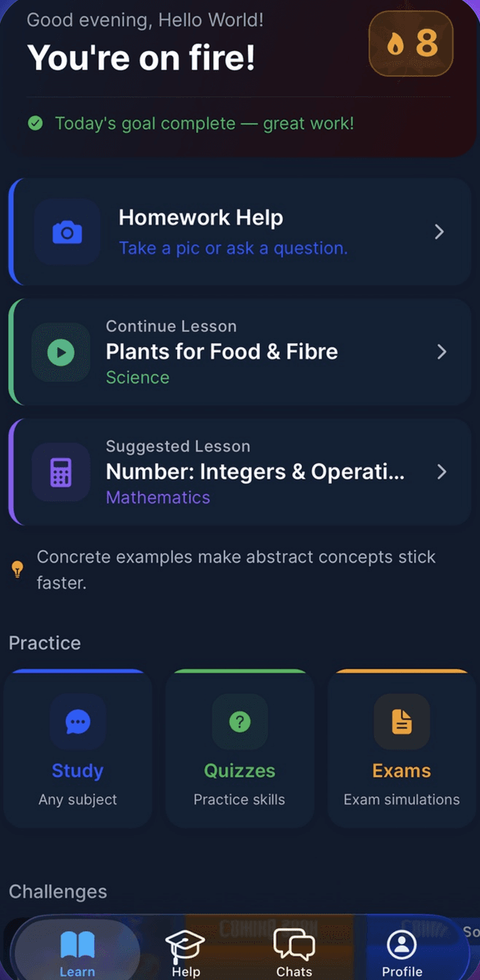
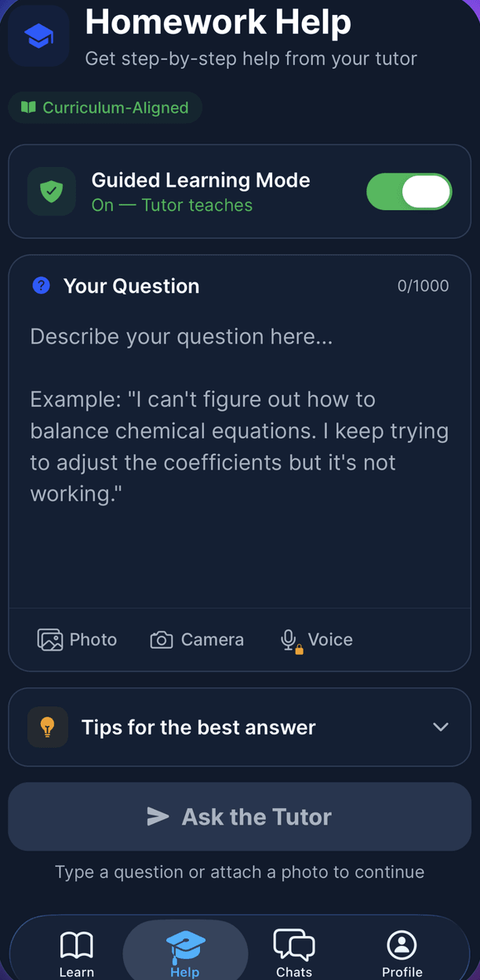
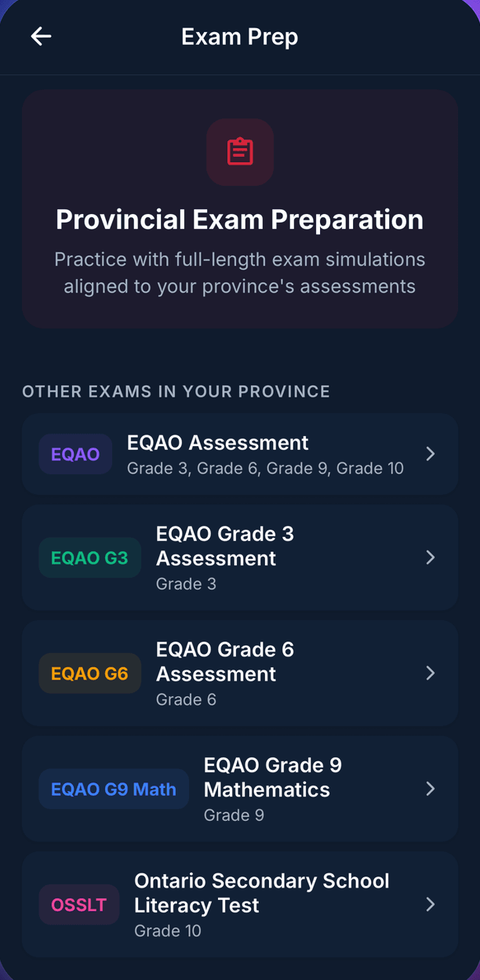
Common questions
Can MapleMind help me with English Language Arts, Grade 9?
Yes. MapleMind's AI tutor covers all 38 skills in Saskatchewan's English Language Arts, Grade 9 — you pick the exact skill, and the tutor teaches it step by step: a short lesson, a worked example, solving together, then a skill check to show it stuck.
Is MapleMind aligned to Saskatchewan's official curriculum?
Yes. Every skill in this course maps to an official outcome code from Saskatchewan's Grade 9 English Language Arts curriculum, and the ministry's own wording is quoted under each unit on this page — with the official government source linked so you can check it yourself.
What does MapleMind cost?
It's free to start — 5 tutoring chats and a practice quiz every day, no credit card. A Pro subscription ($9.99/month or $49.99/year CAD, 7-day free trial) unlocks unlimited tutoring, practice, and exam simulations.
What if I'm stuck on just one topic?
That's the point of skill-level tutoring: open English Language Arts, Grade 9 in the app, tap the exact skill from the list on this page, and the tutor teaches just that — no wading through lessons you don't need.
Does MapleMind work in French or other languages?
Yes — 14 languages, including French. Both the app and the tutor's explanations switch to the language you choose.
Where can I see the official Saskatchewan curriculum for English Language Arts, Grade 9?
The official source is linked on this page — Saskatchewan's official curriculum. The outline here follows it: every MapleMind skill carries its official outcome code, and the ministry's own wording is quoted under each unit.
Keep exploring
Ready when you are
Pick a skill from this page and see it taught properly — free, in the browser, in under a minute.