Get help with English Language Arts, Grade 8
Most tutoring makes you sit through material you already know. MapleMind flips that: pick the exact skill that's causing trouble — any of the 23 below — and the tutor teaches just that one, step by step, as many times as it takes. Ask questions in plain words, any time of day, in English, French, or 12 other languages.
The official Saskatchewan English Language Arts, Grade 8 curriculum
Saskatchewan defines English Language Arts, Grade 8 by strands and outcomes. MapleMind teaches the same curriculum reorganized for one-skill-at-a-time tutoring — the table shows exactly where every official strand lands, and the ministry's own wording is quoted under each unit below.
Official source Saskatchewan's official curriculumRead it on the government site — curriculum.gov.sk.ca ↗| Official strand | Outcomes | Where MapleMind teaches it |
|---|---|---|
| Strand CR | 8 | Comprehend and Respond |
| Strand CC | 9 | Compose and Create |
| Strand AR | 2 | Assess and Reflect |
Every skill below, taught one on one.
 Try the first session free
How MapleMind teaches English Language Arts, Grade 8 — every unit, lesson, and skill
Every skill below runs as a short session: a plain-words lesson, a worked example, solving it together, then a five-question skill check that earns up to three stars. Guided Mode keeps it teaching instead of answer-handing — turning it off needs a parent's password.
Unit 1Comprehend and RespondOfficial strand · Strand CR
Growing as a viewer, listener, and reader in Grade 8: responding analytically to texts on identity, responsibility, and efficacy; evaluating texts for effectiveness, bias, and point of view; and reading and listening across broad genres and cultures.
Responding Analytically and Evaluating Texts
- Responding to becoming-myself textsCR8.1 — View, listen to, read, comprehend, and respond to a variety of texts that address identity.
- Responding to seeking-justice textsCR8.1 — View, listen to, read, comprehend, and respond to a variety of texts that address social responsibility.
- Responding to building-a-better-world textsCR8.1 — View, listen to, read, comprehend, and respond to a variety of texts that address efficacy — building a better world.
- Using inferring and summarizing strategiesCR8.2 — Select and use strategies to construct meaning before, during, and after viewing, listening, and reading, including previewing, making inferences, and paraphrasing and summarizing.
- Using cueing systems for unity and coherenceCR8.3 — Use pragmatic, textual, syntactic, semantic/lexical/morphological, graphophonic, and other cues to construct and confirm meaning.
- Viewing critically to evaluate effectivenessCR8.4 — View critically and understand visual and multimedia texts, including videos, broadcasts, presentations, websites, and news programs, to locate key messages, develop conclusions, and evaluate the text's effectiveness.
- Listening critically to detect biasCR8.5 — Listen critically to understand, gather information, follow directions, form an opinion, and analyze oral presentations for diverse opinions, the presenter's point of view, values, biases, stereotypes, and prejudices.
- Reading to evaluate purpose, values, and biasCR8.6 — Read and understand grade-appropriate prose fiction, poetry, and plays, including First Nations and Métis texts, to evaluate purpose, message, point of view, craft, values, and biases or stereotypes.
- Reading information texts and spotting false reasoningCR8.7 — Read independently and understand a variety of information texts, including main ideas and supporting evidence, connecting new ideas to prior thinking, and recognizing bias or false reasoning.
- Reading with fluency and expressionCR8.8 — Read Grade 8 appropriate texts to increase fluency (140-180 words correct per minute orally; 180-230 silently) and expression.
The official wording — 8 outcomes in this unit
- CR8.1
View, listen to, read, comprehend, and respond to a variety of texts that address identity (e.g., Becoming Myself)
- CR8.2
Select and use appropriate strategies to construct meaning before (e.g., previewing and anticipating message), during (e.g., making inferences based on text and prior knowledge), and after (e.g., paraphrasing and summarizing) viewing, listening, and reading.
- CR8.3
Use pragmatic (e.g., intended audience and tone), textual (e.g., how author organized text to achieve unity and coherence), syntactic (e.g., variety of sentence structures), semantic/lexical/morphological (e.g., imagery), graphophonic (e.g., stress, pitch, and juncture of a word), and other cues (e.g., layout and accompanying graphics) to construct and to confirm meaning.
- CR8.4
View critically and demonstrate comprehension of a variety of visual and multimedia texts including videos, television broadcasts, informational presentations, dramatic presentations, websites, and news programs to locate and interpret key messages and details, to develop conclusions, opinions, and understanding, and to evaluate the effectiveness of the text.
- CR8.5
Listen critically to understand, gather information, follow directions, form an opinion, and analyze oral presentations for diverse opinions, presenter’s point of view, values, and biases, stereotypes, or prejudices.
- CR8.6
Read and demonstrate comprehension and interpretation of grade-appropriate texts including traditional and contemporary prose fiction, poetry, and plays from First Nations, Métis, and other cultures to evaluate the purpose, message, point of view, craft, values, and biases, stereotypes, or prejudices.
- CR8.7
Read independently and demonstrate comprehension of a variety of information texts including understanding the main ideas and supporting evidence, explaining connections between new ideas and information and previous thoughts, and recognizing any biases or false reasoning.
- CR8.8
Read Grade 8 appropriate texts to increase fluency (140-180 wcpm orally; 180-230 silently) and expression.
Unit 2Compose and CreateOfficial strand · Strand CC
Growing as someone who represents, speaks, and writes in Grade 8: creating texts on identity, responsibility, and efficacy; carrying out a group inquiry; writing across broad genres including a documented report; and experimenting with forms and techniques.
Creating Texts and a Group Inquiry
- Creating telling-my-story textsCC8.1 — Create visual, oral, written, and multimedia texts that explore identity.
- Creating examining-popular-culture textsCC8.1 — Create visual, oral, written, and multimedia texts that explore social responsibility.
- Creating turning-point textsCC8.1 — Create visual, oral, written, and multimedia texts that explore efficacy — creating turning points.
- Creating and presenting a group inquiryCC8.2 — Create and present a group inquiry project related to a topic, theme, or issue studied in English language arts.
- Using strategies to communicate meaningCC8.3 — Select and use strategies to communicate meaning before, during, and after speaking, writing, and representing, such as planning to fit purpose and format, maintaining point of view, and revising for effectiveness.
- Using cues to communicate meaningCC8.4 — Use pragmatic, textual, syntactic, semantic/lexical/morphological, graphophonic, and other cues to construct and communicate meaning when creating.
- Creating multimedia presentationsCC8.5 — Create and present visual and multimedia presentations, such as an illustrated report, a role play with tableau, a dramatization, presentation software, or a newscast, to explain, persuade, and entertain.
- Using oral language to interact respectfullyCC8.6 — Use oral language to interact purposefully, confidently, and respectfully in one-to-one, small group, and large group discussions, expressing feelings and viewpoints and contributing to group harmony.
- Using oral language to express complex ideasCC8.7 — Use oral language to effectively express information and ideas of complexity in formal and informal situations, such as debating a point, participating in a meeting, or giving a dramatic reading.
- Writing across broad genresCC8.8 — Write to describe a landscape; narrate a personal or historical story; explain and inform in findings, a biography, a documented research report, and a résumé and cover letter; and persuade in a mini-debate and a review.
- Experimenting with forms and techniquesCC8.9 — Experiment with a variety of text forms, such as Reader's Theatre, role play, an electronic presentation, a dramatization, or a mini-debate, and techniques like imagery, music, and graphics.
The official wording — 9 outcomes in this unit
- CC8.1
Create various visual, oral, written, and multimedia (including digital) texts that explore identity (e.g., Telling One’s Life Story)
- CC8.2
Create and present a group inquiry project related to a topic, theme, or issue studied in English language arts.
- CC8.3
Select and use the appropriate strategies to communicate meaning before (e.g., plan, organize, and sequence ideas to fit purpose, point of view, and format), during (e.g., use and maintain appropriate point of view for audience and purpose), and after (e.g., revise final drafts and presentations to ensure that the format and patterns within that format contribute to the effectiveness of the composition) speaking, writing, and other representing activities.
- CC8.4
Use pragmatic (e.g., use appropriate language register), textual (e.g., use artistic devices such as figurative language), syntactical (e.g., combine sentences to form compound and complex sentences for variety, interest, and effect), semantic/lexical/morphological (e.g., use words to capture a particular aspect of meaning), graphophonic (e.g., correctly pronounce words with proper emphasis), and other cues (e.g, use appropriate sound effects, visuals, and multimedia to enhance presentations) to construct and to communicate meaning.
- CC8.5
Create and present a variety of visual and multimedia presentations including an illustrated report, a role play that ends with a tableau, a dramatization, presentation software, a newscast with adequate detail, clarity, and organization to explain (e.g., an important concept), to persuade (e.g., an opinion on an issue, a mini-debate), and to entertain (e.g., a humourous incident).
- CC8.6
Use oral language to interact purposefully, confidently, and respectfully in a variety of situations including one-to-one, small group, and large group discussions (expressing feelings and viewpoints and contributing to group harmony).
- CC8.7
Use oral language to effectively express information and ideas of complexity in formal and informal situations (e.g., to debate a point, to participate in a meeting, to give a dramatic reading of a poem or play excerpt).
- CC8.8
Write to describe a landscape scene; to narrate a personal story or anecdote and a historical narrative; to explain and inform in a presentation of findings, a biography, a documented research report, and a résumé and covering letter; and to persuade in a mini-debate and a review.
- CC8.9
Experiment with a variety of text forms (e.g., Reader’s Theatre, role play, humourous instructions, an electronic presentation, a dramatization, a mini-debate) and techniques (e.g., imagery, music, graphics and statistics in a multimedia presentation).
Unit 3Assess and ReflectOfficial strand · Strand AR
Thinking about our own learning in Grade 8: using self- and teacher assessment to set improvement goals, and appraising our own and others' work for clarity, correctness, and variety.
Using Assessment and Appraising Work
- Using assessment to set improvement goalsAR8.1 — Use information gathered in self-assessment and the teacher's assessment to develop and work on goals for improving viewing, listening, reading, representing, speaking, and writing.
- Appraising work for clarity, correctness, and varietyAR8.2 — Appraise your own and others' work for clarity, correctness, and variety.
The official wording — 2 outcomes in this unit
- AR8.1
Use information gathered in self-assessment and teacher’s assessment to develop and work on goals for improving viewing, listening, reading, representing, speaking, and writing.
- AR8.2
Appraise own and others’work for clarity, correctness, and variety.
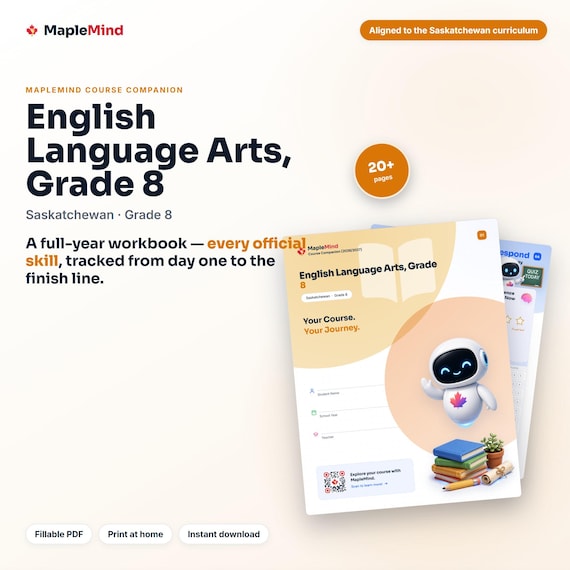
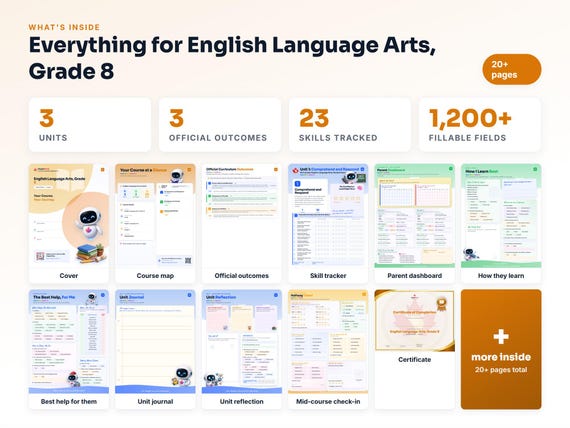
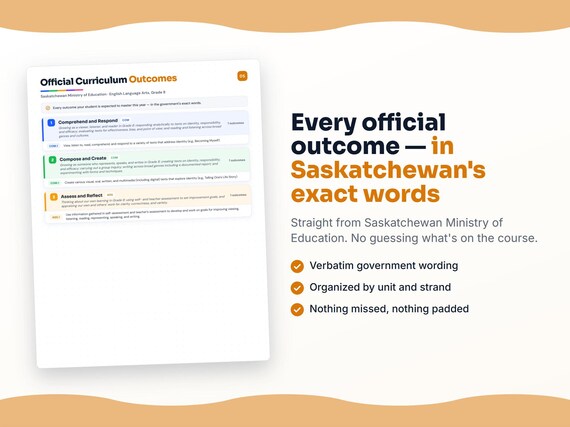
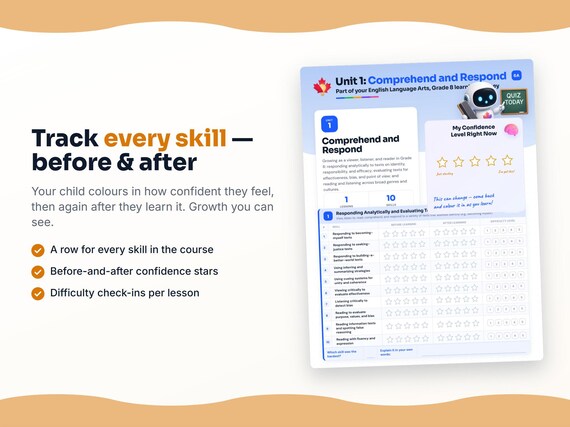
Printable workbook · A keepsake of the year
A English Language Arts, Grade 8 workbook worth keeping
Built from the same official curriculum as this page. Before and after each skill above, your student colours in how sure they feel — so the two of you can see, on one page, what's clicking and what needs another look. It's a quiet way to follow how the year is really going.
By June it's full of their own handwriting: units worked through, confidence grown, a mid-year check-in, notes from parent-teacher night, and a certificate at the end. Less a worksheet, more a record of the year worth keeping on the shelf.
Instant download · see every page, reviews and the full description · five or more workbooks are $2.99 each
What it looks like in the app



Common questions
Can MapleMind help me with English Language Arts, Grade 8?
Yes. MapleMind's AI tutor covers all 23 skills in Saskatchewan's English Language Arts, Grade 8 — you pick the exact skill, and the tutor teaches it step by step: a short lesson, a worked example, solving together, then a skill check to show it stuck.
Is MapleMind aligned to Saskatchewan's official curriculum?
Yes. Every skill in this course maps to an official outcome code from Saskatchewan's Grade 8 English Language Arts curriculum, and the ministry's own wording is quoted under each unit on this page — with the official government source linked so you can check it yourself.
What does MapleMind cost?
It's free to start — 5 tutoring chats and a practice quiz every day, no credit card. A Pro subscription ($9.99/month or $49.99/year CAD, 7-day free trial) unlocks unlimited tutoring, practice, and exam simulations.
What if I'm stuck on just one topic?
That's the point of skill-level tutoring: open English Language Arts, Grade 8 in the app, tap the exact skill from the list on this page, and the tutor teaches just that — no wading through lessons you don't need.
Does MapleMind work in French or other languages?
Yes — 14 languages, including French. Both the app and the tutor's explanations switch to the language you choose.
Where can I see the official Saskatchewan curriculum for English Language Arts, Grade 8?
The official source is linked on this page — Saskatchewan's official curriculum. The outline here follows it: every MapleMind skill carries its official outcome code, and the ministry's own wording is quoted under each unit.
Keep exploring
Ready when you are
Pick a skill from this page and see it taught properly — free, in the browser, in under a minute.