Get help with English Language Arts A10 / B10
Most tutoring makes you sit through material you already know. MapleMind flips that: pick the exact skill that's causing trouble — any of the 28 below — and the tutor teaches just that one, step by step, as many times as it takes. Ask questions in plain words, any time of day, in English, French, or 12 other languages.
The official Saskatchewan English Language Arts A10 / B10 curriculum
Saskatchewan defines English Language Arts A10 / B10 by strands and outcomes. MapleMind teaches the same curriculum reorganized for one-skill-at-a-time tutoring — the table shows exactly where every official strand lands, and the ministry's own wording is quoted under each unit below.
Official source Saskatchewan's official curriculumRead it on the government site — curriculum.gov.sk.ca ↗| Official strand | Outcomes | Where MapleMind teaches it |
|---|---|---|
| Strand CR | 8 | Comprehend and Respond (Semester A) · Comprehend and Respond (Semester B) |
| Strand CC | 8 | Compose and Create (Semester A) · Compose and Create (Semester B) |
| Strand AR | 4 | Assess and Reflect (Semester A) · Assess and Reflect (Semester B) |
Every skill below, taught one on one.
 Try the first session free
How MapleMind teaches English Language Arts A10 / B10 — every unit, lesson, and skill
Every skill below runs as a short session: a plain-words lesson, a worked example, solving it together, then a five-question skill check that earns up to three stars. Guided Mode keeps it teaching instead of answer-handing — turning it off needs a parent's password.
Unit 1Comprehend and Respond (Semester A)Official strand · Strand CR
Semester A viewing, listening, and reading: comprehending and responding critically and personally to First Nations, Métis, Saskatchewan, Canadian, and international texts on foundational stories, life's challenges, and human existence.
Responding to Foundational Stories, Life's Challenges, and Human Existence
- Responding to identity texts (Foundational Stories)CR A10.1 — Comprehend and respond, personally and critically, to visual, oral, print, and multimedia texts about identity, drawing prominently on First Nations and Métis foundational stories.
- Viewing and critically responding to film and mediaCR A10.2 — View, interpret, summarize, and draw conclusions about illustrations, charts, graphs, and television, film, and video presentations, including a documentary or current affairs program.
- Listening critically to talks, interviews, and discussionsCR A10.3 — Listen to, interpret, summarize, and draw conclusions about literary and informational texts including group discussions, oral readings, interviews, and prepared talks about a topic being studied.
- Reading and interpreting literary and informational textsCR A10.4 — Read, interpret, and draw conclusions about ideas, information, concepts, and themes in literary (poems, plays, essays, short stories, novels) and informational (magazines, newspapers, on-line) texts.
The official wording — 4 outcomes in this unit
- CR A10.1
Comprehend and respond to a variety of visual, oral, print, and multimedia texts that address: • identity (e.g., Foundational Stories);
- CR A10.2
View, interpret, summarize, and draw conclusions about the ideas and information presented in a variety of illustrations, charts, graphs, and television, film, and video presentations including a documentary or current affairs program.
- CR A10.3
Listen to, interpret, summarize, and draw conclusions about the ideas and information presented in a variety of literary and informational texts including group discussions, oral readings, interviews, and prepared talks about a topic being studied.
- CR A10.4
Read, interpret, and draw conclusions about the ideas, information, concepts, and themes presented in a variety of literary (including poems, plays, essays, short stories, novels) and informational (including magazines, newspapers, and on-line information) texts.
Unit 2Compose and Create (Semester A)Official strand · Strand CC
Semester A representing, speaking, and writing: composing and creating texts that explore foundational stories, life's challenges, and human existence, including a research inquiry, presentations, formal talk, and written literary and informational forms.
Composing on Foundational Stories, Life's Challenges, and Human Existence
- Composing identity texts (Foundational Stories)CC A10.1 — Compose and create visual, multimedia, oral, and written texts that explore identity, with a clear thesis, supporting details, and appropriate voice.
- Presenting key ideas with charts, drama, and mediaCC A10.2 — Explain and present to a familiar audience key ideas and events through an appropriate combination of charts, diagrams, sound, models, drama, and print.
- Speaking in formal and informal situationsCC A10.3 — Use oral language to express information and ideas in formal (a prepared talk, an oral reading of prose or poetry, retelling a narrative) and informal (discussion and group work) situations.
- Writing literary and informational textsCC A10.4 — Compose and create written literary (a historical persona essay and a review) and informational (an observation report and a researched or technical report) texts, attending to purpose, speaker, audience, and form.
The official wording — 4 outcomes in this unit
- CC A10.1
Compose and create a range of visual, multimedia, oral, and written texts that explore: • identity (e.g., Foundational Stories);
- CC A10.2
Explain and present to a familiar audience the key ideas and events (actual or based on a text studied) through an appropriate combination of charts, diagrams, sound, models, drama, and print.
- CC A10.3
Use oral language to express a range of information and ideas in formal (including a prepared talk on a familiar topic, an oral presentation of a passage of prose or poetry, retelling a narrative or recounting an experience or event) and informal (discussion and group work) situations.
- CC A10.4
Compose and create a variety of written literary (including a historical persona essay and a review) and informational (including an observation [eye-witness] report and researched or technical report) texts attending to various elements of discourse (e.g., purpose, speaker, audience, form).
Unit 3Assess and Reflect (Semester A)Official strand · Strand AR
Semester A metacognition: establishing criteria to evaluate own and others' work and setting personal language-learning goals with strategies to grow.
Evaluating Work and Setting Goals (Semester A)
- Building and applying criteria to evaluate workAR A10.1 — Establish and apply criteria to evaluate your own and others' work, including contributing to rubrics and using feedback to set goals.
- Setting language-learning goals and strategiesAR A10.2 — Set personal language-learning goals and select strategies to enhance growth, including using language to recognize and celebrate accomplishments.
The official wording — 2 outcomes in this unit
- AR A10.1
Establish and apply criteria to evaluate own and others’work.
- AR A10.2
Set personal language learning goals and select strategies to enhance growth in language learning.
Unit 4Comprehend and Respond (Semester B)Official strand · Strand CR
Semester B viewing, listening, and reading: comprehending and responding to texts on diversity of being, degrees of responsibility, and justice and fairness, testing ideas and values and analyzing texts in historical and cultural context.
Responding to Diversity, Responsibility, and Justice
- Responding to identity texts (Diversity of Being)CR B10.1 — Comprehend and respond, personally and critically, to texts about identity through the lens of the diversity of being, including First Nations and Métis resources.
- Viewing and reporting from multiple sourcesCR B10.2 — View, interpret, and report on ideas and information from more than one source to develop and support positions on topics including identity, social responsibility, and personal agency.
- Listening and judging ideas criticallyCR B10.3 — Listen to, comprehend, interpret, and summarize information and ideas in literary and informational texts including group discussion, oral readings, interviews, prepared talks, and a talk-back show.
- Reading classical and contemporary textsCR B10.4 — Read, interpret, and summarize classical and contemporary literary (drama, biography, autobiography, poetry, short stories, novels) and informational (letters, diaries, memoranda, electronic communications) texts.
The official wording — 4 outcomes in this unit
- CR B10.1
Comprehend and respond to a variety of visual, oral, print, and multimedia texts that address: • identity (e.g., Diversity of Being);
- CR B10.2
View, interpret, and report on ideas and information from more than one source to develop and support positions on various topics related to the course including identity, social responsibility, and personal agency.
- CR B10.3
Listen to, comprehend, interpret, and summarize information and ideas presented in a variety of literary and informational texts including group discussion, oral readings, interviews, prepared talks, and a talk-back show about a topic or issue being studied.
- CR B10.4
Read, interpret, and summarize a wide variety of classical and contemporary literary (including drama, biography, autobiography, poetry, short stories, novels) and informational (including letters, diaries, memoranda, electronic communications) texts.
Unit 5Compose and Create (Semester B)Official strand · Strand CC
Semester B representing, speaking, and writing: composing texts on diversity, responsibility, and justice; researching an issue; delivering a research talk; and writing business, literary, and problem-solution communications.
Composing on Diversity, Responsibility, and Justice
- Composing identity texts (Diversity of Being)CC B10.1 — Compose and create texts that explore identity through the diversity of being, developing and articulating a defensible point of view.
- Creating a research presentationCC B10.2 — Create and present a visual or multimedia presentation supporting a prepared talk on a researched issue, using digital or other presentation tools.
- Speaking to inform and persuadeCC B10.3 — Use oral language in formal (a prepared talk on a researched issue, an interview, an oral reading, defence of a personal point of view) and informal (discussion and group work) situations.
- Writing business and literary communicationsCC B10.4 — Create written informational (a business letter, biographical profile, problem-solution essay) and literary (fictionalized journal entries, a short script) communications.
The official wording — 4 outcomes in this unit
- CC B10.1
Compose and create a range of visual, multimedia, oral, and written texts to explore: • identity (e.g., Diversity of Being);
- CC B10.2
Create and present a visual or multimedia presentation supporting a prepared talk on a researched issue, using either digital or other presentation tools.
- CC B10.3
Use oral language to express a range of information and ideas in formal (including a prepared talk on a researched issue, an interview, an oral reading of prose or poetry, and an explanation and defence of a personal point of view) and informal (including discussion and group work) situations.
- CC B10.4
Create a variety of written informational (including a business letter, biographical profile, problem- solution essay) and literary (including fictionalized journal entries and a short script) communications.
Unit 6Assess and Reflect (Semester B)Official strand · Strand AR
Semester B metacognition: applying criteria to evaluate own and others' work as a communicator, and setting personal language-learning goals with strategies to grow.
Evaluating Work and Setting Goals (Semester B)
- Evaluating communication against criteriaAR B10.1 — Establish and apply criteria to evaluate your own and others' work, using feedback to evaluate your effectiveness as a communicator and to set goals.
- Setting goals and celebrating growthAR B10.2 — Set personal language-learning goals and select strategies to enhance growth, including using language to describe and discuss achievements.
The official wording — 2 outcomes in this unit
- AR B10.1
Establish and apply criteria to evaluate own and others’work.
- AR B10.2
Set personal language learning goals and select strategies to enhance growth in language learning.
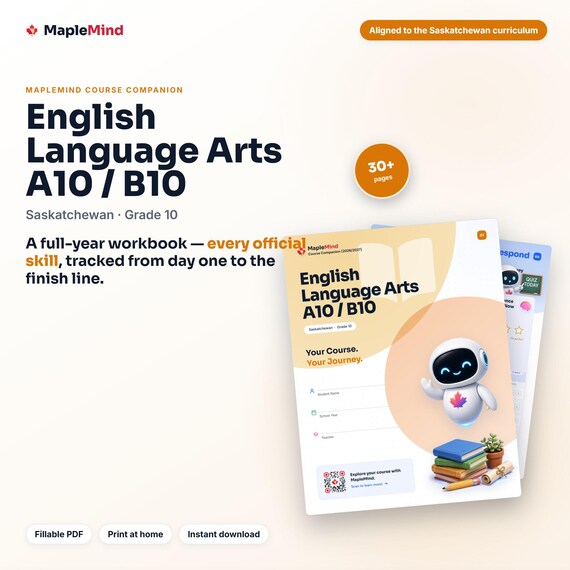
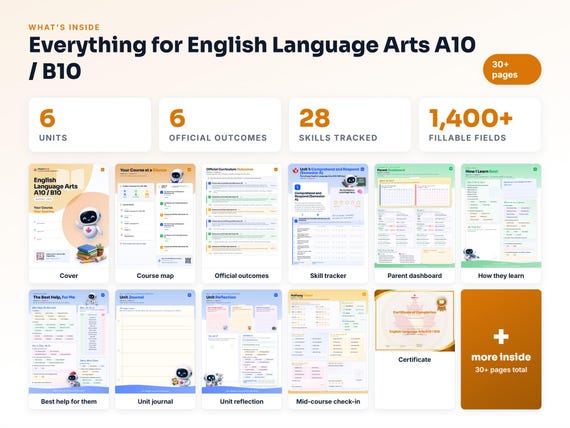
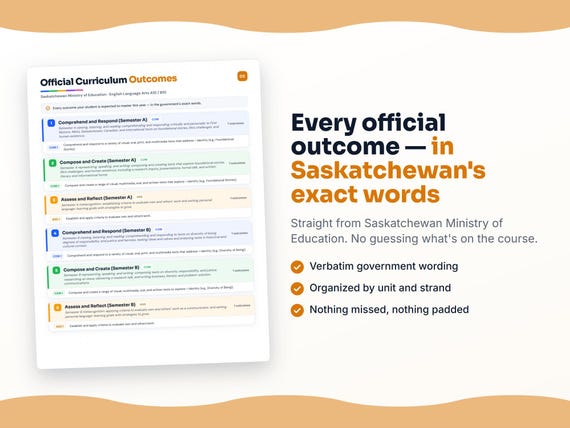
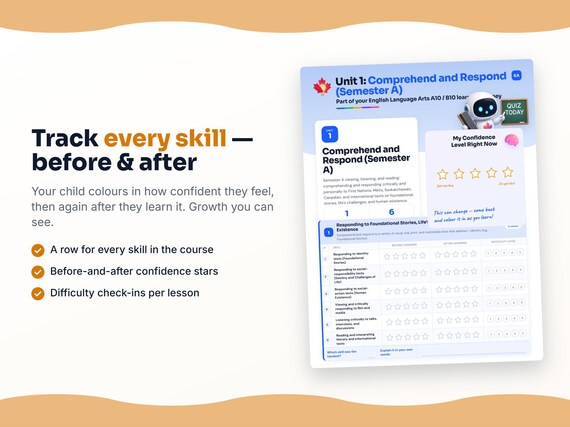
Printable workbook · A keepsake of the year
A English Language Arts A10 / B10 workbook worth keeping
Built from the same official curriculum as this page. Before and after each skill above, your student colours in how sure they feel — so the two of you can see, on one page, what's clicking and what needs another look. It's a quiet way to follow how the year is really going.
By June it's full of their own handwriting: units worked through, confidence grown, a mid-year check-in, notes from parent-teacher night, and a certificate at the end. Less a worksheet, more a record of the year worth keeping on the shelf.
Instant download · see every page, reviews and the full description · five or more workbooks are $2.99 each
What it looks like in the app



Common questions
Can MapleMind help me with English Language Arts A10 / B10?
Yes. MapleMind's AI tutor covers all 28 skills in Saskatchewan's English Language Arts A10 / B10 — you pick the exact skill, and the tutor teaches it step by step: a short lesson, a worked example, solving together, then a skill check to show it stuck.
Is MapleMind aligned to Saskatchewan's official curriculum?
Yes. Every skill in this course maps to an official outcome code from Saskatchewan's Grade 10 English Language Arts curriculum, and the ministry's own wording is quoted under each unit on this page — with the official government source linked so you can check it yourself.
What does MapleMind cost?
It's free to start — 5 tutoring chats and a practice quiz every day, no credit card. A Pro subscription ($9.99/month or $49.99/year CAD, 7-day free trial) unlocks unlimited tutoring, practice, and exam simulations.
What if I'm stuck on just one topic?
That's the point of skill-level tutoring: open English Language Arts A10 / B10 in the app, tap the exact skill from the list on this page, and the tutor teaches just that — no wading through lessons you don't need.
Does MapleMind work in French or other languages?
Yes — 14 languages, including French. Both the app and the tutor's explanations switch to the language you choose.
Where can I see the official Saskatchewan curriculum for English Language Arts A10 / B10?
The official source is linked on this page — Saskatchewan's official curriculum. The outline here follows it: every MapleMind skill carries its official outcome code, and the ministry's own wording is quoted under each unit.
Keep exploring
Ready when you are
Pick a skill from this page and see it taught properly — free, in the browser, in under a minute.