Provincial assessment · Saskatchewan
Saskatchewan Student Assessment: Grade 9 Mathematics (SSA)
- Grade 9
Dates and details can change. We do our best to keep this page up to date, but check the official sources before relying on it.
- Total time
- 2 h
- Marked questions
- 50
- Parts
- 2
- Calculator
- Approved models
- Format
- On a computer
Saskatchewan Grade 9 Math Assessment practice test
The whole exam or the parts you choose, in its own format, on the clock.
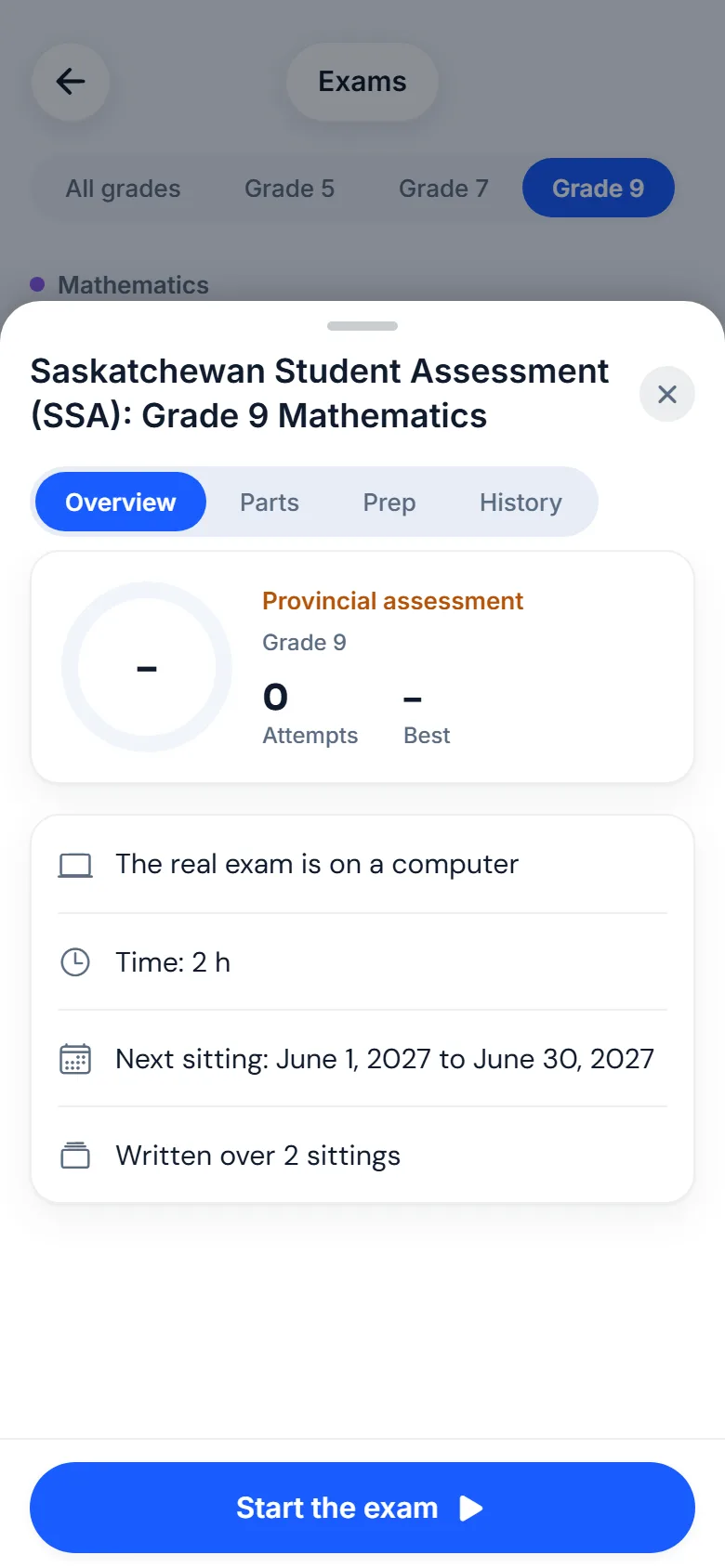 The exam in the app
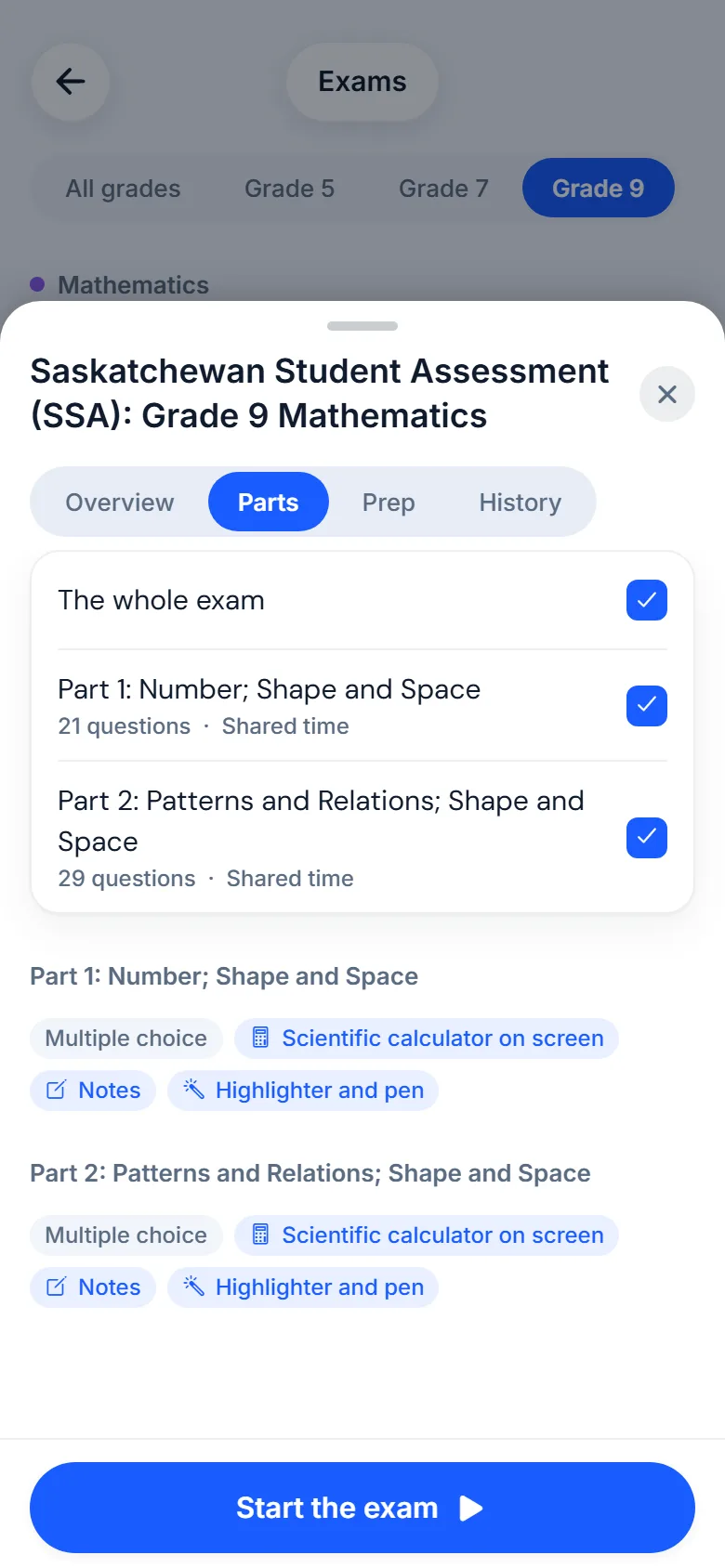 Its parts, and what you can use in each
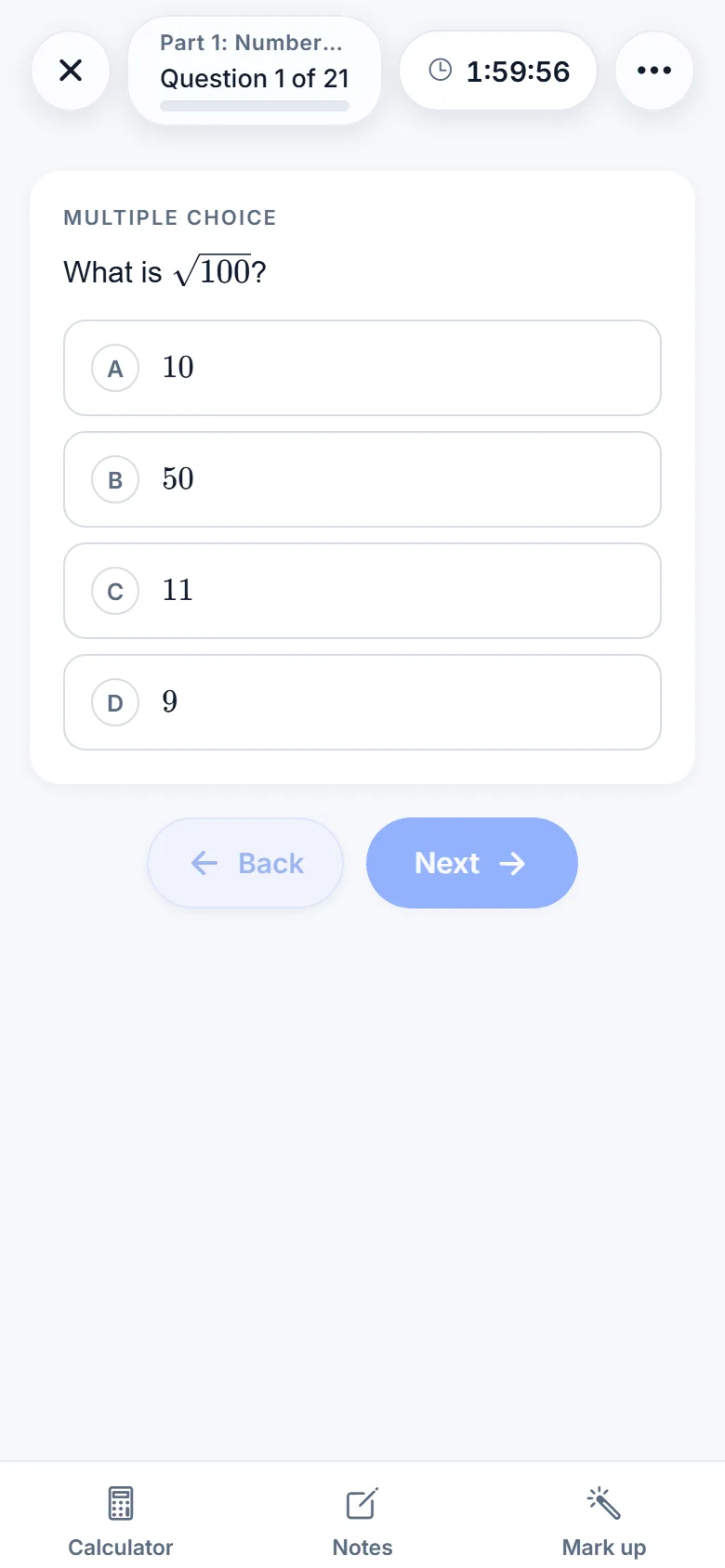 A question, timed, with the exam’s tools
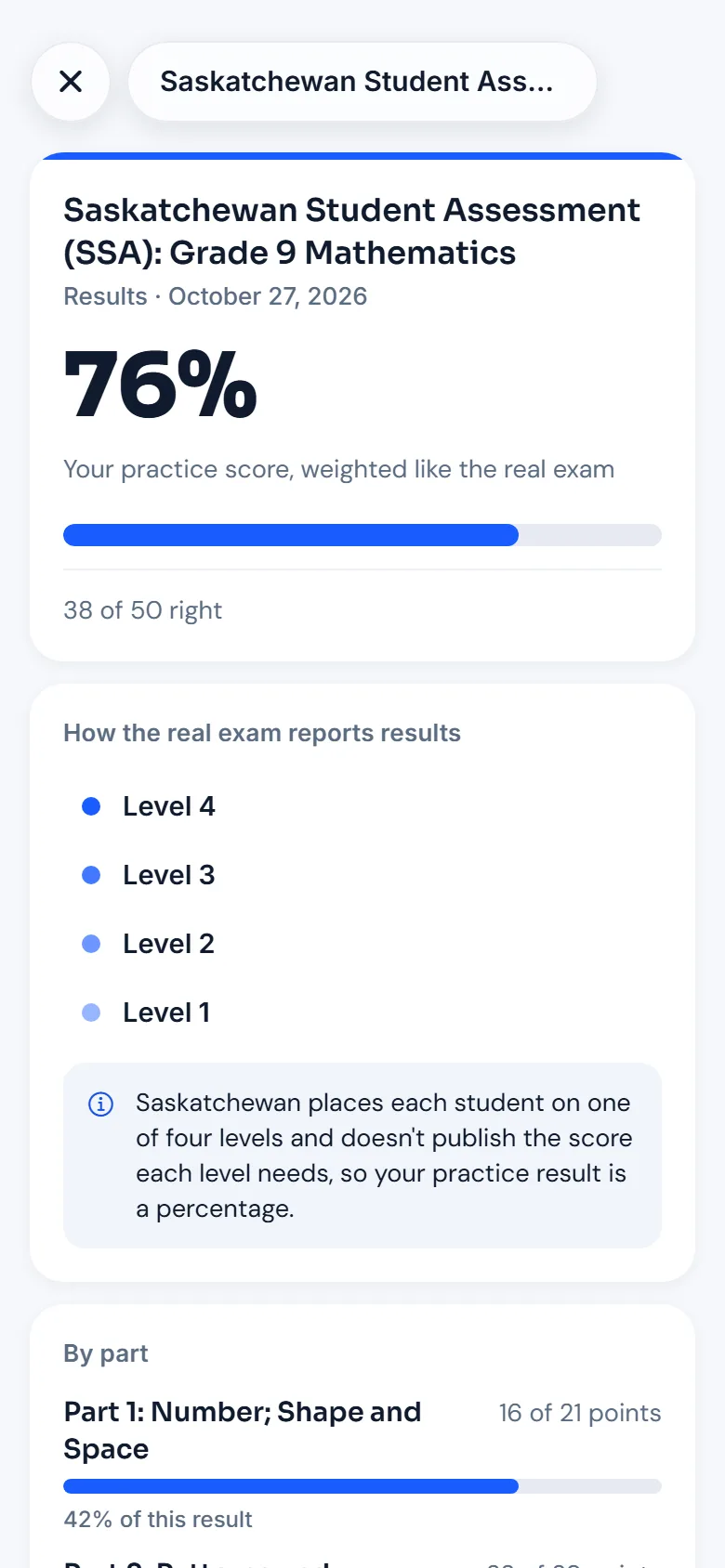 The marked result, part by part
A practice run of Saskatchewan’s Grade 9 math assessment.
Free with a MapleMind account
When
June 2027
- June 1 to June 30, 2027School day · Grade 9 Mathematics Assessment, Parts 1 and 2 (the teacher schedules both sittings within the two-week window)
The dates are Saskatchewan’s own, read on September 29, 2026. See the official schedule (publications.saskatchewan.ca)
What’s on it
- Number
- Patterns and Relations
- Shape and Space
- Statistics and Probability
Each topic’s share of the marks isn’t published.
The skills it tests · 25 skills
- Adding and subtracting polynomials
- Chord and tangent properties
- Comparing and graphing inequalities
- Comparing and ordering rational numbers
- Composite problems and approximation
- Estimating square roots of rationals
- Evaluating powers and the zero exponent
- Exponent laws and situational questions
- Graphing and analyzing linear relations
- Inscribed and central angles
- Interpolating and extrapolating
- Line symmetry
- Modeling and identifying polynomials
- Multiplying and dividing by a monomial
- Operations with rational numbers
- Representing powers
- Rotation symmetry
- Scale diagrams and scale factors
- Similar polygons
- Solving and verifying inequalities
- Solving one- and two-step equations
- Square roots of perfect-square rationals
- Surface area of composite objects
- Variable on both sides and brackets
- Writing linear equations
How it’s built
Multiple-choice questions.
- Part 1: Number; Shape and Space
- Questions
- 21
- Marks
- 21
- Of the marks
- 42%
- Multiple choice
Multiple-choice questions, some where you drag answers into place or choose all that apply, on powers and exponent laws, rational numbers, square roots, surface area and symmetry.
- Part 2: Patterns and Relations; Shape and Space
- Questions
- 29
- Marks
- 29
- Of the marks
- 58%
- Multiple choice
Multiple-choice questions, some where you drag answers into place, on linear relations and their graphs, linear equations, inequalities, polynomials, circle properties and scale diagrams.
How it’s marked
- Level 1
- Level 2
- Level 3
- Level 4
A computer marks your answers. There is no pass mark: you're placed at one of four achievement levels, compared with the provincial standard, and your family gets a report showing where you are.
On the day
- Sitting 1Part 1: number, and shape and space.
- Sitting 2Part 2: patterns and relations, and more shape and space. Your teacher schedules both sittings within a two-week window.
The real assessment is online, in two sittings of about 120 minutes in all. The platform's scientific calculator is on in both parts. Once you submit a part, you can't reopen it.
Getting ready
4 official documents to practise with, and 5 tips.
Official practice
- Grade 9 Math Practice Assessment, Parts 1 and 2 (English and French)studentassessment.saskatchewan.ca
- Saskatchewan Student Assessment Program Overviewpublications.saskatchewan.ca
- Saskatchewan Student Assessment Frequently Asked Questionspublications.saskatchewan.ca
- Saskatchewan Student Assessment 2026‑27 Family Fact Sheetpublications.saskatchewan.ca
Tips from the people who write it
- You don't need extra study for it: it covers the Saskatchewan curriculum you already learn in class.
- Try the ministry's practice assessment. It's about the same length as the real one, with the same kinds of questions.
- Read each question carefully, and don't spend too long on any one.
- Try to answer every question. Once you finish a part, you can't go back to it.
- Before the assessment, practise logging in with the Platform Exploration activity.
After the exam
- Results
School divisions share the results with students and families soon after the assessment.
- Marks
It’s based on what students already learn in class; sample assessments are online for getting used to the format.
From Saskatchewan Student Assessment: information for parents and caregivers, 2026–27 (publications.saskatchewan.ca), read on October 27, 2026.
More for you
Students
Read what’s on it, then write full practice exams under the real time limit.
Practise itParents
Put the dates on the family calendar. The Parent Dashboard shows each practice exam’s result and the skills that need another look.
See the Parent DashboardEducators
The official practice above makes a review plan. Students can practise each skill on its own in MapleMind, free with daily limits.
For schools
Questions about this exam
When is the SSA in 2026–27?
The next sitting is June 1 to June 30, 2027.
How long is the SSA?
It takes 2 hours in all, over 2 parts.
How many questions are on the SSA?
It has 50 marked questions: 21 in Part 1: Number; Shape and Space and 29 in Part 2: Patterns and Relations; Shape and Space.
Can you use a calculator on the SSA?
Yes, a calculator from the approved list.
How are SSA results reported?
At 4 levels: Level 1, Level 2, Level 3 and Level 4.
Where can I find practice tests for the SSA?
Saskatchewan publishes Grade 9 Math Practice Assessment, Parts 1 and 2 (English and French) and Saskatchewan Student Assessment Frequently Asked Questions. MapleMind also builds a full practice exam in its format, free with an account.

Practise for the SSA
Every skill on the SSA, taught one at a time, then practised on questions written like the real ones.


