Prince Edward Island · For parents

What your child learns in Grade 11 in Prince Edward Island

Every subject, unit by unit, from Prince Edward Island’s curriculum: 380 skills in plain words.

Subjects
5
Skills
380
Provincial exams
None
Official curriculum
princeedwardisland.ca

Math in Grade 11

5 courses. Choose the one your child takes.

Applied Mathematics

MAT801A · 6 units · 46 skills

  1. Unit 1

    Number

    A fraction names equal parts of a whole or a set.

    • Simple fractional parts
    • Fractions and mixed numbers
    • Renaming fractions
    1 more skill
    • Comparing and ordering fractions
  2. Unit 2

    Operations

    Rounding to friendly numbers makes an estimate quick.

    • Mental math and estimation strategies
    • Applying estimation in problems
    • Operations with integers and decimals
    13 more skills
    • Adding and subtracting fractions
    • Fraction problems
    • Common fractions to decimals
    • Decimals to sixteenths
    • Adding and subtracting denominate numbers
    • Multiplying and dividing denominate numbers
    • Converting measurements mentally
    • Converting measurements using rate
    • Ratio and rafter proportions
    • Estimating materials and cost
    • Percent in problems
    • Lineal feet and board feet
    • Dry cells in series and parallel
  3. Unit 3

    Patterns and Relations

    In a right triangle, a squared plus b squared equals c squared.

    • Identifying right angles
    • Scale developments
    • Rafter length with Pythagoras
    7 more skills
    • Solving for a side with Pythagoras
    • Equivalent resistance
    • Ohm's Law
    • Analysing series and parallel circuits
    • Electrical power
    • Electrical energy
    • Perimeter and surface area patterns
  4. Unit 4

    Measurement

    Metric rulers and tapes read in millimetres, centimetres, and metres.

    • Metric measuring devices
    • Imperial measuring devices
    • Scale measuring devices
    1 more skill
    • Electrical measuring devices
  5. Unit 5

    Geometry (Spatial Sense)

    A mat plan shows how many cubes stand on each square of a base.

    • Shapes from mat plans and orthographic drawings
    • Orthographic drawings from mat plans
    • Isometric drawings from mat plans
    8 more skills
    • Identifying composite isometric drawings
    • Hidden and missing lines
    • Isometric and orthographic conversion
    • Perimeter of polygons and circles
    • Surface areas of polygons, circles and prisms
    • Volumes of right prisms
    • Surface area and volume patterns
    • Constructing right prisms
  6. Unit 6

    Data Management

    A table, tally, or chart makes data easier to read and total.

    • Organizing and compiling data

Apprenticeship and Workplace Mathematics 11

MAT521K · 3 units · 30 skills

  1. Unit 1

    Geometry

    The Pythagorean theorem finds a side from the other two.

    • Solving with a single right triangle
    • Solving with two and three right triangles
    • Reading and stating scale
    8 more skills
    • Scaling up and scaling down
    • Solving scale problems
    • Top, front and side views
    • Isometric drawings of 3-D objects
    • Building an object from its views
    • Exploded views
    • Component-part drawings
    • Scale diagrams of simple 3-D objects
  2. Unit 2

    Measurement

    Surface area is the total area of all faces.

    • Surface area of prisms
    • Surface area of cylinders and curved solids
    • Composite surface area and verifying solutions
    3 more skills
    • Volume of prisms and cylinders
    • Volume of cones, pyramids and spheres
    • Capacity and converting volume to capacity
  3. Unit 3

    Number

    Numerical reasoning finds and uses number patterns.

    • Strategies for numerical puzzles
    • Analysing why a numerical strategy works
    • Building a personal budget
    10 more skills
    • Adjusting a budget to a goal
    • Making budget decisions
    • Understanding compound interest
    • Computing compound interest
    • Compound interest in saving and borrowing
    • Accounts and transaction services
    • Fees and managing an account
    • Online banking and account security
    • Credit cards and their cost
    • Loans and comparing credit options

Foundations of Mathematics 11

MAT521A · 4 units · 29 skills

  1. Unit 1

    Geometry

    A proof states each claim with a reason from a known rule.

    • Deriving angle-property proofs
    • Deriving triangle-property proofs
    • Building and presenting geometric proofs
    6 more skills
    • Solving angle-property problems
    • Solving triangle-property problems
    • Congruent-triangle problems
    • The cosine law
    • The sine law
    • Choosing between the sine and cosine laws
  2. Unit 2

    Logical Reasoning

    Inductive reasoning generalizes from specific observations.

    • Inductive reasoning and conjectures
    • Deductive reasoning and proof
    • Analysing reasoning and finding errors
    2 more skills
    • Strategies for spatial puzzles
    • Analysing why a strategy wins
  3. Unit 3

    Measurement

    A rate compares two quantities with different units (km/h, $/kg).

    • Understanding and computing rates
    • Solving problems with rates
    • Reading scale diagrams
    5 more skills
    • Creating scale diagrams
    • Solving scale-diagram problems
    • Scale factor and length
    • Scale factor and area
    • Scale factor on 3-D objects
  4. Unit 4

    Relations and Functions

    The boundary line is solid for ≤/≥ and dashed for </>.

    • Graphing a linear inequality
    • Solving systems of linear inequalities
    • Modelling problems with inequality systems
    4 more skills
    • The vertex of a quadratic function
    • Intercepts of a quadratic function
    • Domain and range of a quadratic function
    • Axis of symmetry of a quadratic function

Pre-Calculus 11

MAT521B · 3 units · 35 skills

  1. Unit 1

    Algebra and Number

    The absolute value |a| is the distance of a from zero, always non-negative.

    • Absolute value of real numbers
    • Simplifying and operating on numerical radicals
    • Radicals with variable radicands
    5 more skills
    • Solving radical equations
    • Equivalent forms of rational expressions
    • Multiplying and dividing rational expressions
    • Adding and subtracting rational expressions
    • Solving rational equations
  2. Unit 2

    Relations and Functions

    For a = 1, find two numbers that multiply to c and add to b.

    • Factoring trinomials
    • Factoring differences of squares
    • Absolute value of linear functions
    19 more skills
    • Absolute value of quadratic functions
    • Vertex and direction of opening from vertex form
    • Domain, range and axis of symmetry from vertex form
    • Intercepts from vertex form
    • Vertex and axis from general form
    • Intercepts, domain and range from general form
    • Solving problems with quadratic functions
    • Solving quadratic equations by factoring
    • Solving quadratic equations with the quadratic formula
    • Non-linear systems graphically
    • Non-linear systems algebraically
    • Linear and quadratic inequalities in two variables
    • Quadratic inequalities in two variables
    • Quadratic inequalities in one variable
    • Arithmetic sequences
    • Arithmetic series
    • Geometric sequences
    • Geometric series
    • Reciprocals of linear functions
  3. Unit 3

    Trigonometry

    An angle in standard position has its vertex at the origin and initial arm on the positive x-axis.

    • Angles in standard position
    • Trig ratios from the terminal arm
    • Solving problems with the ratios over 0° to 360°
    2 more skills
    • Applying the cosine and sine laws
    • The ambiguous case of the sine law

Pre-Calculus Elective

MAT521E · 4 units · 34 skills

  1. Unit 1

    Financial Mathematics

    Compound interest adds each period's interest to the principal before the next period.

    • Wages, salary and contracts
    • Commission and piecework
    • Gross and net pay
    6 more skills
    • Calculating compound interest
    • Using compound interest in decisions
    • Comparing the costs of renting, leasing and buying
    • Weighing the benefits of renting, leasing and buying
    • Building a budget
    • Adjusting a budget to circumstances
  2. Unit 2

    Geometry

    A point marks a location; a line extends without end in both directions.

    • Points, lines, segments and planes
    • Angles and 2-D figures
    • Identifying parallel and perpendicular lines
    5 more skills
    • Angle relationships from parallel and perpendicular lines
    • Classifying triangles
    • Side and angle relationships in triangles
    • Congruence conditions
    • Solving problems with congruent triangles
  3. Unit 3

    Logical Reasoning

    Inductive reasoning generalizes from specific cases.

    • Making conjectures inductively
    • Testing conjectures and solving problems
    • Conditional statements and their forms
    6 more skills
    • Valid arguments and reasoning errors
    • Proving conjectures deductively
    • Deductive reasoning in problem solving
    • Writing geometric proofs
    • Writing algebraic proofs
    • Proof by contradiction
  4. Unit 4

    Permutations, Combinations and Binomial Theorem

    Probability = favourable outcomes / total outcomes for equally likely cases.

    • Theoretical probability of an event
    • Experimental probability
    • Odds and probability
    5 more skills
    • Assessing probability statements
    • Independent events
    • Dependent events
    • Mutually exclusive events
    • Events that are not mutually exclusive

Science in Grade 11

3 courses. Choose the one your child takes.

Biology 11 (BIO521A)

4 units · 29 skills

  1. Unit 1

    Working Like a Biologist

    Medical technologies are developed through scientific research over time.

    • Analysing a diagnostic or treatment technology
    • Safe laboratory protocols
    • Collecting and analysing data
    5 more skills
    • Uncertainty in measurement
    • Evaluating phenomena with argumentation
    • Designing a controlled experiment
    • Communicating research and results
    • Constructing an argument from evidence and perspectives
  2. Unit 2

    The Cell

    Water's structure gives it properties essential to living systems.

    • Water and the biochemical compounds
    • Polymers: synthesis and hydrolysis
    • The membrane and passive transport
    2 more skills
    • Active transport and bulk transport
    • Photosynthesis, respiration, and the energy cycle
  3. Unit 3

    Maintaining Dynamic Equilibrium: Homeostasis and the Body Systems

    Homeostasis is maintaining a steady internal environment - a dynamic equilibrium.

    • Homeostasis and interdependent organ systems
    • The heart and blood flow
    • Blood vessels, blood, and homeostasis
    12 more skills
    • Respiratory parts and the mechanics of breathing
    • Gas transport, lung volumes, and homeostasis
    • Mechanical and chemical digestion
    • Absorption, enzymes, and homeostasis
    • Excretory organs and the kidney
    • The nephron and homeostasis
    • Immune barriers and defensive cells
    • Antibodies, immunity, and homeostasis
    • Neurons and signal transmission
    • The nervous system and homeostasis
    • Hormones and endocrine glands
    • Negative feedback and homeostasis
  4. Unit 4

    Disease and Homeostasis

    Diseases have signs (observable) and symptoms (reported) and identifiable causes.

    • Disease and its impact on homeostasis

Chemistry, Grade 11 (CHM521A)

4 units · 28 skills

  1. Unit 1

    Working Like a Chemist

    Scientific theories are tested against evidence and revised, restricted, or replaced when they no longer fit.

    • Evidence, theories, and the evolving atomic model
    • Safe laboratory protocols and WHMIS
    • Collecting and analysing data
    5 more skills
    • Measurement uncertainty and significant figures
    • Evaluating phenomena with argumentation
    • Designing a controlled experiment
    • Communicating plans, data, and results
    • Risks and benefits of applying chemistry
  2. Unit 2

    Stoichiometry

    A mole is 6.02 x 10^23 particles (Avogadro's number); molar mass is the mass in grams of one mole.

    • The mole, molar mass, and conversions
    • Percent composition and empirical/molecular formulas
    • Mole ratios and stoichiometric calculations
    3 more skills
    • Predicting single-replacement and precipitate reactions
    • Limiting reagent and theoretical yield
    • Percentage yield
  3. Unit 3

    Structure, Bonding, and Properties

    Bonding is a continuum: nonpolar covalent to polar covalent to ionic, set by electronegativity difference.

    • Ionic, covalent, and metallic bonding
    • IUPAC naming of polyatomic anions
    • VSEPR molecular shapes
    5 more skills
    • Molecular polarity
    • Types of intermolecular forces
    • Physical properties of ionic, molecular, and metallic substances
    • Solubility as a dynamic equilibrium
    • Solubility curves and precipitate prediction
  4. Unit 4

    Organic Chemistry

    Carbon forms four covalent bonds and can bond to itself in chains, branches, and rings.

    • Carbon and the diversity of organic compounds
    • Naming and classifying hydrocarbons
    • Drawing structural formulas
    3 more skills
    • Structural and geometric isomers
    • Addition and substitution reactions
    • Esterification and combustion reactions

Physics, Grade 11 (PHY521A)

5 units · 47 skills

  1. Unit 1

    Working Like a Physicist

    An investigable question can be answered by observation or measurement.

    • Identifying questions to investigate
    • Carrying out procedures and controlling variables
    • Using research tools to gather information
    25 more skills
    • Interpreting patterns and relationships in data
    • Working co-operatively and troubleshooting
    • Designing an experiment
    • Selecting instruments and processes
    • Using instruments accurately
    • Building and testing a prototype
    • Displaying evidence in tables and graphs
    • Comparing theoretical and empirical values
    • Stating a conclusion from evidence
    • Stating predictions and hypotheses
    • Formulating operational definitions
    • Implementing sampling procedures
    • Integrating information from sources
    • Evaluating the reliability of data
    • How a milestone revolutionized thinking
    • How technology advances scientific understanding
    • Explaining technologies with physics principles
    • Evaluating designs with energy and momentum
    • Analysing natural and technological systems
    • Society's influence on science and technology
    • Communicating results with conventions
    • How a technology developed over time
    • Technologies developed from scientific understanding
    • Distinguishing science and technology questions
    • Risks and benefits of applying science
  2. Unit 2

    Kinematics

    A frame of reference is the viewpoint from which motion is measured.

    • Frame of reference for motion
    • Vectors for motion and force
    • Displacement, velocity, and time
  3. Unit 3

    Dynamics

    Newton's first law (inertia): an object stays at rest or in uniform motion unless a net force acts.

    • Applying Newton's laws of motion
  4. Unit 4

    Momentum and Energy

    Momentum is mass times velocity (p = mv), a vector quantity.

    • Conservation of momentum
    • Work, force, and displacement
    • Work, time, and power
    6 more skills
    • Conservation of energy
    • Mechanical energy as kinetic plus potential
    • Kinematics and dynamics via mechanical energy
    • The work-energy theorem
    • Choosing momentum or energy conservation
    • Percent efficiency of energy transformations
  5. Unit 5

    Waves

    A wave transfers energy without transferring matter.

    • Longitudinal and transverse waves
    • The wave equation
    • Reflection and refraction
    3 more skills
    • Interference, diffraction, and the Doppler effect
    • Comparing sound and electromagnetic radiation
    • How sound and radiation are produced and transmitted

English in Grade 11

English Language Arts 11 (ENG521A)

3 units · 29 skills

  1. Unit 1

    Speaking and Listening

    Effective communication is a shared responsibility between speaker and listener.

    • Roles and responsibilities of an effective speaker and listener
    • Analysing others' viewpoints through active listening
    • Asking complex, open-ended questions to analyse ideas
    6 more skills
    • Examining a mentor text defence
    • Presenting a viewpoint to a critical audience
    • Critiquing opposing viewpoints with support
    • Examining responses to complex, open-ended questions
    • Assessing the situation in which questions are asked
    • Responding with precise information and examples
  2. Unit 2

    Reading and Viewing

    Grade-11 texts are increasingly complex, so strategy use must be flexible and deliberate.

    • Comprehending increasingly complex texts using strategies
    • Identifying a text's purpose, structure, and characteristics
    • Analysing how texts manipulate and shape belief and power
    9 more skills
    • Reading an issue across a multi-genre study
    • Identifying allusion, irony, and symbolism and their meaning
    • Analysing a literary device in context
    • Identifying an author's portrayal of gender and socioeconomic status
    • Analysing gender and socioeconomic status across texts
    • Assessing the reliability of information
    • Identifying reliable and unreliable sources
    • Selecting increasingly sophisticated, reliable sources
    • Synthesizing sources with quotations and citing properly
  3. Unit 3

    Writing and Other Ways of Representing

    Grade-11 forms include expressive, expository, expository research, visual/multimedia, and the creative multi-genre collection.

    • Using the writing process to develop a text
    • Selecting form, style, and content for audience and purpose
    • Making informed language and technique choices
    5 more skills
    • Developing a creative multi-genre collection
    • Assessing a text against success criteria
    • Giving specific, respectful suggestions for improvement
    • Considering critical feedback and its advantages
    • Revising a text in response to feedback

French in Grade 11

Core French, Grade 11

FRE521A · 3 units · 13 skills

  1. Unit 1

    La production orale et l'ecoute

    Anticipate a detailed argument, not just a single message.

    • Active listening to detailed speech (11e-12e band)
    • Comprehending a detailed spoken text
    • Catching nuance and register in speech
    4 more skills
    • Structuring speech on social issues
    • Speaking fluently with growing independence
    • Debating and justifying in conversation
    • Presenting a detailed argument
  2. Unit 2

    La lecture et le visionnement

    Preview the text structure (title, subheadings, connectors) before reading.

    • Reading strategies for detailed varied texts
    • Comprehending everyday text on wider topics
    • Reading a francophone-world text and connecting
  3. Unit 3

    L'ecriture et la representation

    Plan for purpose and audience, then outline organized paragraphs.

    • Orienting your writing with growing independence
    • Writing a detailed argument text
    • Writing a reflective or narrative text

Social studies in Grade 11

2 courses. Choose the one your child takes.

20th-Century World History 521A

HIS521A · 5 units · 14 skills

  1. Unit 1

    The Road to War

    M.A.I.N. stands for militarism, alliances, imperialism, and nationalism.

    • The M.A.I.N. long-term causes
    • Political, economic, and cultural conditions
    • The significant events of World War One
    1 more skill
    • The end of the war and its immediate aftermath
  2. Unit 2

    Between the Wars

    The Treaty of Versailles left grievances unresolved.

    • The interwar conditions
    • The rise of totalitarian ideologies
  3. Unit 3

    World War II

    World War II was fought across Europe, the Pacific, and beyond.

    • The significant events of World War II
    • Examining the Holocaust
    • The conclusion and aftermath
    1 more skill
    • Consequences for the global community
  4. Unit 4

    A Divided World

    The Cold War was a rivalry between the United States and the Soviet Union.

    • The Cold War and the superpower rivalry
    • Economic and cultural movements
    • Political and social movements
  5. Unit 5

    A New World Order

    The end of the Cold War reshaped global patterns.

    • Global patterns and 21st-century challenges

Introductory Law 521A

LAW521A · 4 units · 46 skills

  1. Unit 1

    Foundations of Law

    Law is a set of enforceable rules that govern behaviour in a society.

    • The need for and purpose of law
    • Historical roots and influences on Canadian law
    • Sources that create the basis of Canadian law
    11 more skills
    • Primary categories of Canadian law
    • Factors that influence change in law
    • How law reform happens: pressure groups and reform bodies
    • Division of powers among governments
    • Issues related to Aboriginal self-government
    • The lawmaking process at various levels of government
    • Structure and powers of federal and provincial courts
    • Impact of the Charter of Rights and Freedoms
    • Impact of legislation concerning Aboriginal peoples
    • The Supreme Court's role in Charter decisions
    • Comparing the Canadian and PEI Human Rights Acts
  2. Unit 2

    Criminal Law

    A crime is an act society has decided to prohibit and punish through criminal law.

    • Society's need to criminalize certain behaviours
    • Crime, criminal law, and the Criminal Code
    • Elements of a criminal offence
    19 more skills
    • Parties to an offence
    • Indictable, summary, and hybrid offences
    • Analysing cases under the Criminal Code
    • Legal aspects of police investigation
    • Rights of citizens and responsibilities of police on arrest
    • Release and pre-trial procedures
    • Roles of the court and its officers
    • Criminal trial procedures
    • Types of evidence and rules of evidence
    • The jury system: selection and duties
    • Standard defences to criminal charges
    • Objectives of sentencing
    • Traditional sentencing and alternative justice
    • Release procedures after sentencing
    • Canada's correctional system
    • Changing attitudes toward young offenders
    • Youth justice legislation over time
    • Rights and protections for young offenders
    • Treating young offenders differently from adults
  3. Unit 3

    Civil Law

    Criminal law is an offence against society, prosecuted by the state.

    • Civil versus criminal matters
    • Civil versus criminal court procedures
    • Torts and the purposes of tort law
    6 more skills
    • Intentional versus unintentional torts
    • Three categories of torts
    • Types of special liability
    • Remedies for victims of civil wrongdoing
    • Defences to torts
    • Applying tort law to cases
  4. Unit 4

    Inquiry-Based Learning in Other Areas of Law

    Beyond foundations, criminal, and civil law, many other fields of law exist to investigate.

    • Inquiry into another area of law

MapleMind

See Grade 11 in MapleMind

Real screens from the app your child would use.

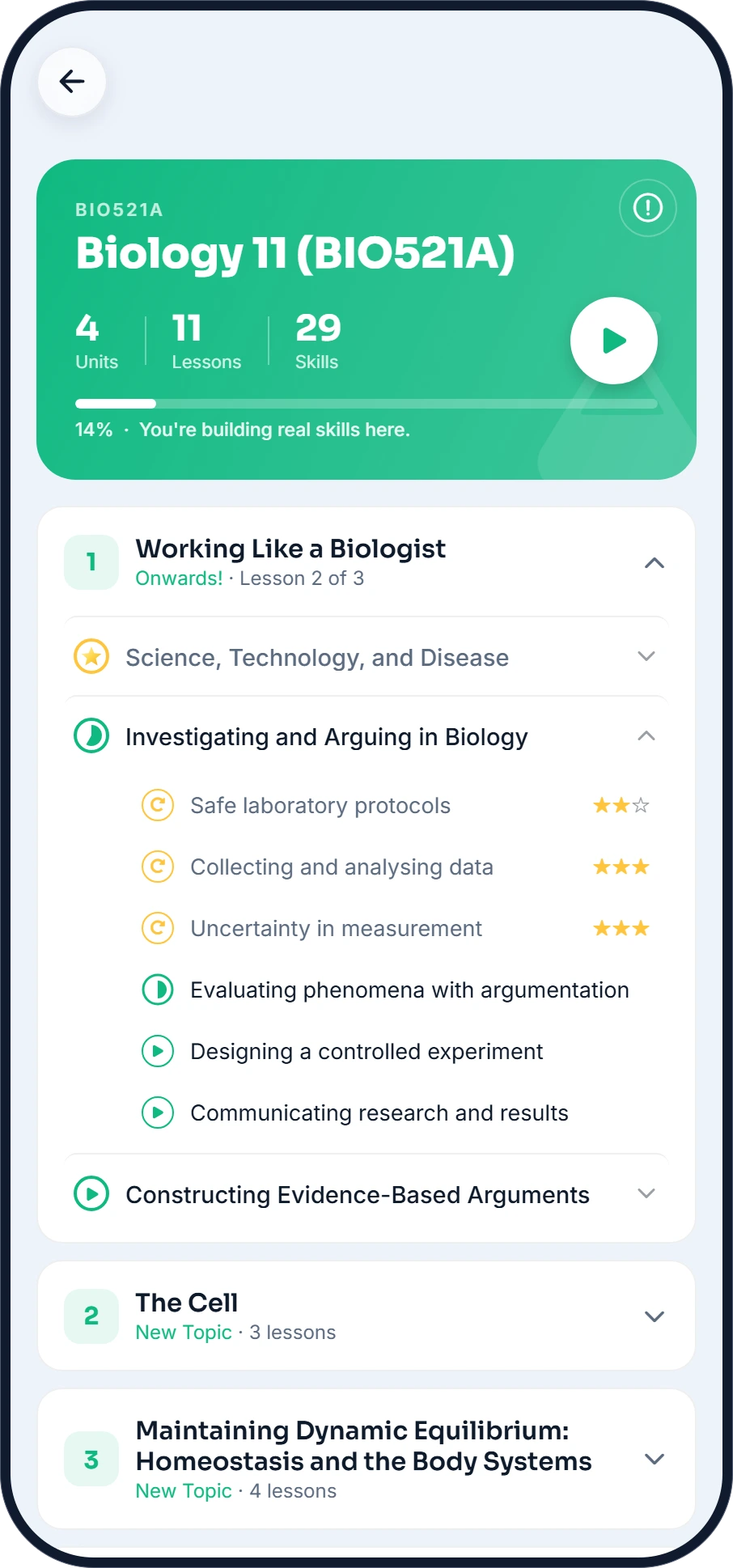
Biology 11 (BIO521A) in MapleMind on a tablet: its units and lessons in order, a student partway through.Biology 11 (BIO521A) in MapleMind on a phone: its units and lessons in order, a student partway through.
Their course, unit by unit, the way Prince Edward Island teaches it.Shown: Biology 11 (BIO521A)
Homework Help on a tablet: a photo of a worksheet, the tutor’s worked example of a two-step equation, and a question back to the student.Homework Help on a phone: a photo of a worksheet, the tutor’s worked example of a two-step equation, and a question back to the student.
Homework Help: they take a photo of the question, and the tutor works through it with them.
The Parent Dashboard on a tablet: a student’s days studied, streak, lessons, quiz average and recent activity.The Parent Dashboard on a phone: a student’s days studied, streak, lessons, quiz average and recent activity.
The Parent Dashboard: how each child’s week went, in lessons, quizzes and days studied.
A Grade 9 provincial mathematics exam on a tablet: a readiness score, the exam’s time and its next sitting.A Grade 9 provincial mathematics exam on a phone: a readiness score, the exam’s time and its next sitting.
A provincial exam: a practice sitting under the real time, and how ready they are.
The Learn tab on a tablet: a four-day streak, the week’s days, Homework Help, the next lesson and a review.The Learn tab on a phone: a four-day streak, the week’s days, Homework Help, the next lesson and a review.
The Learn tab: their week so far, and the next thing to do.

Help at home

Questions parents ask

What will my child learn in Grade 11 in Prince Edward Island?

Math: Applied Mathematics, Apprenticeship and Workplace Mathematics 11, Foundations of Mathematics 11, Pre-Calculus 11 and Pre-Calculus Elective. Science: Biology 11 (BIO521A), Chemistry, Grade 11 (CHM521A) and Physics, Grade 11 (PHY521A). English: English Language Arts 11 (ENG521A). French: Core French, Grade 11. Social studies: 20th-Century World History 521A and Introductory Law 521A. That’s 380 skills in all, from Prince Edward Island’s curriculum.

Does my child write a provincial exam in Grade 11?

No. Prince Edward Island has no provincial exam in Grade 11.

Where does this list come from?

From Prince Edward Island’s official curriculum, the documents its education ministry publishes for each course. Each skill here is one of their expectations, written in plain words.

Can MapleMind help my child in Grade 11?

Yes. Every course on this page is in MapleMind, with lessons, practice and a tutor that works through each step with them. A free account gets 30 messages and 4 activities a day.

Help with Grade 11, one skill at a time.

Every course on this page is in MapleMind, free with daily limits.