Prince Edward Island · For parents

What your child learns in Grade 5 in Prince Edward Island

Every subject, unit by unit, from Prince Edward Island’s curriculum: 171 skills in plain words.

Subjects
5
Skills
171
Provincial exams
None
Official curriculum
princeedwardisland.ca

Math in Grade 5

Mathematics, Grade 5

4 units · 32 skills

  1. Unit 1

    Number

    Big numbers are grouped into ones, thousands, and millions.

    • Numbers to 1 000 000
    • Front-end rounding and compensation
    • Compatible numbers
    16 more skills
    • Skip counting, doubling, and halving
    • 9s patterns and repeated doubling or halving
    • Annexing then adding zero
    • Halving and doubling
    • Using the distributive property
    • Multiplying 2-digit by 2-digit numbers
    • Solving 2-digit multiplication problems
    • Dividing 3-digit by 1-digit numbers
    • Interpreting remainders
    • Equivalent fractions
    • Comparing fractions with like denominators
    • Comparing fractions with unlike denominators
    • Showing decimals to thousandths
    • Decimals and fractions to thousandths
    • Comparing and ordering decimals
    • Adding and subtracting decimals
  2. Unit 2

    Patterns and Relations

    A pattern rule tells how each term relates to its position.

    • Pattern rules and predictions
    • One-step equations with a variable
  3. Unit 3

    Shape and Space

    Rectangles with the same perimeter can have different shapes and areas.

    • Rectangles with a given perimeter
    • Rectangles with a given area
    • Referents for millimetres
    6 more skills
    • Millimetres, centimetres, and metres
    • Referents for cubic centimetres and metres
    • Estimating volume
    • Measuring and recording volume
    • Building prisms for a given volume
    • Sorting quadrilaterals
  4. Unit 4

    Statistics and Probability

    First-hand data is collected by us directly.

    • First-hand and second-hand data
    • Making and reading double bar graphs

Science in Grade 5

Science, Grade 5

4 units · 61 skills

  1. Unit 1

    Life Science: Meeting Basic Needs and Maintaining a Healthy Body

    The body has systems made of parts that work together.

    • Questions about how the body works
    • How saliva starts digestion
    • Technologies for handling waste
    7 more skills
    • Testable questions about breathing and heartbeat
    • Investigating breathing and heartbeat
    • Scientific processes used
    • Systems working together for movement
    • Canadians in body science
    • Exploring response time
    • Medical technologies for movement
  2. Unit 2

    Physical Science: Properties and Changes in Materials

    A property is a feature of a material.

    • Properties that distinguish materials
    • Physical changes
    • Chemical changes
    8 more skills
    • Reversible and non-reversible chemical changes
    • Classifying states of matter
    • Reversible and non-reversible physical changes
    • Distinguishing materials by chemical properties
    • Displaying chemical test results
    • Mass of the whole and its parts
    • Manufactured materials that improve living
    • Tracing materials to their sources
  3. Unit 3

    Physical Science: Forces and Simple Machines

    A force is a push or a pull.

    • How forces act
    • Contact and non-contact forces
    • Changing the amount of force
    16 more skills
    • Planning a friction investigation
    • Comparing friction on surfaces
    • Describing force in words and numbers
    • Estimating the force to move a load
    • Rollers, wheels, and axles
    • Products that change friction
    • Using simple machines
    • Comparing manual and machine effort
    • The effort problem
    • Parts of a lever
    • Designing an efficient lever
    • Pulleys and pulley systems
    • Designing a system of machines
    • How simple machines improved living
    • Sharing and improving machine designs
    • Machines developed over time
  4. Unit 4

    Earth and Space Science: Weather

    Folklore is a traditional saying or belief.

    • Weather folklore
    • Weather measuring instruments
    • Weather terms and instruments
    18 more skills
    • Recording weather observations
    • Classifying clouds
    • Features of weather systems
    • Estimating weather measurements
    • Weather innovations across cultures
    • The Sun's energy and weather
    • Measuring how light heats materials
    • Properties of air
    • When air or water masses meet
    • Patterns in air movement
    • The water cycle
    • Displaying and explaining weather data
    • How the community predicts weather
    • Uses of weather forecasts
    • Predicting local weather patterns
    • Weather phenomena being studied
    • Effects of technology on weather
    • Environmental issues and change

English in Grade 5

English Language Arts, Grade 5

3 units · 50 skills

  1. Unit 1

    Speaking and Listening

    Active listening means paying attention on purpose.

    • Using active listening strategies
    • Setting a purpose for listening and viewing
    • Identifying and comparing important ideas
    12 more skills
    • Contributing ideas with courtesy
    • Defending opinions with evidence
    • Using vocabulary and conversational conventions
    • Using varied sentences and subject-verb agreement
    • Using organizational patterns to communicate
    • Using correct pronunciation, intonation, and volume
    • Distinguishing and adapting levels of language
    • Reading aloud with fluency and expression
    • Planning and delivering a presentation
    • Using strategies for different audiences
    • Using visual aids to enhance a presentation
    • Reflecting on presentation strengths and goals
  2. Unit 2

    Reading and Viewing

    A reading purpose focuses your reading.

    • Activating prior knowledge before reading
    • Setting a purpose and choosing a text
    • Predicting a text's ending or message
    18 more skills
    • Using text features to search for information
    • Applying French language knowledge to reading
    • Using word-solving strategies
    • Using visualization to understand texts
    • Monitoring and revising comprehension
    • Reading at an appropriate rate and expression
    • Identifying elements of narrative texts
    • Identifying the form and elements of poems
    • Identifying elements of scripts
    • Identifying the structure of expository paragraphs
    • Explaining how magazine contents fit their purpose
    • Identifying characteristics of interviews
    • Identifying elements of procedural texts
    • Identifying elements and techniques of media texts
    • Justifying opinions about texts
    • Analysing how advertisements influence choices
    • Analysing language and visual effects
    • Drawing inferences and alternative perspectives
  3. Unit 3

    Writing and Representing

    Purpose is your reason for writing.

    • Determining purpose and audience
    • Using pre-writing strategies to generate ideas
    • Sorting ideas for purpose and audience
    11 more skills
    • Choosing literary and media devices
    • Writing poems with literary devices
    • Writing a script for a short drama
    • Writing an expository paragraph
    • Writing interview questions
    • Writing procedural texts
    • Producing persuasive media texts
    • Revising for coherence and word choice
    • Editing and proofreading with conventions
    • Producing a clean, legible final draft
    • Reflecting on writing strengths and goals

French in Grade 5

Core French, Grade 5

3 units · 14 skills

  1. Unit 1

    La production orale et l'ecoute

    Ecoute active at Grade 5: predict the topic first, then listen for the key words that confirm it.

    • Active listening strategies
    • Following simple directives
    • Answering quel/pourquoi questions
    3 more skills
    • Strategies for speaking clearly
    • Speech acts: expressing, interacting and justifying
    • Giving a short presentation
  2. Unit 2

    La lecture et le visionnement

    Word families: if you know 'jouer' (to play), you can guess 'un jeu' (a game), 'un joueur' (a player).

    • Reading strategies to build meaning
    • Understanding texts and justifying my point of view
    • Finding specific details in a text
    2 more skills
    • Reading familiar text aloud with fluency
    • The Acadian national holiday on PEI
  3. Unit 3

    L'ecriture et la representation

    Plan two or three ideas before you write.

    • Strategies to guide my writing
    • Writing a personal text with a reason
    • Writing a short message or invitation

Social studies in Grade 5

Social Studies, Grade 5

5SOCA · 6 units · 14 skills

  1. Unit 1

    Introduction

    History is constructed by discovering and interpreting evidence.

    • Primary sources and oral history
    • The major historical eras
  2. Unit 2

    Environment

    Ancient societies often developed where the environment met their needs.

    • How environment shaped an ancient society
    • How an ancient society changed over time
  3. Unit 3

    Social Structure

    Social structure is how a society is organized into groups and roles.

    • Why social structure mattered
    • Roles in a medieval society
  4. Unit 4

    Decision Making

    First Nations and Inuit societies lived across all of what later became Canada.

    • First Nations and Inuit societies across the regions
    • Way of life and technology
    • Who made decisions: roles and power
    1 more skill
    • Resources, needs, and oral tradition
  5. Unit 5

    Interactions

    The British, French, First Nations, and Inuit interacted in early Atlantic Canada.

    • Contributions and exchanges
    • The devastating consequences of European exploration
  6. Unit 6

    My Society

    Historical evidence helps us compare past societies with ours.

    • How we are similar to past societies
    • How we differ from past societies

MapleMind

See Grade 5 in MapleMind

Real screens from the app your child would use.

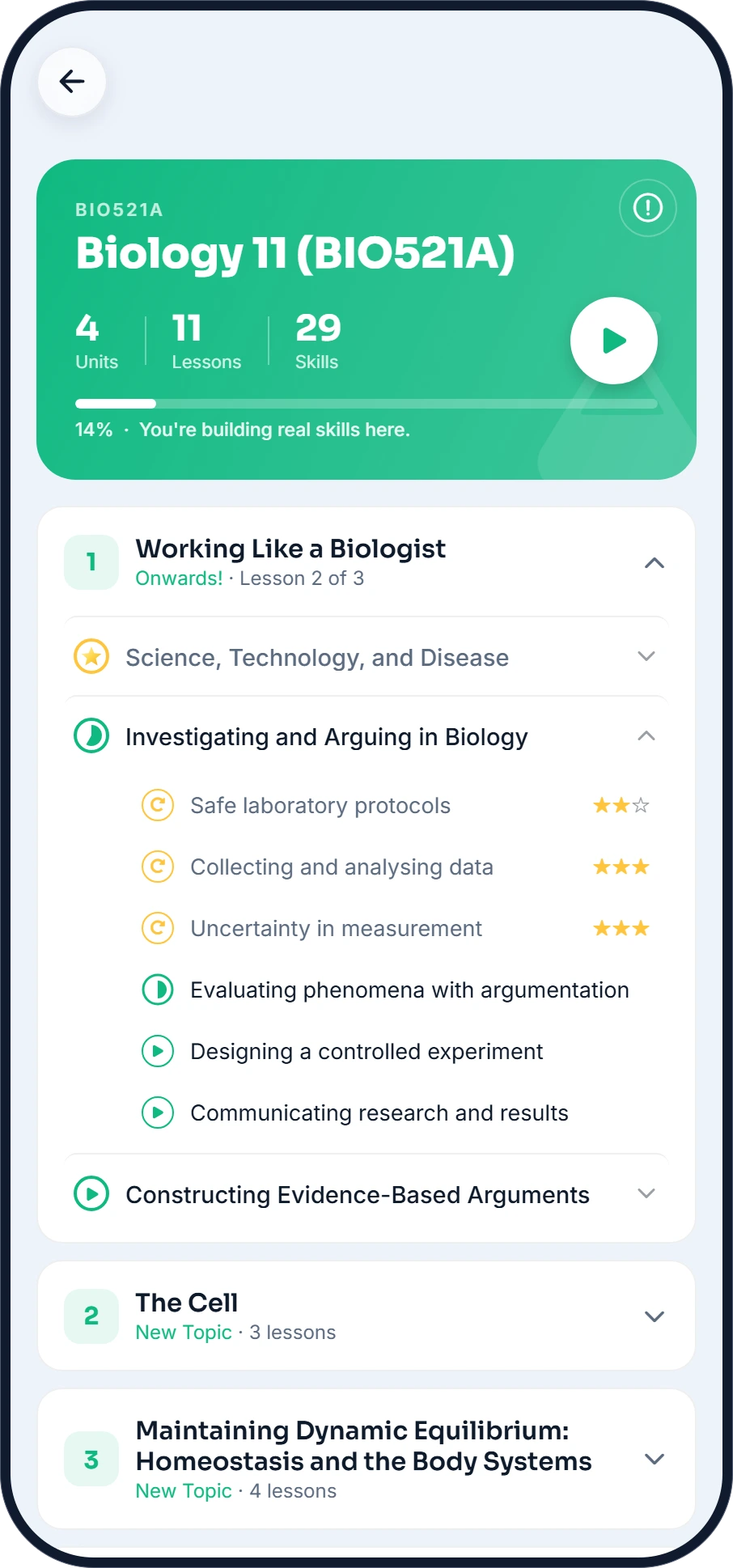
Biology 11 (BIO521A) in MapleMind on a tablet: its units and lessons in order, a student partway through.Biology 11 (BIO521A) in MapleMind on a phone: its units and lessons in order, a student partway through.
Their course, unit by unit, the way Prince Edward Island teaches it.Shown: Biology 11 (BIO521A)
Homework Help on a tablet: a photo of a worksheet, the tutor’s worked example of a two-step equation, and a question back to the student.Homework Help on a phone: a photo of a worksheet, the tutor’s worked example of a two-step equation, and a question back to the student.
Homework Help: they take a photo of the question, and the tutor works through it with them.
The Parent Dashboard on a tablet: a student’s days studied, streak, lessons, quiz average and recent activity.The Parent Dashboard on a phone: a student’s days studied, streak, lessons, quiz average and recent activity.
The Parent Dashboard: how each child’s week went, in lessons, quizzes and days studied.
A Grade 9 provincial mathematics exam on a tablet: a readiness score, the exam’s time and its next sitting.A Grade 9 provincial mathematics exam on a phone: a readiness score, the exam’s time and its next sitting.
A provincial exam: a practice sitting under the real time, and how ready they are.
The Learn tab on a tablet: a four-day streak, the week’s days, Homework Help, the next lesson and a review.The Learn tab on a phone: a four-day streak, the week’s days, Homework Help, the next lesson and a review.
The Learn tab: their week so far, and the next thing to do.

Help at home

Questions parents ask

What will my child learn in Grade 5 in Prince Edward Island?

Math: Mathematics, Grade 5. Science: Science, Grade 5. English: English Language Arts, Grade 5. French: Core French, Grade 5. Social studies: Social Studies, Grade 5. That’s 171 skills in all, from Prince Edward Island’s curriculum.

Does my child write a provincial exam in Grade 5?

No. Prince Edward Island has no provincial exam in Grade 5.

Where does this list come from?

From Prince Edward Island’s official curriculum, the documents its education ministry publishes for each course. Each skill here is one of their expectations, written in plain words.

Can MapleMind help my child in Grade 5?

Yes. Every course on this page is in MapleMind, with lessons, practice and a tutor that works through each step with them. A free account gets 30 messages and 4 activities a day.

Help with Grade 5, one skill at a time.

Every course on this page is in MapleMind, free with daily limits.